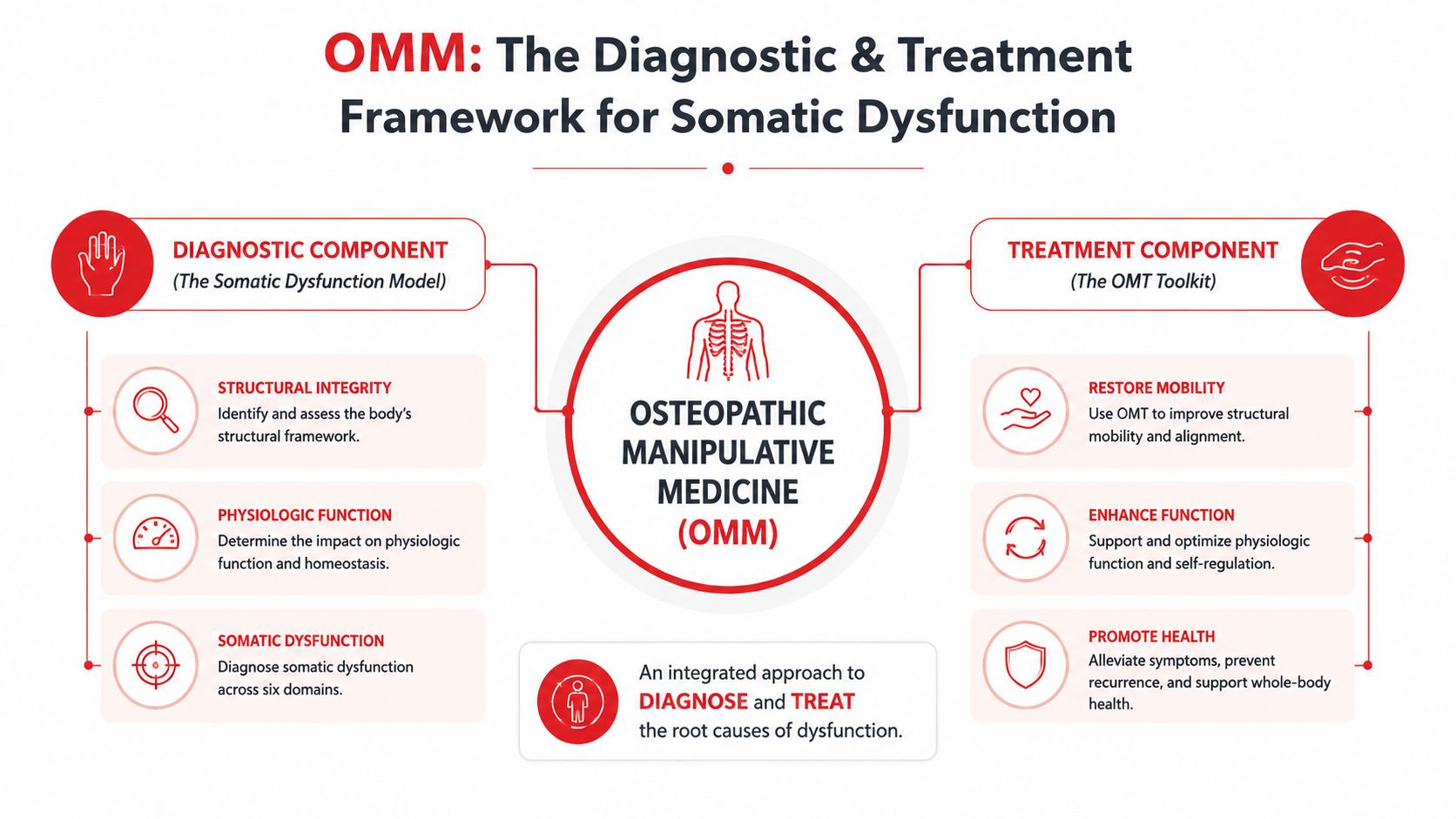
What makes OMM, osteopathic manipulative medicine, easy to memorize but hard to use on exams is that students often learn the names of techniques before they understand the clinical question they're being asked. OMM is the physician's diagnostic-and-treatment framework for somatic dysfunction, and OMT is the set of manual techniques used inside that framework, like the toolbox that follows the reasoning. If you can separate those two ideas early, the rest of the subject starts to make sense much faster.
That distinction matters on boards because osteopathic students now make up more than one-quarter of all U.S. medical students, and 8,945 first-year osteopathic medical students were expected to matriculate in 2021-22, which shows how central this content has become in training PMC article on osteopathic medical education. For a student trying to connect class lab, clinic, and board-style stems, a helpful outside resource on symptoms of spinal misalignment can make the structural exam feel more concrete.
If you want a student-friendly definition before you go deeper, the overview of what osteopathic manipulative treatment is is a useful anchor. The rest of this guide builds from the ground up, starting with history, then techniques, then evidence, then how COMLEX and USMLE test the material, and finally a study plan you can use this week.
What OMM Is and Why It Matters on the Boards
At the simplest level, OMM is the osteopathic physician's way of thinking about why a body region isn't moving normally and what hands-on treatment fits that finding. Somatic dysfunction is the structural problem being identified, and OMT is the manual treatment chosen to address it. A clean way to remember it is this, OMM is the reasoning, OMT is the toolbox.
Why the distinction matters
That distinction keeps you from flattening the subject into a list of maneuvers. A student who only memorizes “muscle energy, counterstrain, HVLA” can miss the exam's real task, which is often to identify the dysfunction, recognize the barrier, and choose the safest technique. The exam writer is usually testing whether you know what to do and why, not just whether you can name a hand position.
Practical rule: start every OMM question by asking, “What tissue is restricted, and is the technique trying to move toward the barrier or away from it?”
The scale of osteopathic education shows why this is not an elective niche. There are 37 accredited colleges of osteopathic medicine in the United States, and osteopathic students now make up a very large share of the medical student pipeline PMC article on osteopathic medical education. That is one reason OMM shows up so visibly in both classroom assessment and board preparation.
What you should expect from this guide
A strong working model of OMM has to cover history, technique families, evidence strength, exam patterns, case reasoning, and a study plan. Without that structure, students often memorize isolated facts and then freeze when a vignette uses different wording than their lab handout. A better approach is to learn how the pieces fit, then practice recognizing the same concept in different disguises.
For board prep, that means building a mental map of direct and indirect techniques, contraindications, and the most tested musculoskeletal patterns. It also means knowing that a field guide can't stop at “OMM helps pain.” Some indications are well supported, some are mixed, and some are still emerging. The rest of the article is built to help you sort those levels quickly.
A Short History of Osteopathic Manipulative Medicine
Osteopathic medicine began as a response to the limits of late nineteenth-century care, when Andrew Taylor Still argued that anatomy, structure, and function had to be considered together. That philosophical shift mattered because it pushed osteopathic physicians toward a hands-on model instead of a purely symptom-based one. In other words, the movement started as a way of asking what the body was doing mechanically, not just what disease label fit the chart.
From founding idea to modern training
Once the first osteopathic schools were established, the profession had to turn philosophy into teachable clinical practice. That is one reason the modern technique taxonomy is so broad. A single “osteopathic” approach would have been too blunt for the variety of dysfunctions DOs were expected to identify, so the field developed many named methods instead. The result is a discipline that values pattern recognition, palpation, and individualized choice.
The California merger with the MD profession is a useful historical marker because it shows that the profession's evolution was shaped by both separation and integration. Osteopathic medicine kept its distinct emphasis on structure-function thinking, but it also had to fit into a broader U.S. medical system that increasingly demanded standardization, licensure consistency, and board-style accountability. That pressure helps explain why today's osteopathic curriculum is so explicitly mapped to exams.
Why history still shows up on test day
History matters on boards because the exam often disguises philosophy as a clinical decision. A question may not ask, “What did Still believe?” It may ask whether you understand that a restrictive pattern is approached through direct force, indirect positioning, or a technique chosen for tissue response. That logic is a descendant of the original osteopathic idea that the body's structure and function are inseparable.
The historical lesson is simple, osteopathic technique didn't grow as a random bag of tricks. It developed because one philosophy had to become many practical tools.
That's also why modern students should not treat OMM as a museum piece. It is a living part of the curriculum, shaped by the same reasoning that created it. When a board stem asks about structure-function integration, it's testing whether you can carry that old osteopathic logic into a modern clinical setting.
Core OMT Techniques Every Student Should Recognize
OMT technique questions are easier when you stop trying to memorize every name at once and instead sort them by mechanism, typical use, contraindication, and clue words. The broad taxonomy contains many methods, but a few families account for most of the high-yield board logic. If you can identify the family, the stem usually becomes manageable.
High-Yield OMT Techniques at a Glance
| Technique | Mechanism | Best For | Key Contraindication |
|---|---|---|---|
| HVLA | Quick, precise thrust at the restrictive barrier | Acute segmental restriction when the joint is safe to move | Fracture risk, instability, severe osteoporosis, acute inflammatory concern |
| Muscle Energy | Patient gently contracts against resistance | Restricted motion with a cooperative patient | Inability to cooperate, severe pain, unstable structures |
| Counterstrain | Passively positions the body away from tenderness to reduce tension | Tenderpoints and painful, guarded areas | Patient cannot tolerate positioning, unstable fracture concerns |
| Soft Tissue | Stretching, kneading, inhibition, and tissue preparation | Hypertonicity, guarding, restricted soft tissue | Usually limited by pain tolerance or fragile tissue |
| Myofascial Release | Sustained pressure or stretch to fascial restriction | Fascial tightness and motion restriction | Caution with acute tissue injury or poor tolerance |
| Lymphatic Techniques | Promote fluid movement and drainage patterns | Congestion, secretion clearance, supportive care | Avoid when forceful movement is unsafe |
HVLA means high-velocity, low-amplitude thrust. It works by taking a joint to the barrier and delivering a short thrust to restore motion. On exams, the clue is often a clean segmental restriction with no red flags, and the warning sign is anything that makes forceful manipulation unsafe.
Muscle energy is a cooperative technique. The patient actively contracts a muscle against resistance, which makes it useful when the problem involves a motion restriction but the patient can participate. A classic clue is a rotated or sidebent dysfunction in a patient who can follow commands and tolerate the effort.
Counterstrain is easy to spot once you remember that it moves away from the tenderpoint rather than into the restriction. The goal is to shorten or slacken the involved tissue until the pain calms down. If the stem emphasizes a very specific tenderpoint and relief with passive positioning, counterstrain belongs near the top of your list.
Soft tissue is the broad, hands-on tissue preparation family. It's often the first thing done when a region is too tight to assess cleanly. Think of it as loosening the knot before deciding whether a more specific technique is appropriate.
Myofascial release targets fascial restriction with sustained pressure or stretch. The exam clue is a story of tight fascia, restricted glide, or global stiffness rather than a single sharply localized joint problem. It often reads like a technique meant to calm a region before more targeted work.
Lymphatic techniques are the “move fluid, help drainage” family. They show up in supportive inpatient care, congestion, and secretion problems. If a question involves secretion mobilization or chest wall restrictions in a hospitalized patient, this family deserves serious attention, but only if the technique is safe for the overall context.
Exam habit: if a stem sounds mechanically simple but medically unstable, stop chasing the flashy technique and check whether any manipulation is contraindicated first.
One more board-ready reminder helps here. AACOM describes 40 named methods within a broader taxonomy, and osteopathic sources also describe a very large set of major types and individual techniques, so no one should expect ad-hoc memorization to work well AACOM OMM explanation. A structured comparison is easier to retain than a pile of disconnected labels.
Where the Evidence Is Strong and Where It Is Still Thin
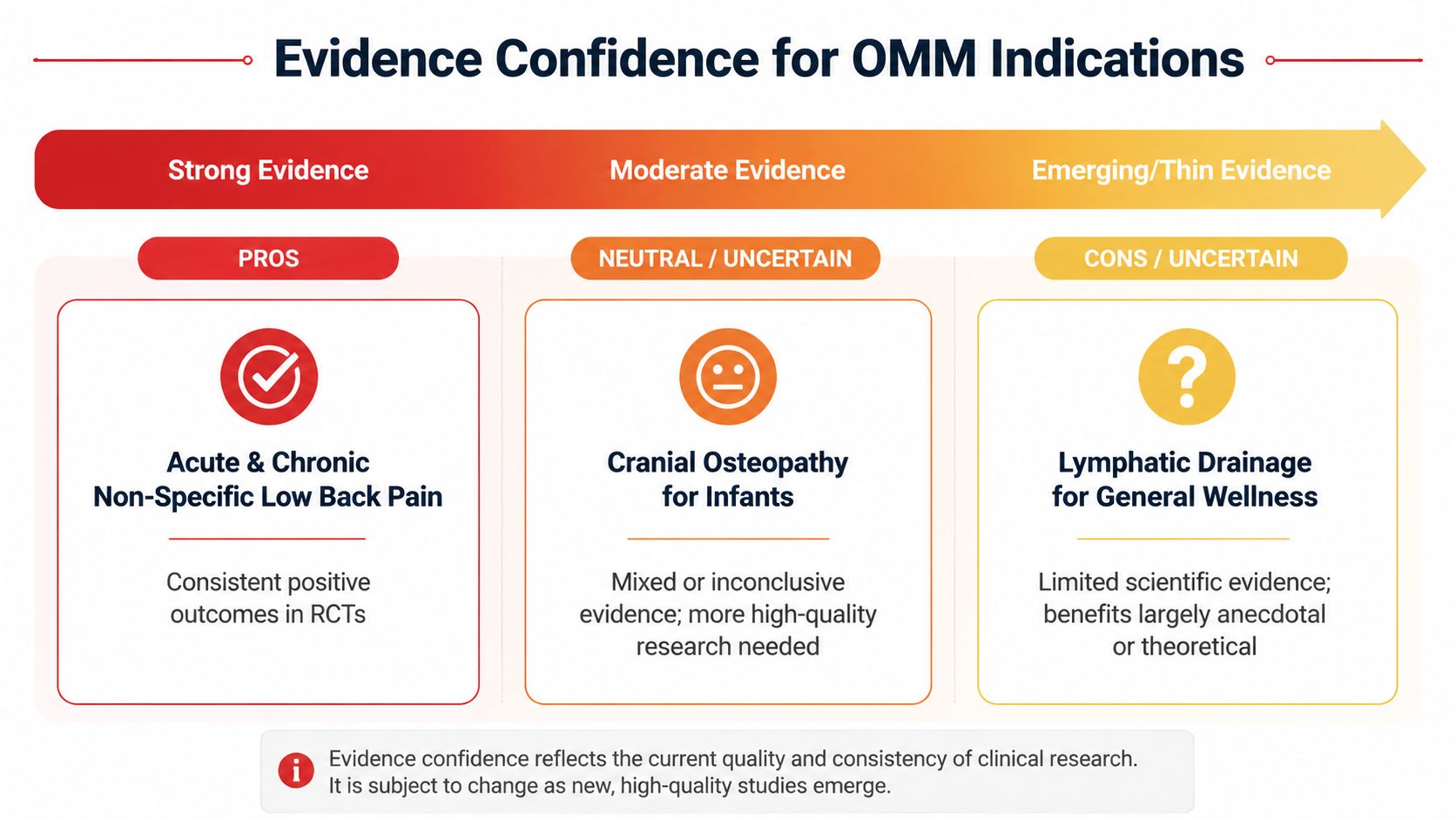
The cleanest evidence picture in OMM is not “works” versus “doesn't work.” It's more useful to think in tiers. The best-supported uses are acute and chronic non-specific low back pain, chronic non-specific neck pain, and chronic non-cancer pain 2024 review of osteopathic manipulation applicability.pdf). That's the zone where students should feel most comfortable recognizing OMM as a credible part of care.
Stronger versus thinner evidence
The weaker end of the spectrum matters just as much because boards often test whether you can distinguish established practice from emerging interest. Evidence is limited or inconclusive for low back pain with sciatica, pediatric conditions, neurological conditions, and IBS 2024 review of osteopathic manipulation applicability. A stem in those areas may be asking whether you can avoid overclaiming benefit.
The same review also notes that OMM is being explored in newer areas such as palliative care, anxiety, dizziness, inflammation, and preterm or neonatal disorders 2024 review of osteopathic manipulation applicability. For a student, that means the field is expanding, but expansion is not the same as settled evidence. If a vignette uses one of these topics, the safest answer is usually to treat it as emerging rather than oversold.
Why underuse matters
The contrarian point is that underuse among DOs doesn't seem to be only about the evidence. In a 2020 survey of 10,000 osteopathic physicians, 1,683 responded, 56.95% of respondents reported not using OMT at all, and 77.74% used it on less than 5% of their patients, with barriers including time constraints, lack of residency training, poor public perception, and competing professional interests JOM survey on OMT use among osteopathic physicians. That makes OMM a workflow and training problem as much as a knowledge problem.
A later qualitative study adds that scheduling complexity, limited patient awareness, panel management, and practice autonomy also get in the way of integration, which is why many public explanations miss the implementation barrier JOM study on utilization and referral barriers. If you're a student, that matters because the exam may not ask you to solve a systems problem directly, but it can absolutely ask you to recognize why a good treatment doesn't get used routinely.
Clinical reasoning point: OMM underuse isn't always a referendum on the technique itself. Sometimes it's a question of whether the clinic has time, training, and patient buy-in.
For board prep, the takeaway is not to choose sides blindly. It's to know where OMM is most established, where it's still evolving, and why real-world practice doesn't always match classroom enthusiasm.
How OMM Questions Show Up on COMLEX and USMLE
COMLEX is the more direct test of OMM knowledge, while USMLE often tests the same underlying reasoning through musculoskeletal and structure-function stems. That means you can't study OMM as a silo and expect it to transfer automatically. You need to recognize the stem style, then decode what the test writer wants.
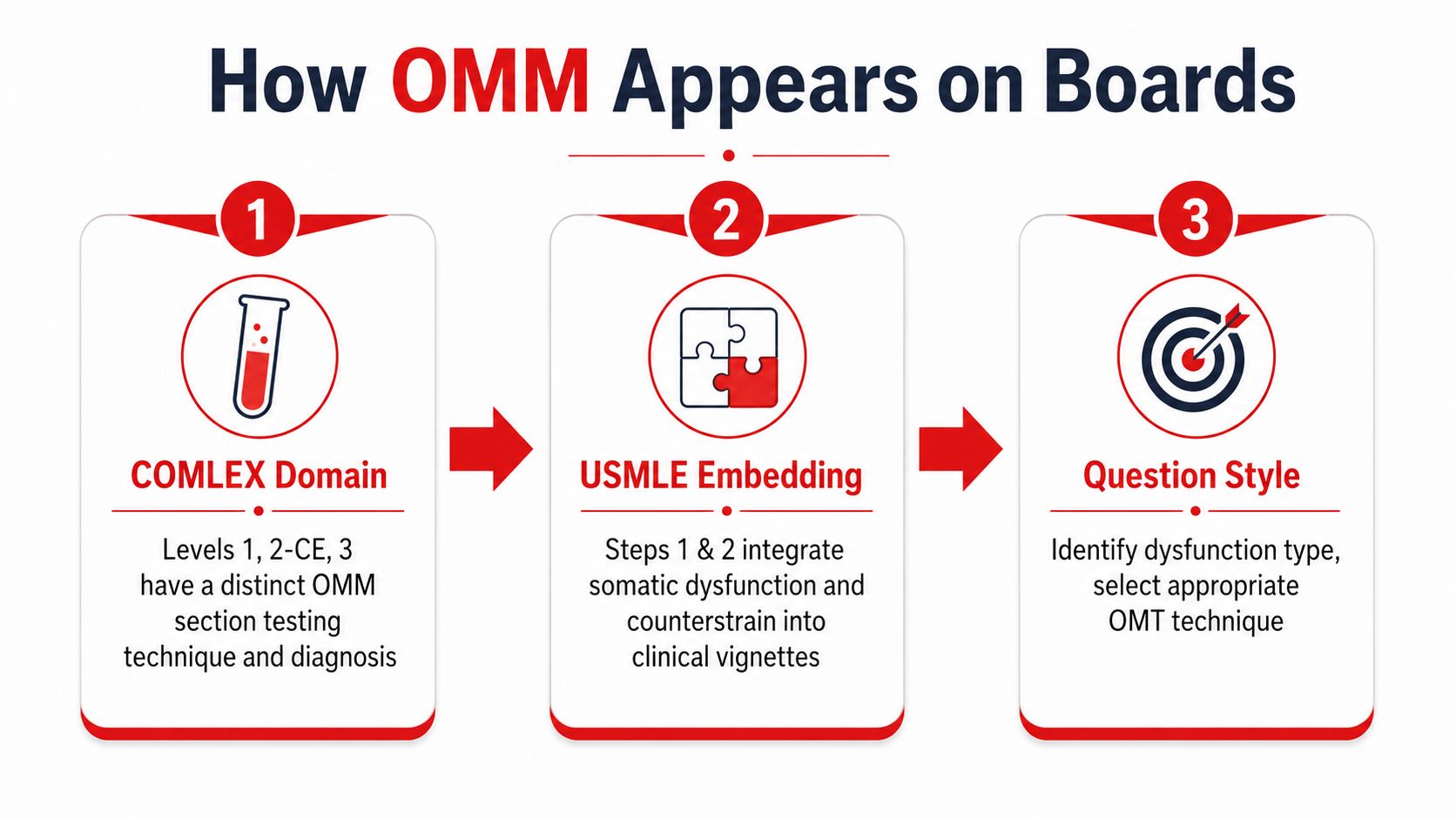
COMLEX has a dedicated OMM domain across its levels, which is why osteopathic students need clean technique recognition and contraindication recall. USMLE, by contrast, tends to fold OMM-adjacent ideas into broader clinical reasoning, especially when the stem involves a musculoskeletal complaint, a movement restriction, or an exam finding that implies structure-function dysfunction. The content overlap is real, but the question style is different.
The four stem patterns that repeat
One common pattern is technique identification from a description of the hand placement or the patient's position. Another is the contraindication trap, where the stem gives you the right-sounding technique but hides a fracture risk, instability, or another safety problem. A third pattern is mechanism reasoning, where the question asks whether the method is direct, indirect, active, passive, or supportive. The last pattern is management sequencing, which asks what should be done first, not just what technique sounds familiar.
The fastest way to triage an OMM question is a four-step mental chain:
- Identify the dysfunctional tissue.
- Classify the barrier as direct or indirect.
- Match the technique family.
- Check contraindications before committing.
That sequence keeps you from jumping straight to a keyword and missing the exam's actual logic. It also fits well with the kind of clinical reasoning the boards like to test, because it forces you to move from finding to decision, not from buzzword to guess.
The review page on COMLEX Step 1 questions is a useful companion if you're trying to translate this into practice. For deeper work on clinical reasoning itself, the guide to how to critically appraise research pairs well with OMM because both subjects reward careful reading rather than memorized fragments.
Two Practice Vignettes That Show the Reasoning
A good OMM answer is rarely just the name of a technique. It's the path from tissue finding to barrier choice to safe intervention. When you practice that path out loud, the exam question gets much easier to understand.
Vignette one, an ambulatory back pain case
A 34-year-old runner has acute non-specific low back pain, no red flags, and a restricted L5-S1 motion on seated flexion testing. The structural exam suggests a localized dysfunction, and the key decision is whether a direct or indirect technique makes sense. Muscle energy fits because the patient can cooperate and the barrier can be engaged actively, while HVLA can also be reasonable if the exam context is clean and no contraindications are present.
The board-style chain should sound like this: tissue, barrier, technique, contraindication. First identify the segment and motion restriction. Then decide whether the patient's condition allows an active technique or a thrust technique. Only after that do you check for fracture risk, instability, inflammatory concern, or any other reason to avoid forceful treatment.
Vignette two, an inpatient respiratory-support case
A hospitalized 68-year-old post-pneumonia patient has retained secretions and rib cage restriction. In that setting, supportive hands-on techniques such as lymphatic and rib-raising approaches are the kind of answer a student should be ready to consider, because the question is about mobilization and ease of mechanics rather than segmental thrust correction. HVLA would not be the right instinct when the patient is acutely ill and the stem is focused on secretion clearance and thoracic restriction.
A strong response here stays close to the dysfunction. What is restricted, what movement is being encouraged, and what safety issues make forceful manipulation a poor fit? That logic is more important than memorizing a long list of names.
The inpatient use pattern is worth keeping in the back of your head. One retrospective study identified 1,509 OMM consultations, which represented 11% of all inpatient consultations between January 1, 2001 and March 31, 2008, and more recent consultations were often for musculoskeletal complaints and newborn feeding problems JOM inpatient OMM consultation data. That doesn't tell you what to choose in every case, but it does show that OMM has a real inpatient footprint.
The phrase to keep on your scratch paper is simple, tissue, barrier, technique, contraindication. If you can write that out in order, you'll make your reasoning visible instead of guessing in your head.
Educational note, not medical advice. These vignettes simplify real decision-making for board review, and actual treatment choices belong to the supervising clinician and the patient's full clinical context.
A Four-Week Study Plan and High-Yield Resources
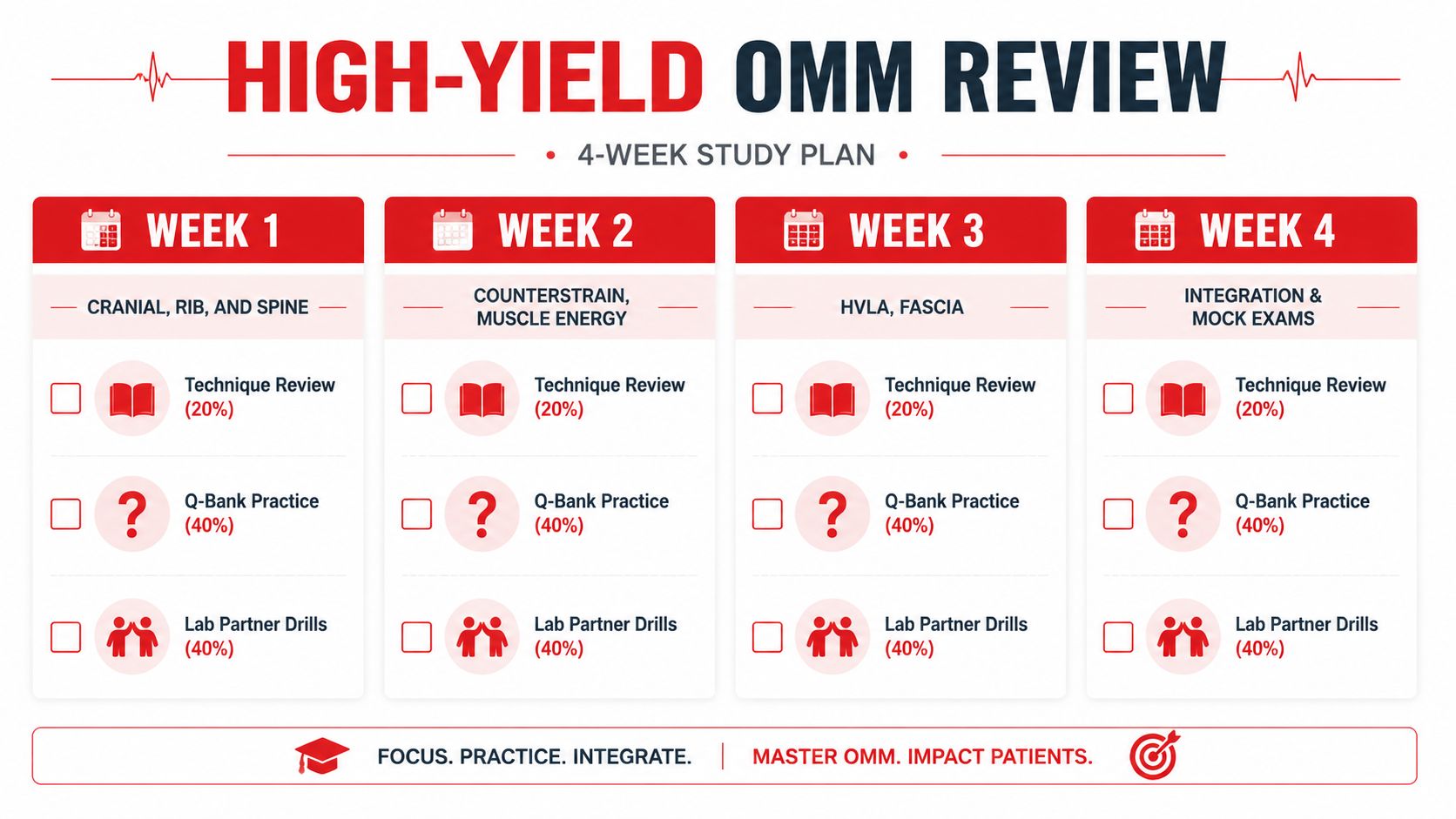
A four-week OMM plan works better than last-minute technique cramming because the subject has too many moving parts to absorb in one pass. The trick is to split your time between technique mechanics, question interpretation, and systems integration rather than treating them as separate worlds. One practical way to do that is to spend roughly 40% of your time on technique mechanics, 40% on question practice, and 20% on integration with other systems.
A simple four-week rhythm
Week 1: focus on cranial concepts, ribs, and spine mechanics.
Week 2: drill counterstrain and muscle energy until you can recognize them from short stems.
Week 3: revisit HVLA and fascia, then test yourself on contraindications.
Week 4: mix everything together with timed questions and mock cases.
That structure is easier to follow if you use official and third-party materials in different roles. AACOM's technique taxonomy is good for seeing the scope of the field, while question banks such as COMQUEST and TrueLearn are useful for pattern recognition. A one-on-one tutor, including an option like Ace Med Boards for COMLEX-USA review, can help you sort missed questions and tighten your decision tree without replacing your own study.
AACOM's list of 40 named OMT methods and the broader span of more than 1,000 individual techniques are exactly why a mixed study plan beats random memorization AACOM OMM explanation. The more techniques you see in context, the easier it becomes to recognize them on test day.
Three high-yield memory hooks
- Counterstrain: think “shorten to soothe”, because the body is positioned away from the tenderpoint.
- Lymphatic techniques: think “drain and support”, especially when congestion and fluid movement are the issue.
- Muscle energy: think “patient helps move the barrier”, which reminds you that the patient must be able to cooperate.
If you want a more formal review path, the OMM board review page can sit alongside your question bank and lab practice. The best results usually come from repetition, not from collecting more resources than you can realistically finish.
Key Takeaways and Common Questions
OMM is a clinical reasoning framework, not just a list of maneuvers. OMT is the hands-on treatment set inside that framework. The strongest evidence is for non-specific musculoskeletal pain, and COMLEX tests the content more directly than USMLE. A four-week mixed plan is usually more realistic than technique cramming.
FAQs
How are OMM and OMT different? OMM is the broader osteopathic diagnostic-and-treatment approach, while OMT is the manual treatment used within it.
Do IMGs and foreign medical graduates need OMM for USMLE? Not as a separate exam domain, but they should know the underlying musculoskeletal reasoning if they're studying for U.S. clinical exams.
Can you recover academically after a low COMLEX performance? Yes, with a structured audit of missed content, timing, and technique recognition, then a targeted plan instead of a full reset.
If you want personalized COMLEX-USA support, a calm review of your weak areas can save time and reduce second-guessing. The right plan should feel organized, not overwhelming.
Ace Med Boards works with students who want structured help turning OMM into board-ready reasoning instead of memorized fragments. If you want a focused review plan for COMLEX-USA, visit Ace Med Boards and look for support that matches your current stage, your weak points, and your testing timeline.