You're probably in one of two places right now. Either OMM feels like a neglected pile of old lab material that you haven't touched since preclinical years, or it feels disproportionately stressful because you know it can show up on COMLEX and you don't want to give away easy points.
Both reactions are understandable. Both also lead students into bad decisions.
The students who do OMM board review well usually don't treat it like a giant separate course. They treat it like a small, testable, high-return domain inside a much larger COMLEX plan. That shift matters. It changes how you allocate time, what resources you choose, and how quickly you stop wasting energy on low-yield review that never shows up in question stems.
A good OMM plan is not about becoming the most philosophically fluent student in your class. It's about recognizing the patterns boards ask, refreshing the material that fades first, and staying sharp enough to convert that knowledge under timed conditions.
The Right Mindset for Strategic OMM Prep
Most students overestimate how much OMM should dominate their study schedule. That mistake starts with anxiety, then turns into overcorrection. They buy massive review books, reopen every forgotten technique, and spend hours trying to “feel caught up” instead of asking what moves their score.
The better frame is simpler. On modern COMLEX Level 3, OMM-type content is under 10% of the exam, with realistic estimates often closer to the 5 to 8% range, and that supports spending only about 10 to 15% of dedicated study time on OMM refreshment rather than letting it consume your prep, as outlined in this COMLEX Level 3 OMM breakdown.
That doesn't mean OMM is optional. It means it should be handled with precision.
Respect the subject without letting it hijack your schedule
Students get into trouble when they confuse “important” with “needs half my study block.” OMM matters because it's tested, because it contains points many people leave behind, and because the questions are often predictable once you relearn the patterns. But the rest of COMLEX is still medicine-heavy. If your medicine foundation is weak, no amount of extra sacral memorization will rescue the exam.
A strategic mindset looks like this:
- Protect your core study time: Keep the bulk of your day for medicine, management, and question-based review.
- Use OMM as a scoring lane: Treat it as a contained category where disciplined review can pay off.
- Aim for retrieval, not comfort: If you can answer stems correctly, you're ready. If you only feel familiar with the notes, you're not.
Practical rule: OMM should sit in your study plan like a focused lane, not like a second full curriculum.
Why panic leads to bad resource choices
Students who feel behind tend to pick the biggest resource they can find. That usually backfires. Large manuals create the illusion of seriousness, but for boards they often produce passive reading, weak recall, and poor prioritization. You end up reviewing everything equally, which is exactly what board prep shouldn't do.
What works better is a metacognitive approach. You need to know not just what you missed, but why you missed it. Was it a forgotten fact, a pattern recognition error, a stem-reading problem, or rushing? That kind of self-audit is part of metacognitive awareness in board prep, and it matters a lot in OMM because the content often feels familiar enough to fool you.
The mindset shift that actually helps
Stop asking, “How do I relearn all of OMM?”
Ask, “What does COMLEX keep asking, and how do I get those points back efficiently?”
That question leads to calmer planning. It also leads to better outcomes, because the students who score well in OMM usually aren't the ones who studied the most pages. They're the ones who studied the right patterns, at the right time, with enough repetition to recognize them fast.
Building Your Phased OMM Study Timeline
OMM board review works best when it's spread across phases instead of dumped into one panicked weekend. You don't need constant, daily deep dives for months. You need a structure that keeps OMM alive early, then sharpens it late.
A useful benchmark is about 7 to 10 focused days of dedicated OMM study across your preparation period, especially if you paid reasonable attention to it during the first two years, based on this discussion of how much OMM matters in boards and residency prep.
Here's the timeline I recommend students use.
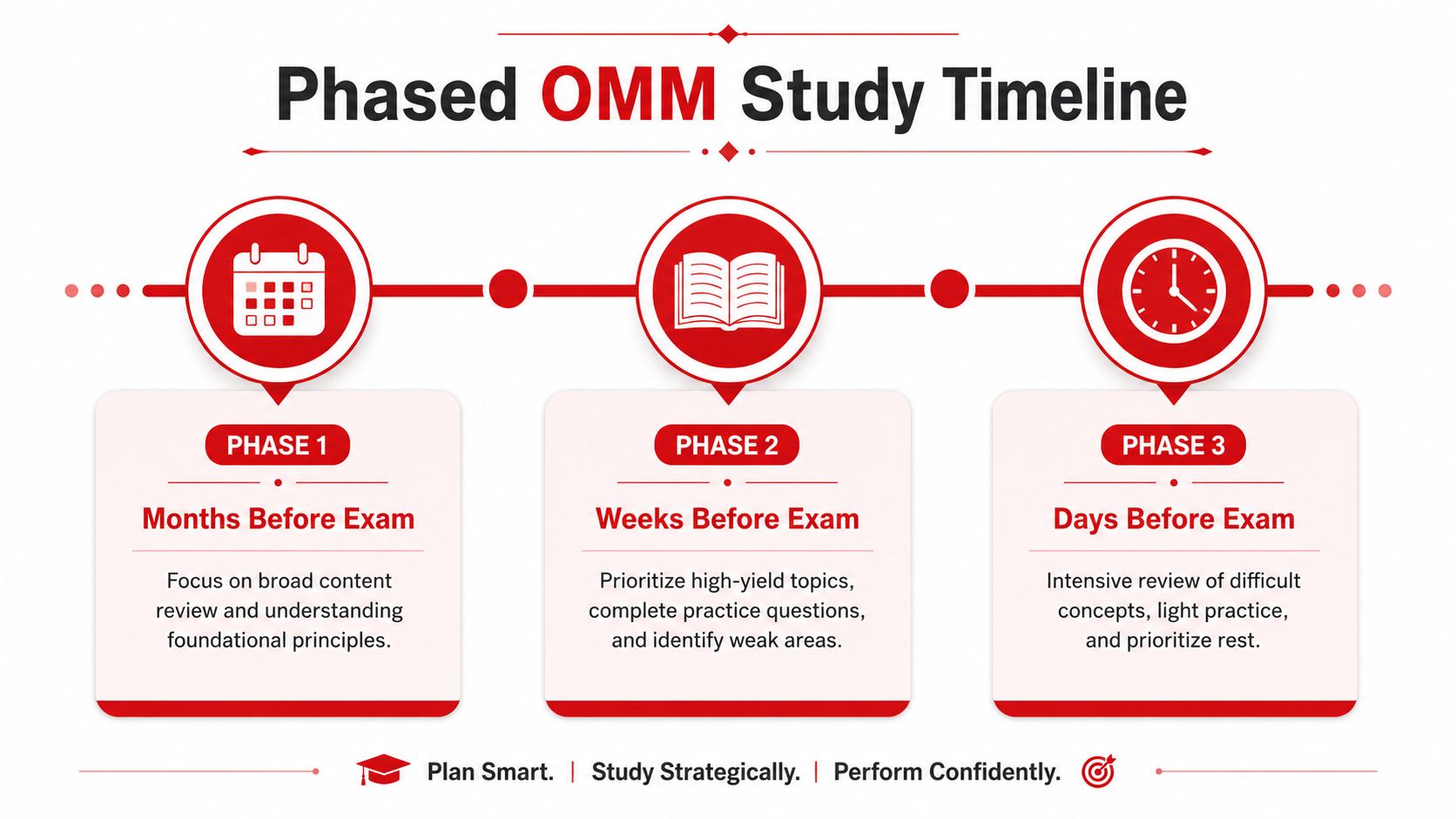
Months before the exam
This phase is light-touch. You are not doing a full OMM block yet.
Use this window to reconnect with the subject. That means board-style OMM questions mixed into your larger qbank work, short review sessions on major frameworks, and quick notes on recurring misses. The goal is not mastery. The goal is to prevent total rust.
If your broader COMLEX plan still feels messy, it helps to anchor OMM inside a larger COMLEX study schedule framework rather than treating it as a separate project.
Weeks before the exam
OMM review becomes more deliberate. Your question review should tell you which categories keep costing you points. Some students repeatedly miss rib mechanics. Others know the diagnosis but pick the wrong technique. Others get lost when OMM is buried inside a longer clinical vignette.
During this phase:
- Increase OMM question frequency: Mix it into timed blocks instead of saving it for “later.”
- Build a short weak-area list: Keep it limited to categories you're missing.
- Review answer logic aloud: If you can't explain why the right option is right and the others are wrong, your grasp is still shallow.
Don't wait until the final days to discover that your “OMM weakness” is really a question interpretation problem.
Days before the exam
This is the final push. It should be focused, narrow, and high-yield.
Use your dedicated OMM days here for rapid review of recurring patterns, common stem structures, autonomic and viscerosomatic associations, and technique indications or contraindications that you keep mixing up. At this point, reading broadly is usually a mistake. You should be tightening what you already identified, not opening new rabbit holes.
Sample OMM Board Review Schedules
| Study Phase | 6-Week Dedicated Plan | 12-Week Integrated Plan |
|---|---|---|
| Early phase | Add small sets of OMM questions into regular qbank blocks and note repeat misses | Use brief weekly OMM review sessions while medicine remains the main focus |
| Middle phase | Start targeted review of weak categories and revisit missed stems | Increase OMM exposure gradually, pairing question review with focused concept refreshers |
| Final push | Use the main concentrated OMM block during the final stretch of dedicated | Consolidate into a focused late review block after months of lighter integration |
How to know your timeline is working
Your timeline is working if OMM starts feeling more recognizable, not more expansive. You should notice that many questions are variations on familiar structures. If instead your materials keep multiplying and your confidence keeps dropping, that usually means your plan lacks triage.
A phased plan solves that. It keeps OMM from being ignored early and from taking over late. That balance is the whole point.
Mastering High-Yield OMM Topics and Vignettes
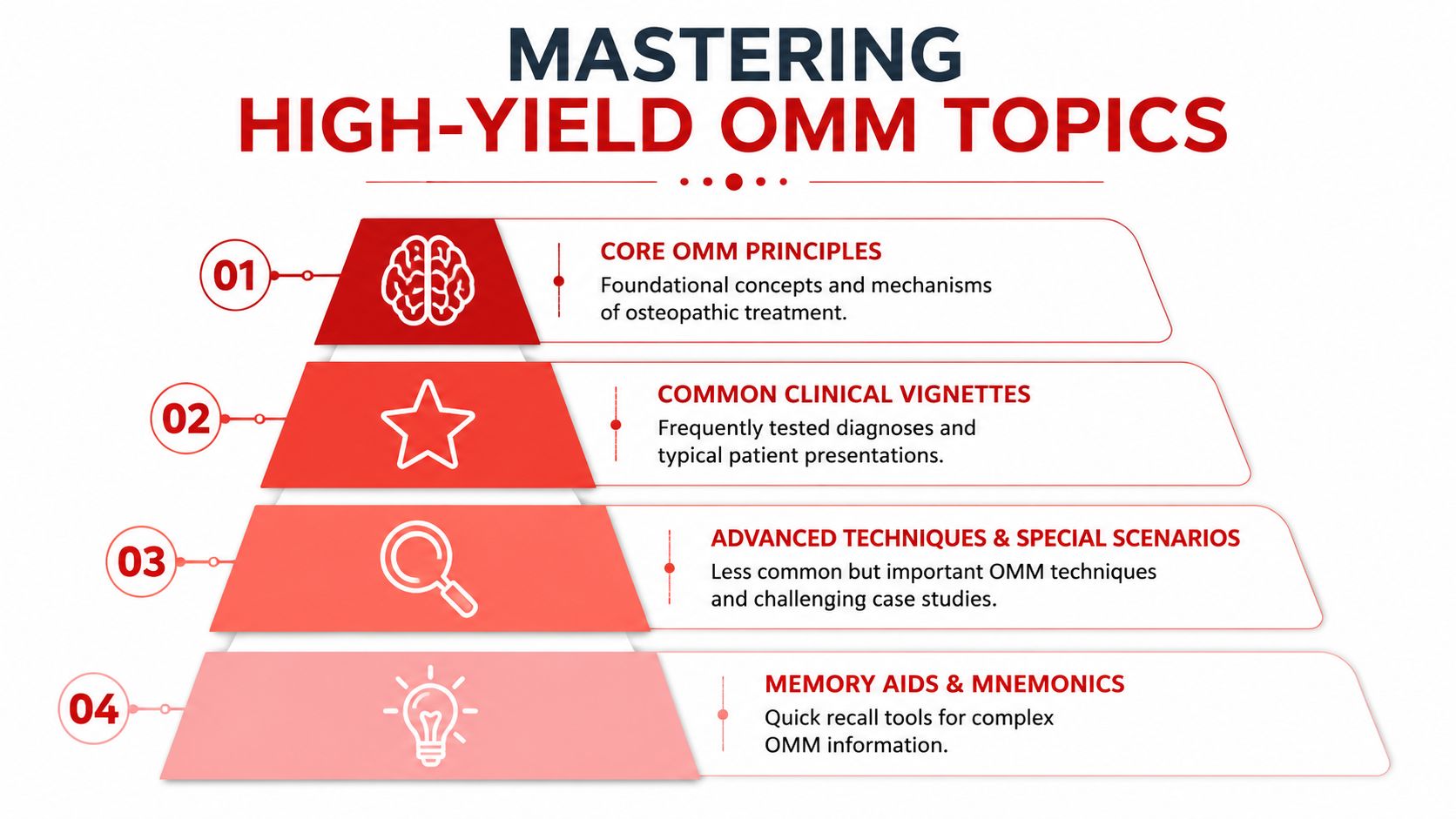
The biggest mistake in OMM board review is treating every topic as equal. They aren't. Boards don't reward equal attention to every old lecture slide, and neither should your study plan.
For COMLEX Level 3, rib dysfunctions and sacrum or innominates are considered high priority, while cranial basics are lower priority, as highlighted in this review of common COMLEX Level 3 study errors. That kind of tiering is what most OMM resources fail to do well.
Think in tiers, not chapters
If you study OMM by moving chapter to chapter, you'll spend too much time on material that feels complete but isn't especially test-dense. A better approach is to rank topics by how often they anchor clinical stems, how often they connect to management choices, and how often they expose pattern recognition weaknesses.
That usually means your top tier includes the mechanical areas that repeatedly show up in practical vignettes. Your lower tier includes topics that are still fair game, but shouldn't dominate your limited OMM window.
A general working hierarchy looks like this:
- Top tier: Categories that repeatedly show up in board-style clinical stems and require quick mechanics recognition
- Middle tier: Topics that matter but usually show up in narrower forms
- Lower tier: Material worth refreshing briefly, not building your week around
If you need a refresher on the broader clinical role of manipulative care, a concise overview of osteopathic manipulative treatment can help reorient the framework before you return to board-style application.
How high-yield topics appear in question stems
Boards usually don't ask OMM in a vacuum. They wrap it in a patient story.
That means your job isn't just memorizing a dysfunction name. Your job is learning to spot the signal inside the vignette. The stem may hand you a posture clue, a motion finding, a pain pattern, a post-procedure context, or a contraindication hidden among other details. Students who miss these questions often know the content but don't isolate the key clue fast enough.
A good OMM test-taker reads the stem looking for the mechanic that decides the answer, not for every fact they've ever learned about the body region.
A practical way to master vignettes
Use a simple review loop after every missed question:
Name the tested concept
Was this rib mechanics, sacral diagnosis, autonomics, technique choice, or something else?Identify the trigger phrase
What specific wording in the stem should have led you to the answer?Separate diagnosis from treatment
Did you miss the dysfunction itself, or did you identify it correctly and then choose the wrong next step?Write one takeaway only
Keep the lesson narrow enough that you can retrieve it later.
This is why a short, targeted list beats a giant OMM binder. You're not trying to preserve all information. You're trying to train fast recognition for what boards repeatedly reward.
Active Study Methods That Actually Work
Passive OMM review feels productive because it's familiar. You open notes, reread a chart, highlight a section on sacral mechanics, and finish the session with the sense that you “went over it.” Then the next qbank block exposes the problem. You recognized the page, not the concept.
That's why I push students toward question-based review early and hard. A stepwise approach centered on getting board-style questions right correlates strongly with higher board performance, with the effect especially notable among students with weaker in-training performance, according to this peer-reviewed study on board preparation and outcomes.

Use the qbank as a teacher, not just a score report
Many students use TrueLearn, COMBANK, or another board-style bank as a way to measure readiness. That's useful, but it's incomplete. The qbank should also teach you how COMLEX asks OMM.
The most effective review is slow enough to catch your reasoning errors. After each miss, don't just read the explanation and move on. Reconstruct the decision.
Ask:
- What clue in the stem mattered most
- What wrong answer I was tempted by
- Why that distractor looked attractive
- What one distinction would help me avoid this miss next time
That process is where learning happens.
Build flashcards from misses, not from entire chapters
Most students don't need more cards. They need better cards.
When you miss an OMM question, only turn it into a card if the miss reflects a true retrieval failure that cost you time or points. Keep it to one concept. Don't create broad cards that dump an entire region's mechanics onto one prompt. Those become review clutter fast.
A targeted system works better, especially if you're already using spaced repetition with Anki. The card should force recall of the exact distinction you missed, not a vague summary of the whole topic.
Examples of useful card logic:
- one card for the specific pattern you confused
- one card for a technique contraindication you keep forgetting
- one card for a recurring vignette clue that you failed to recognize
Don't let reading replace retrieval
Reading still has a role. It helps when you need to repair a weak foundation or reorganize a confusing topic. But reading should support active recall, not substitute for it.
A strong OMM study session usually includes some combination of these:
- Timed questions: To practice speed and pattern recognition
- Untimed deep review: To understand the structure of the question
- Brief targeted reading: To patch the exact hole exposed by the miss
- Active recall afterward: To make sure the concept sticks
If your OMM sessions end without you having to retrieve information from memory, you probably didn't study in a way that matches exam day.
The students who improve fastest are rarely the ones doing the most beautiful note-taking. They're the ones who repeatedly force themselves to decide, commit, review, and correct.
Common OMM Board Review Pitfalls to Avoid
Most OMM score problems don't come from a lack of effort. They come from effort pointed in the wrong direction.
One of the clearest examples is theory-only prep. A major pitfall in OMM board preparation is relying only on text without integrating evidence-based manual treatment concepts, even though over 90% of published studies support OMT modalities as effective courses of treatment, as noted in this review of osteopathic manipulative treatment evidence and related educational outcomes. For board prep, the practical takeaway is straightforward. OMM questions often test application, not just definitions.
Pitfall one: studying OMM like a history course
If your review is all reading and no clinical application, you'll struggle on vignettes. Boards want you to connect findings, mechanics, and treatment decisions. Students who only memorize prose descriptions often freeze when the question changes the wording.
A better move is to pair each concept with a likely board use. Ask yourself what the exam would make you do with that information.
Pitfall two: spending too much time on low-yield detail
This shows up when students sink hours into content that feels intellectually satisfying but doesn't return much on test day. You can tell this is happening when your review keeps expanding outward and your question accuracy isn't improving.
Use a correction rule:
- If a topic keeps showing up in your misses, promote it
- If a topic takes a lot of time and rarely affects your performance, demote it
That's how you stop low-yield drift.
Pitfall three: confusing familiarity with readiness
A lot of students say, “I looked at that already,” right before missing it again.
Recognition is not mastery. If you can't work through a stem under pressure and land on the right answer for the right reason, the material is not secure yet. This is especially common in OMM because many concepts feel half-remembered from lab, which creates false confidence.
You don't need OMM to feel comfortable. You need it to feel answerable.
Pitfall four: neglecting technique logic
Students sometimes memorize diagnoses but skip the logic of which treatment fits which patient. That creates avoidable misses. If the vignette gives you a patient who can't participate, has a red-flag contraindication, or needs a gentler option, the right answer depends on applying technique principles, not just naming anatomy.
Pitfall five: last-minute overload
Cramming all of OMM at the end usually produces panic, not clarity. The subject is finite, but it still needs repeated exposure. If you delay too long, every category feels equally weak, which makes prioritization harder.
A clean OMM board review plan prevents that by keeping the subject active enough that your final review becomes sharpening, not rescue.
When to Get Help and Integrate Targeted Tutoring
Most students can handle the bulk of OMM prep on their own. They need a good qbank, a realistic schedule, and enough discipline to critically review mistakes. But there's a point where independent study stops being efficient.
That point usually shows up in one of three ways. Your OMM misses are repeating despite review. You understand explanations but can't apply them cleanly in new vignettes. Or OMM has become mentally louder than it should be, and it's draining time from the rest of COMLEX.
That's when targeted help makes sense.

What good tutoring should actually do
A tutor should not re-teach all of OMM from scratch. That's too broad, too slow, and usually unnecessary.
Useful tutoring is diagnostic. It should identify whether your problem is content recall, prioritization, question interpretation, pacing, or anxiety under testing conditions. It should also narrow your workload instead of adding to it.
A strong tutoring intervention usually helps with:
- Pattern analysis: Figuring out what kinds of OMM questions you miss
- Resource control: Cutting out duplicate materials and building one usable plan
- Error correction: Turning repeated misses into specific retrieval targets
- Accountability: Making sure the plan is executed instead of endlessly revised
If you're considering support, this guide on finding specialized COMLEX tutoring help is a practical place to start.
Signs self-study is no longer enough
You probably need help if any of these are true:
- Your misses cluster in the same OMM categories even after review
- You keep switching resources because none of them feel complete
- You know the topic when reading but can't solve fresh questions
- You avoid OMM blocks because they create more stress than progress
Those aren't signs that you're incapable. They're signs that your feedback loop is broken.
The real role of outside support
The best tutoring doesn't replace self-study. It makes self-study sharper. It compresses the time between “I keep missing this” and “I know exactly how to fix it.” That matters in OMM because many students aren't dealing with a total knowledge deficit. They're dealing with scattered recall and poor targeting.
If your OMM board review already has structure and traction, keep going. If it's stalled, bloated, or repeatedly costing you points, targeted help can turn a frustrating weak spot into a manageable part of your larger COMLEX plan.
If you want expert, one-on-one help turning OMM into a controlled part of your COMLEX prep instead of a recurring stress point, Ace Med Boards offers personalized tutoring built around your exact weak areas, question patterns, and exam timeline. Their team helps students simplify bloated study plans, analyze misses more effectively, and build a board strategy that stays focused on high-yield gains.