

The student on rotation is usually staring at a full day on the wards, a half-finished question block, and a COMAT date that feels closer than it should. The fix is not more random studying. How to study for COMAT exams starts with the official NBOME blueprint, then turns every missed question into a targeted repair plan.
What a COMAT Actually Tests and How It Differs From a Shelf
A COMAT Clinical Subject Exam is built around NBOME's blueprint, and that blueprint is what you should study first. NBOME reports clinical COMAT scores on a standard-score scale from 9 to 200, with the reference group centered at 100 and a standard deviation of 10. The score is normed, so a good strategy is not chasing a percent-correct target, but fixing the kinds of misses that move your rank against other test takers NBOME COMAT administration guide.
Why the distinction matters
Shelf exams and COMAT exams reward different habits. Shelf prep often starts with broad subject lists and familiar allopathic resources. COMAT prep has to respect the NBOME split between disease content and physician tasks, which means you need to know the diagnosis, then handle the next clinical move: history and physical, diagnostic technologies, and management all show up inside the same item set NBOME COMAT clinical subject exams.
That changes the triage immediately. If your error log shows repeated misses on “next step” or “best test” questions, stop rereading disease summaries and spend that time on decision points. COMAT school reports also give a frequency table, a score roster, and a subtopic performance summary, so remediation should follow your weak physician tasks, not a random question tally.
A cardiology vignette makes the difference obvious. The diagnosis may be heart failure, but the exam may really be asking whether BNP, chest X-ray, or diuretic dosing is the right move. Tag that miss as a management task in your error log, because that is what you failed.
Practical rule: study COMAT by blueprint and by error pattern. If a topic keeps breaking in the same task category, that is the spot to fix.
| Feature | COMAT Clinical Subject | NBME Shelf Exam |
|---|---|---|
| Exam owner | NBOME | NBME |
| Score style | Standard score, normed around 100 | Shelf-specific reporting format |
| Content structure | Disease domains plus physician tasks | Shelf blueprint tied to NBME subject outline |
| Best study lens | Blueprint-driven triage and error logs | Shelf-specific subject review and question practice |
| Core skill tested | Clinical reasoning inside rotation content | Clinical reasoning inside the subject tested |
For a shelf-oriented comparison and broader third-year strategy, see how to study for shelf exams, but COMAT still demands a blueprint-first approach.
Reading the Official NBOME Blueprint for Your Subject
A student who studies every topic equally is wasting time. Start with the official NBOME blueprint for the exact COMAT subject and build your plan around what the exam weights. NBOME blueprints split content into patient presentation or disease-system weighting and physician-task weighting, and both should shape how you spend your time Internal Medicine COMAT blueprint.
How to turn percentages into triage
Internal Medicine shows the method clearly. Cardiovascular disease, hematology, oncology, immunology, and gastrointestinal disease carry real weight, and the physician-task side gives serious room to history and physical, diagnosis, and diagnostic technologies. If you are memorizing rare diagnoses while ignoring management and diagnostic reasoning, you are studying the wrong half of the exam.
The same blueprint logic changes by clerkship. Emergency Medicine puts more visible weight on trauma, procedures, imaging, labs, ECG interpretation, and airway-related skills, while Psychiatry emphasizes anxiety, trauma- and stressor-related disorders, mood disorders, and management Emergency Medicine COMAT blueprint. Do not carry priorities from one rotation into the next without checking the outline.
A blueprint-to-time method that works
Start with the highest-weight systems in the outline. Then weight your task review against your own error log. If you keep missing interpretation, diagnosis, or management questions, those categories deserve more time than another pass through easy facts you already know.
Use a two-column note for every miss. Put the blueprint domain in one column and the task asked in the other. That keeps your review tied to the test instead of to what feels comfortable. A cardiology miss might belong in cardiovascular disease, but if the stem asked for the next best action, the core issue is task recognition, not disease recall.
Useful habit: build a two-column note for each missed item, one column for the blueprint domain, one for the task asked. That keeps the study plan anchored to the exam instead of to mood.
For a broader COMLEX-linked overview, see the COMLEX-USA overview for how related preparation is organized. Then keep your COMAT plan strict, official weighting first, personal weak spots second.
Building a Two-Week Rotation Study Schedule
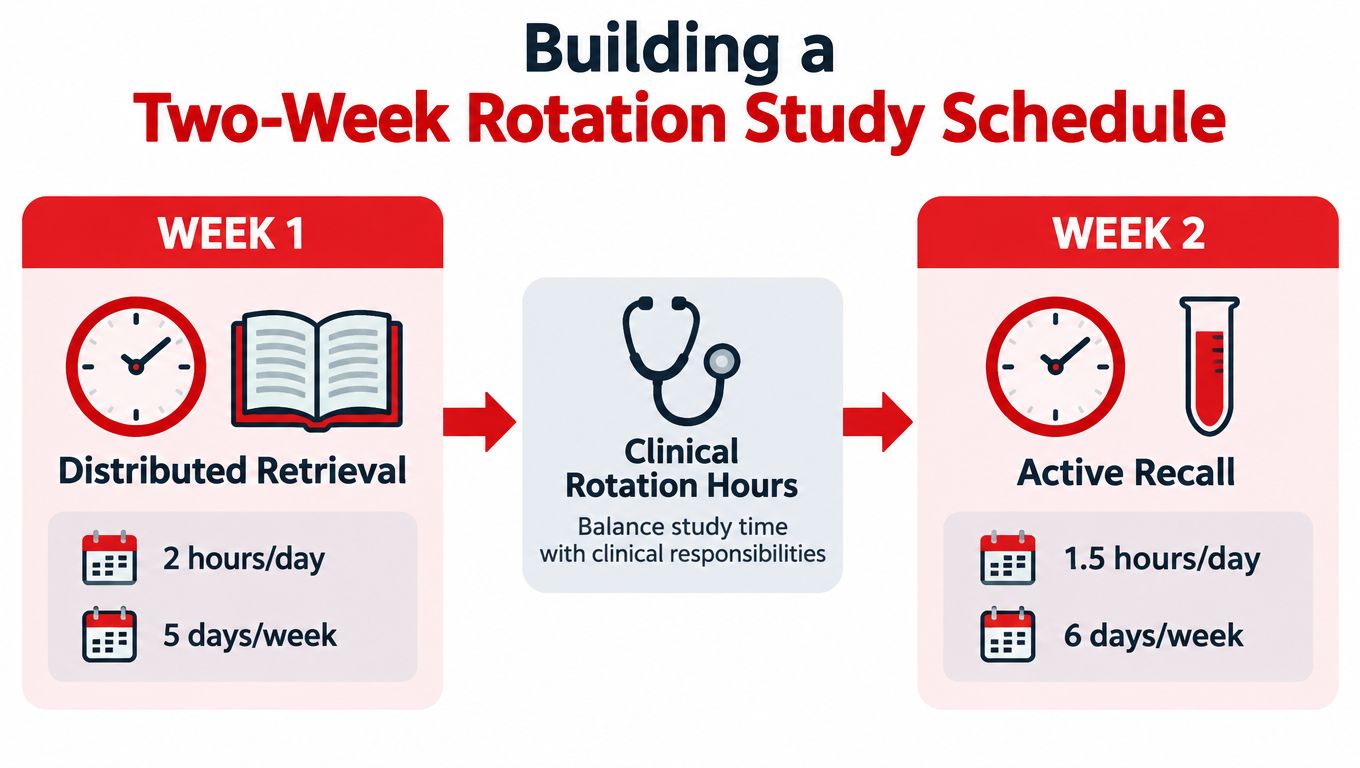
Your rotation will eat the day if you let it. Build the schedule around the COMAT blueprint, then use your error log to decide where the extra minutes go. If cardiology and management questions keep breaking you, that is where the time goes. If your misses are mostly recall, keep the content repair short and move back to retrieval fast. The study literature in health professions education favors distributed practice and retrieval practice over massed rereading, which is the right fit for COMAT prep systematic review on retrieval and distributed practice.
A blueprint-first two-week structure
Use the highest-weight blueprint domains first. Then split the rest of your time by what you miss. A question set that keeps exposing interpretation errors deserves more attention than another pass through a topic you already know.
| Day | Morning (15 min) | Evening (45 min timed block) | Blueprint tag |
|---|---|---|---|
| Mon, Week 1 | Anki misses on cardio management | 20 mixed IM questions | Cardio + management |
| Tue, Week 1 | Review wrong-answer themes | 15 timed questions, then review | Highest-weight domain |
| Wed, Week 1 | Rework one weak concept | 20 mixed questions | Domain plus task |
| Thu, Week 1 | Old misses and recall drills | Timed block with explanations | Personal error log |
| Fri, Week 1 | Short flashcard pass | Mixed timed questions | Mixed blueprint review |
| Mon, Week 2 | Return to repeated misses | Harder timed set | Weakest domains |
| Wed, Week 2 | Rapid recall only | Mixed block under time pressure | Exam pacing |
| Fri, Week 2 | Light review of flagged items | Final mixed block | Readiness check |
Week 1 should feel controlled and repetitive. Week 2 should feel more like the exam, with less passive reading and more timed retrieval. That shift matters because comfort does not raise scores, retrieval under pressure does. The Zemith on effective exam prep guide reaches the same conclusion, keep practice active and spaced, then keep the plan simple enough to execute during rotation.
A practical daily rhythm
A strong day does not need to be long. It needs to be honest.
- Morning flashcards: hit old misses before the day gets noisy.
- Midday micro-repair: fix one weak concept, then stop.
- Evening timed block: work questions under time pressure.
- Weekly cumulative review: pull earlier topics back into circulation so they do not fade.
The common mistake is spending off-days reading too much and testing too little. COMAT rewards the opposite.
Choosing Practice Questions and Resources Wisely
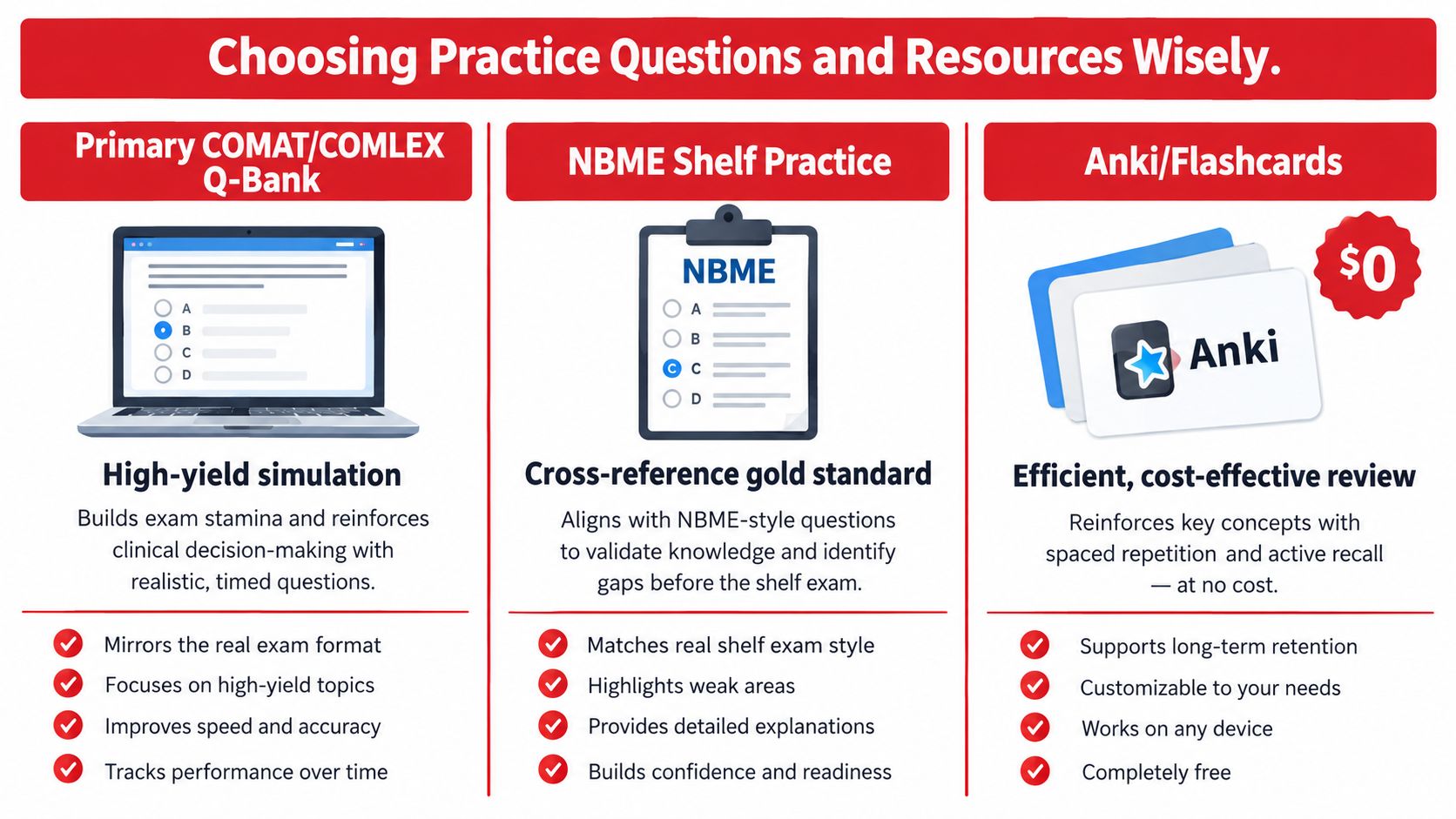
Question banks are not a trophy wall. They are a diagnostic tool. A student who completes a large number of items without changing the review process is just rehearsing mistakes, not fixing them.
What to use and what to avoid
Primary COMAT or COMLEX-style questions should carry most of the weight because they force the same kind of clinical reasoning the exam demands. Shelf-style practice can still help as a cross-reference, but it should not replace COMAT-aligned work. The internal guide on best COMLEX practice questions and study resources for DO students is the closest matching resource page for students deciding what to anchor to.
Anki and other flashcards are useful only when they force real recall. If a deck becomes a recognition exercise, it stops helping. That is especially true during rotations, when passive review feels productive but doesn't expose the gaps that timed questions expose.
Hard truth: untimed marathon blocks followed by a fast skim of explanations give the illusion of progress. Timed mixed blocks tell the truth.
A student who needs reasoning feedback beyond answer explanations can add tutoring, but only as a supplement to independent question work. One option in that category is Ace Med Boards, which provides private COMAT support through study planning, question review, clinical-reasoning guidance, pacing support, and feedback on weak areas. That kind of help is most useful when the issue is not just content, but the way the student is reading the case.
Resource comparison at a glance
| Resource | Best use | Main limitation |
|---|---|---|
| COMAT or COMLEX-style question bank | Blueprint-aligned clinical reasoning | Can be wasted if review is shallow |
| Shelf-style practice | Cross-reference and broad exposure | Not the same blueprint as COMAT |
| Anki or flashcards | Fast retrieval of recurring facts | Easy to turn into passive recognition |
The selection rule is straightforward. Use the primary bank to simulate the exam, use flashcards to keep old material alive, and use shelf-style practice only when it helps cross-check a concept rather than dictate the plan.
A Question-Review Workflow That Actually Changes Scores
Most students review questions backwards. They read the explanation first, then convince themselves they knew the answer all along. That feels efficient and often does almost nothing.
The first pass should force a decision
Every item needs an active answer before the explanation opens. If the student is unsure, the item still gets a guess and a confidence mark. The exam rewards decision-making, not just familiarity with the explanation after the fact.
The second pass should classify the miss
Once the explanation is open, each missed or shaky item needs a label. The label should be one of three things, knowledge gap, misinterpretation, or timing error. Then the student writes a four-line error log, the tested principle, the decisive clue, the distractor logic, and one prevention rule for next time.
That error log should map back to the blueprint, not just to the topic name. A missed nephrology item might be a management error, a timing mistake, or a failure to identify the task. Those are different problems, and they should not get the same fix.
A student who needs help organizing spoken lecture material into notes can also use a transcription tool such as taking notes in lectures, but lecture capture is only useful if it feeds the same error-log system. Passive note piles do not improve COMAT performance by themselves.
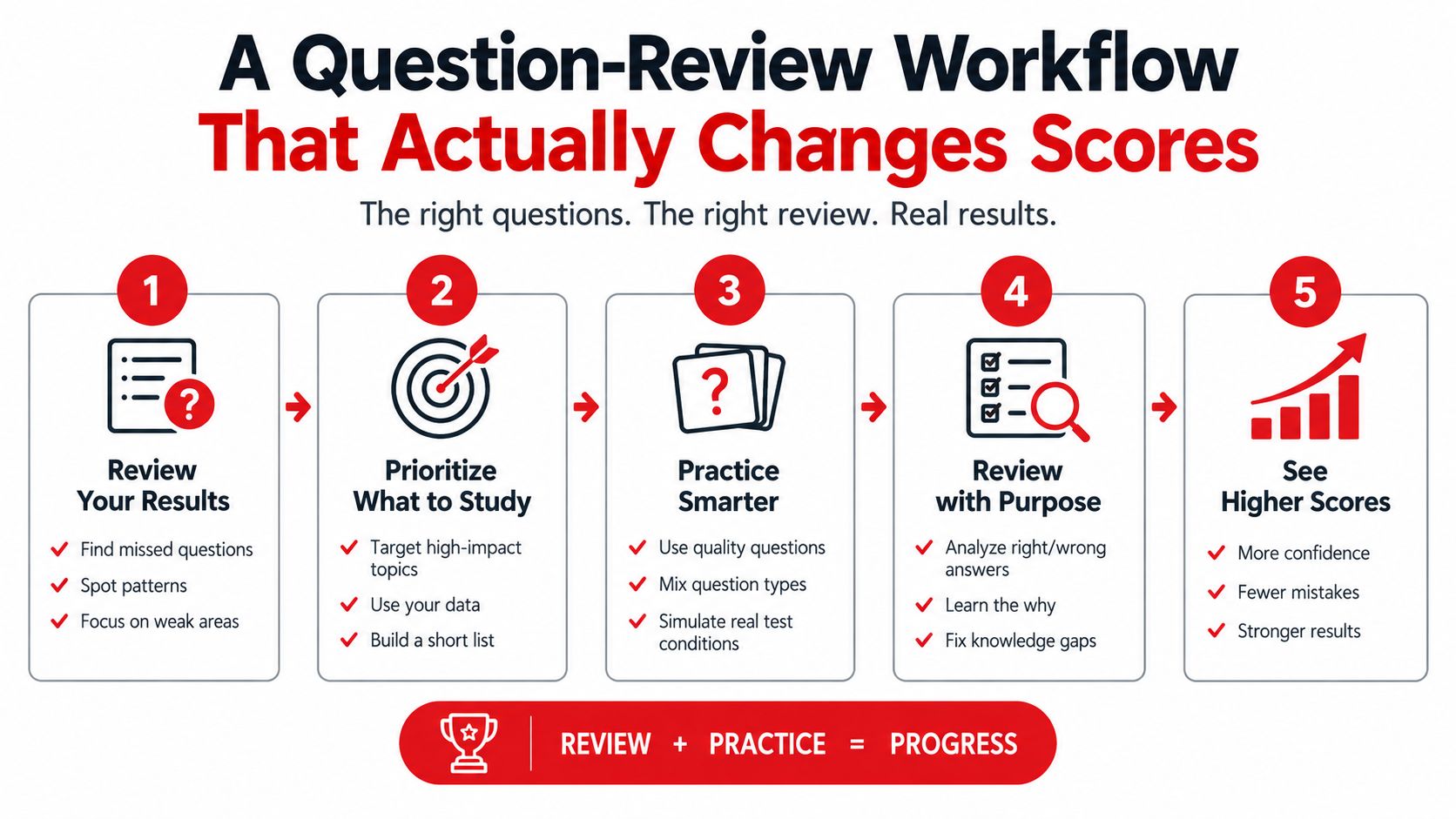
How to use the log
- Write the clue: identify the one detail that should have triggered the right path.
- Name the trap: note why the wrong option looked tempting.
- Tag the task: diagnosis, test choice, or management.
- Assign the fix: reread, redo, or re-question the concept within the same blueprint domain.
The internal distractor analysis guide fits this workflow well because it pushes the student to study why the wrong answer felt right. That is the kind of review that changes future blocks, not just past ones.
Tracking Readiness With Milestones Instead of Question Count
Completing a question bank is not readiness. It is exposure. You are ready when practice performance improves at checkpoints and your weak domains shrink, not when a counter reaches a satisfying number.
What the score is actually saying
NBOME uses a mean of 100 and a standard deviation of 10 for clinical subject scores, so track percentile movement rather than raw percent-correct. A low practice score is a baseline, not a verdict.
Track more than one number. Subject, domain, confidence level, and error type all matter, because a flat overall score can hide real progress in one weak area while another stalls. School score rosters and subtopic summaries help here because they show whether the same weak category keeps resurfacing.
Read your results like a triage sheet. If cardio-management questions keep dropping while diagnosis items improve, that is a different problem from a broad content gap, and it needs a different fix. Milestones should come from your error log, not from total questions completed.
Milestone example, after two weeks of mixed blocks, cardio-management errors fall from 40% to 15% while the overall score holds at 105. That domain-specific trend shows readiness better than a bigger question count ever will.
One institutional COMLEX report showed that delaying the exam after repeated study without objective improvement was linked with weaker pass patterns than taking it when mock performance was already strong, but those figures are institutional and should not be treated as universal rules LUCOM COMLEX guide. The useful takeaway is simpler. Do not wait for a magical feeling of readiness. Wait for sustained evidence.
A week-before checklist
- Two recent timed blocks show the same weak domain shrinking.
- Error logs show fewer task-misread items.
- Mixed review still holds when older material reappears.
- School reporting matches what you already suspect.
- Sleep and pacing stay stable enough to support recall.
Use the progress tracking dashboard for trend visibility, not trivia.
Test-Day Techniques That Match the COMAT Format
COMAT subject exams run 120 items in 2.5 hours, which works out to about 75 seconds per item. That is not generous, so test-day pacing has to be deliberate NBOME COMAT clinical subject exams. The student who spends too long proving certainty on easy items usually steals time from the ones that need it most.
Use a two-pass pacing plan
The first pass should be quick. Straightforward items get answered, uncertain items get flagged, and multi-step cases get a bit more room. The second pass is where the student returns to image-based, lab-based, ECG-based, or management-heavy questions that needed a later look.
The task label matters under pressure. A student may know the disease but still miss the item because the question asks for diagnosis, a test, or the next management step. That mistake is common, and it is fixable if the student has practiced reading the task before reading the answer choices.
Day-before habits should stay simple. Stop heavy studying early enough to protect sleep, keep the final review light, and avoid introducing new content that only increases noise. Morning-of habits should be equally plain, eat normally, hydrate, and open the exam with the same two-pass plan used in practice.
Last check: if the student has already built an error log and used mixed timed blocks, the test day job is execution, not reinvention.
Short FAQs
How should a student study for COMAT exams without copying shelf strategies?
By using the NBOME blueprint, not a generic shelf outline, and by weighting physician tasks as heavily as disease domains.
How much of the exam is about content versus reasoning?
The exam tests both, but the physician-task side makes reasoning, task recognition, and management choices central.
Is finishing a question bank enough?
No. Quality of review and trend improvement matter more than raw completion.
What should a student do if the subject feels broad?
Start with the official blueprint, then narrow study time to the highest-weight systems and the most repeated error-log patterns.
How important is pacing?
Very. The 120-item, 2.5-hour format makes timing part of the skill being tested.
If the student wants a blueprint-first COMAT plan built around weak domains, timed blocks, and question review that changes performance, Ace Med Boards offers one-on-one support for selected COMAT exams, including study planning and reasoning feedback. Visit Ace Med Boards to review current options and set up a consultation.