
You just got a COMAT report back, and the first thing your eyes find is the percentile. That number can feel like a verdict, but it's really a ranking, not a raw measure of how many questions were right. A careful read of comat score percentile helps a DO student separate what the report is really saying from what anxiety makes it seem to say.
Understanding Your COMAT Score Percentile
A COMAT score percentile shows how your result compares with the national reference group. It does not show how many questions you got right. For clinical COMAT exams, NBOME uses nationally normed standard scores to compare performance with first-time osteopathic medical school test takers, so the percentile is a ranking within that group, not a raw accuracy rate NBOME percentile scores.
A score above 100 means performance above the national reference-group average, but it does not mean the student answered every question correctly.
Read the number the right way
That distinction matters because two students can see different percentile results even when their performance is closer than the numbers suggest. The report is comparing you with a norm group, not grading you like a classroom quiz. That is why the percentile can feel surprising if you read it as a percent correct.
Practical rule: Treat the percentile as a comparison point, not a percentage correct.
For students trying to make sense of clerkship feedback, a useful habit is to ask, “Compared with whom?” That question keeps the report grounded and makes adviser conversations more precise, especially when school grading rules and remediation decisions combine score data, clinical performance, and faculty input.
If you want a plain-language refresher on how educators frame performance comments, see feedback for student assessments. For a COMLEX-aligned comparison of standardized reporting, Ace Med Boards also has a related COMLEX score percentile guide.
How COMAT Clinical Standard Scores Are Calculated
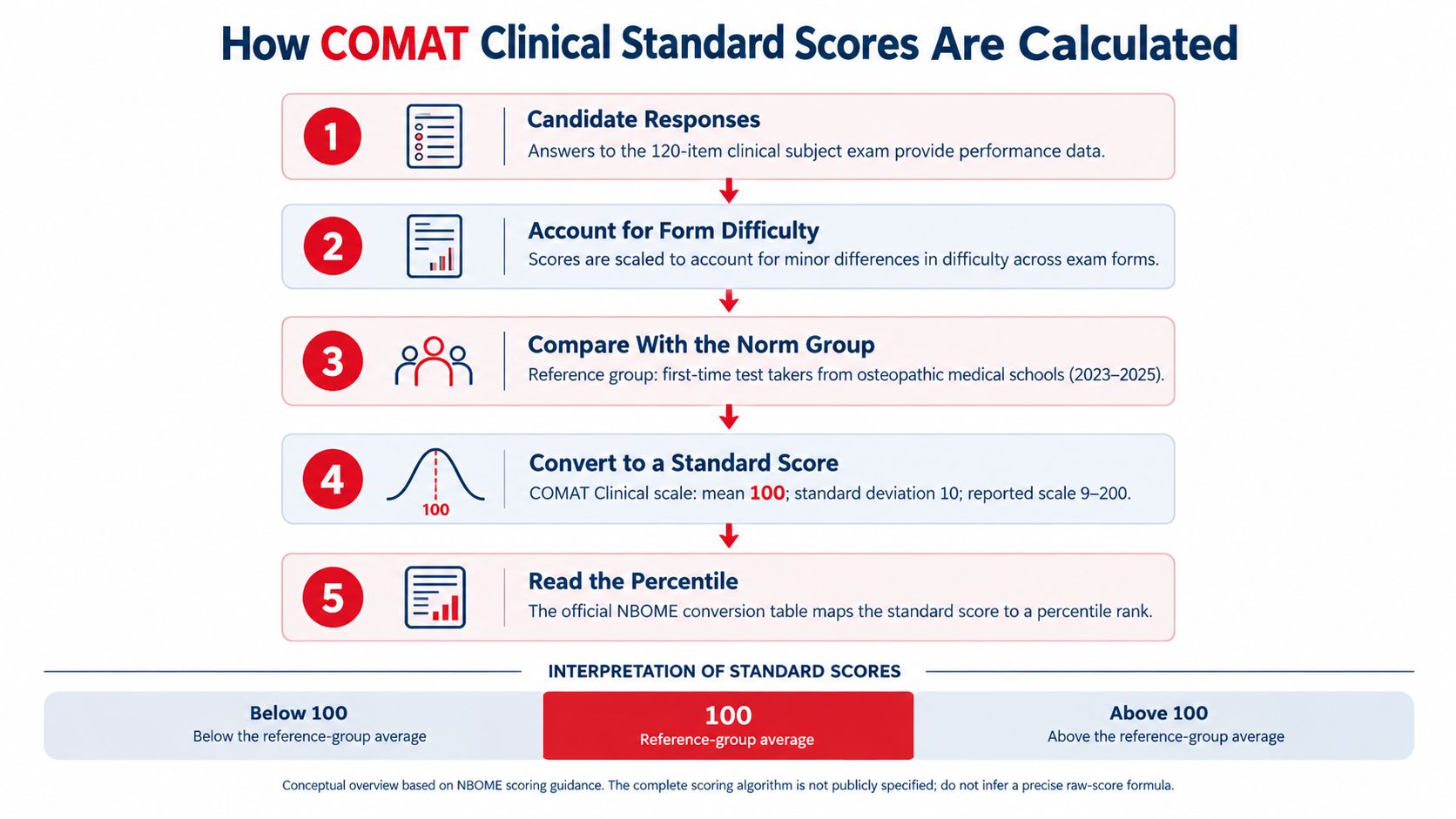
A clinical COMAT report starts with a standardized score, not a raw percent. NBOME describes the clinical scale as running from 9 to 200, with a mean of 100 and a standard deviation of 10 NBOME scoring and reporting. That structure lets different versions of the exam sit on the same reporting scale, so one form is not judged by a simple question-count total.
Why the norm group matters
The percentile comes from comparison with a reference group. For COMAT clinical subject exams, NBOME uses first-time test takers from osteopathic medical schools, usually students tested near the end of a clerkship, rotation, or related course NBOME percentile scores. In plain terms, the report is asking how a student performed against peers in the same testing frame, not against a fixed classroom target.
A score of 110 sits about one standard deviation above the mean and lines up with the 84.1st percentile. A score of 90 sits about one standard deviation below the mean and lines up with the 15.9th percentile NBOME scoring and reporting. That is why the number on the page can feel more like a ranking than a percent correct.
A clinical COMAT report only makes sense when the score family is identified first.
That warning matters because clinical subject percentiles and foundational biomedical science percentiles use different scales. The same NBOME documentation lists FBS-C with a mean of 200 and FBS-T with a mean of 550, so a student who reads both reports the same way can misread the result.
For a simple comparison of how standardized testing reports work in another setting, see this Step 2 CK scores and percentiles guide.
If a COMAT report feels confusing, start with the exam family, then read the standardized score inside that family, and only then match it to the correct percentile table.
Percentile Rank vs Raw Percent and Standard Score
A COMAT report can look simple until the numbers start talking past each other. A standard score shows performance on the exam's scale, a percentile shows where that score sits among peers, and a raw percent would only matter if the report were listing answered-correctly data, which the clinical report is not asking you to read that way.
What each number actually tells you
If a student sees 110, that is a point on the standard-score scale, not “110 percent.” If the report shows the 84.1st percentile, it means the score outperformed most students in the reference group, not that 84.1% of items were correct NBOME scoring and reporting. That difference matters, because a high percentile can come from a strong standardized score even when the raw percentage is unknown.
| Report element | What it measures | What it does not measure |
|---|---|---|
| Standard score | Performance on the normed COMAT scale | Raw percent correct |
| Percentile rank | Relative standing in the reference group | Number of questions right |
| Raw percentage | Direct item accuracy, if provided elsewhere | National comparison |
A student who reads 125 as “125 percent correct” is making the same kind of mistake. The number is a position on a scale, not a count of correct answers. For a clear explanation of how students often confuse score types, see supporting students through achievement testing.
A simple interpretation example
A clinical COMAT score of 90 sits about one standard deviation below the mean and corresponds to the 15.9th percentile. That does not automatically mean a student is unprepared for medicine. It means the result is lower than most peers in the same comparison group, so the next question is whether the issue is content gaps, pacing, or a study approach that does not match the exam.
For students who want a test-focused resource library while sorting out those distinctions, Ace Med Boards' COMAT tutoring-related materials can sit alongside school resources and question banks without replacing them.
COMAT Percentile Cutoffs and School Grading Policies
A percentile only becomes meaningful when it's read next to a school's clerkship rules. Some osteopathic medical schools use COMAT performance as part of honors, pass, remediation, or competency decisions, while others fold it into a broader clinical evaluation rather than using a single hard cutoff.
Why schools can treat the same report differently
That variability is why one student's “good enough” can be another student's remediation trigger. The percentile itself comes from NBOME's national norm group, but the grade policy belongs to the school. So a report near the middle of the curve may be acceptable in one program and concerning in another, depending on local standards and clerkship expectations.
Best practice: Ask the clerkship or course director how the school uses the report before drawing conclusions from the number alone.
A helpful way to read the report is to separate three layers. First, there is the standard score. Second, there is the percentile rank. Third, there is the institutional decision that may follow from those numbers. Confusing those layers is how students end up overreacting to a score that needs only a routine advisor conversation.
A realistic interpretation example
If a student earns a score around the middle of the scale, that may map to a middle-percentile result, but the school may still ask for reflection, a brief remediation plan, or a documentation note in the clerkship file. If the score sits much lower, the same program may set a formal review. The right next step depends on the institution's handbook, the clinical evaluator's comments, and whether the student has shown the same pattern on more than one rotation.
For a broader view of how DO applicants and residents should think about score data across training, Ace Med Boards has a related COMLEX scores and residency match guide. That context helps students avoid assuming one score report defines the whole application.
What COMAT Percentiles Mean for Clerkships and Residency
COMAT percentiles matter because they help schools and residency advisors read clinical performance in a standardized way, but they're still only one part of the story. A steady pattern of acceptable performance across rotations can support a strong clinical narrative. A lower percentile on one exam, handled transparently and followed by improvement, can also be explained without turning it into a career-ending event.
Keep COMAT and Shelf reporting separate
DO students sometimes compare COMAT percentiles with NBME Shelf percentiles as if the reports speak the same language. They don't. The scales, norm groups, and reporting systems are different, so a shelf percentile should not be used to interpret a COMAT report, and a COMAT percentile should not be forced into a shelf framework.
That distinction matters during residency planning, where advisors and program directors care more about trends, clerkship consistency, and professionalism than about one isolated number. A single lower result is better understood in the context of remediation, rotation comments, and later performance than in isolation.
How to frame the result constructively
If a student is asked about a weaker result, the best explanation is usually straightforward. The student can acknowledge the score, identify what changed in the next study cycle, and show what was learned from the experience. That approach reads as maturity, not defensiveness.
A score pattern that improves over time tells a cleaner story than a one-time spike. Even when the percentile isn't where the student wanted it to be, the report can still support a convincing narrative of adaptation, self-correction, and readiness for more advanced clinical work.
Actionable Strategies to Raise Your COMAT Percentile

A weak COMAT score percentile usually means the study plan does not match the problem. Some students need content review. Others need help reading clinical stems, and some need better pacing under timed conditions. The fastest way to improve is to match the fix to the miss pattern.
Build the plan around the miss pattern
A useful way to sort missed questions is into three groups, content gap, reasoning gap, and execution gap. Content gaps call for review of the topic itself. Reasoning gaps call for more work with clinical vignettes. Execution gaps call for timed blocks and more disciplined answer selection under pressure.
Start with missed-question notes, but write down what the item was testing, not just why the chosen answer was wrong. Group misses by system so weak areas stand out. Use active recall first, since pulling facts from memory is more effective than passively rereading them. Ace Med Boards' active recall resource fits that approach well. Revisit the same concept after a short delay, then check whether the correction held. In the final week, narrow the focus to repeated weaknesses instead of trying to relearn the whole book.
Where tutoring fits
One-on-one COMAT tutoring helps when the problem is structure rather than effort. It is useful for students who need help interpreting the report, setting study priorities, or turning question-bank misses into a workable plan. Ace Med Boards offers COMLEX tutoring as one support option for students who want personalized review alongside official materials, school lectures, and question banks.
A tutor can organize the work, but the score still changes because the student does the practice.
A short readiness check before the next exam keeps the process honest:
- Weakest systems identified
- Incorrect questions reviewed twice
- Timing practice completed
- School grading policy confirmed
- Advisor conversation scheduled if needed
Next Steps and Professional Support Options
A COMAT percentile only helps if it leads to a clearer next move. A student with a middle-range score may only need to check the school policy and keep preparing. A lower percentile can call for targeted remediation, a meeting with the clerkship director, or a more structured question-review plan.
A calm way forward
Read the report in three parts. The standard score shows where the result sits on the calibrated scale. The percentile shows the relative rank within the national group. The school policy tells you what that number means for grading or remediation. That order keeps students from giving the score more meaning than it can support.
A score that needs a closer look can go through a Board Score Audit or consultation to separate signal from noise. A COMLEX tutoring session can turn that review into scheduled practice, with the score report, course policy, and missed topics all in the same conversation.
The main point is simple. A COMAT report is feedback, not a label. Used well, it can show where study time should shift, where a clerkship advisor should get involved, or where performance is already strong enough to keep going with confidence.
Ace Med Boards helps students interpret COMAT-style score reports, identify study gaps, and build a more focused plan for the next exam. If this report still feels hard to read, visit Ace Med Boards to explore tutoring and score-audit support that fits the DO pathway.