No official COMSAE-to-COMLEX conversion table exists, and COMSAE scores should be read as probability-of-passing indicators, not as equivalent COMLEX scores. A COMSAE 400, 450, and 500 corresponded to estimated Level 1 passing probabilities of roughly 94%, 97%, and 99%, but those are cohort-based estimates, not guaranteed individual outcomes.
The most common advice online sounds reassuring because it promises a neat chart. The problem is that COMSAE was built to help students judge readiness, not to produce a fixed score translation that works for every person.
| Question | Straight answer |
|---|---|
| Is there an official COMSAE to COMLEX conversion? | No. |
| Should a COMSAE be treated like a COMLEX score? | No. |
| What is COMSAE actually best for? | Pass-readiness and trend interpretation. |
| What matters more than one score? | Timing, test conditions, and other academic markers. |
The Short Answer on COMSAE to COMLEX Conversion
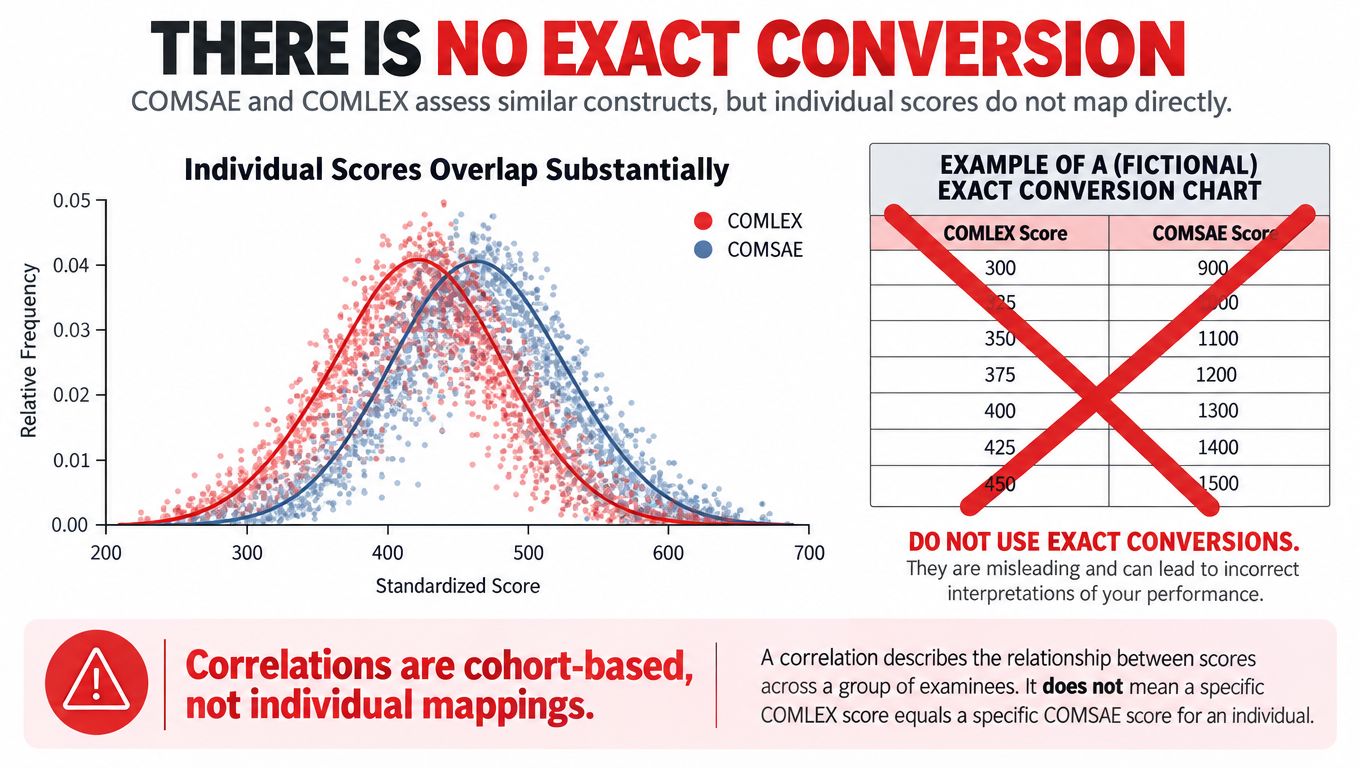
There is no official COMSAE-to-COMLEX conversion. The National Board of Osteopathic Medical Examiners does not publish a fixed lookup table, and the safest interpretation is that a COMSAE score reflects readiness to pass, not an equivalent COMLEX-USA score. For students trying to answer a real question, “Am I ready?”, that distinction matters more than the fantasy of a perfect chart. See the broader COMLEX context in this COMLEX score percentile guide.
What the score is really telling you
COMSAE is useful because it helps estimate how a student is trending against a target exam, especially for COMLEX-USA Level 1, which moved to pass/fail reporting in 2022. But a readiness estimate is not the same thing as a one-to-one conversion. A student can have the same COMSAE result as someone else and still have a different likelihood of passing because timing, study habits, test-day conditions, and content strengths all differ.
That is why the most honest answer is also the least flashy one. COMSAE is a probability signal, not a score substitute. If a chart says a certain COMSAE “equals” a certain COMLEX score, that chart is oversimplifying what the exam data can support.
Practical rule: if someone uses the phrase “official conversion,” that should be a red flag.
The rest of this discussion focuses on what COMSAE measures, why conversion charts break down, how interpretation changes by exam level, and how to build a readiness decision that is calmer and more useful than chasing a fake exact number.
What COMSAE Measures and How It Differs From COMLEX
COMSAE means Osteopathic Medical Self-Assessment Examination, and COMLEX-USA means Osteopathic Medical Licensing Examination of the United States. That naming difference matters because COMSAE is designed as a self-assessment, while COMLEX is a licensing exam. One is meant to help students judge where they stand, the other is the exam that schools, licensing systems, and residency processes care about directly.
Why the formats matter
COMSAE Phase 1 remains a three-digit numerical self-assessment, while COMLEX-USA Level 1 moved to pass/fail reporting in 2022. That creates an immediate problem for anyone trying to "convert" one score into the other. A numerical self-assessment can estimate readiness, but it can't be treated like a hidden duplicate of the actual exam.
The structure matters too. COMSAE Phase 1 is 176 items over about 4 hours, while COMLEX Level 1 is 320 items over 8 hours. That means COMSAE does not fully reproduce the fatigue, pacing, and endurance demands of the actual exam. A student's ability to stay sharp for four hours is informative, but it's not the same as sustaining attention for twice that long.
Why that gap breaks direct score thinking
A conversion chart assumes the two tests behave like interchangeable currencies. They don't. COMSAE and COMLEX share content domains, but they are not the same experience, and they're not scored in a way that supports a universal formula. That's why a student can't responsibly take a COMSAE score, apply a constant, and pretend the result is a true COMLEX equivalent.
The better mental model is simple. COMSAE tells a student something about readiness, trend, and risk, while COMLEX tells the system whether the student passed or earned a score under the exam's own rules. Treating those as different tools prevents a lot of unnecessary panic.
This COMLEX versus USMLE guide for DO students helps place COMSAE within the broader context of osteopathic examinations without confusing it with USMLE-style score logic.
Why No Conversion Chart Can Be Trusted
Conversion charts look precise because they attach one number to another. The problem is that the numbers come from group data, not from a promise about any one student. A correlation can show that two measures move together, but it cannot tell a student that a specific COMSAE score will always become a specific COMLEX result. That is the core mistake behind the charts that get shared online.
What the NBOME data actually supports
In a recent NBOME validity analysis, Phase 1 scores correlated positively with Level 1 performance, with correlation coefficients ranging from r = 0.59 to 0.70. At an average 67-day interval between assessments, first-attempt COMSAE scores of 400, 450, and 500 corresponded to estimated Level 1 passing probabilities of approximately 94%, 97%, and 99%, respectively. The same analysis makes the limitation clear. Those are cohort-based estimates, not guaranteed conversion values, and they should not be handed to students as if they were fixed equivalencies. The source also notes that timing, repeat testing, administration conditions, curriculum performance, and clinical-subject assessments all materially affect interpretation. NBOME's Phase 1 usage analysis
Why a probability is not a prediction
A probability says what tends to happen across a group. It does not say what must happen for the next individual. A student with a COMSAE of 450 may pass comfortably, but another student with the same score might still need more review because the test was taken under loose conditions, the score trend flattened, or anxiety affected performance. That doesn't mean the score is useless, it means the score is context-dependent.
A COMSAE score is more like a weather forecast than a guarantee. It can guide planning, but it can't promise a specific outcome for one day.
A useful way to think about this is the difference between a thermometer and a prediction model. A thermometer gives a single reading. A prediction model uses more than one input. COMSAE behaves more like the second kind of tool, which is why a clean conversion chart is too crude to trust.
If the goal is honest interpretation, the right question is not, “What COMLEX score equals my COMSAE?” The better question is, “How likely is this score to mean I'm ready when paired with everything else I've been doing?”
This research-appraisal guide is useful for students who want to spot when a chart is pretending to be stronger evidence than it really is.
Interpreting Readiness by Exam Level
The most common mistake is treating all COMSAE results as if they answer the same question. They don't. COMLEX Level 1, COMLEX Level 2-CE, and later levels ask for different readiness logic, so COMSAE should be interpreted differently depending on the target exam.
Level 1 and Level 2-CE are not the same problem
For Level 1, the practical question is pass-readiness. A peer-reviewed analysis found that the COMSAE taken closest to COMLEX-USA Level 1 correlated with the eventual Level 1 score at r = 0.61, while the relationship with USMLE Step 1 was weaker at r = 0.41. That means COMSAE is more useful for osteopathic readiness than for trying to translate scores across systems. NBOME's COMSAE scoring and reporting page also reminds students to use COMSAE with other academic markers, not in isolation.
For Level 2-CE, the question changes. Students often care about the actual three-digit result because residency applications still use score reporting in many contexts. In that setting, a study model combining COMSAE Phase 2, average clinical COMAT scores, preclerkship exam performance, and Level 1 pass/fail status explained 73.9% of the variance in Level 2-CE performance, and that sample identified a COMSAE Phase 2 cutoff of 447 for passing. NBOME's COMLEX scoring and reporting page points students toward the same broad idea, which is that readiness works best when multiple measures are considered together.
A practical framework by level
| COMSAE Interpretation Framework by Exam Level | |||
|---|---|---|---|
| Exam Level | Key Readiness Question | Measures to Combine | Research Benchmark |
| Level 1 | Am I likely to pass? | COMSAE trend, question-bank performance, course performance, anxiety, timing | r = 0.61 with the closest COMSAE |
| Level 2-CE | What mix of measures best predicts my target score and pass outcome? | COMSAE Phase 2, COMATs, preclerkship performance, Level 1 status | Model explained 73.9% of variance, cutoff 447 in that sample |
| Level 3 | What does my current preparation pattern suggest about licensing readiness? | School expectations, clinical performance, cumulative habits, timed practice | Use readiness markers, not a borrowed conversion rule |
Don't overread thin subscores
NBOME also cautions that domains represented by only a few questions are more vulnerable to measurement error. That means a weak subscore in a small domain can look more alarming than it really is. A single narrow weakness should trigger a review plan, not panic. The same logic applies to students who see one content area dip while the broader pattern stays stable.
The cleanest reframe is this. Ask which combination of readiness measures predicts the target outcome, not what number supposedly equals your number.
A Better Method Than Score Conversion
A better process starts with conditions, not with a magic formula. If the COMSAE was rushed, untimed, interrupted, or taken on an unusually easy day, its usefulness drops. If it was timed, proctored, and done under conditions that resemble the actual exam, it becomes much easier to trust as part of a broader readiness picture.
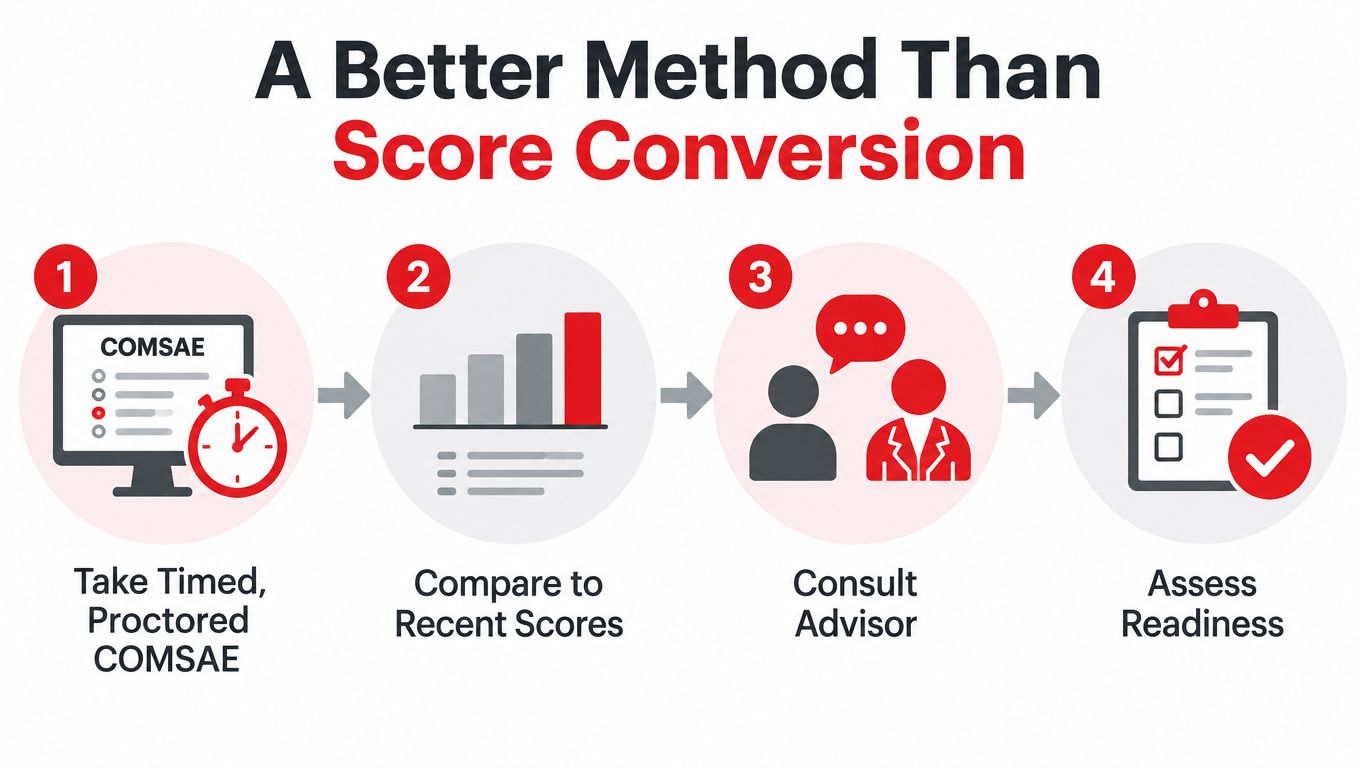
The four-step interpretation workflow
Take a timed, proctored COMSAE.
The closer the testing setup is to real exam conditions, the more useful the result becomes.Compare the score with recent question-bank performance.
A flat COMSAE with improving question-bank accuracy can mean the student is still trending upward.Add COMAT results and coursework performance.
Those markers help separate a temporary dip from a broader readiness issue.Judge the trend, not just the latest number.
One score is a snapshot. Several data points show direction.
These COMLEX practice-resource comparisons can help students think about what to pair with COMSAE, but the main principle stays the same, use more than one signal.
A simple worked example
A hypothetical DO student sees a mid-range COMSAE score, but the last two weeks of question-bank work show stronger accuracy and fewer repeat misses on similar topics. That student should not assume the COMSAE is “wrong.” The smarter reading is that the score may have captured a weaker test day, a pacing issue, or a gap that the question bank is starting to correct.
If that same student also has solid COMAT results and coursework performance, the combined picture may support keeping the exam date. If the trend is flat, the testing conditions were poor, and question-bank accuracy is still inconsistent, the same score should trigger a postponement conversation. The score didn't become less honest. It just stopped being the only thing that mattered.
Bottom line: readiness improves when the student looks at the whole pattern, not at one number in isolation.
COMLEX Readiness Checklist Before You Schedule
A readiness discussion works best when it asks for proof, not vibes. This checklist is meant for the conversation that happens before a test date gets booked, especially when the COMSAE result feels close but not fully convincing.
Assessment conditions
- Timed administration: Was the COMSAE completed under a clock, not casually paused and resumed?
- Proctored or realistic setting: Was the environment close to the pressure of a real exam day?
- Current exam phase: Does the form match the current COMLEX level being planned for?
- No unusual distractions: Was the result shaped by interruptions, fatigue, or a clearly off day?
Score evidence
- Recent COMSAE trend: Are the most recent scores stable or moving upward?
- Question-bank performance: Are missed topics shrinking, or are the same gaps repeating?
- COMAT alignment: Do clinical or subject exams support the same readiness story?
- Coursework consistency: Has class and rotation performance stayed aligned with the target?
Non-score factors
- Sleep and stamina: Is the student reliably functioning for long blocks without fading?
- Pacing under pressure: Does the student finish timed sets without rushing late questions?
- Anxiety management: Does stress reliably distort performance, or is it under control?
- Recovery time: Is there enough time left to convert a weak pattern into a stronger one?
School requirements
- Institutional threshold: Does the school use a current COMSAE cutoff?
- Eligibility policy: Has the student confirmed the program's rules for sitting the exam?
- Deadline pressure: Is the scheduled date realistic, or is it only driven by external timing?
- Adviser input: Has someone reviewed the broader academic picture, not just the score?
A postponement is not a failure if the pattern is still unstable. It is a strategy when the evidence says the student needs more time to turn mixed signals into consistent ones. Schools can set their own thresholds, so students should confirm the current requirement with their own institution rather than relying on old advice.
Study Moves That Actually Move Your Predicted Performance
The fastest way to improve a COMSAE story is not to chase a fake conversion. It is to improve the underlying pattern that the score is trying to measure. That starts with reviewing errors in a way that changes future decisions, not just reading explanations and moving on.
What to do next
Build an error log that groups misses by reason.
Separate knowledge gaps, misreads, and timing problems so the fix matches the cause.Use subscores carefully.
Focus on weak domains only when the pattern is stable, not when the domain has too few questions to be reliable.Train endurance with timed blocks.
Four-hour study sessions help, but the student should also practice sustaining attention across multiple blocks.Review question-bank trends weekly.
Look for repetition in incorrect answers, not just a raw percentage.Combine tutor feedback with official materials.
One-on-one help works best when it complements question banks and self-assessment, especially if the student has plateaued or anxiety is interfering with performance.
Active recall for medical students pairs naturally with this kind of review because it pushes students to retrieve, not just recognize.
When outside help makes the biggest difference
Tutoring tends to help most when the student already has data, but not a clear interpretation. That happens when scores stall, when repeated mistakes keep appearing in the same forms, or when the student understands the content but loses points because of pacing and test-day pressure. In those cases, the problem is often not raw intelligence. It is the way preparation is being organized.
FAQs
Should a COMSAE be retaken?
A retake makes sense when the first test was taken under weak conditions or when the student needs a newer trend line. Retesting just to hunt for a friendlier number is less useful than fixing the study pattern.
How do school thresholds work?
They vary. Some schools set internal cutoffs before allowing a student to sit for COMLEX, and those rules can change, so the current institutional policy matters more than old stories from other programs.
How soon before COMLEX should the final COMSAE be taken?
Close enough to reflect current readiness, but not so close that there's no time left to respond to the results. Many students benefit from using the final COMSAE as part of a last review window rather than as a last-minute surprise.
What if the COMSAE and question-bank results disagree?
Treat it as a signal to inspect the method. The mismatch may come from pacing, fatigue, content mix, or an improving trend that the self-assessment hasn't fully captured yet.
Does one low COMSAE score end the plan?
No. One score is a data point, not a verdict. The better response is to check the trend, adjust the study system, and decide whether more time will create a stronger outcome.
Ace Med Boards helps medical students make sense of COMSAE results, COMLEX readiness, and study plans that need more structure. If a score feels unclear or the trend isn't matching the effort, Ace Med Boards can help turn the data into a calmer, more actionable plan.