
You're staring at hundreds of overdue Anki cards, your question-bank performance isn't moving, and you're wondering whether the system has failed you. Anki and spaced repetition can support durable medical learning, but only when the cards test useful knowledge, the schedule remains sustainable, and you measure progress through applied performance rather than card counts.
For medical students preparing for USMLE, COMLEX-USA, Shelf exams, or related coursework, Anki is best treated as one part of a broader learning system. It helps preserve facts. It doesn't replace understanding, clinical reasoning, question review, or deliberate practice.
Why Anki and Spaced Repetition Work for Medical Board Prep
A student may recognize a diagnosis during review, then miss it in a question stem a week later. That gap explains why spaced repetition matters for board preparation. The method schedules retrieval across increasing intervals rather than concentrating review in one cramming session. Successful recall strengthens access to the answer, while difficulty signals that the card should return sooner.
Anki's history places it within a longer effort to turn memory research into a practical digital study system. Its developer identified 5 October 2006 as Anki's birthdate, and its traditional scheduling model traces back to the SM-2 algorithm, originally created for SuperMemo in the late 1980s. Anki's documented history and scheduling background
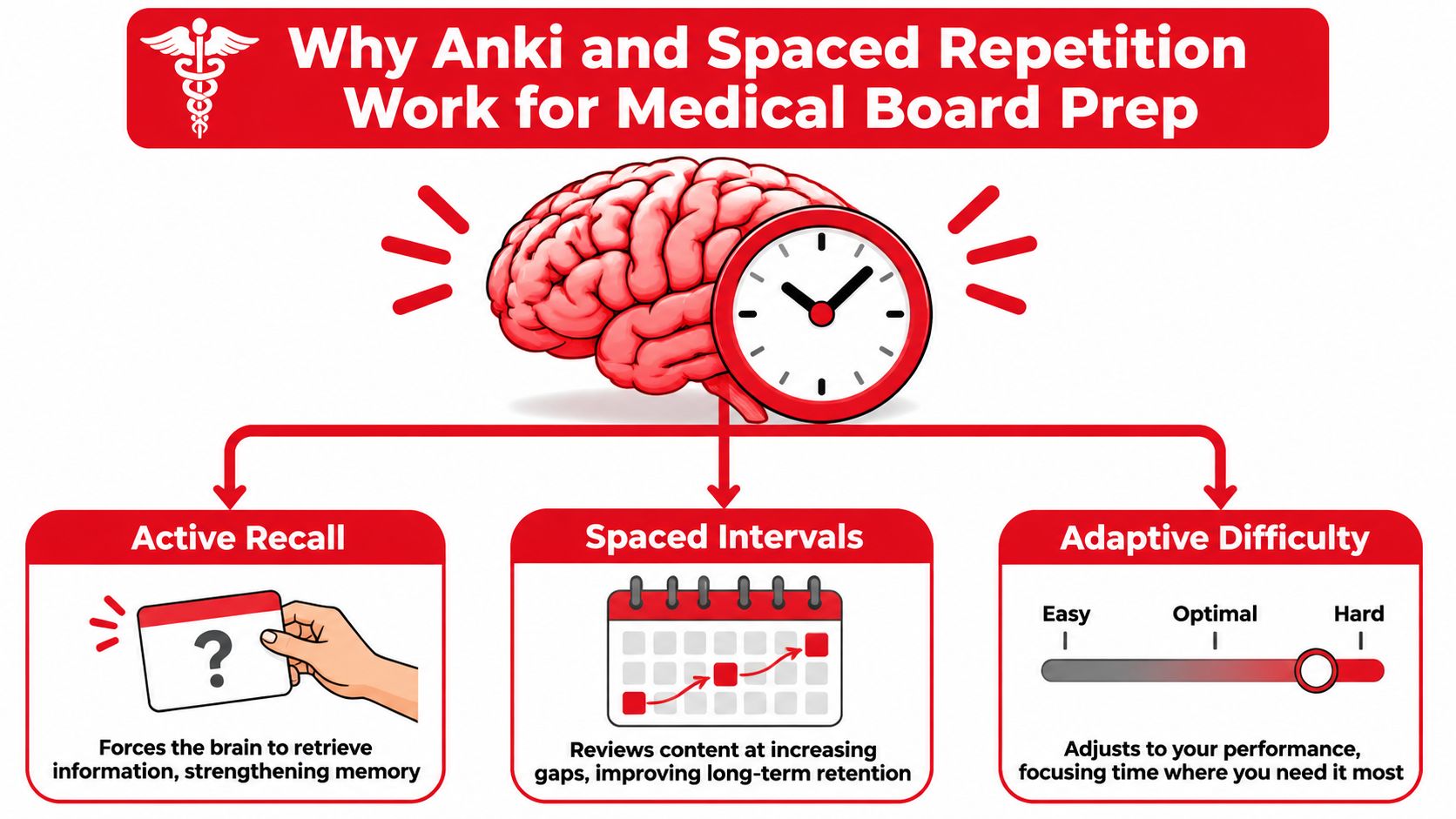
The memory process in plain language
You encounter a fact, begin to forget it, and then attempt to retrieve it before seeing the answer. That attempt does more for memory than rereading the same explanation, because it forces your brain to reconstruct the information.
The useful challenge is desirable difficulty. A card should require a specific answer, but not depend on obscure wording or uncontrolled guessing. This guide to active recall explains the retrieval process that makes this difficulty productive.
Two related ideas help clarify the schedule:
- Retrieval strength describes how accessible an answer feels at this moment.
- Storage strength describes how firmly the information has been established in memory.
A card may feel easy immediately after review because retrieval strength is high, while storage strength remains weak. Spacing the next attempt tests whether the memory survives after that temporary familiarity fades.
Anki's legacy SM-2 scheduler used an early pattern in which the first two successful reviews occurred at 1 day and then 6 days. Later intervals expanded according to the card's easiness factor and performance history. The official Anki algorithm FAQ describes this scheduling lineage and explains why your response affects the next interval.
What the evidence means for board preparation
A 2024 study of 26,258 family physicians or residents reported better learning with spaced repetition than with no spaced repetition at quarter 6, 58.03% versus 43.20%, and better knowledge transfer at quarter 10, 58.33% versus 52.39%. The reported effects were statistically significant, with P < .001, and the corresponding Cohen d values were 0.62 and 0.26. The PubMed study on spaced repetition and medical learning also reported better learning and transfer with double-spaced repetitions than with single-spaced repetitions, 62.24% versus 51.83% and 60.08% versus 55.72%.
These findings support a specific use of Anki. They do not justify unlimited card creation or treating a growing review count as progress. The relevant test is whether you can apply the fact in unfamiliar clinical contexts.
Practical rule: Anki schedules memory; it does not build the underlying concept for you.
Learn the material through a lecture, textbook, anatomy resource, or question explanation. Then write or select cards that require precise retrieval. Track the errors those cards address, and reassess them against question-bank and practice-exam performance. If recall improves but clinical questions do not, revise the explanation, card wording, or broader reasoning process rather than adding more cards.
Recommended Settings and Card Templates for High-Yield Facts
Anki settings should protect your future schedule. The most common mistake is adding new cards based on what feels manageable today, without considering the reviews those cards will create later.
The visual below gives a practical starting framework for a dedicated study period.
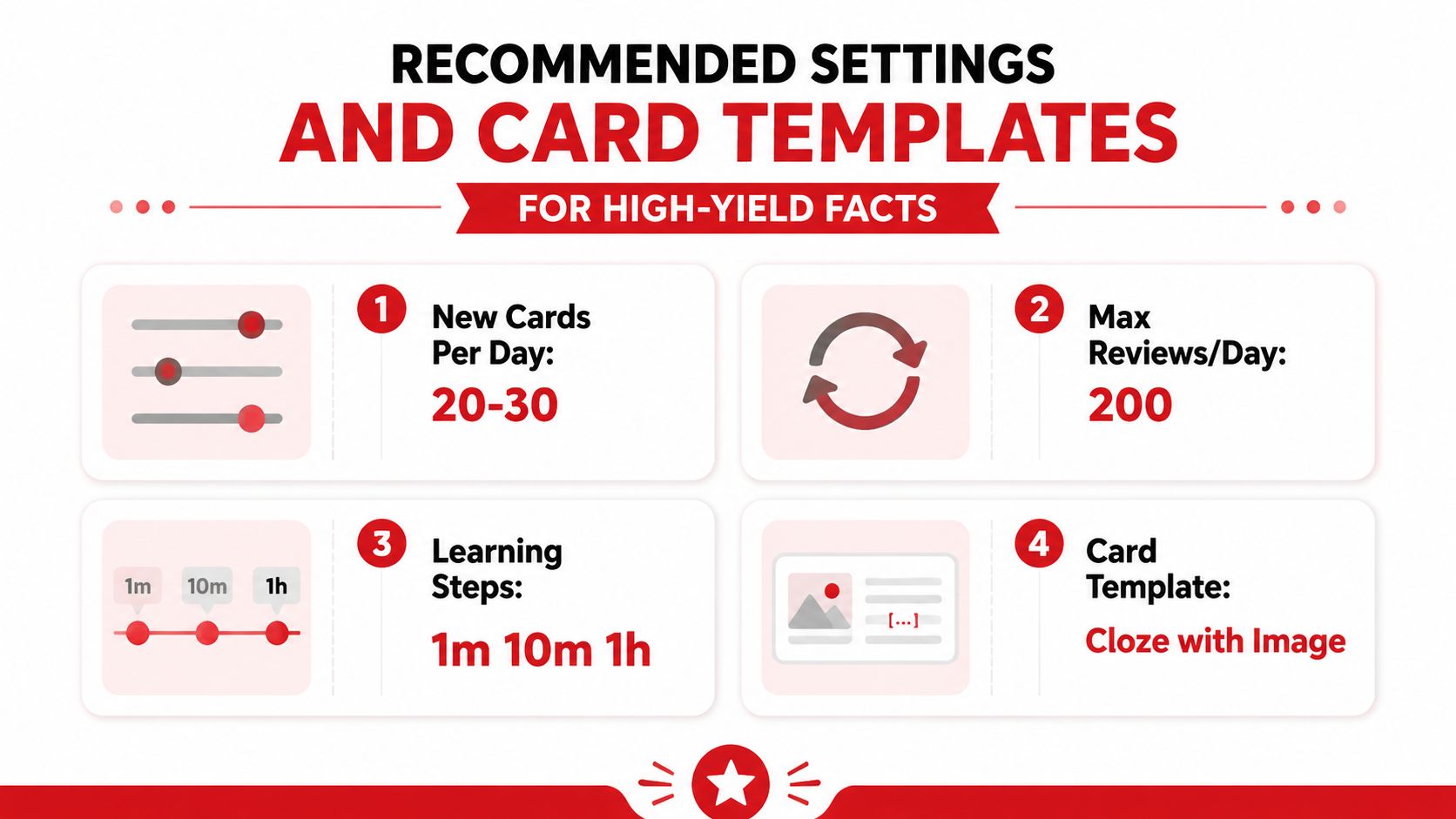
Settings that deserve attention
The provided starting values are 20 to 30 new cards per day, a maximum of 200 reviews per day, learning steps of 1 minute, 10 minutes, and 1 hour, and card templates that combine cloze text with an image when appropriate. Ace Med Boards' flashcard guidance can serve as a related starting resource, but you should still adjust the workload to your course demands and available time.
Think in terms of two study modes:
| Study phase | Sensible approach |
|---|---|
| Longitudinal coursework | Keep new cards modest and add material soon after you understand it. |
| Dedicated board preparation | Use a controlled daily intake, protect time for questions, and avoid adding cards faster than you can review them. |
The maximum reviews per day requires judgment. Raising it can hide the size of a backlog rather than solve the cause. If reviews repeatedly exceed your available time, reduce new cards, suspend low-yield material, and rebuild consistency.
Card design determines efficiency
A strong medical card asks for one meaningful retrieval. The answer should be specific enough that you can judge it as correct or incorrect without negotiating with yourself.
Useful formats include:
- Cloze deletion: Best for relationships such as drug mechanism, adverse effect, organism association, or diagnostic finding.
- Image occlusion: Useful for anatomy, histology, radiographic structures, and labeled pathways.
- Basic question and answer: Appropriate when the prompt naturally asks for one clear fact.
- Clinical comparison: Use separate cards for discriminating features rather than one overloaded differential table.
Original pharmacology example
Front: “Clonidine lowers blood pressure primarily by reducing {{c1::sympathetic outflow from the central nervous system}}.”
Back: “Central alpha-2 agonist effect, reduced sympathetic activity.”
This card tests a single relationship. It also leaves enough context for you to understand what the answer means.
Poor design
Front: “What are the mechanism, indications, contraindications, adverse effects, interactions, and monitoring requirements of clonidine?”
This card tests too much at once. You may remember part of the list and incorrectly mark the whole answer as correct. Split it into atomic prompts, then connect the cards through tags and your clinical reasoning practice.
Card-writing test: If you can't identify exactly what a correct answer must contain, the card is probably too broad.
Use tags for metadata such as source, organ system, difficulty, or exam relevance. Use subdecks sparingly for different review contexts. Excessive subdecks can fragment scheduling and encourage constant reorganization.
Deck and Tag Organization Strategies by Exam Type
A student preparing for a Shelf exam may need to isolate rotation-specific material today, then reconnect it with broader board knowledge later. Deck structure should support that decision, not copy the way a commercial resource is packaged.
| Approach | Best For | Pros | Cons |
|---|---|---|---|
| Master deck with tags | Longitudinal study and integrated USMLE preparation | Preserves mixed review and reduces reorganizing | Requires disciplined tagging and searching |
| Subject-based subdecks | Coursework and focused content review | Makes it easier to isolate anatomy, pharmacology, or pathology | Can encourage studying subjects in isolation |
| Exam-specific decks | Shelf, COMAT, or a short dedicated review | Helps target a defined assessment | Can duplicate cards and create maintenance work |
For USMLE Step 1 dedicated study, a master deck with consistent tags usually supports connections across organ systems. During clinical rotations, a subject or rotation-focused subdeck can make a narrow Shelf exam easier to target. For COMLEX Level 1, add tags for osteopathic principles and practice while keeping foundational biomedical cards connected to the broader deck.
A workable decision framework
Before creating another deck, ask:
- Will this material need review after the current exam?
- Does separation improve a daily study decision, or only make the sidebar look cleaner?
- Can a consistent tag help me find it later?
Students using a large pre-made deck, such as AnKing or Zanki, should not import every card automatically. Suspend cards outside the current curriculum, add class-specific cards only when they fill a documented gap, and search for duplicates before creating a new note. Treat the deck like a clinical supply cart: keep frequently used items accessible, but do not let storage choices replace patient care, or in this case, question practice.
A practical tag hierarchy might include:
source::lecturesource::question_banksystem::cardiovasculardifficulty::highexam::step1exam::comlex1status::rewrite
External knowledge management can store explanations, notes, and linked resources that do not belong in a flashcard. This overview of PKM systems for founders, described as the best PKM systems for founders, offers broader organizational context. Keep Anki's tags specific to retrieval and exam decisions.
Anki's statistics can show recent activity and longer-term history, but review counts do not establish readiness. Pair those views with missed-question patterns, topic accuracy, and practice-exam results. A progress tracker such as the Ace Med Boards progress-tracking dashboard can organize that broader review. Reassess the structure when cards are piling up, searches take too long, or exam performance fails to improve.
Daily Scheduling and Sample Workflows for Board Prep
Anki works best when it has a protected place in the day. It shouldn't consume every available hour, and it shouldn't be postponed until the evening when fatigue makes careful retrieval difficult.
For a USMLE Step 1 dedicated period, a practical day might look like this:
| Time | Activity | Purpose |
|---|---|---|
| Morning | Due Anki reviews | Clear scheduled retrieval while attention is fresh |
| Midmorning | Question-bank block | Practice application and identify gaps |
| Afternoon | Content review and new cards | Learn the concept, then encode only useful prompts |
| Evening | Missed-question cards and selected reviews | Repair errors without starting an uncontrolled second session |
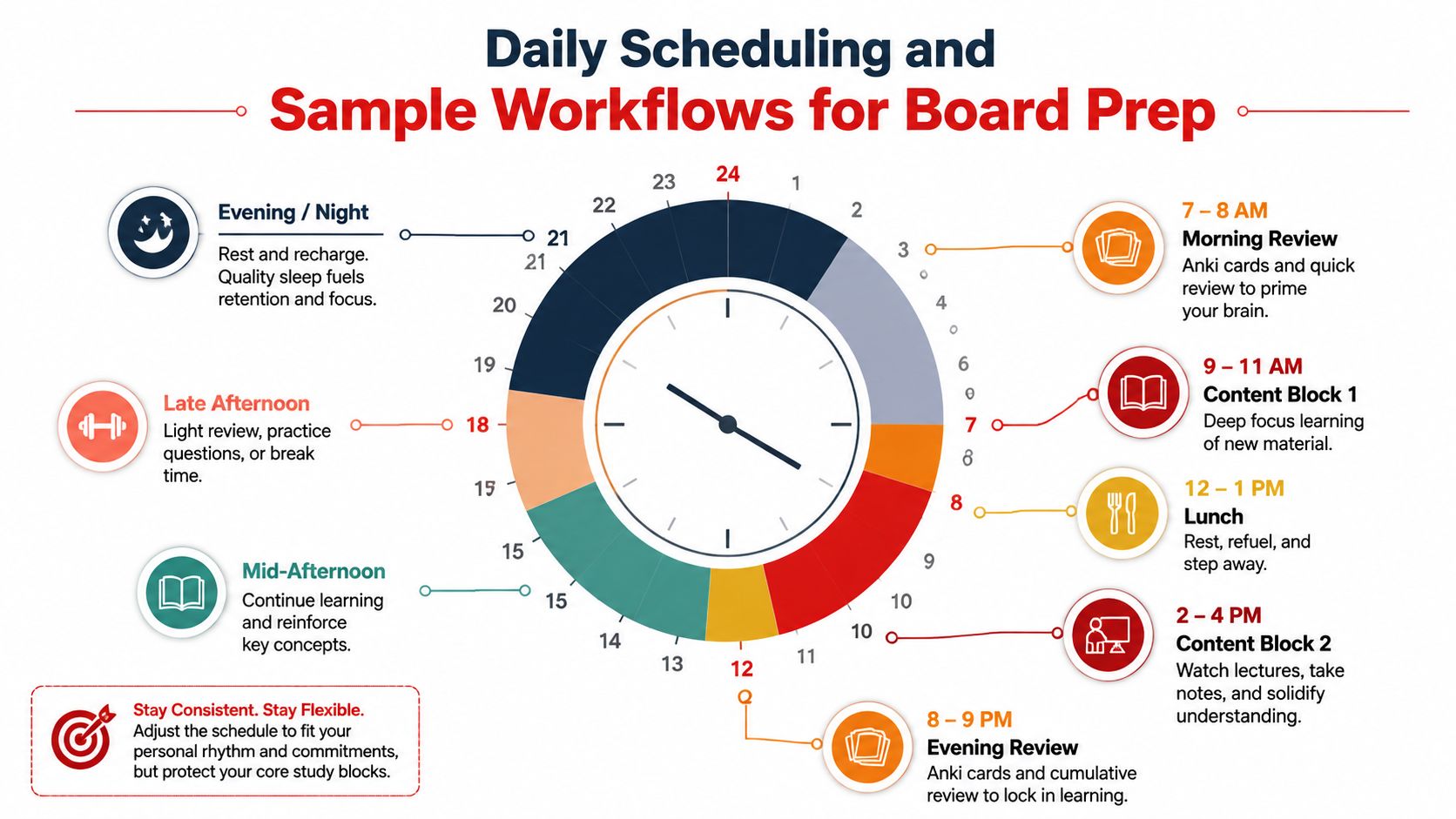
A weekly rhythm should include question-bank review, targeted content correction, and periodic practice exams. Keep new-card volume stable during the week rather than adding a large batch after a difficult day. The study schedule guide for medical students can help you think through how Anki fits alongside broader study blocks.
A sample weekly rhythm
- Monday through Thursday: Complete due reviews, work through questions, and add cards only for recurring or consequential gaps.
- Friday: Review error tags, suspend weak cards, and rewrite prompts that produce repeated confusion.
- Saturday: Use a longer mixed question session and review the related cards afterward.
- Sunday: Complete essential due cards, plan the coming week, and protect recovery time.
The exact number of cards depends on your schedule, baseline knowledge, and exam timeline. The safe principle is simple: new cards must remain low enough that future reviews stay sustainable.
When you fall behind
Don't respond to a backlog by adding more new cards or pressing through every low-yield review. Triage in this order:
- Protect cards tied to missed questions, core mechanisms, and frequently tested distinctions.
- Suspend duplicates, trivia, and cards you can't explain conceptually.
- Reduce new cards until the review load becomes realistic.
- Resume normal growth only after you've restored a consistent routine.
The goal isn't a perfect streak. The goal is a repeatable cycle of retrieval, feedback, correction, and reassessment.
The following video can provide a visual complement to the scheduling ideas above.
Common Mistakes and an Error-Tracking Checklist
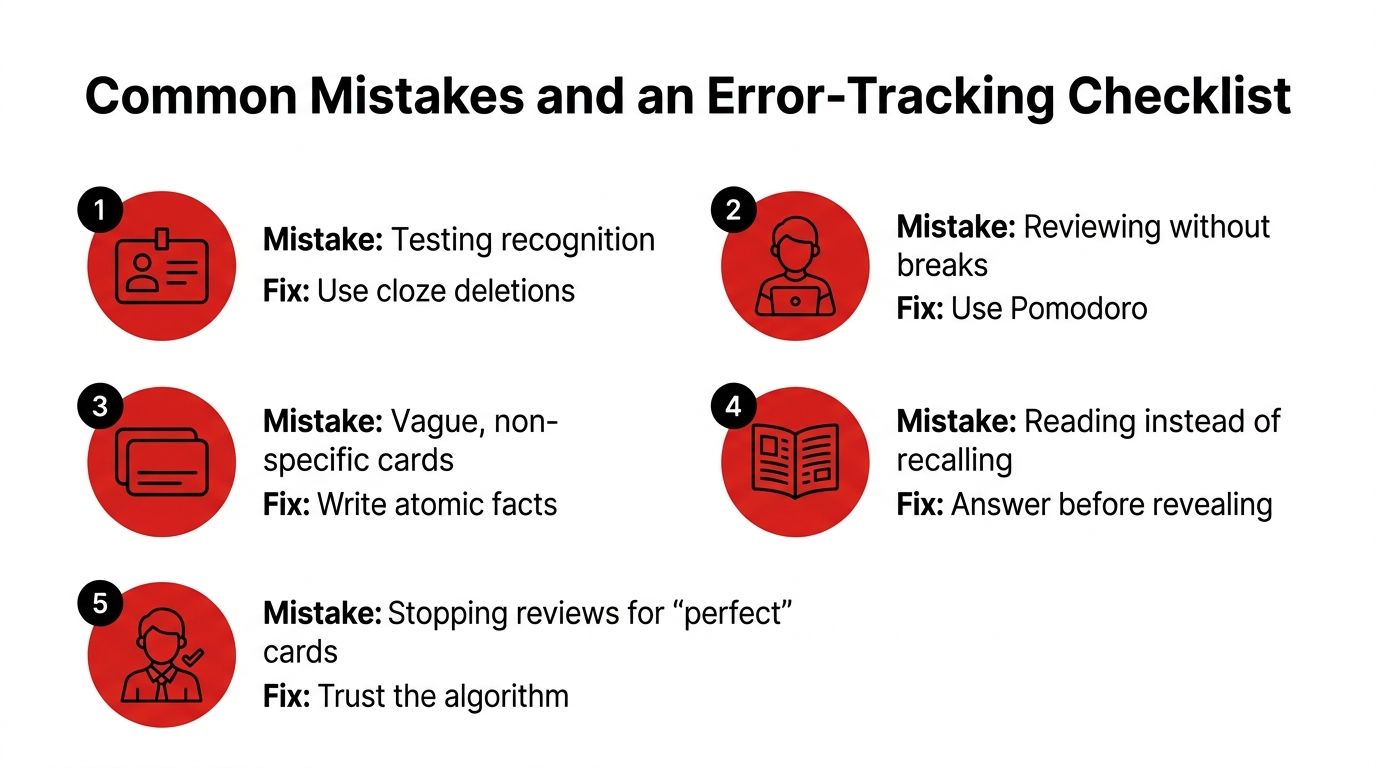
Anki can make inefficient studying feel productive. You may complete a large review session while testing recognition, ignoring repeated lapses, or memorizing isolated facts that never help you answer a clinical question.
Five patterns to stop
- Testing recognition: A card with the answer visible in the prompt can create familiarity without recall. Hide the key phrase and answer before revealing it.
- Reviewing without understanding: Memorizing a mechanism you can't explain makes later application fragile. Read the explanation first, then write a focused card.
- Ignoring repeated lapses: A card that repeatedly fails may be poorly written, poorly learned, or low yield. Rewrite it, split it, suspend it, or delete it.
- Treating streaks as mastery: A long review streak measures attendance, not clinical transfer. Compare Anki performance with question-bank and practice-test results.
- Keeping every card: More cards increase maintenance. Delete or suspend material that adds little value to your exam decisions.
A cohort study of medical students found that Anki users scored higher across four major exams by 6.2% to 12.9% compared with non-users, including a 12.9% gain on the CBSE with P = 0.003. The same study found little correlation between Anki-specific statistical markers and exam performance, which means card volume alone isn't a reliable proxy for mastery. The medical student cohort study supports tracking outcomes rather than celebrating review counts.
Weekly error-tracking checklist
Use this during a weekly audit:
- Review lapses: Identify cards that repeatedly fail and ask whether the wording, scope, or underlying concept is the problem.
- Flag persistent failures: Cards with more than three lapses deserve rewriting, splitting, deletion, or suspension.
- Check workload: Determine whether your new-card intake is producing a review burden you can sustain.
- Compare applications: Check whether Anki accuracy is accompanied by stronger question-bank performance.
- Inspect error types: Separate factual forgetting from misreading, poor reasoning, timing, and distractor errors.
- Reassess priority: Remove cards that don't support your current exam objectives.
- Plan repair: Assign a specific action for each problem card rather than merely marking it difficult.
For learners who need a structured way to examine why an answer choice was attractive, distractor analysis for medical questions can complement card review. Anki should preserve the corrected fact, while question analysis should explain why the competing options were wrong.
Advanced Tips for Challenging Topics and Long-Term Retention
A student may recall every cardiovascular card yet miss a murmur question. The problem is often card design: isolated associations do not rehearse the integration required by an exam.
Difficult topics need retrieval plus application. For pediatric dosing, write separate prompts for the formula, unit conversion, and safety check, then solve unfamiliar problems without viewing the answer. For electrocardiogram interpretation, use image occlusion for measurable features and add prompts requiring rhythm classification and the next reasoning step. For biostatistics, test what a formula means, when to use it, and how changing a variable changes the result.
Interval adjustments without micromanagement
Use shorter learning steps when a concept repeatedly fails during its initial learning phase. Avoid forcing every difficult card into constant review. First identify the cause: unclear content, a weak prompt, an overloaded answer, or too little application practice.
Custom study and filtered decks can support targeted repair before a Shelf exam or practice test. Review the selected cards, address the underlying weakness, and then return them to the normal schedule. Image Occlusion can support anatomy study, AnkiConnect can connect Anki with external tools, and Review Heatmap can make consistency visible. Add-ons should reduce friction, not become a separate productivity hobby.
A useful boundary: If an add-on changes how you organize time but does not improve recall or review decisions, it may not deserve a permanent place in your workflow.
Reassess every four to six weeks
At regular intervals, compare Anki retention patterns with question-bank performance. If both improve, continue. If Anki accuracy is high while UWorld or COMQUEST performance remains stagnant, examine the gap between recognition and application.
Composite hypothetical example, not a real student: A student reviewing cardiovascular cards reports excellent recall but continues missing questions involving murmur interpretation. During reassessment, the student finds that the cards test isolated associations, while the questions require integrating timing, location, radiation, and maneuvers. The student keeps the highest-yield fact cards, adds comparison prompts, practices new ECG and murmur examples, and later retests the same reasoning skill.
The example is fictional, and results vary. Its value is the reassessment process: change the workflow according to exam-style evidence instead of treating a high card accuracy percentage as proof of readiness.
A meta-analysis involving 21,415 learners reported a strong overall benefit for spaced repetition in medical education, with SMD 0.78. A 2026 systematic review also associated Anki use with better performance while emphasizing that benefits can be dose-dependent and inconsistent across studies. The systematic review and related medical education evidence supports a conditional conclusion: judge how much Anki you use, which content it covers, and how well it fits the rest of your study workflow.
Frequently Asked Questions About Anki for Medical Exams
Should I use a pre-made deck or create my own?
Use a pre-made deck to cover common foundational material, but customize it with focused cards from your lectures, missed questions, and recurring weaknesses. Don't keep every card merely because it came from a popular deck.
How can I use Anki during clinical rotations?
Reduce new cards and protect a small, consistent review window. Add cards from meaningful patient-care learning and missed Shelf-style questions, but don't let flashcards replace clinical responsibilities or question review.
Is Anki enough for board preparation?
No. Anki supports factual retention, while question banks and practice exams test interpretation, integration, timing, and application. Use each tool for its distinct function.
How early should I begin?
Earlier adoption can make the workload more manageable because learning is distributed over time. Research in first-year medical students found that higher-scoring students studied more total flashcards and began using Anki earlier in the year, although that association doesn't establish that Anki alone caused stronger performance. The first-year medical student study
Anki and spaced repetition are powerful when used deliberately. Keep the cards focused, protect a sustainable schedule, and judge progress by durable understanding and exam application rather than completion metrics.
Ace Med Boards offers personalized tutoring for USMLE, COMLEX-USA, and selected medical-school exams, including guidance on integrating Anki with question-bank review and broader board-preparation planning. If your flashcard routine feels disconnected from your practice performance, visit Ace Med Boards to learn about a free consultation or Board Score Audit.