

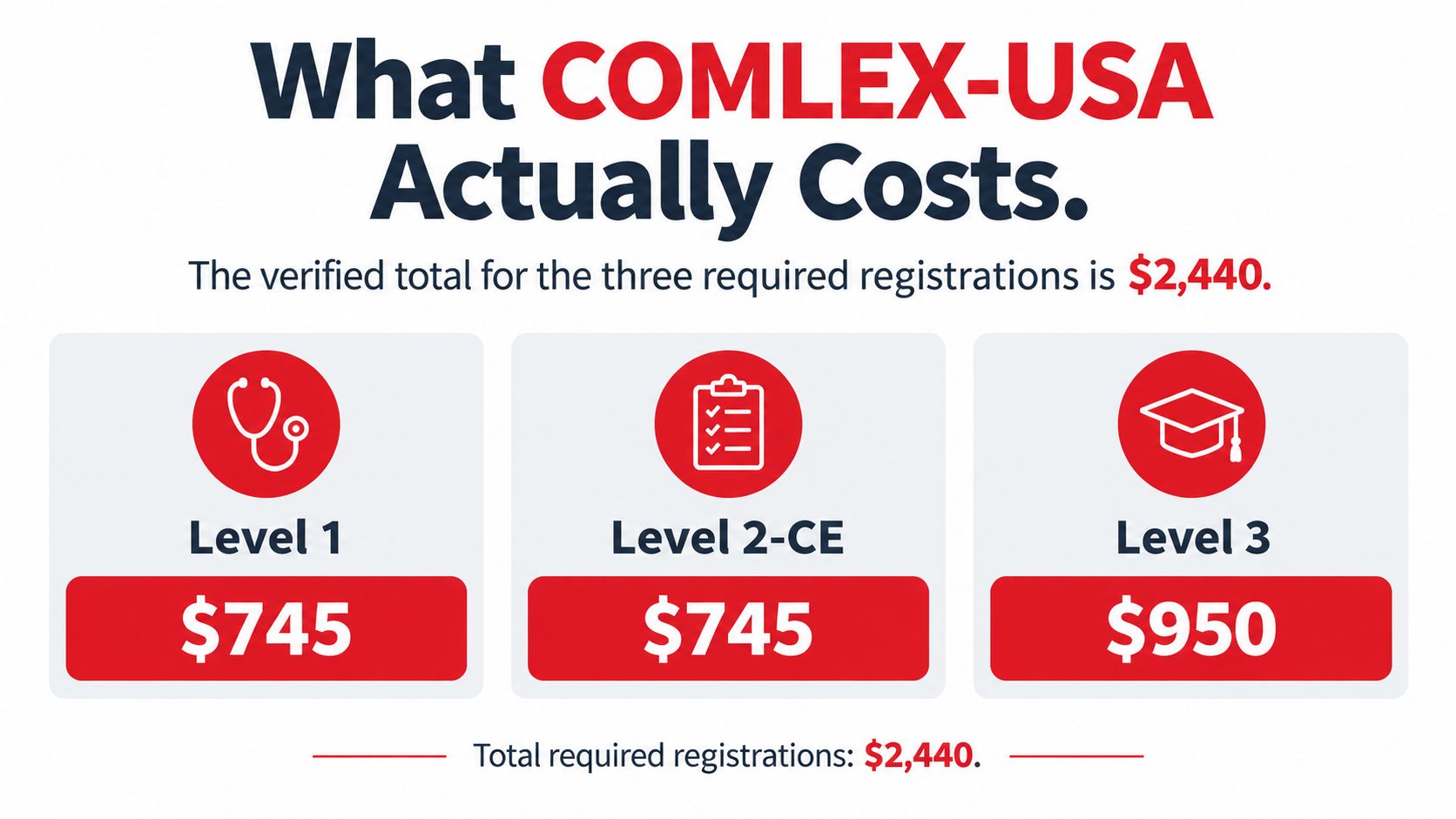
The three required COMLEX-USA registrations total $2,440: $745 for Level 1, $745 for Level 2-CE, and $950 for Level 3, before preparation materials, travel, lodging, score reports, or rescheduling costs. These fees are time-sensitive and should be verified with NBOME before payment.
For a Doctor of Osteopathic Medicine (DO) student, that registration total is a starting point, not a complete board-exam budget. A useful COMLEX cost plan separates required examination payments from conditional administrative charges, preparation choices, and school-specific expenses.
Byline: Ace Med Boards Editorial Team
What COMLEX-USA Actually Costs
The Osteopathic Medical Licensing Examination of the United States (COMLEX-USA) budget has distinct categories. The National Board of Osteopathic Medical Examiners (NBOME) collects examination and administrative fees. Preparation providers, transportation companies, hotels, and institutions may account for separate expenses.
Fee-status note as of publication: The amounts below reflect NBOME's published fee information supplied for this article, not a live checkout verification. The current NBOME fee schedule and applicable bulletin should control any payment decision.
Separate the required payment from the spending decision
The registration charge is a required examination expense for an eligible candidate proceeding through that level. A question-bank subscription, review course, or tutoring arrangement belongs in a different category. None should be presented as part of the official registration fee.
A practical worksheet separates spending this way:
- Required registrations: Examination fees, organized by level and expected payment date.
- Conditional administrative costs: Documentation or score services needed for a particular purpose.
- Preparation spending: Resources selected to address an identified learning need.
- Logistical and institutional costs: Transportation, lodging, and any applicable school charges.
- Contingency spending: Appointment changes or other expenses that might arise.
That distinction helps students compare preparation options without confusing a provider's price with an NBOME charge. A student evaluating a COMLEX Level 1 preparation course should record its current price separately and check whether existing school resources already cover the same need.
Plan cash flow as well as total cost
A budget can look manageable overall while still creating difficulty when payment comes due. Each expense needs an anticipated payment date, a funding source, and a status such as planned, purchased, or reimbursed.
Budgeting principle: A required registration fee and an optional preparation purchase shouldn't occupy the same worksheet line.
Money already paid should also remain separate from money reserved for later. Otherwise, a student may accidentally treat an examination registration as still available for travel or study materials.
Level by Level Fee Breakdown
Level 3 has the largest individual registration charge, so dividing the overall examination budget evenly across levels would underfund that later payment. The fee distribution below comes from the NBOME examination and administrative fee schedule.
COMLEX-USA Registration Fees by Level
| Level | Registration Fee | Share of Total | Eligibility Prerequisite |
|---|---|---|---|
| Level 1 | $745 | About 30.5% | Completion of the first year at an accredited osteopathic medical school, plus the required dean's attestation |
| Level 2-CE | $745 | About 30.5% | Passing Level 1 and completion of the second year |
| Level 3 | $950 | About 38.9% | Passing Levels 1 and 2-CE, graduation, and required standing and clinical-skills attestations |
The prerequisite summaries follow NBOME's COMLEX-USA eligibility requirements. Eligibility must be checked against the candidate's circumstances and applicable examination cycle rather than inferred from the fee table alone.
Match payment dates to eligibility gates
Candidates must take the examinations in sequence and pass each level before becoming eligible for the next, under the eligibility rules cited above. A student's savings schedule can anticipate later expenses, but the examination calendar must still respect those requirements.
The graduation prerequisite is especially relevant to Level 3 planning. Its registration shouldn't automatically be assigned to a pregraduation residency-application budget. A student can reserve money earlier while placing the actual payment in the period when eligibility will be established.
The same eligibility policy limits candidates to four scored attempts at each level and prohibits more than four attempts within a 12-month period, counting incomplete or voided attempts. An unsuccessful attempt therefore calls for an academic and scheduling review, not another payment.
- Before reserving funds: Identify the level and likely eligibility period.
- Before registering: Confirm required school or program attestations.
- After a setback: Review the applicable attempt rules and remediation plan with an academic advisor.
A broader COMLEX-USA overview can help students place each examination within the sequence. The official eligibility policy remains the authority for registration decisions.
Administrative Fees Most Students Forget
Administrative services belong in the budget, but not every student needs every service. Treating all listed fees as automatic charges overstates the baseline; ignoring them entirely leaves predictable requests unfunded.
Under the NBOME fee schedule cited earlier, the relevant charges are:
| Service | Listed Fee | Budget Treatment |
|---|---|---|
| Score confirmation | $75 | Conditional, based on whether a confirmation is requested |
| Transcript | $65 | Include when an official transcript is needed |
| Score report | $5 | Include when the applicable score-report service is needed |
Distinguish confirmation from another attempt
A score confirmation concerns an existing examination result. NBOME permits one confirmation request per examination; it doesn't create another attempt or allow a passed examination to be retaken to improve the score, according to NBOME's examination-score policies.
Those policies also distinguish the reporting systems: Level 1 reports pass/fail, while the passing standard scores are 400 for Level 2-CE and 350 for Level 3. These are standard scores, not percentages answered correctly.
That distinction matters when a disappointing result prompts a spending decision. A confirmation request and additional preparation serve different purposes. Neither should be purchased on the assumption that it guarantees a changed outcome.
A disappointing score can justify a careful review without making every available administrative purchase necessary.
Order documentation for a defined purpose
A transcript and a score report shouldn't be assumed to be interchangeable. Before ordering either, the student should confirm what the receiving school, program, or other organization requires.
A useful documentation check includes:
- Document type: Confirm whether an official transcript or another report is requested.
- Recipient: Identify the correct destination before submitting the order.
- Timing: Check whether the needed examination result is available.
- Payment responsibility: Ask whether the student, school, or program covers the charge.
These are conditional expenses, not necessarily avoidable mistakes. The budget should include them when needed, while leaving unused services unpurchased. Current prices and ordering instructions should be reconfirmed before payment.
Rescheduling Penalties and How They Escalate
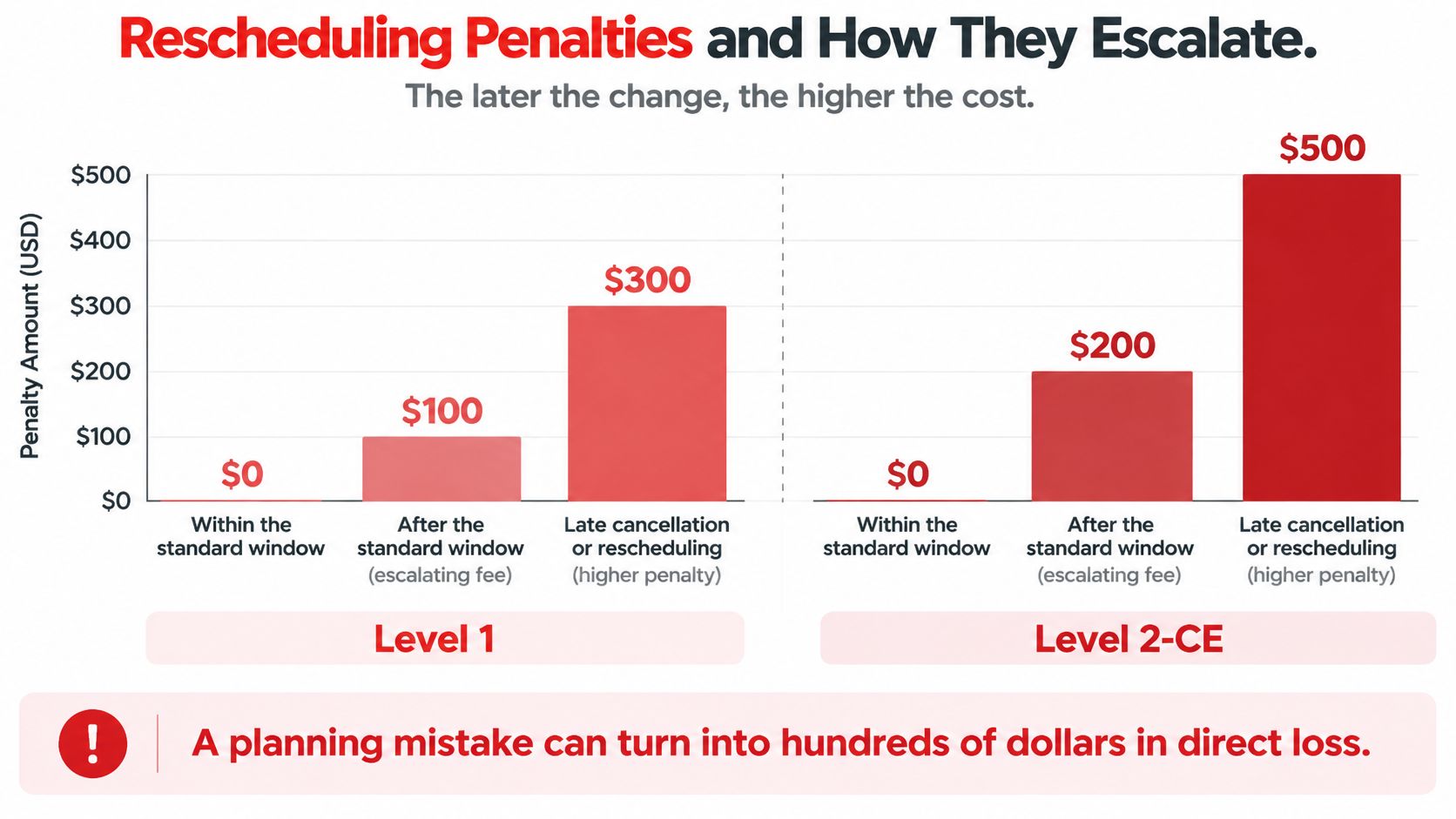
The financial consequence of changing an appointment depends heavily on when the change occurs. A student who recognizes a problem early has more room to adjust without adding an administrative loss.
The following tiers follow NBOME's registration and scheduling policy. Charges are assessed per examination day, so the applicable administration must be checked before calculating the full consequence.
| Timing | Level 1 or Level 2-CE | Level 3 |
|---|---|---|
| More than 30 days before the appointment | $0 | $0 |
| 6–30 days before the appointment | $85 | $170 |
| 1–5 days before the appointment | $250 | $350 |
| No-show | $400 | $500 |
Build an early decision point
The most useful planning deadline comes before the free-change window closes, not immediately before examination day. An early review gives the student time to consider performance, academic requirements, travel arrangements, and available alternatives together.
A readiness threshold should be defined with the school or academic advisor. It can consider timed, mixed-topic practice performance, pacing, recurring content gaps, and the ability to explain missed questions. A commercial question-bank percentage shouldn't be treated as a universal passing guarantee.
The scheduling protocol can remain simple:
- Define readiness before booking: Establish what evidence would support keeping the appointment.
- Set an early review reminder: Leave room to act before a paid-change tier begins.
- Keep a contingency buffer: Allow for academic obligations, illness, or disrupted preparation.
- Confirm the completed change: Retain the updated appointment record and any payment receipt.
The COMLEX rescheduling guide can support planning, but NBOME's current policy governs the actual charge.
Handle unavoidable disruptions without blame
Some changes arise from circumstances outside a candidate's control. Under the scheduling policy cited above, NBOME may waive some or all of a fee when documented circumstances qualify and a written request is submitted within 30 days after the scheduled or missed administration.
A waiver isn't automatic, so supporting documentation and timely contact matter. An early-change strategy reduces financial exposure, but it shouldn't pressure an unready student to sit merely because money has already been spent.
Scheduling safeguard: The cheapest administrative choice isn't always the appropriate academic choice.
How COMLEX Costs Compare with USMLE
A responsible comparison can't declare either examination sequence cheaper without current, verified fees for both. This budget establishes COMLEX-USA charges; it doesn't supply verified United States Medical Licensing Examination (USMLE) prices.
For a DO student considering an additional examination, the useful question is therefore narrower: What additional expense would that decision create, and what purpose would it serve? The comparison should support an individual academic plan rather than imply that the examinations are interchangeable purchases.
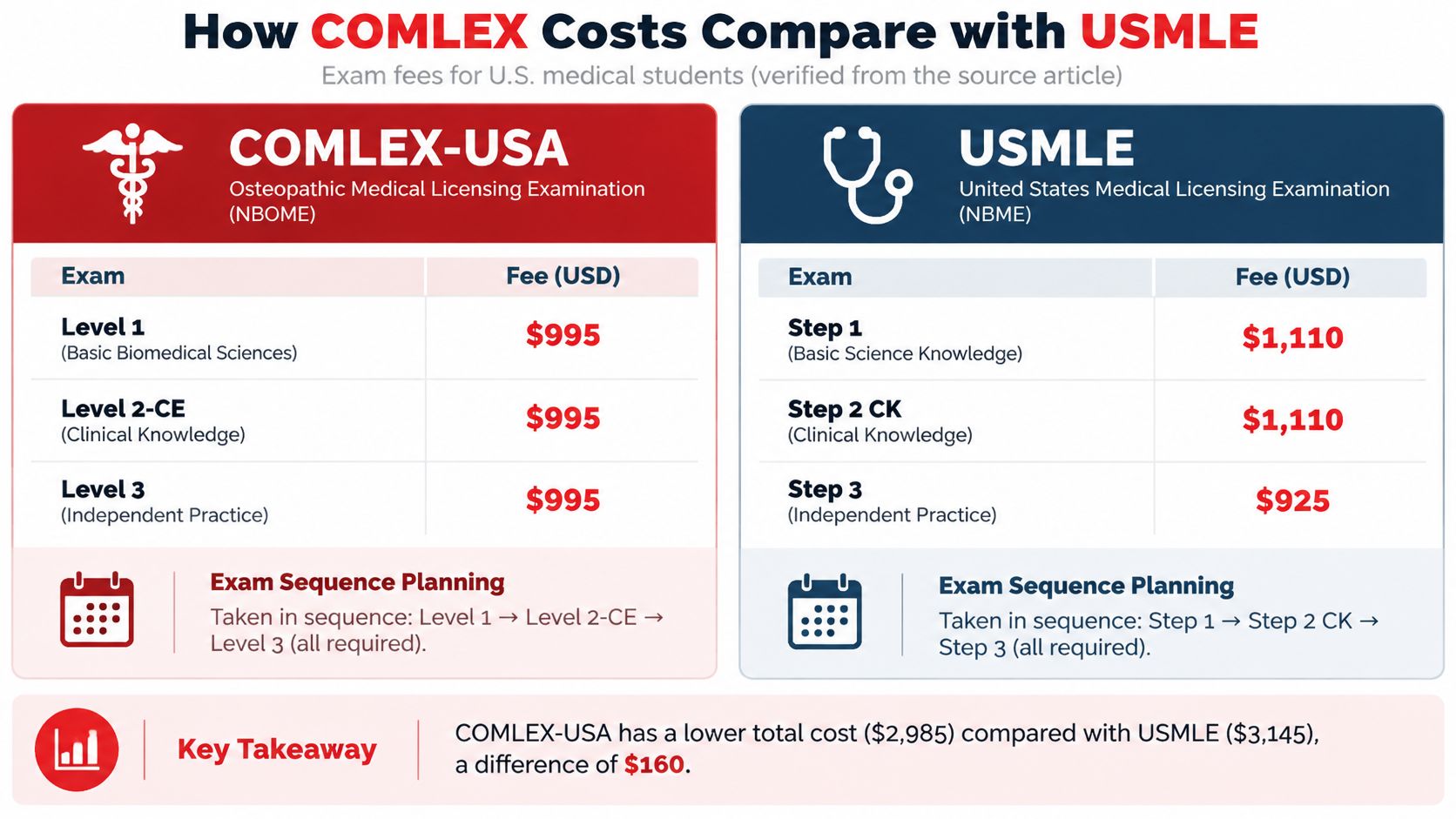
Compare categories without inventing a price difference
| Budget Question | COMLEX-USA Worksheet | Additional USMLE Worksheet |
|---|---|---|
| Registration | Use the level-specific fees established above | Enter the current, independently verified fee |
| Appointment changes | Apply the relevant NBOME policy | Verify the applicable policy separately |
| Documentation | Include only the services needed | Confirm any separate documentation expense |
| Preparation | Identify existing resources and remaining gaps | Assess additional resource needs before purchasing |
| Travel | Use the actual appointment location | Check whether another appointment adds travel |
Any figure shown in a comparison graphic should be checked against the responsible examination organization before payment. A graphic isn't a substitute for the current fee schedule.
Avoid paying twice for the same planning assumption
Separate examination registrations should have separate worksheet entries. Preparation spending needs a more careful review: an existing resource may remain useful, but that doesn't establish that it fully addresses another examination's requirements.
The student should list resources already owned, identify the specific additional need, and obtain a current price before buying anything else. This is more informative than automatically duplicating the entire preparation budget.
A discussion with the school's academic or career advisor can clarify whether an additional examination fits the student's goals. No general cost article can settle that decision for every DO student.
For related planning, the USMLE Step 1 cost guide offers a separate place to examine that budget. Its figures should still be checked at the responsible primary source, and its expenses shouldn't be folded into the required COMLEX registration total.
Building Your COMLEX Budget Template
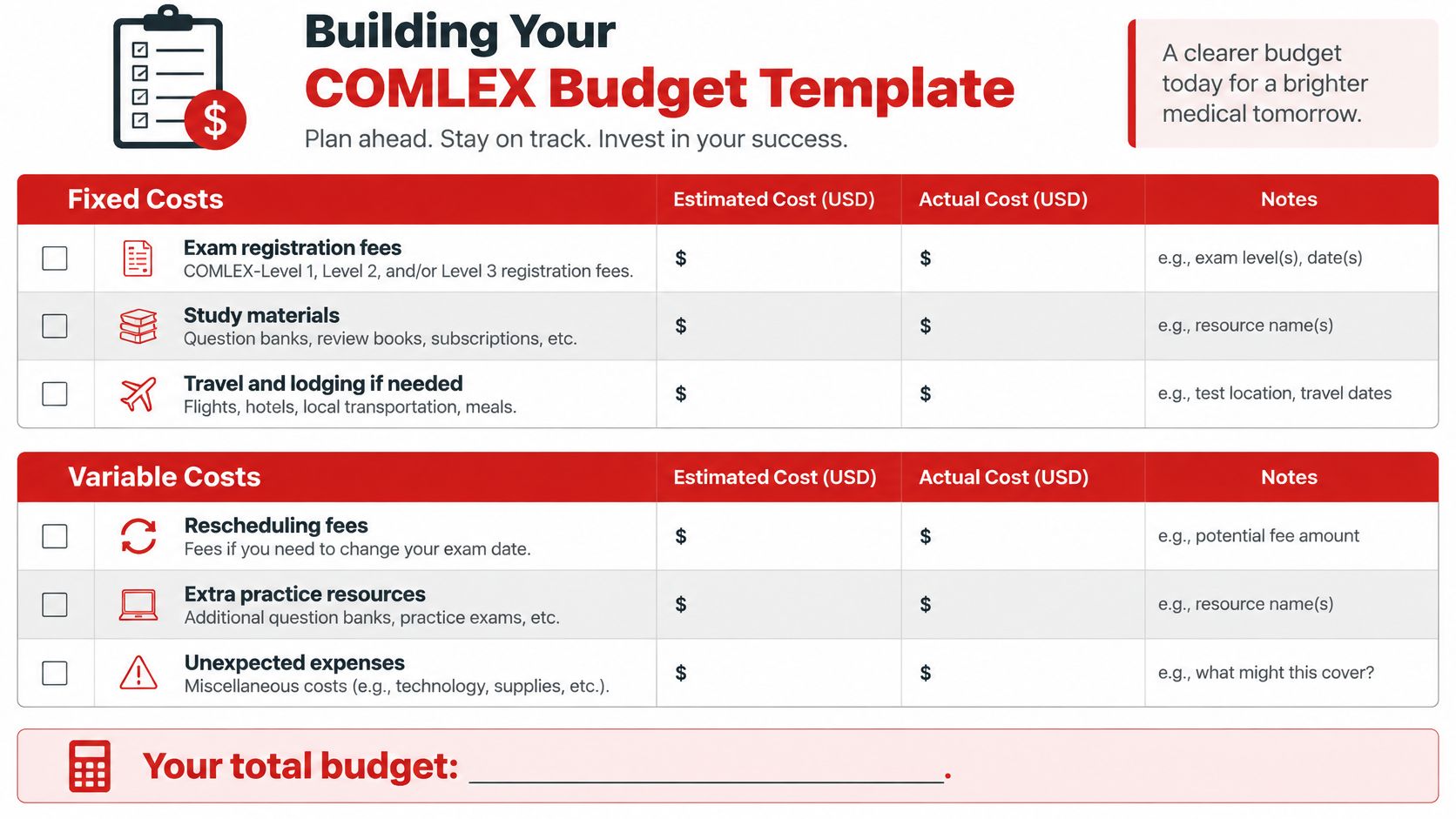
A useful COMLEX budget shows what must be paid, what may be paid, and when funds are needed. It also separates the listed price from the amount you will owe after confirmed institutional coverage. Each line works like a labeled envelope: you can see which costs are fixed, which depend on a decision, and which still need a price.
A budget template for Excel offers a starting format for tracking expenses. Add the examination-specific categories below, since a general budget template does not establish NBOME fees or policies.
Fill-in worksheet
Use separate lines for required fees, conditional administrative charges, optional services, preparation, travel, and institutional expenses. Study materials and travel can become committed costs once purchased or booked, but they are not universal NBOME fees.
| Category | Expense | Amount | Payment Date or Trigger | Coverage Confirmed |
|---|---|---|---|---|
| Required | Level 1 registration | Enter listed fee | ______ | ______ |
| Required | Level 2-CE registration | Enter listed fee | ______ | ______ |
| Required | Level 3 registration | Enter listed fee | ______ | ______ |
| Conditional | Transcript or score report | ______ | Documentation needed | ______ |
| Optional | Score confirmation | ______ | Request decision | ______ |
| Preparation | Question bank and assessments | ______ | Purchase or renewal | ______ |
| Preparation | Review course or tutoring | ______ | Current written quote | ______ |
| Logistics | Transportation and lodging | ______ | Appointment confirmed | ______ |
| Institutional | Applicable school charges | ______ | School confirmation | ______ |
| Contingency | Appointment change | ______ | Applicable policy tier | ______ |
| Total | Remaining personal obligation | ______ | ______ | ______ |
Leave school charges and coverage blank until you have confirmation. Institutions may handle expenses differently, so verify whether a cost applies and whether any support is available before counting on it.
Compare planning choices without inventing a case study
Use a hypothetical worksheet to see how choices affect the total. If a Level 1 candidate changes an appointment in the late-change tier and requests score confirmation, the budget should include both listed charges in addition to registration and any other actual expenses.
If the candidate changes within the free window and does not request confirmation, those conditional lines remain unused. This comparison shows why timing and administrative services belong on separate lines. It does not mean delaying an exam is always the better choice.
Before registering, review these planning points:
- Readiness evidence: Discuss timed practice, pacing, and unresolved learning gaps with an advisor.
- Calendar fit: Check academic obligations and set an early date to review the appointment.
- Resource inventory: Identify school-provided materials before paying for overlapping products.
- Written prices: Record current preparation quotes separately from examination fees.
- Available funds: Confirm what is due at checkout, not only the worksheet total.
The education investment information can help frame a separate decision about preparation spending. Individual COMLEX tutoring is one optional support to compare with independent study, school guidance, and practice resources.
Key Takeaways and Next Steps
A COMLEX budget is easier to manage when each line has a clear role: required exam fees form the baseline, optional services are choices, and schedule changes are contingencies. Keeping those categories separate shows where money is committed and where planning can reduce avoidable costs.
Use these decision rules:
- Treat registration as the floor: Examination fees do not cover every preparation or attendance expense.
- Review the appointment early: Discuss readiness before a change could trigger a scheduling charge.
- Use administrative services with a purpose: Add documentation or score confirmation only when it meets a specific need.
- Separate preparation spending: Tutoring and courses are not NBOME examination fees.
- Confirm institutional details: Ask your school about charges, coverage, and academic requirements.
Turn the worksheet into a payment plan
Fill in the worksheet with current fees and actual preparation quotes. For each expense, record who is responsible, when payment is due, and whether school or other coverage has been confirmed. This turns a list of possible costs into a plan you can check against available funds.
Then compare the plan with your academic calendar. If practice results raise concerns, discuss readiness and study support before changing an appointment. If an unexpected delay occurs, update the budget and review which charges may apply. A revised timeline is a planning adjustment, not a judgment about ability.
Additional structure may help when it addresses a specific learning or study-planning need. Students considering COMLEX tutoring can compare that option with independent study and school-based support, then decide whether the current quoted price fits their budget.
Sources
The primary references for this budget are NBOME's Frequently Asked Questions, Registration and Scheduling policy, Eligibility requirements, and Examination Scores policy, linked beside relevant information above. Confirm current examination rules and fees with NBOME before registering.
Keep cost planning alongside content review and readiness assessment. Students can prepare carefully, seek support when needed, and adjust their timeline without treating an unplanned expense as a personal failure.
Ace Med Boards offers personalized COMLEX tutoring as an optional complement to independent study and school-based support. Students considering the expense can visit Ace Med Boards to schedule a free consultation and discuss preparation needs before adding tutoring to the budget.