

A winning study schedule for medical students isn't a magic template you download online. It's a personalized system you build from the ground up, one that respects the workload of med school while fitting your unique life. It means ditching generic planners and embracing high-yield, active learning from day one.
Why Generic Study Templates Fall Short in Med School
Many students find they can waste weeks on passive reading and re-highlighting notes without being able to retrieve information under pressure. The calendar isn't always the problem; what fills it matters just as much.
How I Picked These Strategies
These filters reflect how the strategies in this article were selected and are presented as editorial criteria, not as a controlled study. Each strategy should meet three standards:
- It has to be active. If a method relies only on re-reading, re-watching, or highlighting, it may leave too little room for retrieval practice.
- It has to fit a sustainable study day. Plans demanding marathon days can be difficult to maintain. Sustainability matters more than intensity.
- It has to survive a bad week. If one missed morning breaks the whole system, it isn't a resilient plan.
These filters point to a handful of core principles. Learn them before you touch a calendar, because they're the load-bearing walls of a schedule that can hold up. These are also foundations behind a winning USMLE Step 1 study plan.
Core Principles of an Effective Medical Study Schedule
| Principle | Why It Matters in Medical School | Quick Example |
|---|---|---|
| Active Recall | Forces your brain to retrieve information, strengthening memory more than passive review. | Instead of re-reading a chapter, do a set of 20 practice questions on that topic. |
| Spaced Repetition | Interrupts the natural forgetting curve by strategically re-exposing you to material. | Using an app like Anki for 30 minutes daily to review flashcards. |
| High-Yield Focus | Acknowledges you can't learn everything; you must prioritize the most testable concepts. | Spending more time on common, testable concepts than on rare topics. |
| Energy Management | Matches your most demanding tasks, like new learning, with your peak energy times. | Scheduling question-bank blocks in the morning if that's when you're sharpest. |
| Flexibility | Med school is unpredictable. A rigid schedule breaks; a flexible one bends. | Building in a catch-up block for topics that took longer than expected. |
| Sustainability | Prevents burnout by incorporating breaks, sleep, and life outside of medicine. | Scheduling regular exercise and taking time off. |
One important note on that last row: treat sleep as an academic-performance variable, not as time stolen from studying. A systematic review and meta-analysis of medical students' sleep found that 39.8% reported poor sleep quality, and it identified a statistically significant association between academic grades and sleep quality (r = 0.15). A schedule that bends around a bad night is more resilient than one that shatters.
Building a schedule on these principles moves you from managing time to strategically directing effort where it can have the greatest impact. That kind of medical school schedule management starts with a realistic view of your time and energy.
Building Your Weekly Study Blueprint Hour by Hour

With the big-picture principles down, it's time to get granular. The theory now becomes a practical, hour-by-hour blueprint you can follow. Your med student schedule stops being an idea and becomes a real tool.
The method we'll use is called time blocking. It's all about creating a visual, repeatable weekly calendar.
First, place your "big rocks," the key appointments that anchor your week. Open Google Calendar, a physical planner, or whatever you use, and block these out before you do anything else.
This includes scheduled class time, mandatory labs, and any clinical duties. Also block out a consistent 8 hours for sleep, meal times, and your commute. These aren't optional extras; they're the foundation for your energy and focus.
Layering in Your Study Blocks
Once your non-negotiables are on the calendar, you'll see the empty spaces. These open slots are where your focused study sessions will live. The key is to be specific.
Don't just write a vague block labeled "Study." Assign a specific mission to each block. This simple change reduces the daily struggle of figuring out what to work on and lets you dive right in.
For example, a Tuesday morning slot isn't just "Study." It's "Cardiology Practice Questions (40 Qs) + Review." A Thursday afternoon block becomes "Draw Nephron Transporters from Memory."
This level of detail turns your schedule from a list of nice ideas into a concrete action plan. While this weekly blueprint gives you structure, breaking it down into manageable daily tasks using effective daily planning features can make it easier to follow.
A well-structured schedule doesn't just organize your time; it protects your focus. By pre-deciding what you'll work on, you free up mental energy for learning rather than figuring out where to start.
Alternating Subjects to Beat Fatigue
Staring at the same dense subject for four hours straight can lead to fatigue. To keep your focus sharp, alternate between different types of material throughout the day.
This cognitive gear shifting varies the work and can help sustain attention. A useful approach is to pair a dense, memorization-heavy topic with one that's more conceptual or problem-based.
Sample Daily Structure:
- Morning Block 1 (90 min): Anatomy Memorization (e.g., brachial plexus pathways).
- Morning Block 2 (90 min): Physiology Concepts (e.g., cardiac output regulation).
- Afternoon Block (2 hours): Active Recall (e.g., UWorld block covering mixed topics).
This approach engages you with different kinds of material and can help make a demanding curriculum more manageable.
Mastering Focus with Pomodoro
Once you have your blocks, the Pomodoro Technique can help structure focus within each one. The method is simple: work in focused 25-minute sprints, then take a 5-minute break.
After four of these "Pomodoros," take a longer break of 15-30 minutes. This system helps in two ways:
- It makes starting easier. Committing to just 25 minutes can feel less intimidating than facing a 2-hour study block.
- It preserves your focus. Regular, short breaks can help prevent the mental fatigue that leads to scrolling Instagram or zoning out.
By combining time blocking, subject alternation, and the Pomodoro Technique, you create a dynamic weekly blueprint. This schedule becomes more than a calendar: it's a repeatable routine that provides structure and minimizes daily decision-making.
How to Write a Study Plan: A Step-by-Step Framework
If you've ever sat down with a blank planner and frozen, this is a practical way to get started. Writing a study plan can be a short, focused exercise. Use this sequence to build a med school study schedule:
- Audit your week. Fill in every fixed commitment first: lectures, labs, commutes, meals, and sleep. What remains is your actual study capacity, which may be smaller than you assumed.
- Set one measurable goal per week. Not "get better at pharm." Instead: "Finish the antiarrhythmic card deck and complete a UWorld arrhythmia block." Vague goals make plans harder to evaluate.
- Assign mission-specific blocks. Every study slot gets a task, not just a subject name. "40 cardiology questions + review," not "study cardio." This level of detail reduces daily decision-making.
- Build in a catch-up block. Reserve time on Friday, or whenever your week is lightest, for anything that ran long. Without a buffer, one disruption can cascade through the week.
- Review and adjust every Sunday. Take a few minutes to consider what got skipped. Move it, shrink it, or cut it. A plan you never revise is a plan you may abandon.
Here is a sample weekday structure:
| Time | Block |
|---|---|
| 6:30–7:30 | Anki reviews (new + due cards) |
| 8:00–12:00 | Lectures / labs |
| 13:00–14:30 | Practice questions on that morning's material |
| 15:00–17:00 | New content review, active (drawing pathways, teaching aloud) |
| 19:30–20:30 | Second Anki pass + missed-question log |
| Evening | Free. Genuinely free. |
That "free" line is important. A plan with no white space isn't ambitious—it's difficult to sustain.
Active Recall and Spaced Repetition
A structured calendar is only as effective as what you fill it with. Active recall and spaced repetition can work together as a practical workflow.

The Anki + UWorld Loop
One possible approach is to start a topic with a 20-question UWorld block before reviewing content, then make Anki cards for questions you missed. Cards can be reviewed at 1-day, 3-day, and 7-day intervals before relying on Anki's algorithm. Adapt the sequence to your course and workload rather than treating it as a fixed prescription.
Starting with questions on material you haven't studied may feel backwards, but a short question set can help identify gaps before a longer content review. Keeping cards focused on missed concepts can also help make a deck more manageable. Use question banks as part of an active study routine.
Where the Approach May Work—and Where It May Not
This loop may suit pharmacology topics such as antimicrobials, autonomic drugs, and antiarrhythmics, where individual facts can fit on a card. Spaced reviews can help revisit material over time.
It may be less useful on its own for interconnected, multi-step processes. Isolated flashcards can fragment pathways; drawing an entire pathway from memory and explaining each step aloud may provide a more connected review. For topics such as the Krebs cycle or RAAS, consider drawing first and using cards afterward for specific steps that need reinforcement.
A 2019 study about student habits and GPA correlation reported that some students studied 3-4 hours daily and examined time management in relation to academic performance. Its findings support considering both study habits and how students manage their time when planning a schedule.
Research comparing cohorts around Step 1's pass-fail transition found that students preparing for the scored exam were more likely to use traditional board resources and to report studying for more than 7–8 weeks; students preparing after the transition generally reported shorter preparation periods. The cohort study of Step 1 preparation provides context for how preparation patterns have shifted. The scheduling lesson is to plan consistently and adapt the approach to the exam and individual needs.
For a deeper dive into active learning, our guide on effective study techniques for med students goes broader. Some AI tools for students can assist with flashcard formatting and summarization, leaving scheduled study time for retrieval and review.
Best Study Tools and Planners for Medical Students in 2026
A tool doesn't replace a schedule—it either supports it or makes it harder to maintain. A practical medical study planner can be as simple as one tool for each job. Here are options to consider in 2026:
- For spaced repetition (the backbone): Anki is a widely used spaced repetition tool for exam preparation. It is available on desktop and schedules cards for review. For students comparing tools, it may serve as a best spaced repetition exam study scheduler for medical students, depending on their needs and study habits.
- For question-based learning: UWorld for Step-prep-level questions, supplemented during M3/M4 by rotation-specific banks. A study schedule without questions can become a reading list.
- For visual learning: Visual mnemonics for micro and pharm can support memorization-dense subjects and pair with the whiteboard method for conceptual material.
- For the planner itself: Google Calendar or a plain paper weekly spread can be enough for time blocking. Digital planning tools with daily task structure, such as Obsibrain's daily planning features, are another option; choose a calendar or planner you will use consistently.
A common failure mode is owning several tools and maintaining none. One deck, one question bank, and one planner may be enough.
That high-intensity study schedule that works in the first year may not survive the first day of clinical rotations. A static plan can fail in medical school. Your approach has to evolve alongside the curriculum, shifting from foundational science to clinical application and, finally, focused board preparation.
Sticking to one rigid study schedule for medical students ignores the reality on the ground. To succeed, adapt your strategy to match the demands of each year.
The Preclinical Years: M1 and M2
Your first two years are about building a foundation of knowledge. You're balancing biochemistry, anatomy, physiology, and pathology. The volume is a major challenge, so your schedule needs structure and consistency.
This is a good time to use time blocking and high-yield study techniques. A typical week may include lectures and labs followed by structured independent study. The demands vary by curriculum and exam schedule. You can find more details on what first-year students face at AUC School of Medicine.
Your goal is to master core concepts. That means your schedule can include:
- Structured Content Review: Dedicate daily blocks to reviewing that day's lecture material.
- Consistent Active Recall: Make daily sessions with a spaced repetition tool like Anki part of your routine. This helps keep facts fresh across subjects.
- Weekly Synthesis: Protect time on the weekend to connect concepts across courses, such as linking a drug's pharmacology to its physiological mechanism.
The Clinical Years: M3 and M4
When you begin third-year rotations, the schedule you developed in preclinical years may need substantial adjustment. Your day is shaped by the clinical service, which can involve long and unpredictable hours. Flexibility becomes especially important.
The focus shifts from textbook memorization to practical, case-based application. You're studying for Shelf exams while learning as part of a medical team.
Your study schedule may need to fit around the day in shorter sessions:
- On-the-Go Learning: Use flashcard apps during appropriate downtime between tasks or on your commute.
- Targeted Question Banks: Focus practice questions on your current rotation. For pediatrics, use the Pediatrics section of UWorld.
- Case-Based Review: In the evenings, review conditions relevant to patients you saw that day. This contextual approach can connect learning with clinical experience.
The key takeaway for your clinical years is to shift from long, pre-planned study blocks to shorter sessions when time allows. Your schedule becomes less of a rigid calendar and more of a flexible to-do list of high-priority learning tasks.
This infographic illustrates the gap that can exist between the hours you plan to study and the reality of a medical student's week.
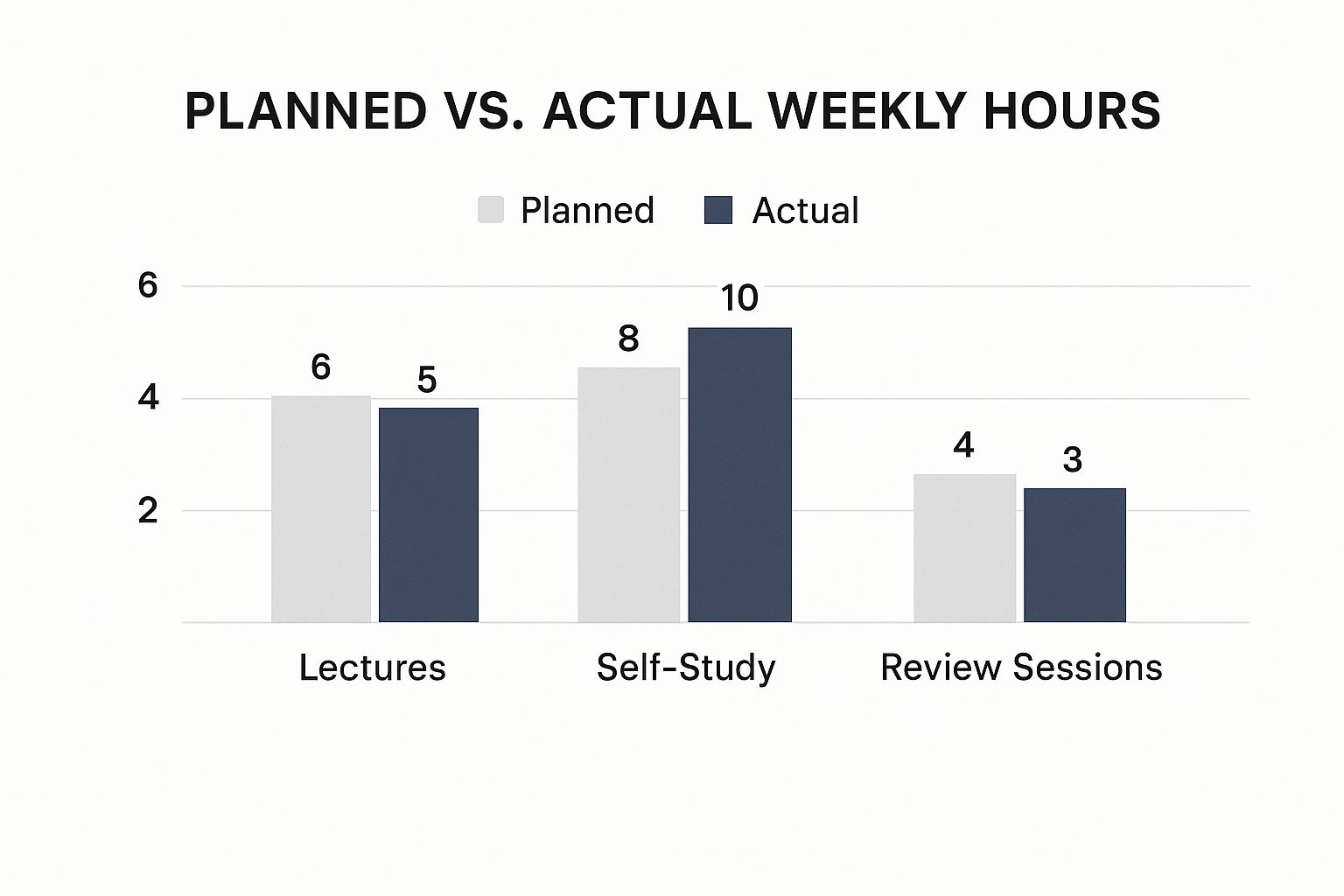
Unpredictable clinical duties or lectures that run long can eat into planned study time, which is why a flexible, adaptable schedule matters.
To make this clear, here's how your focus can change across the different phases of medical school.
Study Focus by Medical School Phase
| Phase | Primary Goal | Key Study Method | Scheduling Priority |
|---|---|---|---|
| Preclinical (M1/M2) | Foundational knowledge mastery | Structured content review, spaced repetition (Anki) | Consistency & Routine |
| Clinical (M3/M4) | Clinical application, Shelf exams | Question banks (UWorld), case-based learning | Flexibility & On-the-Go |
| Dedicated Prep | High-yield board exam content | Practice exams (NBMEs), weak area review | High-Intensity Sprints & Rest |
This table highlights the transition from building a broad base to applying that knowledge clinically, and finally, to preparing for a high-stakes exam.
The Dedicated Board Prep Sprint
Preparing for a major exam like USMLE Step 1 is a distinct phase. During a dedicated period, studying may take priority, but the schedule still needs to account for rest and individual needs.
Your schedule can become more structured, with a focus on covering material while avoiding burnout. Practice exams and detailed review can help organize your study time.
A dedicated schedule can include:
- Baseline Assessment: Start with a practice exam, such as an NBME, to identify areas for further review.
- System-Based Blocks: Organize days by organ system, such as cardiology or renal, to integrate physiology, pathology, and pharmacology.
- Regular Practice Exams: Schedule practice tests at intervals that fit your plan. This can help simulate test conditions and track progress.
- Scheduled Rest: Plan days or periods off. Rest is part of a sustainable study plan.
Step 1 moved to pass-fail reporting in January 2022, and its minimum passing score increased from 194 to 196. First-time pass rates in 2021 were 95% for students from U.S. MD-granting schools and 94% for those from U.S. DO-granting schools. After the transition, reported first-time pass rates ranged from 91% to 93% for MD students and 86% to 89% for DO students, according to the AMA's overview of Step 1 pass rates. These differences are another reason to individualize your plan rather than rely on a single national average.
Scheduling Your Well-Being to Prevent Burnout
The most perfectly designed study schedule for medical students is worthless if you're too exhausted to follow it. The volume of material and constant pressure can make burnout a risk in medicine. Treating well-being with the same respect as your studies can help make a plan sustainable.

Intentionally carve out time for breaks, hobbies, exercise, and seeing other people. These aren't just leftovers to squeeze in if you finish your flashcards early. They are protected appointments in your calendar that support your ability to perform.
Spotting the Early Warning Signs
Burnout may develop gradually. Learning to recognize signs of strain can help you make changes before they affect your well-being and progress.
Keep an eye out for these symptoms:
- Overwhelming Exhaustion: A deep physical and emotional drain that rest doesn't seem to resolve.
- Cynicism and Detachment: Feeling negative or disconnected from your studies, or finding that your initial enthusiasm has faded.
- A Sense of Ineffectiveness: Putting in hours but feeling as though you're not accomplishing anything. This can undermine confidence and motivation.
Recognizing these signs early can give you a chance to reassess your workload and make changes.
A schedule that ignores your humanity is unsustainable. The goal isn't just to survive medical school; it's to thrive. That means building a system that supports both your academic goals and your personal well-being.
Building Resilience into Your Schedule
Preventing burnout requires deliberate planning. Building resilience into your weekly schedule is a practical way to support the mental endurance a demanding career requires.
Treat sleep as important. Aiming for a consistent 7-8 hours a night can support memory, focus, and emotional well-being. Sacrificing sleep can undermine your ability to study effectively.
Next, schedule short, frequent breaks. A 5-10 minute break every hour gives you time to get up, stretch, or look away from your screen. For more ideas, our med student time management tips offer practical ways to integrate breaks.
Actionable Stress Management Techniques
Beyond scheduling breaks, use practical ways to manage stress when it spikes. These don't have to take a lot of time, but they do require practice.
Simple Stress-Reduction Tactics
| Tactic | How It Works | Quick Example |
|---|---|---|
| Mindful Breathing | Can create a calming pause. | Before starting a tough block of questions, take five slow, deep breaths and focus on the air moving in and out. |
| Physical Activity | Provides a break from studying and an opportunity to move. | Take a brisk 20-minute walk between afternoon study blocks. |
| Protected Hobbies | Gives your brain time away from medicine. | Block out two hours on Saturday for an activity you enjoy. |
Scheduling time for yourself, protecting your sleep, and having stress-relief strategies are fundamental parts of a sustainable study plan. This proactive approach can help you preserve energy and resilience.
Common Questions About Med School Schedules
Even with a carefully designed plan, med school can throw curveballs. A good study schedule for medical students isn't something you set in stone. It's a living document that you troubleshoot and adapt. If you're unsure how to structure your plan from scratch, the step-by-step framework earlier in this article walks through it.
How Many Hours a Day Should I Actually Study?
There's no magic number. Study needs depend on the curriculum, the time of year, and individual circumstances. For many students, 3-5 focused hours of active study on weekdays, outside of required lectures and labs, can be a reasonable planning range. A typical medical school schedule can vary widely, so use this as a starting point rather than a universal target.
The quality of those hours matters: active recall and practice questions are more engaging than passively rereading notes. The goal is focused learning, not time in a chair. If you consistently need much longer to keep up, consider reviewing your study methods and schedule.
How Do I Become a Top 1% Student?
There is no single formula for becoming a top student, but useful study habits include using active recall regularly, keeping up with spaced repetition, and targeting weaker areas instead of repeatedly reviewing what you already know. The goal is to direct study time toward the material that needs the most attention, rather than increasing study time alone.
What Is the Best Way to Schedule for Multiple Exams?
Exam weeks can be demanding. Juggling prep for several high-stakes tests is a skill, and combining prioritization with consistent review in the weeks leading up to exams can help.
First, identify which subject is most challenging or which exam carries the most weight. Give it an appropriate share of your study time. You don't need to abandon other subjects, but you can allocate time in proportion to their difficulty and importance.
- Interleave Your Subjects: Instead of studying anatomy for six hours straight, switch tasks. Try 90 minutes of anatomy, take a break, then move to biochemistry. Varying the work can help keep your study day manageable.
- Lean on Spaced Repetition: In the weeks before an exam cluster, use a spaced repetition system like Anki to keep reviewing cards from relevant subjects. This helps you revisit information rather than starting from scratch.
My Schedule Fell Apart. How Do I Get Back on Track?
It happens. A family emergency, a clinical rotation that runs late, or exhaustion can derail even a carefully planned schedule. The important thing is not to panic or throw the whole system away.
Take a breath and spend some time figuring out what happened. Was it a one-off disruption, or is there a specific study block you repeatedly skip?
Perfection is the enemy of consistency. The goal of a study schedule isn't to be followed flawlessly 100% of the time. It's to provide a reliable structure that you can return to after inevitable disruptions. Forgive the lapse and simply start fresh with the next scheduled block.
If you spot a recurring problem, like repeatedly missing an early review session, adjust the plan rather than forcing yourself into a system that isn't working. The block may need to be shorter or moved to another time. Tweak the broken part, not the whole machine.
Should I Study with a Group or Alone?
Both approaches can be useful. Solo study and group study have different strengths, and each can suit different tasks.
Solo Study is for:
- First-Pass Learning: When you're learning new material, uninterrupted focus can help.
- Deep Memorization: Reviewing an Anki deck or tracing nerve pathways may be easier to do alone.
- Practice Questions: Timed question blocks let you work under exam-like conditions.
Group Study is for:
- Unsticking Complex Concepts: Talking through a difficult physiological process can help reveal gaps in understanding.
- Active Recall Drills: Quizzing each other offers practice retrieving facts.
- The Feynman Technique: Explaining a topic clearly to others can help test your understanding.
Set a clear agenda before a group session. Decide exactly what topics you're covering to keep the session focused. Shared commitment can also help some students; if that appeals to you, consider the benefits of finding a study accountability partner.
At Ace Med Boards, we know that building and maintaining the right study schedule is a dynamic, personal process. Our tutors work with students one-on-one to craft a plan that fits their learning style and adapts as med school brings new challenges. If you're ready to move beyond generic templates and build a personalized strategy, learn more at Ace Med Boards.