
No recalled question or feeling about how Step 1 went can establish the result. The official outcome is reported as Pass or Fail and is generally available within two to four weeks, though the USMLE advises allowing up to eight weeks for delays.
If you've searched “feel like I failed Step 1” after leaving the testing center, a difficult block or a string of uncertain answers may be replaying in your mind. That reaction can feel convincing, but it isn't an official result. The useful task now is to separate what you remember from what the score report can tell you, set a reasonable plan for checking it, and get support if the wait is interfering with daily life.
Why Recalled Mistakes Cannot Decide Your Result
A hard question, an unexpected topic, or a stretch of guesses can stand out long after the exam ends. Students often treat those memories as if they were a complete record of performance. They aren't: a person can recall the most stressful moments without knowing how those moments fit into the whole examination.
The official result reflects performance against a proficiency standard, not a score reconstructed from the questions a student remembers afterward. USMLE says the percentage of questions needed to pass varies by Step and by examination form, and describes approximately 60% correct as a typical, not guaranteed, figure. That isn't a conversion tool for remembered mistakes or practice-question percentages. USMLE's scoring policy explains how the passing standard works.
Practical rule: Treat “I remember missing that” as an observation, not a prediction.
A hypothetical example
Two students leave the same exam and both remember an especially difficult question. One keeps replaying the answer choices and leaves convinced the exam went badly. The other remembers the same question but focuses on several blocks that felt manageable. Their memories differ, yet neither person can derive an official outcome from that impression.
This example is hypothetical. It doesn't suggest that either student passed or failed. It shows why a strong feeling, whether confident or worried, isn't the same thing as a report.
The distinction matters for medical students, osteopathic medical students, and international and foreign medical graduates alike. Reconstructing recalled questions can lead to more guessing, not more certainty. Avoid sharing or seeking recalled examination content; it won't provide an official result.

A more useful approach is to wait for the official report and make notes only about general test-day conditions, such as whether pacing felt steady or fatigue became difficult to manage. Those observations may help you reflect later, but they don't establish the outcome.
Reading the Pass/Fail Score Report Once It Arrives
The report gives you the official outcome, so read its wording before drawing conclusions. For Step 1 exams taken on or after January 26, 2022, USMLE reports a Pass or Fail result rather than a three-digit score. For a failing result, the report includes information about distance from the minimum passing standard and feedback by content area. Check the current USMLE examination results and scoring policy when your report arrives, since reporting rules may change.
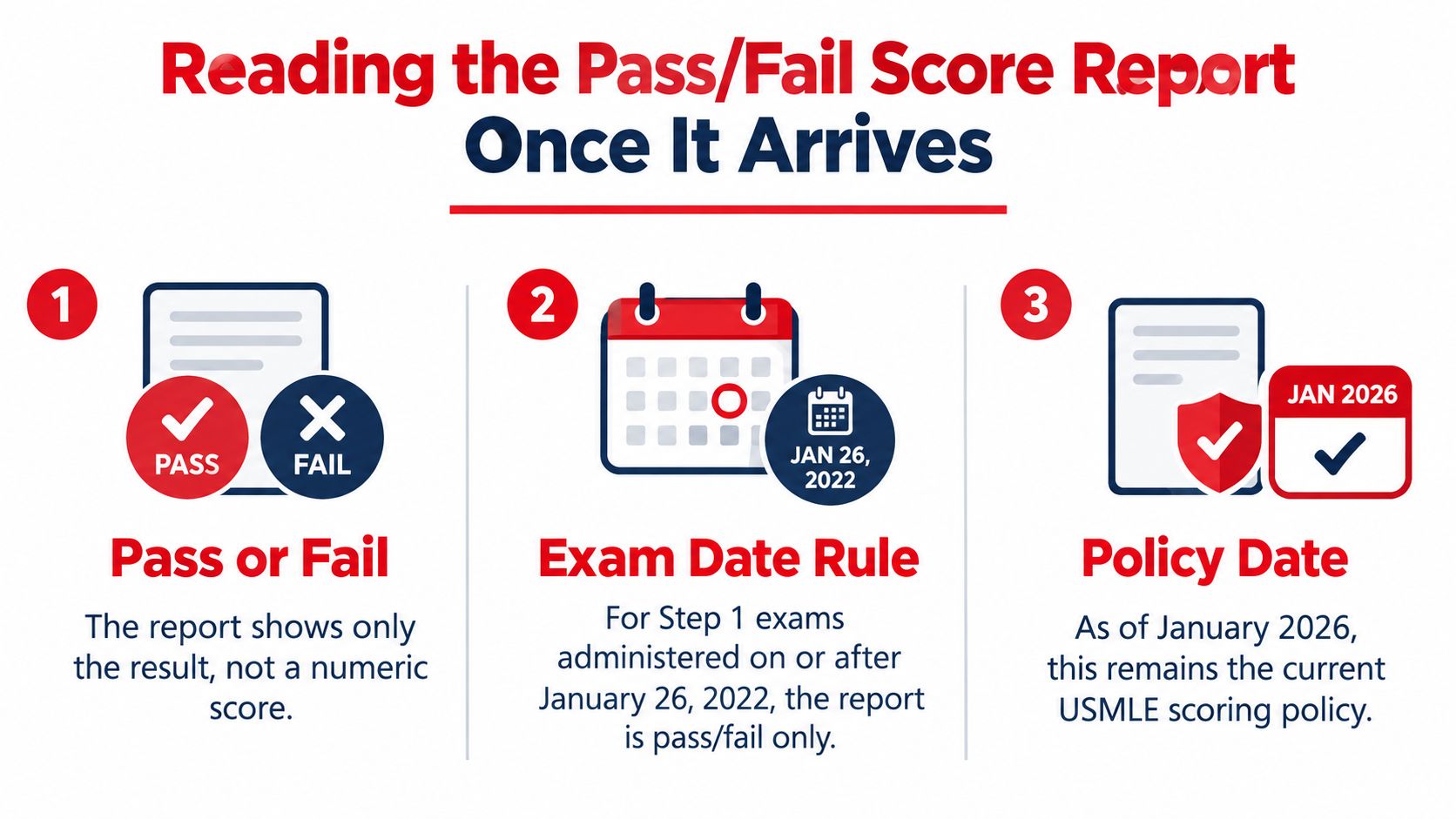
A Pass or Fail result is a threshold outcome, not a numerical ranking. If you receive a Fail, the content-area feedback can help guide a discussion about what to review. It does not measure your full ability or determine your future in medicine.
A score-report checklist
Choose a calm time to read the report, and use the official wording rather than comparisons with online accounts.
- Confirm the exam date: Check that the report matches the exam you took and the policy that applies to that date.
- Read the result first: Note the Pass or Fail designation without adding meaning the report does not provide.
- Review the content-area feedback: Record each line as written. Feedback describes performance in those areas, not your entire knowledge base.
- Separate possible explanations: If review is needed, distinguish knowledge gaps from question interpretation, pacing, or test-day conditions.
- Use the official policy: For an explanation of how Step 1 scores and reports work, consult a resource that explains the scoring process alongside USMLE's current guidance.
A report can give you a clear starting point for a conversation with your school or an academic support person. Before it arrives, there is no official outcome to interpret.
A Date-Based Plan for the Waiting Period
USMLE says results are generally available within two to four weeks, but advises allowing up to eight weeks because delays can occur. Its 2026 bulletin addendum on results timing provides the official guidance; check it for current information rather than relying on a classmate's timeline.
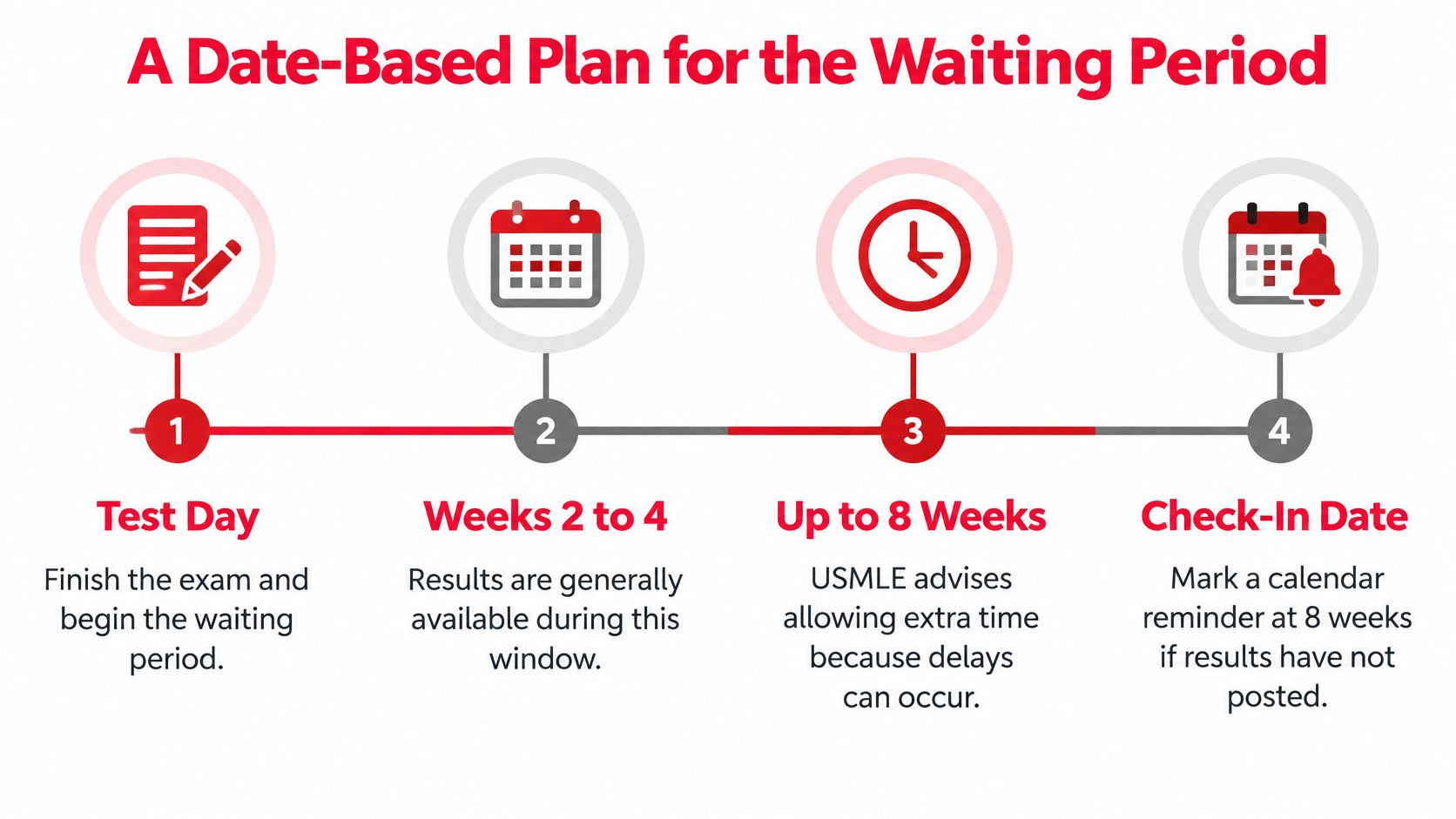
A calendar can make the wait feel less open-ended. Use the dates below as a simple structure, not as a prediction of when your own result will post.
| Point in the wait | What to do |
|---|---|
| Test day | Finish the examination and note the date. Don't try to produce a verdict from memory. |
| Weeks 2 to 4 | Check for the result at a set time rather than refreshing the portal repeatedly. |
| If it hasn't posted | Remember that USMLE advises allowing up to eight weeks when delays occur. |
| At eight weeks | If the result is still unavailable, follow the current USMLE instructions for checking on it. |
You can keep a short observation log, too. Write down the exam date, which parts of the session felt slow or demanding, and how pacing and fatigue seemed to affect you. Label those entries as observations, not evidence of passing or failing.
Repeatedly checking remembered answers can turn uncertainty into an exhausting loop without producing reliable information. Choose a calendar reminder and then return to ordinary routines: meals, sleep, movement, and contact with people you trust. If anxious anticipation is hard to manage, Refresh Psychiatry & Therapy's guide to anticipatory anxiety offers general information about the experience. For exam-related burnout support, see Ace Med Boards' guide to USMLE exam burnout.
This waiting plan ends when the result arrives. Any academic remediation belongs to a separate conversation based on the official outcome and your school's guidance.
Telling Normal Doubt From a Need for Support
Feeling sure the exam went badly doesn't show that a failure is coming. The more useful distinction is between ordinary doubt that comes and goes, distress that's disrupting daily functioning, and a result that has been confirmed.
| Situation | What it can look like | Distinct next step |
|---|---|---|
| Post-exam doubt | Replaying difficult moments, wondering about answers, or feeling unsure while still managing ordinary routines. | Use the fixed check-in plan and avoid treating memories as a result. |
| Distress needing support | Anxiety, sleep difficulties, or trouble managing daily responsibilities that persist or feel difficult to handle alone. | Consider contacting confidential campus counseling, a trusted advisor, or an academic dean. |
| Confirmed Fail result | The official report shows Fail. | Contact your school and use a focused guide for interpreting the report and considering next steps. |
A 2025 survey reported that 63% of students agreed school counseling services helped their mental health during the pass/fail experience, while 57% endorsed wellness advising. These are survey responses, not guarantees that a particular service will suit every student. The survey article also describes advisor check-ins and reduced isolation as supports students valued.
You don't have to wait for a score report to ask your school what support is available. A counselor, advisor, dean, or trusted peer may help you get through the waiting period without trying to determine the result for you. Seeking support is a practical choice, not a judgment about your ability. Ace Med Boards' medical student mental health resource may also be useful as general educational reading.
This article isn't individualized medical or mental-health advice and can't diagnose what you're experiencing. If you're in crisis or unable to stay safe, contact local emergency services.
Choosing Where to Get Help Before Results Arrive
Different resources answer different questions. A school can explain its own academic procedures; counseling can offer personal support; official materials can clarify examination policies. None can tell you what your unpublished Step 1 result will be.
| Option | What it can help with | What it can't establish |
|---|---|---|
| School advising or academic dean | School requirements, available support, and whom to contact if a result raises academic questions. | Whether a result that hasn't posted will be Pass or Fail. |
| Confidential counseling | Support with distress, coping, or difficulty managing daily routines. Confirm confidentiality terms and access with the provider. | Your examination outcome or a substitute for academic advising. |
| Official USMLE materials | Current scoring and results information from the organization responsible for the examination. | A personalized prediction based on remembered questions. |
| Independent study planning | A way to organize existing practice data and reflect on study habits if planning becomes useful later. | A replacement for a score report or your school's requirements. |
| One-on-one tutoring | Structured review of your own practice data and preparation plan. Confirm current availability, fees, and program details directly with the provider. | A prediction or alteration of an exam result already recorded. |
Ace Med Boards offers one-on-one USMLE tutoring. Tutoring can be considered as a planning resource, but it can't reveal an unpublished result or change one that has already been recorded. It also complements, rather than replaces, official USMLE materials and school guidance.
If you're deciding whether study support is useful before results arrive, this guide to USMLE Step 1 tutoring can help clarify the kinds of questions a student might consider. Before choosing any service, confirm its current scope, cost, access, and terms directly with the provider.
Next Steps Once Your Result Is Available
When the official report appears, use it to guide your next conversation. A remembered answer or a difficult exam-day feeling cannot confirm the outcome.
If your report says Pass, check your school's published requirements and timelines for upcoming academic milestones. Contact the relevant office if a policy or deadline is unclear.
If your report says Fail, allow yourself time to absorb the news, then speak with your school about its requirements and your options. The report gives you information about this attempt; it does not define your ability or determine every future outcome. For guidance specific to a confirmed unsuccessful attempt, read what to do after failing USMLE Step 1.
In either case, base academic plans on the official report and your school's guidance. Avoid making major decisions from remembered questions or a test-day impression alone.
Ace Med Boards offers a free consultation for students who want help reviewing their practice data and considering study plans. It cannot predict or change a recorded result. You can visit Ace Med Boards to learn about current services and request a consultation.