Active recall is the deliberate act of retrieving information from memory without looking at notes, also called retrieval practice or the testing effect. It strengthens memory pathways for durable retention far better than passive rereading, and that's why students who used retrieval practice remembered about 80% of studied material after one week versus about 36% for students who mainly re-read, even with the same total study time (Roediger and Karpicke's 2006 testing effect experiments).
You know the feeling. You've reread First Aid, highlighted the same pages, maybe even told yourself the chapter looked familiar, then a practice question wipes that confidence out in one sentence. That gap between recognition and recall is exactly where active recall earns its place in medical school studying.
What Active Recall Means for Medical Students
A medical student opens First Aid, reads a page on renal physiology, and closes it. The question is simple: can they explain the concept without looking back? If yes, that is active recall. If they need the page in front of them before the answer feels clear, they are still in passive review.
The difference between knowing and recognizing
Passive study creates familiarity, and familiarity can be misleading. You see the same terms, diagrams, and sentence patterns often enough, then your brain starts treating recognition like understanding. That is why rereading can feel productive right up until a question asks you to produce the answer with no cue.
Active recall asks you to pull information out of memory without the page in front of you, and that effort is the point. Each successful retrieval reactivates the memory trace and strengthens the pathway for later access, which is why recall-based studying lasts longer than passive review (active recall definition and mechanism).
Practical rule: If you cannot answer a topic without looking, do not count it as learned yet. Count it as recognized.
That does not mean passive methods have no role. They work best for the first pass, when you are still building an initial mental map of the material. Active recall is the check that shows whether that map still holds when the page disappears.
For students building a broader system, how to study as a medical student starts with deciding what deserves review, what deserves memorization, and what should be tested only after the basics are in place.
Why the struggle matters
Medical students often assume strong studying should feel smooth. Active recall feels harder because your brain has to search, organize, and produce the answer instead of just taking it in, and that effort strengthens later access (active recall as retrieval practice).
That difficulty is useful, but only when the material is ready for it. High-yield concepts you have already encoded well are good candidates for retrieval practice. Low-yield details, or facts you have barely learned, can waste time if you try to quiz them before you have enough structure in memory to retrieve them. For USMLE, COMLEX-USA, or Shelf exams, the goal is not to test everything at once. It is to spend recall effort where it will improve exam performance, not where it only creates frustration.
The difference matters because those exams do not reward “I saw this before.” They reward clean retrieval under pressure, often with wording changes or application steps that recognition alone cannot handle.
The Cognitive Science Behind Retrieval Practice
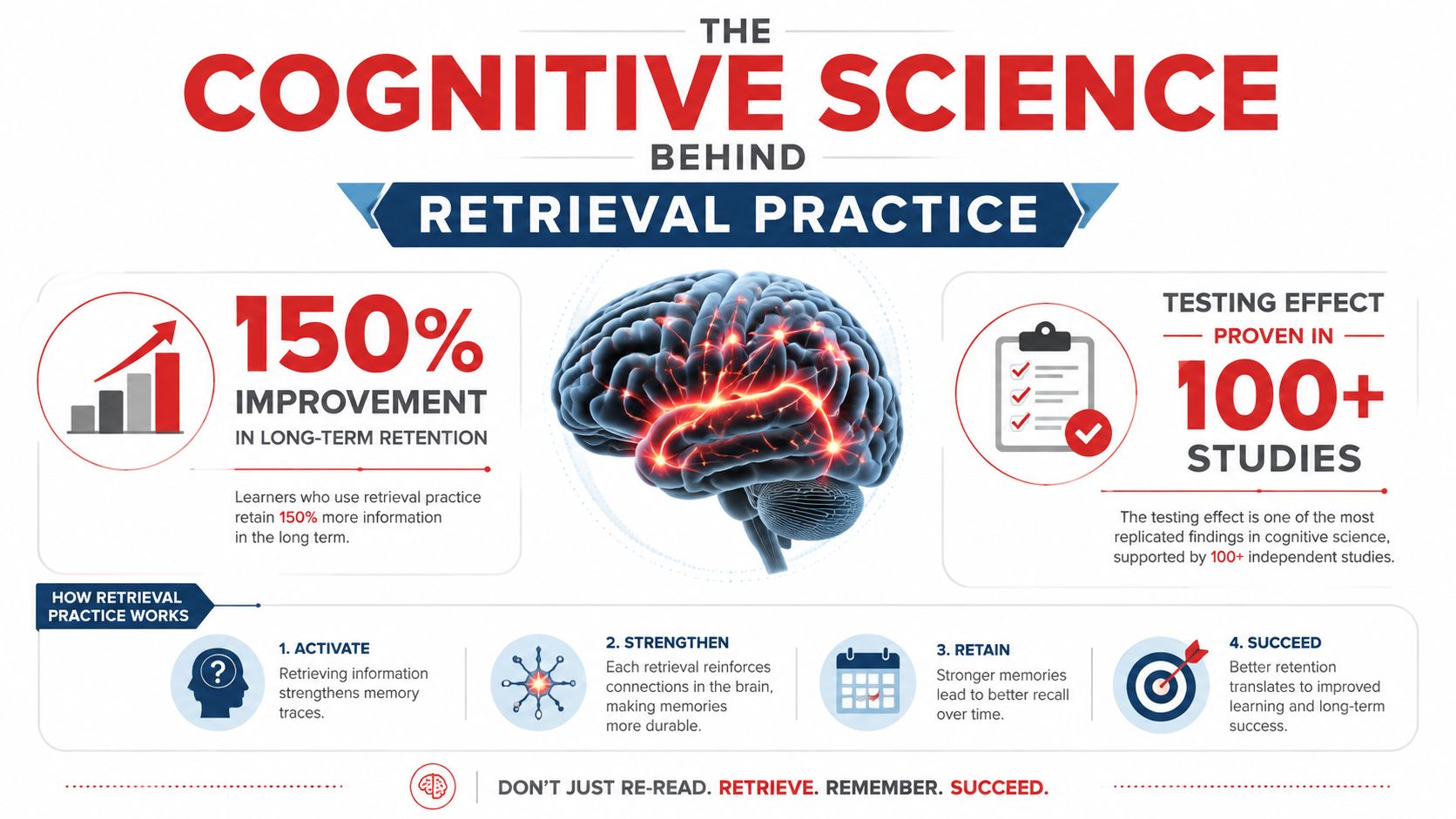
Active recall is not just a tougher way to study. It works because pulling information out of memory changes how well that information sticks, which is why retrieval practice has remained a central finding in learning science for years. In Roediger and Karpicke's 2006 experiments on the testing effect, students who used retrieval practice remembered about 80% of the material after one week, compared with about 36% for students who mainly reread the same content, even though both groups spent the same total study time (study summary).
What that means in practical terms
The point is not that tests are magical. The point is that memory gets stronger when you have to rebuild the answer from within, instead of recognizing it while the page is still in front of you. That is why a study session should end with a check, not just with the feeling that the material looked familiar.
For medical students, the harder question is what to test first. The best targets are topics you have already encoded well enough to explain in your own words, then apply to a vignette or mechanism question. If a fact is still too loose to retrieve at all, it may need another pass of encoding before recall becomes useful, which is the same reason memory retention improves more when you review material in a structured way, as discussed in how to improve memory retention.
Rowland's 2014 meta-analysis in Psychological Bulletin gave the field a broader view. It pooled 159 effect sizes from 61 studies and found a reliable advantage for retrieval practice over restudying, with a mean effect size of g = 0.50; 81% of the comparisons favored testing over rereading (meta-analysis summary).
That matters because the benefit shows up across many settings, not just in one course or one style of learner. An effect size around 0.50 means the average learner using retrieval practice outperformed the average learner using passive review, and that pattern held across many subjects and age groups. For board prep, that broad consistency is reassuring because it supports a simple habit, spend recall effort on material that is ready to be tested, then keep tightening it with feedback.
Why researchers take it seriously
Meta-analytic summaries of retrieval-practice research report effect sizes of about 0.50 to 0.61 across hundreds of experiments, which points to a moderate-to-strong learning benefit versus passive review (mechanisms and summaries). The practical takeaway is straightforward, closed-book self-testing, short-answer prompts, and error-checking cycles do more for durable learning than rereading or highlighting alone. The reason is not just that you notice gaps. Retrieval practice forces the brain to reconstruct the path to the answer, and that reconstruction makes later access easier.
Retrieval practice works best when you generate the answer first and correct the gap afterward.
That is the part many students miss. The correction matters, but the struggle before correction matters too. If you skip the retrieval step, or use it too early on material that has not been encoded yet, you lose the memory-building effect that makes active recall useful in the first place.
Active Recall Versus Passive Study Methods
The easiest way to audit your current habits is to compare what your brain is doing during each method. Rereading, highlighting, and watching lecture videos can help you get oriented, but they mostly rely on familiarity. Active recall forces production, which is a different and more exam-relevant kind of mental work.
| Study Method | Memory Engagement | Retention Outcome | Best Use Case |
|---|---|---|---|
| Active Recall | Produces answers from memory without looking | Stronger durable retention, especially after delays | Self-testing, board prep, identifying gaps |
| Rereading | Low, mainly recognition-based | Useful for first exposure, weak as a primary review strategy | Initial encoding, quick orientation |
| Highlighting | Very low unless paired with testing | Helps organize notes, but doesn't prove recall | Marking key terms during first pass |
| Lecture Videos Without Pausing | Mostly passive intake | Can clarify confusing concepts, but can create false confidence | Learning a new topic before testing yourself |
Passive methods are not useless. They just shouldn't be the main event. A dense physiology chapter, for example, may need one careful read before you can test mechanisms, pathways, or clinical consequences accurately.
If you want a simple rule, use passive methods to build understanding, then use active recall to verify understanding. The first pass helps you encode the material. The second pass tells you whether you can retrieve it under exam conditions. That's the difference between “I've seen this before” and “I can answer it now.”
For medical students who want to tighten that balance, this medical-student study approach is a useful companion to the recall habits outlined here.
Proven Active Recall Methods for Board Exam Prep
A stressed medical student can spend hours “studying” and still fail to test the right material. That usually happens when recall is aimed at low-yield trivia before the core idea is even encoded. The better approach is to test what is already partially understood, then use recall to expose what still needs work.
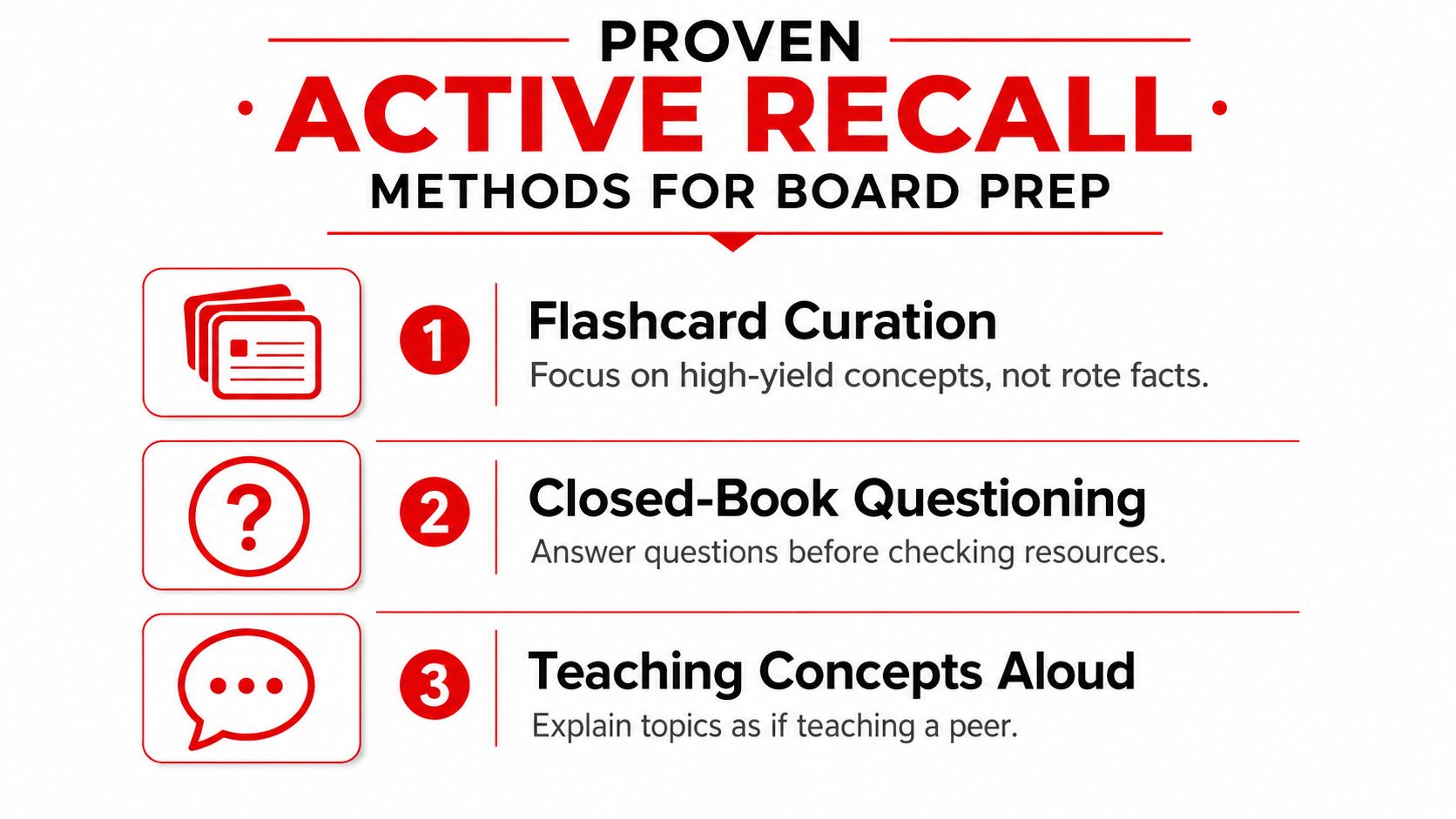
For board prep, the most useful methods are usually flashcards, practice questions, and closed-book explanation. Each one forces retrieval in a different way, but the common thread is simple, you answer before you look.
Flashcards that test thinking, not trivia
Anki works best when each card asks for a mechanism, a relationship, or a clinical pattern. A card that asks, “What explains chest pain that worsens with exertion and improves with rest?” asks you to retrieve the concept. A card that only asks, “What is the name of stable angina?” can drift into memorization without much thinking.
Card design matters here. If you turn every sentence in your notes into a card, you end up rehearsing fragments that may not be ready for recall yet. Use cards for material you have already encoded enough to test, especially high-yield mechanisms, classic associations, and common differentiators that boards like to probe.
If you are building cards from notes, the ChatGPT Anki flashcard creation guide can help you convert dense passages into cleaner prompts without stripping out the important content.
Practice questions and blank-page recall
Practice questions work because they force selection, not just recognition. You have to decide which fact fits the stem, which distractor is wrong, and which clue changes the diagnosis. That is a different skill from rereading notes, and it is much closer to what board exams ask of you.
After a missed question, do more than read the explanation. Turn the miss into a new prompt, especially if the error came from a weak mechanism or a confusing differential diagnosis. If the topic is not yet stable, fix the underlying understanding first, then test it again later.
The blank-page method is even simpler. Close your resources and write everything you know about a topic before checking what you forgot. For pharmacology, for example, write the mechanism of action, a major adverse effect, and one common board association from memory, then compare it with your notes. If the page stays empty, that is a sign to return to the material and build the base before pushing harder on retrieval.
Good use case: If the topic has relationships, such as symptoms, causes, mechanisms, or next steps, retrieval practice usually beats passive rereading.
Teaching aloud works for the same reason. If you cannot explain the renal handling of sodium in plain language, the concept is still shaky. A short explanation to an imaginary classmate, or even to yourself out loud, often shows exactly where the gap is.
For students who want a structured medical-school video refresher on this topic, the clip above can reinforce the basic workflow, but it still works best when paired with self-testing afterward. For a broader review of how retrieval fits into longer-term study planning, this spaced repetition overview for medical students is a useful companion.
Combining Active Recall with Spaced Repetition
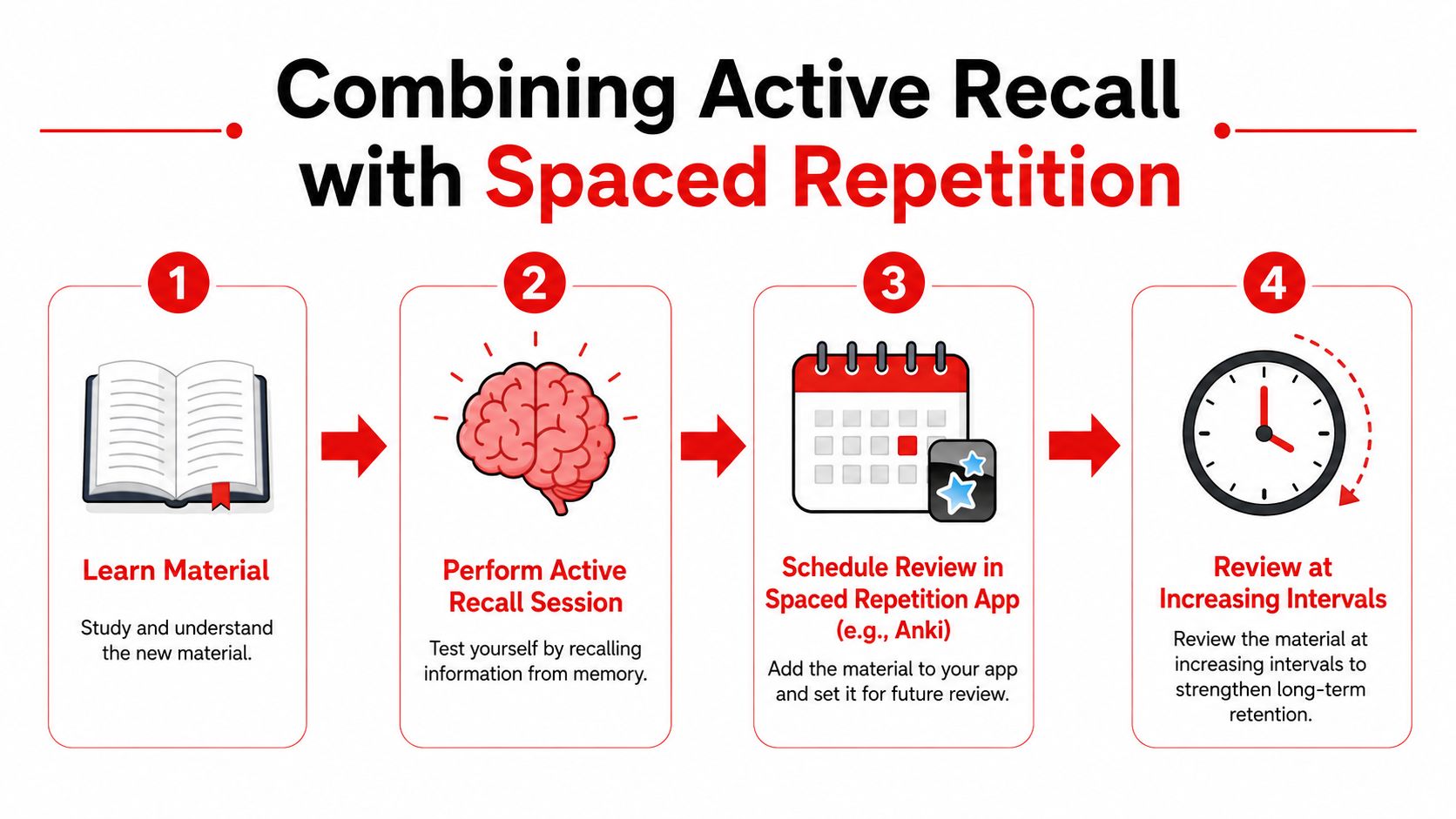
A student who keeps rereading the same renal physiology page may feel busy, but that feeling fades fast. Active recall changes the job from recognition to retrieval, and spaced repetition decides when the next retrieval should happen. Together, they turn studying into a sequence of timed memory checks instead of a one-time review.
Why the two methods fit together
Spaced repetition spreads review across time so you meet a topic again before it slips too far from memory. Tools like Anki do this by scheduling reviews at widening intervals, which helps older material stay available while you keep adding new content. For a clear walkthrough of that pairing, Ace Med Boards' spaced-repetition guide is a useful companion.
The catch is that spaced repetition works best after the material has been encoded well enough to test. If you try to drill every low-yield fact too early, you can end up rehearsing confusion instead of strengthening memory. For medical students, the smarter move is to test what is high-yield, structurally important, or already partially learned, then return to the details after the base is in place.
A simple weekly structure for a dedicated USMLE Step 1 or Step 2 CK study period might look like this:
- Morning: Learn a new topic, then close the resource and do a short recall pass.
- Midday: Complete practice questions and convert misses into new prompts.
- Afternoon: Review spaced cards from earlier topics.
- Evening: Do a brief blank-page summary of the day's highest-yield mechanisms.
That framework still works during Shelf preparation, but the balance changes. Third-year students usually need to absorb fresh clinical material while keeping older subjects active, so the daily recall load has to stay smaller and more targeted.
A practical weekly rhythm
For board prep, the goal is not to test everything at the same depth. The goal is to keep the highest-yield material in rotation often enough that it stays accessible under pressure. A combined workflow usually looks like learn, retrieve, check, and reschedule, not learn once and hope it sticks.
The timing matters as much as the method. New content needs a first pass that builds a usable mental model, then active recall confirms whether that model is stable enough to stand on its own. After that, spacing helps you revisit the material after enough time has passed to make retrieval effortful again. If you are building a schedule around that cycle, a study schedule for medical students can help you place recall sessions in the right part of the day.
If you are building your own routine, think in layers. New content gets initial encoding. Same-day active recall checks whether the concept landed. Spaced repetition then carries that concept forward so you do not keep starting from zero.
Common Active Recall Mistakes and How to Avoid Them
A lot of students say active recall “didn't work,” when the problem was how they used it. The method is powerful, but it only helps when you aim it at material that is ready to be tested and worth testing.
A useful rule is to match the recall task to the stage of learning. If the topic is still fuzzy, more encoding comes first. If you already have a workable mental model, retrieval practice can expose weak spots and make the material stick better.
Testing too early
If you have not encoded the material enough to form a usable mental model, retrieval turns into guesswork. That is not a sign that active recall failed. It usually means you need a stronger first pass before you start drilling yourself. For a dense chapter, spend enough time understanding the main mechanism or framework first, then test it.
Many stressed medical students waste effort. They start quizzing themselves on low-yield details before the core idea is in place, then interpret the confusion as proof that they are “bad at recall.” A better sequence is the one outlined in Ace Med Boards' study schedule for medical students, which places recall after an initial learning pass.
Making cards that miss the point
Some flashcards become lists of low-yield details. Those cards are easy to make and tedious to review, but they do not help much when the exam asks about a mechanism, a pattern, or the next best step. Build prompts around what boards reward, the relationship between facts, not just the facts alone.
A card should force you to retrieve something clinically useful. A pharmacology fact, for example, matters more when it is tied to a mechanism, an adverse effect, or a common vignette pattern. A lab value matters more when it points toward a diagnosis or management choice. If the card could be answered by simple recognition, it is probably not pulling enough weight.
Confusing recognition with recall
Flipping a card too quickly, reading the answer and thinking, “I knew that,” or scanning options until one looks right all blur the line between memory and familiarity. A better test is to pause long enough that you would feel a little pressure if the answer had to come from you right then. If you need the card's backside to feel confident, you were not fully recalling yet.
Correction: Slow the reveal. Give yourself a real attempt before checking the answer, even when the card feels easy.
Medical students often get tripped up with board prep because they treat retrieval practice as a fix for everything. It works best after the concept has been encoded enough to support a real attempt. If the prompt asks for a detail you have not learned well yet, the problem is usually the target, not the method.
Your Active Recall Study Plan and Quick-Start Template
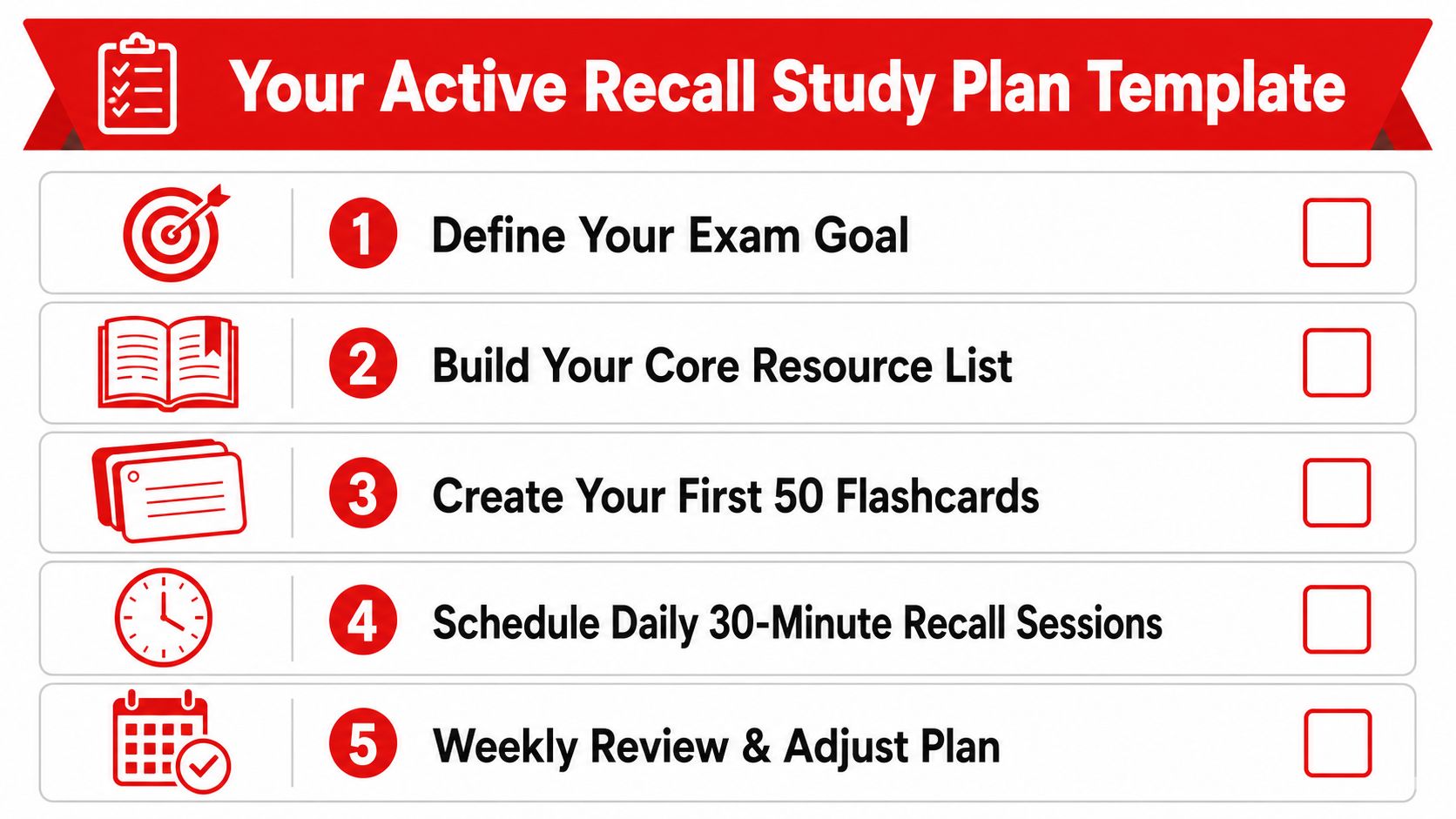
Before you start a heavier recall routine, check whether the material is ready for it.
- You can state the main mechanism from memory.
- You know the major clinical association or board-style pattern.
- You've already done one clear first pass with the resource.
- You can answer at least part of the topic without staring at the page.
If most of those boxes are still empty, spend a little more time encoding first. If they are mostly filled, the topic is ready for testing. That order matters, because active recall works best after the material has enough structure to retrieve. For a simple way to organize that sequence, see this study schedule for medical students.
Quick-start template
Take one chapter and turn it into three prompt types.
- Mechanism prompt. Ask how the concept works.
- Association prompt. Ask what it is linked to clinically.
- Application prompt. Ask how it appears in a board-style vignette.
A pharmacology page can become a mechanism card, an adverse-effect card, and a case-based question. A renal topic can become a physiology prompt, a lab-pattern prompt, and a management-pattern prompt. That keeps the deck aimed at the kinds of relationships board exams reward, instead of scattering effort across low-yield fragments.
Choosing the right recall format
- Anki flashcards work well for facts, mechanisms, and recurring associations.
- Practice questions work well for application and exam-style reasoning.
- Blank-page retrieval works well when you want to see how much of a topic you can generate on your own.
Use the format that matches the target. A fact you already understand can go on a card, but a concept you have barely encoded may need another pass through the resource before retrieval practice helps. That is the common mistake, treating active recall as a fix for every weak spot instead of using it after the basic framework is in place.
If you want help turning your current resources into a recall plan, Ace Med Boards offers one-on-one tutoring and study guidance for medical students preparing for board exams. A short consultation can help you decide where active recall fits in your current workflow and what to test first.
If you are ready to make studying feel more deliberate and less like endless rereading, start by turning one topic into recall prompts today. Ace Med Boards can help you organize that process into a board-focused plan.