

Yes, taking a full-length practice MCAT before studying is recommended, and the result should be treated as a baseline diagnostic rather than a prediction of the final score. The value comes from section scores, pacing data, and missed-question patterns, not from one early total.
Most premeds delay that first test because a low number feels personal. Students worry that a disappointing baseline proves the target score is out of reach, so studying starts with weeks of content review and no evidence about where time will pay off. That delay feels safer, but it leaves the first study plan built on guesswork.
The Short Answer and Why a Baseline Matters
Students asking should I take a practice MCAT before studying should take one, provided it's a full-length practice exam taken under timed conditions and reviewed in detail. The test isn't a readiness exam. It isn't a verdict on medical school prospects. It's a measurement taken before instruction, when unfamiliar passages, an unfamiliar interface, and untested endurance are expected to drag performance down.
That distinction matters because a pre-study result is most useful for showing whether the largest opportunity lies in content knowledge, passage interpretation, timing, or endurance, as described in the AAMC guide to official low-cost practice products. Those four problems require four different responses. More memorization won't fix a student who reads figures too slowly, and passage drills won't fix missing foundational science.
What a Low Baseline Does and Doesn't Mean
A low starting score usually means the test format is new, not that the ceiling is low. Before formal review, many questions test material that hasn't been revisited in months or years, and even familiar material appears inside dense passages with a strict clock. Treating that score as a forecast confuses starting point with capacity.
A high baseline needs the same caution. Prior exposure to MCAT-style questions can inflate the result, and correct guesses can hide fragile knowledge. The number alone can't distinguish solid mastery from lucky selection, which is why review matters as much as the score report.
A baseline is useful only when it changes what happens next. A score that doesn't alter the study plan is just a stressful souvenir.
Used properly, the diagnostic sets priorities before habits harden. It shows which section needs the earliest attention, whether pacing breaks down late in the test, and how much content review is enough. Students deciding on timing alongside coursework can pair that evidence with guidance on when to start studying for the MCAT and build a schedule around actual weaknesses instead of anxiety.
How the MCAT Is Scored and What a Diagnostic Actually Measures
The Medical College Admission Test, or MCAT, contains 230 questions across four sections, with about 6 hours and 15 minutes of content time and roughly 7 hours and 30 minutes of seated time including breaks, according to the AAMC overview of what's on the MCAT exam. A baseline therefore measures stamina across a long test day, not just knowledge in short bursts. Students who practice only in brief sets often discover that distinction the hard way.
Each section is scored from 118 to 132, and the four section scores sum to a total from 472 to 528. There's no penalty for guessing, so unanswered questions waste scoring opportunities and distort the diagnostic picture. Students who leave blanks under time pressure aren't protecting a score. They're hiding a pacing problem that needs to be named.
MCAT Section Structure at a Glance
| Section | Questions | Minutes | Scaled Score |
|---|---|---|---|
| Chemical and Physical Foundations of Biological Systems | 59 | 95 | 118 to 132 |
| Critical Analysis and Reasoning Skills | 53 | 90 | 118 to 132 |
| Biological and Biochemical Foundations of Living Systems | 59 | 95 | 118 to 132 |
| Psychological, Social, and Biological Foundations of Behavior | 59 | 95 | 118 to 132 |
The table shows why one total hides the useful story. The Association of American Medical Colleges, or AAMC, score-report example shows a total of 501 at the 49th percentile, built from section scores of 124, 123, 127, and 127 at the 43rd, 35th, 72nd, and 64th percentiles respectively, in the AAMC sample score report for admissions officers. That student profile doesn't need equal time everywhere. It needs urgent work in the second section and maintenance elsewhere.
Current percentile context sharpens the same point, since recent tables place 502 at the 55th percentile, 510 at the 76th, 515 at the 91st, and 520 at the 97th. Small total changes can reflect very different section patterns underneath. Students who want the full scoring mechanics can review what the MCAT is scored out of before interpreting a first report.
Scored or Unscored First Diagnostic
The AAMC offers two different starting points, and the right choice depends on purpose. The free Unscored Sample Test has the same 230-question length and format as the MCAT but provides no scaled score or percentile, while Practice Exam One uses previously administered questions and reports an official-style scaled score and percentile rank, as explained in the AAMC guide to creating an MCAT study plan. Both expose pacing and content breadth. Only one produces a number to anchor to.
That number helps some students and harms others. A scored baseline gives a concrete reference for setting a test date, choosing a target, and measuring change after a study block. It also creates a risk of premature self-labeling, especially for students with significant test anxiety who haven't yet learned passage strategy or timing.
A Simple Decision Rule
- Choose the unscored sample first: Anxiety is high, the main goal is learning the interface, or a low number would derail motivation before studying begins.
- Choose the scored exam first: A test-date decision is near, section-level targets matter now, or a numeric baseline will change how study time is allocated.
- Choose unscored now and scored later: Confidence is fragile but accountability still matters, and preserving a scored form for a cleaner later comparison is valuable.
Neither option is wasted if review follows. The unscored form still yields a content-and-skills breakdown, missed-question patterns, and honest pacing data. The scored form adds percentile context, but that context shouldn't be mistaken for a prediction before any instruction has occurred.
Students comparing official and third-party options should start with AAMC material for the baseline whenever possible, then use a structured comparison of the best MCAT practice tests for later practice volume. The first diagnostic should resemble the exam as closely as possible. Later tests can serve different purposes.
Realistic Test-Day Conditions for the Baseline
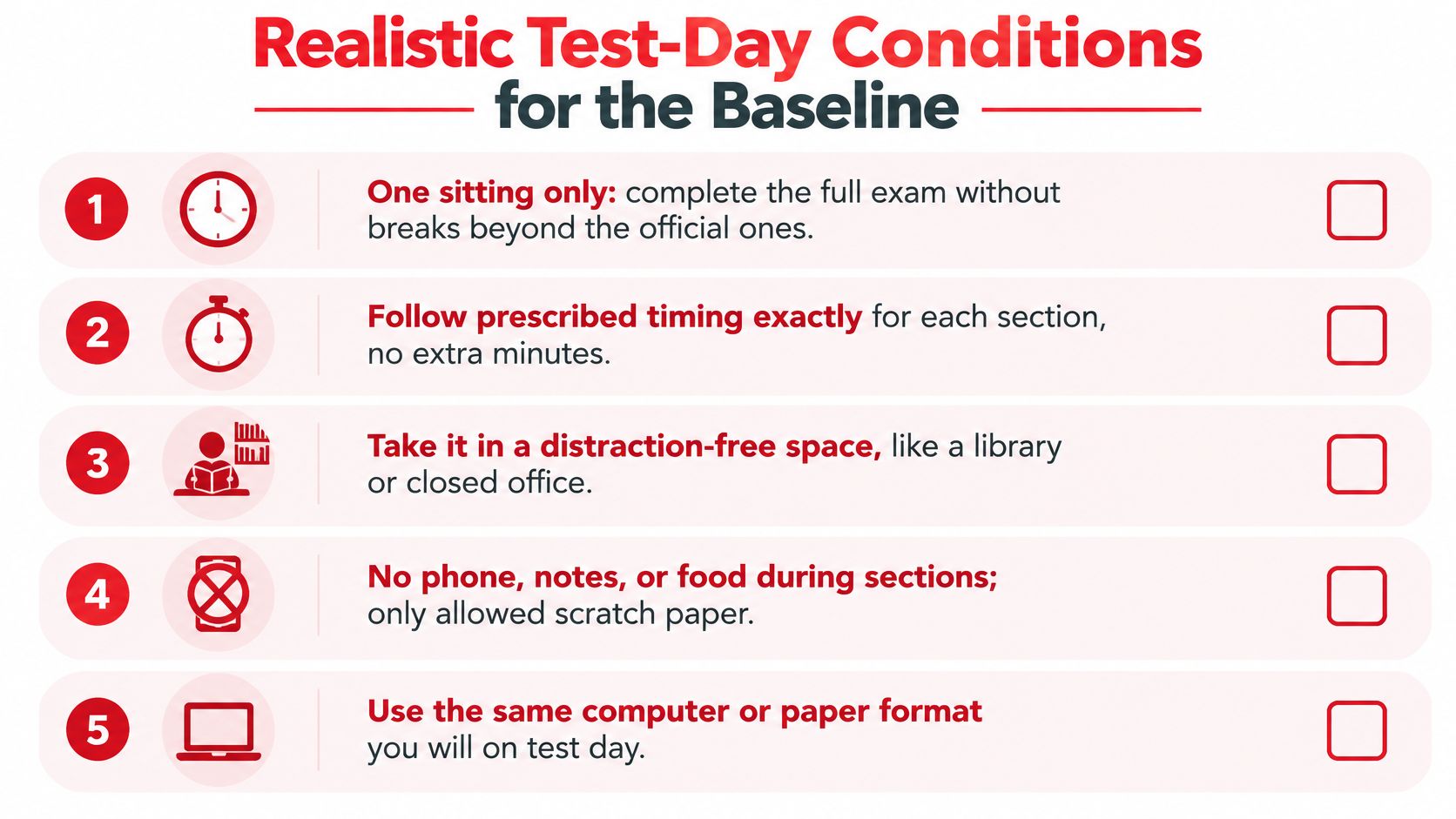
A student pauses the timer halfway through CARS to answer a text. Another finishes Bio/Biochem on Tuesday and saves Psych/Soc for Thursday. Both produce a score, and both scores lie. A baseline taken casually produces casual data: every paused clock, checked note, or split session converts the exam into a content quiz and erases the pacing and endurance information that makes a full-length worth taking.
Honest conditions matter more than perfect ones.
Where Baselines Go Wrong
| Shortcut | What it costs |
|---|---|
| Pausing or extending the timer | Per-section pacing data |
| Splitting the exam across days | Any real measure of endurance |
| Checking notes or looking up concepts mid-section | An accurate map of content gaps |
| Skipping or stretching breaks | Stamina rehearsal for test day |
| Leaving questions blank | Guessing-strategy data |
The standard itself is simple. Finish the exam in one sitting, hold the prescribed section timing, take the scheduled breaks on schedule, and keep the phone in another room. Answer every question, guessing when necessary, and flag guesses for review. When fatigue hits, mark the moment: the section where concentration first slipped is information, and so are sleep, hunger, and distractions. Recording conditions separates a stamina problem from a knowledge problem, and each points to a different fix.
One condition should never be part of the plan: an official MCAT administration used as the baseline. Examinees may take the exam up to three times in a single testing year, four times across two consecutive years, and seven times over a lifetime, and voids and no-shows count toward those limits, per the AAMC MCAT frequently asked questions. A practice exam delivers the same diagnostic exposure without spending an official attempt.
Practical rule: If conditions were unrealistic, the score shouldn't drive decisions. Review the questions, discard the number, and retake a different form under real constraints.
Students who want the exact section timing before test day can check the MCAT test time breakdown and rehearse breaks with the same discipline as questions. Endurance is trainable, but only after it gets measured. A baseline that hides fatigue helps no one.
Building an Error Log That Drives Study Decisions
A missed biochemistry question turns into a log entry like this: tested concept, competitive inhibition; passage evidence, the graph showing unchanged maximum velocity; error reason, confusing inhibition types under time pressure; corrective action, review inhibition patterns, work untimed graph questions, then repeat timed. That entry can be retested on the next full-length. A margin note saying "review biochem" cannot. The difference between those two records is the difference between a plan and a wish.
University advising guidance recommends using a full-length exam to identify strengths and weaknesses because AAMC reports provide detailed breakdowns of correct and incorrect responses, and it prescribes a closed-loop cycle of remediation, untimed verification, timed practice, and reassessment, per the University of Houston AAMC MCAT study plan guidance. Reading explanations once doesn't close that loop. Recording why each error happened does.
Log every miss. Log every guess, too, including the guesses that landed as correct answers. Lucky answers are unflagged knowledge gaps, and a gap that isn't written down returns on the next exam disguised as a new problem.
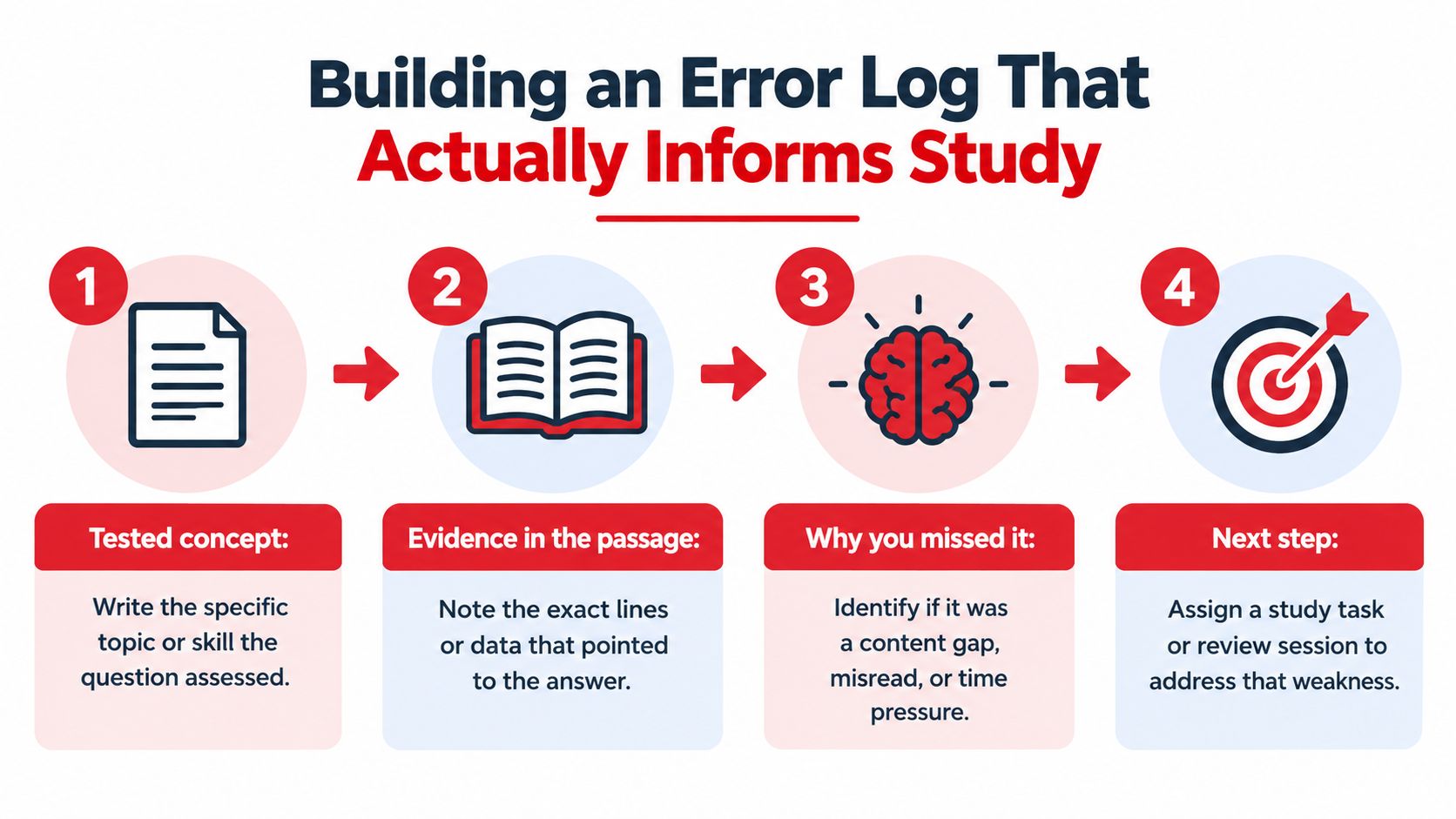
Four fields give each entry enough detail to act on:
| Field | What to record |
|---|---|
| Tested concept | The specific topic or reasoning skill, not a vague chapter title |
| Passage evidence | The lines, figure, or data that pointed to the correct answer |
| Why the wrong option appealed | Knowledge gap, misreading, calculation slip, or time pressure |
| Corrective action | One concrete task, such as reviewing enzyme kinetics and completing untimed questions on that skill |
Once the log exists, calculate an actionable rate for each section: missed-or-guessed items divided by total items. Rank the four sections by that rate, then look at how often each error type repeats inside them. A section leaking points to careless misreads needs pacing work and passage discipline. A section with broad content gaps needs scheduled review blocks. Same score, completely different prescription, and only the log tells you which one you're facing.
Turning the Baseline Into a Study Plan
A student scores below target on a first diagnostic, then spends weeks rereading every science chapter. That is usually a poor use of study time. Build the schedule around the patterns in the error log, and use the total score only to estimate the distance to the target.
A single pre-study score is an imperfect planning signal. Improvement in recurring error types and timed accuracy across later practice tests gives a clearer measure of learning.
Match the Timeline to the Work
Choose a study window based on what needs fixing:
- About three months: A reasonable fit for students with recent science coursework whose main issues are pacing, CARS passage strategy, or test-taking habits.
- About four to six months: Allows time to address a mix of content gaps, reasoning errors, and timing problems while completing practice questions and full-length exams.
- Six months or longer: Consider this if you need to rebuild foundational knowledge, have been away from prerequisite courses, or are studying alongside a demanding course load or job.
Then assign study time by priority. Review high-frequency content gaps first. Schedule separate practice for repeated reasoning and timing errors. Keep strong topics fresh with brief review instead of spending weeks rereading them. Use a targeted MCAT content review plan to work through the topics your log identifies, rather than following a cover-to-cover routine.
Set the retest date before you begin studying. Take a different official practice exam after a defined study block, and compare section-level performance, timing, and recurring error types, not just the total score. A quick retake of the same form mainly tests answer familiarity.
Students who want help turning a baseline into a schedule can consider one-on-one support from Ace Med Boards alongside official AAMC materials. Review current MCAT pricing before committing to a program.
A Baseline Checklist and What Not to Do Next
The protocol fits on one page. Take one full-length under realistic conditions, log every missed or guessed item, rank weaknesses by section and error type, study against that ranking, and retest on a different form after a defined block. Treat the first score as a starting coordinate, not a forecast.

What Not to Do With the Result
- Don't treat a low score as a verdict: Unfamiliarity with format and timing depresses early performance by design.
- Don't retake the same form soon: Familiar answers inflate the second score and fake progress.
- Don't ignore pacing and stamina data: Late-section guess strings won't resolve through content review alone.
- Don't over-invest in strong areas: Comfortable topics feel productive but rarely move the total.
Students ready to convert the checklist into dated study blocks can adapt a structured MCAT study schedule to the baseline profile rather than following a generic calendar. The diagnostic has already done the hard part by showing where effort belongs. The next step is to study in that order and measure again.
Students who want help turning a baseline diagnostic into a section-by-section study plan can explore MCAT preparation and admissions support through Ace Med Boards and schedule a free consultation to review goals and options. That conversation can clarify whether independent study is enough or whether structured one-on-one guidance fits the timeline.