

A good MCAT score is context-specific, but 510 is approximately the 79th percentile and 515 is approximately the 91st percentile. The MCAT total runs from 472 to 528, with four section scores from 118 to 132, so your target should reflect both your total score and section balance.
A national cutoff can't answer every applicant's question. A 510 may be a strong foundation for one school list, while another applicant may need a different target based on program selectivity, GPA, residency, mission fit, and scholarship goals. The most useful question isn't “Is my score good?” It's “Good enough for which schools and which application outcome?”
What Counts as a Good MCAT Score Right Now
A 510 sits around the 79th percentile, while a 515 sits around the 91st percentile in the current AAMC percentile table, effective May 1, 2026, through April 30, 2027. Those positions explain why applicants often call 510+ good and 515+ strong. The labels are useful shorthand, not admission guarantees.
A better definition has three parts: your percentile, your section profile, and your target schools. The total score shows your place in the broader testing population, like a headline on a report card. Your section scores provide the supporting detail. A total that looks competitive nationally may still include a section below the ranges reported by your target programs. A balanced score may fit a carefully researched list even when it is not near the top of the national distribution.
National reference points also need context. Recent matriculant means cluster around 511.5 to 512.1, according to AAMC applicant and matriculant score reports. This comparison can help you assess distance from a broad benchmark, but it does not function as a cutoff or calculate your individual admission odds.
A useful definition
A good score is one that:
- Matches your goal: It supports the type of medical school list you are building.
- Holds together by section: It does not conceal a weakness that matters to your target programs.
- Fits your full application: GPA, experiences, academic trend, state residency, and mission fit shape its meaning.
- Supports a sound decision: It gives you enough information to choose between applying, retesting, or revising your list.
For a quick explanation of commonly discussed score bands, review MCAT score ranges and admissions context. Then record your total, section balance, GPA, school ranges, and retest factors in the Score-Context Worksheet later in this guide. The worksheet turns “good” into a decision you can explain, rather than a single national cutoff.
This article addresses MCAT preparation and medical-school admissions. USMLE, COMLEX-USA, and residency-match scores serve different purposes, so they should not be judged with the same framework.
How the MCAT Score Scale Actually Works
The MCAT's scale compresses performance into a defined reporting range. The number of questions you answer correctly is converted into scaled section scores, and the four section scores combine into one total. Because the scale is fixed, a small total-score change can move you across several percentile positions.
Start with the four sections
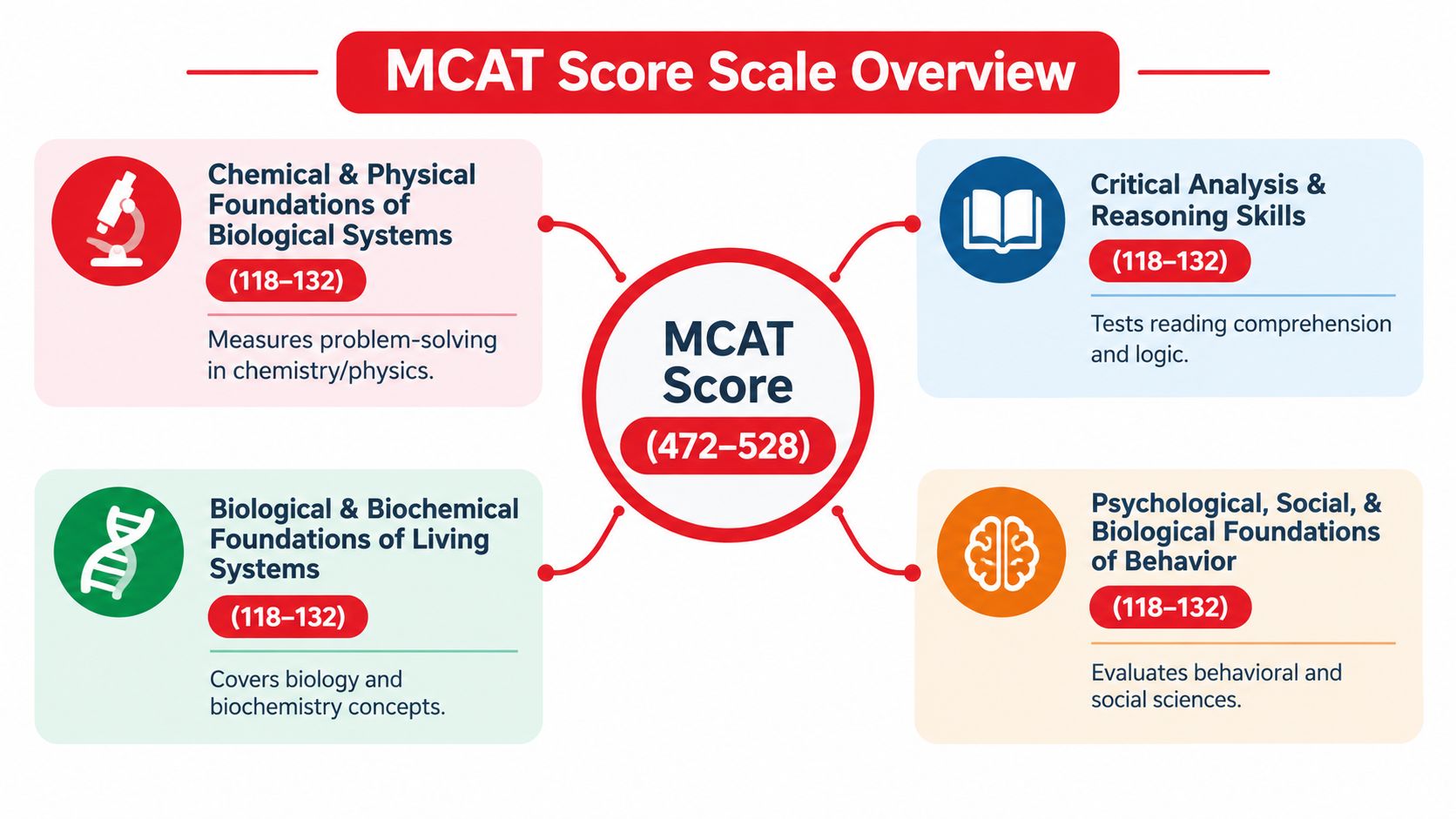
The four sections are:
- Chemical and Physical Foundations of Biological Systems, which combines chemistry and physics reasoning in biological contexts.
- Critical Analysis and Reasoning Skills, or CARS, which assesses reading comprehension and reasoning through passages.
- Biological and Biochemical Foundations of Living Systems, which emphasizes biology and biochemistry.
- Psychological, Social, and Biological Foundations of Behavior, which draws on behavioral and social science concepts alongside biology.
Each section receives a score from 118 to 132, and the midpoint is 125. The total score ranges from 472 to 528, with 500 as the midpoint, as explained in the AAMC's official MCAT exam score scale.
That structure creates an important distinction between a total and its composition. Two applicants can have the same total while showing different section patterns, and admissions readers may interpret those patterns in the context of a school's published information and the rest of the application.
Read the official report as a profile
Your official score report gives you more than a single total. It presents the total, each section score, and percentile ranks. That profile helps you identify whether your performance is broadly even or whether one area deserves closer review.
A section score isn't a verdict on your ability to become a physician. It is a testing result that can guide planning. If you consider a retest, examine the section pattern alongside practice-test trends, study time, and the consequences of adding another score to your application.
For a plain-language explanation of the total-score structure, see what the MCAT is scored out of. Keep the fixed scale in mind, but don't let the scale turn your result into a judgment about your potential.
Turning Scores Into Percentiles You Can Interpret
Raw scores are useful, but percentile rank gives them meaning. The AAMC defines a percentile rank as the percentage of test takers who earned the same score or lower. A 79th-percentile result, for example, means the score is at or above the performance of that share of the testing group, according to the current AAMC reporting framework.
The current table is effective from May 1, 2026, through April 30, 2027. Its key reference points are:
| Total score | Percentile rank | Interpretation |
|---|---|---|
| 500 | 48th percentile | Near the middle of the current testing distribution |
| 505 | 64th percentile | Above the middle of the distribution |
| 510 | 79th percentile | Roughly the top fifth of examinees |
| 515 | 91st percentile | Approximately the top 9% of examinees |
These figures come from the AAMC MCAT percentile ranks table. They show why the phrase “good MCAT score” usually points to a range rather than one universally correct number.
Why the percentile matters
A score of 500 isn't automatically poor, and a score of 515 doesn't automatically make an applicant competitive everywhere. The percentile tells you where the score sits among examinees, while the target-school range tells you how that score relates to a particular admissions pool.
The distinction matters because schools don't all serve the same missions or evaluate applicants against identical profiles. A national percentile can help you understand your test performance, but it can't replace program-level research.
Date-stamp every comparison
AAMC percentile ranks change slightly over time because the AAMC updates them every May 1 using the most recent three years of examinee data, as described in AAMC's explanation of MCAT scoring. When you record a percentile in your worksheet, write down the effective table period.
That habit prevents an old screenshot or forum post from becoming your benchmark. For additional interpretation practice, use MCAT percentile guidance alongside the current AAMC table, not instead of it.
Practical rule: Record the score, percentile table period, and section scores together. A number without its date and profile is incomplete context.
What Good Means by Medical School Competitiveness
Recent matriculant data place the mean total MCAT score around 511.5 to 512.1, and that average sits just above the 80th percentile on the current scale, according to AAMC score data for applicants and matriculants. These figures give 512 useful context, but they do not create a universal admissions cutoff. A good MCAT score depends on how the total, section scores, GPA, and school list fit together.

Compare three types of information
| Metric | What it tells you | What it cannot tell you |
|---|---|---|
| National percentile | Your position among MCAT examinees | Whether a particular school will admit you |
| Matriculant mean | The average score reported for students who enrolled | The score every admitted student earned |
| School-specific range | How enrolled or accepted students' scores are distributed at that program | Your individual admission probability |
These metrics answer different questions. A percentile works like a position on a class ranking, while a matriculant mean describes the center of a group that enrolled. A school-specific range shows the spread around that group. None of them functions as a personal probability calculator.
AAMC applicant and matriculant tables also show that matriculants have a higher mean MCAT performance than applicants overall, as reported in AAMC's MCAT and GPA tables. That difference explains why a score above 500 can still fall short of the typical academic profile at some MD programs, while a score in the low-to-mid 510s may align more closely with many enrolled-student profiles. Alignment is useful evidence, not a promise.
School context changes the target
Programs with highly selective research priorities may report different score patterns from schools emphasizing primary care, regional service, or a particular community. Use current MSAR information to compare the schools on your actual list. A range describes the program's enrolled or accepted students as a group. It does not predict your individual result.
Build a Score-Context Worksheet for each school. Record your total, four section scores, percentile, GPA, and the school's reported range. Then add mission fit, residency, service, research, clinical experience, and academic trend. The worksheet works like a map: the total shows your general location, while the section balance and application details show which routes may be realistic.
A 3 to 5 point change near 510 can cross several percentile bands and alter how your score aligns with historical matriculant distributions. Treat that movement as one factor when weighing preparation, retesting, school-list design, and timing. Review medical school admissions requirements and confirm current details through each program and MSAR.
How to Set Your Personalized Good Score Goal
Your target shouldn't begin with a slogan such as “I need the highest score possible.” It should begin with evidence. Review the official result, compare it with your actual school list, and decide whether another attempt would improve the application enough to justify the time and risk.
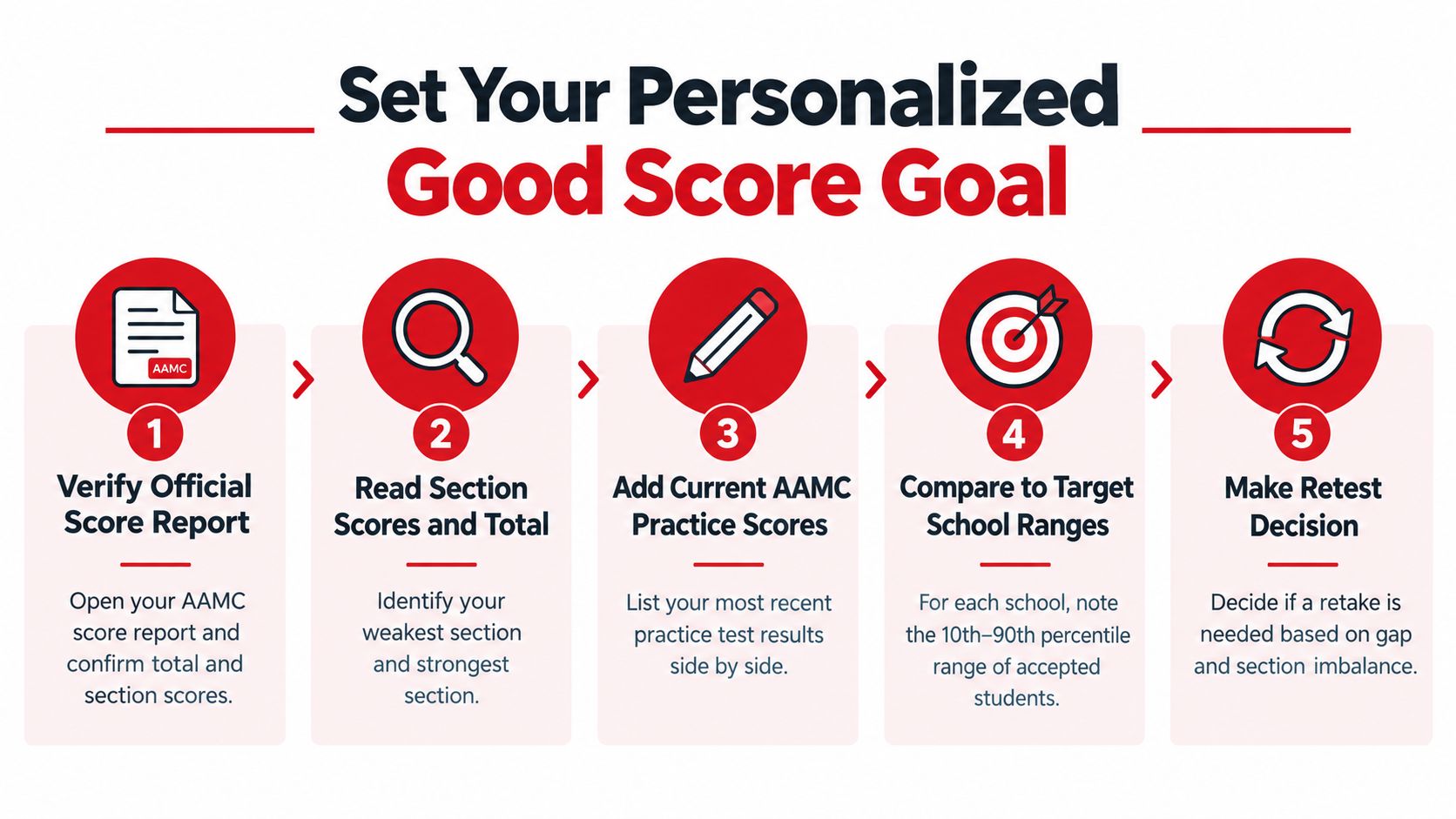
Use this sequence
- Verify the official score report. Record the total, four sections, and the percentile associated with the current AAMC table.
- Read the profile, not just the headline. Identify the strongest and weakest sections. A balanced total may support a different decision than the same total with a substantial section imbalance.
- Build a balanced school list. For each target program, record the current MSAR information that applies to your applicant type. Don't turn a school's group range into your personal admission probability.
- Audit the weakness. Separate content gaps from passage reasoning, timing, careless errors, and test-day execution. Each problem requires a different response.
- Choose among applying, retesting, or broadening. Weigh the score gap, practice performance, available study time, application timing, GPA, and the rest of your record.
Reusable Score-Context Worksheet
Copy this structure into a document or spreadsheet:
| Field | Your entry |
|---|---|
| Total score | |
| Chemical and Physical Foundations | |
| Critical Analysis and Reasoning Skills | |
| Biological and Biochemical Foundations | |
| Psychological, Social, and Biological Foundations | |
| Current AAMC percentile and table period | |
| Target schools and MSAR score information | |
| Cumulative and science GPA context | |
| State residency and mission fit | |
| Strongest section | |
| Weakest section and error types | |
| Recent practice-test trend | |
| Time available before application or retest | |
| Retest factors | Score gap, section imbalance, practice consistency, timing, and readiness |
The AAMC reports percentile ranks for both section and total scores, and those ranks represent test takers who earned the same score or lower. Because AAMC updates the tables annually using the most recent three years of examinee data, preserve the table date in your worksheet.
Use measurable performance goals to turn a weak section or error category into a defined study objective. A goal should describe the behavior you can control, such as completing targeted passage review or classifying recurring mistakes, rather than promising a particular final score.
A focused review can also be supported by this short explainer:
Worked Example Using the Score Context Worksheet
The following is a clearly labeled hypothetical composite, not a verified Ace Med Boards student story, testimonial, or measured outcome. It uses an original admissions-planning example and does not reproduce a recalled or copyrighted MCAT question.
Suppose a composite applicant has a total score that appears competitive nationally, but the section profile includes one materially weaker result. The applicant shouldn't label the score “good” or “bad.” The first task is to enter the total, each section, and the current percentile into the worksheet.
Read the imbalance against the list
The applicant then creates a school-by-school comparison using current MSAR information. One program may report a section profile that makes the weak area worth investigating, while another may evaluate the total within a different institutional context. The comparison doesn't produce an individual admission probability. It identifies where the score appears aligned, where it may be a reach, and what information remains incomplete.
Next, the applicant reviews practice-test history and error types. If the weak section reflects inconsistent timing and avoidable reasoning errors, a focused plan may be more useful than restarting every subject. If it reflects persistent content gaps, the plan should allocate time to structured review before returning to mixed practice.
The rest of the application belongs in the same worksheet. GPA, academic trend, experiences, state residency, mission fit, and available time can all affect whether retesting is sensible. A strong total with one weak section may call for targeted preparation, while a score that already fits a balanced school list may support applying without another attempt.
A good score is a decision point, not a verdict. Use it to choose the next action that fits your application.
This approach reflects the AAMC's broader applicant and matriculant data, which show that matriculant mean MCAT performance is materially higher than applicant mean performance and that low-to-mid 510s align more closely with successful matriculant profiles. Those group-level patterns can guide planning, but they can't predict an individual result.
Key Takeaways and Next Steps for Your MCAT Plan
A useful answer to “what MCAT score is good” should leave you with a process, not anxiety about one cutoff.
- The scale is fixed: Total scores run from 472 to 528, and each section runs from 118 to 132.
- Percentile gives the national context: In the current AAMC table, 510 is the 79th percentile and 515 is the 91st percentile.
- Matriculant data provide a reference, not a promise: Recent means cluster around 511.5 to 512.1, but schools and applicant profiles differ.
- Section balance matters: Record all four sections and investigate any meaningful weakness.
- Your school list determines the practical target: Compare your profile with current MSAR information and review GPA, mission fit, residency, and timing together.
Before choosing to apply or retest, complete the worksheet, date the percentile table, review your official score report, and identify the error types you can realistically address. If you need structured support with MCAT preparation or admissions planning, compare the service details and expectations carefully, and keep official AAMC information as your primary reference.
As of the May 1, 2026 percentile-table update, score interpretation should use the current AAMC table rather than an older online chart. Recheck school-specific information when you finalize your list because admissions data and reporting periods can change.
Ace Med Boards offers MCAT preparation and medical-school admissions support that can help you organize score interpretation, section-level review, and target-setting around your actual application context. Visit Ace Med Boards to review the available support and decide whether a free consultation or Board Score Audit fits your next step.