

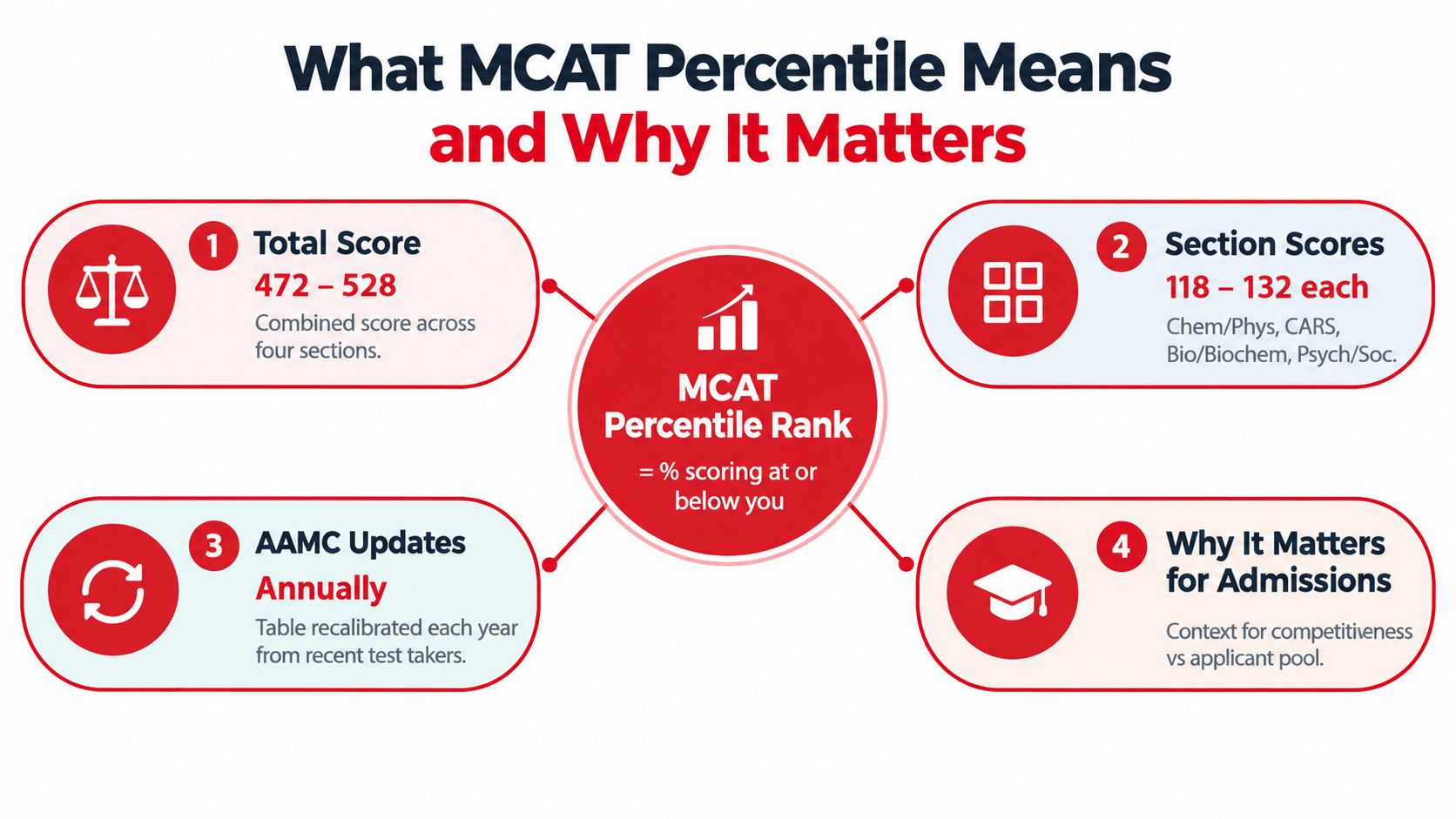
An MCAT percentile rank is the percentage of recent test takers who scored the same as or lower than a given total or section score. The Association of American Medical Colleges, or AAMC, updates percentile ranks annually on May 1 using a rolling three-year pool, and the current table is based on 2022, 2023, and 2024 testing years.
That distinction changes how you should read a score report. A raw MCAT number is useful, but its percentile gives the number context against a recent testing cohort. A score that looks strong among all test takers can still sit near the center of the matriculant pool, so a thoughtful applicant compares the percentile with section balance, academic history, experiences, and each school's current data rather than treating one conversion as an admissions prediction.
What MCAT Percentile Means and Why It Matters
The AAMC defines an MCAT percentile rank as the percentage of scores equal to or lower than a given score. If your total score falls at a particular percentile, that doesn't mean you answered that percentage of questions correctly. It means your scaled score compares with the scores of other recent examinees in that position.
The AAMC recalculates the table every May 1 using the most recent three years of examinee data, according to its official explanation of MCAT percentile ranks. The current table in the source set uses the combined 2022–2024 testing years, so percentile interpretation depends on the reporting period, not only on the score printed on your report.
What a percentile can tell you
A percentile translates a scaled score into a comparative position. That helps you:
- Benchmark performance: See how your score compares with recent test takers.
- Set a target: Use current AAMC data rather than an outdated conversion chart.
- Read the profile: Compare your total percentile with the percentiles for all four sections.
- Discuss competitiveness: Frame the score alongside the ranges reported by schools you're considering.
A percentile can't predict an individual admission decision. It doesn't account for your GPA, course history, clinical exposure, service, writing, letters, state residency, institutional mission, or the school list you build. It also doesn't predict specialty fit or residency outcomes later, because the MCAT belongs to the medical-school admissions stage, not residency selection.
Practical rule: Treat percentile as a reference point, not a verdict.
The rest of the score interpretation process is straightforward: understand the scaled score, verify the current percentile table, read every section result, compare the profile with realistic school data, and decide whether applying or retesting makes sense for the whole application.
How the MCAT Is Scaled and Scored
The MCAT has four section scores from 118 to 132 and a total score from 472 to 528, as described in the AAMC score-report materials. The four sections are:
- Chemical and Physical Foundations of Biological Systems
- Critical Analysis and Reasoning Skills, commonly called CARS
- Biological and Biochemical Foundations of Living Systems
- Psychological, Social, and Biological Foundations of Behavior
The total is the sum of the four section scores. Each section has a midpoint of 125, and the total scale has a midpoint of 500. These midpoints help orient you to the scale, but they aren't admission thresholds.
A test form contains questions that vary in difficulty. The AAMC converts a raw number of correct answers into a scaled score through an equating process designed to make scores comparable across different forms. Percentiles attach to the scaled score, not to the number of questions answered correctly.
That means you shouldn't compare raw correct-answer counts from different administrations as though they represent the same performance. A scaled score of 510 is the meaningful comparison point, and the current percentile table tells you how that score ranks against the relevant recent cohort.
Total and section scores answer different questions
Your total score summarizes performance across the four sections. Section scores show whether that total is balanced or depends heavily on one area.
A strong total with a substantially lower section can prompt a closer review, particularly if the weaker area connects to a school's expectations or to a broader academic pattern. The opposite is also possible. A balanced profile may communicate consistency even when the total isn't at the highest end of the scale.
For a plain-language overview of the numerical scale, see what the MCAT is scored out of. Use the official score report for your actual result, and use the current AAMC percentile table for interpretation. Don't infer your percentile from a practice test unless that practice product explicitly provides a carefully labeled estimate, because practice and official scoring systems aren't interchangeable.
How AAMC Calculates Percentile Ranks Each Year
The AAMC builds percentile ranks from a rolling three-year pool of MCAT results. The current source set combines scores from 2022, 2023, and 2024, rather than relying only on one testing year. The AAMC then updates the ranks annually on May 1, so the comparison group changes as a new year enters the pool and the oldest year leaves it.
This structure explains why a score doesn't carry a permanently fixed percentile. The AAMC reported that 74% of total MCAT scores were at or below 508 in the 2022–2024 combined dataset, while its earlier 2020–2022 table reported 72% at or below 508. Those figures come from different reporting windows, so applicants using an older chart may read the same score differently.
The change can be small, but small changes matter when applicants compare themselves with a school's published data or decide whether a retest is worth the time and risk. The AAMC's definition remains consistent: percentile rank includes scores equal to or lower than the score being interpreted.
Why older charts create confusion
Online tables often remain available after the AAMC has released a newer version. A chart can be mathematically accurate for its original reporting period and still be unsuitable for a current applicant.
Before relying on a conversion, check:
- The effective reporting period: Identify the three testing years included.
- The score definition: Confirm that the table uses scores equal to or lower than the reported score.
- The score type: Make sure you're reading a total-score table or the correct section table.
- The source date: Prefer the current AAMC table over an undated secondary chart.
The same rolling-pool principle applies to section percentiles. A section score's rank can move as the national distribution changes, even when your scaled score remains exactly the same.
For broader score-range context, review MCAT score ranges and their interpretation. The useful question isn't whether an older chart called your score “good.” It's whether the current percentile, section pattern, and target-school data support the application strategy you're considering.
Reading Your Score Report and Section Percentiles
Your official MCAT score report gives you more than a total. It includes the four section scores, the total score, and a percentile rank for the total and each section, as shown in the AAMC's score-report guidance for admissions officers.
Read the report in this order:
- Verify the total score. Confirm that the four section scores add to the reported total.
- Record every section percentile. Don't evaluate the total while ignoring the profile underneath it.
- Review the confidence band. The report's 95% confidence band communicates measurement uncertainty around the score.
- Read profile statements carefully. A statement can flag a section that falls 1 to 2 standard deviations below the mean.
- Check the letter value scale. Use it as one signal when considering whether a retest deserves further review, not as a standalone decision rule.
Consider this labeled, hypothetical composite example. The applicant has section scores of 128, 127, 130, and 129, for a total of 514. The section order below follows the standard MCAT sequence. The percentile descriptions are illustrative, so an applicant should replace them with the current AAMC values shown on their own report.
Composite MCAT Score-Reading Example 514 Total
| Section | Scaled Score | Illustrative Percentile Rank | What to Note | Action Cue |
|---|---|---|---|---|
| Chemical and Physical Foundations | 128 | Use current AAMC report | Compare science strength with target-school expectations | Keep if practice and academic evidence support it |
| Critical Analysis and Reasoning Skills | 127 | Use current AAMC report | Review whether reading speed or reasoning creates avoidable misses | Consider focused review before retesting |
| Biological and Biochemical Foundations | 130 | Use current AAMC report | Identify a clear academic strength | Preserve this section while addressing weaker areas |
| Psychological, Social, and Biological Foundations | 129 | Use current AAMC report | Check balance rather than relying on the total alone | Review any profile statement or academic concern |
| Total | 514 | Use current AAMC report | Compare with current school data and the full application | Apply or retest only after a whole-file review |
Your score-context worksheet
Copy this template into a planning document:
- Total score: ______
- Chemical and Physical Foundations score: ______
- Critical Analysis and Reasoning Skills score: ______
- Biological and Biochemical Foundations score: ______
- Psychological, Social, and Biological Foundations score: ______
- Current AAMC total percentile: ______
- Current AAMC section percentiles: ______ / ______ / ______ / ______
- Target-school ranges from current MSAR data: ______
- Academic strengths and concerns: ______
- Profile statement flags for advisor review: ______
- Retest factors: practice trend, error pattern, preparation time, application timing, and stress cost
The report is a starting point. MCAT score release dates can help you place the score review within your application timeline, but the decision should follow the complete worksheet rather than one percentile number.
Percentile Versus Admissions Competitiveness
The all-test-taker percentile and the matriculant benchmark answer different questions. The percentile asks how your score compares with recent MCAT examinees. The matriculant benchmark describes students who ultimately entered medical school, a more selective group shaped by academic preparation, application decisions, school selection, and the admissions process.
The source set reports a recent matriculant median of about 512.1 for 2025–2026, while the score near the 50th percentile for all test takers remains around 500. It also places a 515 around the 91st percentile among all test takers. A 515 is therefore clearly above the center of the testing population, yet it remains relatively close to the center of the matriculant pool.
That gap is why “above average” can be misleading. Being above the average test-taker score doesn't automatically mean that a file is competitive at every medical school. Admissions committees read the MCAT beside the rest of the application and within the context of each institution's mission.
A more useful comparison
| Total Score | Approx. All-Test-Taker Percentile | Matriculant Pool Position | Competitiveness Note | Section Balance Reminder |
|---|---|---|---|---|
| Around 500 | Near the all-test-taker midpoint | Below the recent matriculant median | Requires careful school-list and application-context review | Examine every section |
| 508 | About the mid-70s in the current reporting window | Below the recent matriculant median | May require a particularly deliberate, balanced list | A lower section can affect interpretation |
| 512 | Above the all-test-taker midpoint | Near the recent matriculant median | Context, mission fit, and academic record remain central | Don't assume the total tells the whole story |
| 515 | Around the 91st percentile | Near or modestly above the recent matriculant median | Strong relative standing, but not an admission probability | Review section spread and school ranges |
| 518 | Around the mid-90s in the current reporting window | Above the recent matriculant median | The rest of the application still matters | A weaker section may deserve attention |
These categories aren't tiers that guarantee an outcome. They're comparison anchors. A current good MCAT score framework should begin with the AAMC table and each target school's current Medical School Admission Requirements, or MSAR, range, then account for GPA, experiences, writing, identity, geography, and mission fit.
Don't convert a group's score range into an individual admission probability. A school's reported range describes a population, not a promise for any one applicant.
Decide Whether to Apply, Retest, or Adjust Your List
A score-release decision should be deliberate, not a reaction to anxiety. Start with the official report, then move through four questions: What caused the misses? Which section is weakest? How much usable preparation time remains? How strong is the rest of the application relative to the schools under consideration?
The decision tree
1. Classify the errors. Separate content gaps from passage reasoning, timing, careless reading, and endurance problems. If your practice record shows a stable pattern and you have time to correct it, a retest may be worth evaluating. If the score reflects your recent timed performance and the rest of the application is ready, applying may be reasonable.
2. Identify the weakest section. A balanced score and a single materially lower section lead to different conversations. Check the section percentile, relevant coursework, practice trend, and the expectations of your target schools.
3. Check the calendar. If you have enough time for content review, timed practice, and full-length analysis without damaging the application, keep retesting on the table. If a retest would delay a coherent application or force rushed preparation, applying with a carefully revised list may be wiser.
4. Review the full file. Include GPA, academic trends, clinical exposure, service, writing, letters, state ties, and school mission. A percentile can't evaluate those factors.
Retesting should have a reason, a measurable preparation plan, and a realistic timeline.
Three hypothetical pathways
- A 507 with strong extracurricular preparation: This applicant might apply if the target list is balanced and the school data support the profile. A retest becomes more compelling when practice scores show room to improve and the application timeline allows focused work.
- A 514 with CARS below 125: The total alone doesn't settle the decision. The applicant should compare the section profile with target-school expectations, review whether the weakness is persistent, and decide between a focused retest and a broader list.
- A 518 with a weaker GPA: A high percentile doesn't erase an academic concern. The applicant may need to broaden the list, explain academic trends through the application, and seek schools whose missions and review practices fit the full record.
The outcomes are therefore simple, even when the reasoning isn't:
- Apply now when the score is stable, the application is ready, and the school list is balanced.
- Plan a retake when practice data identify correctable weaknesses and the timeline supports thorough preparation.
- Adjust the list when the score or section profile doesn't align with the current list, especially when other application factors add risk.
A low MCAT score planning guide can help organize that review without turning one result into a judgment about your future. Percentiles are reference points, not pass-fail thresholds, and holistic review always matters.
A Practical Plan to Raise Your MCAT Percentile
Percentile improvement usually starts with a better study system, not with indiscriminate content accumulation. Begin by finding the specific reason points are being lost, then build practice around that reason.
Four phases for focused preparation
Phase 1, diagnostic baseline. Take an AAMC full-length under strict timed conditions. Record the total, every section score, timing issues, confidence level, and the questions you changed from right to wrong or wrong to right.
Phase 2, error logging. For each missed or guessed question, identify the section, question type, content area, and reasoning error. Useful categories include knowledge gap, passage interpretation, graph reading, calculation setup, premature answer choice, timing, and careless reading.
Phase 3, focused review. Choose one weakest section as the primary weekly target. Review the relevant content only when the error log shows a knowledge problem, then return to passage-based practice to test whether the review changed your reasoning.
Phase 4, timed practice loop. Use AAMC section banks and full-length retests at planned intervals. Review each assessment thoroughly rather than treating the score as the only output. Official AAMC practice materials remain the most relevant reference for estimating readiness because they reflect the exam's own style and objectives.
An eight-week planning framework
| Time | Primary work | Checkpoint |
|---|---|---|
| Week 1 | Diagnostic and error taxonomy | Establish section priorities |
| Week 2 | Targeted content review and timed passages | Check whether recurring errors have clear causes |
| Week 3 | Weakest-section practice with deliberate review | Track timing and reasoning changes |
| Week 4 | Section-focused assessment | Reclassify unresolved errors |
| Week 5 | Mixed timed practice and endurance work | Look for consistency across sections |
| Week 6 | AAMC practice assessment and full review | Compare patterns, not just totals |
| Week 7 | Final targeted repair | Protect strengths while addressing the largest weakness |
| Week 8 | Readiness review and decision point | Decide whether to test, delay, or apply |
One-on-one MCAT tutoring can complement independent study when you need an outside review of error patterns, a structured accountability system, or help separating content confusion from passage reasoning. Ace Med Boards offers individualized MCAT preparation, but tutoring should supplement, not replace, official AAMC materials and your own careful practice review.
Progress checklist
- Practice record: Log each assessment's total and section results.
- Error pattern: Count recurring reasoning and content categories qualitatively.
- Stamina: Note when accuracy or focus declines during timed work.
- Section balance: Check whether the weakest area is improving without sacrificing a strength.
- Decision readiness: Choose a test date only when the preparation trend and application timeline support it.
The goal isn't to chase a percentile in isolation. The goal is to develop a repeatable performance pattern that supports a well-reasoned application decision.
Key Takeaways and Frequently Asked Questions
Key takeaways
- Percentiles are relative: The AAMC builds them from a rolling three-year pool and updates them on May 1.
- All-test-taker and matriculant benchmarks differ: A 515 sits around the 91st percentile among all test takers, while the recent matriculant median is about 512.1 for 2025–2026.
- Sections matter: A total score can hide an uneven profile, so read all four section percentiles.
- Context drives decisions: Compare the current percentile with GPA, experiences, school mission, and current MSAR ranges.
- Systems beat cramming: Diagnostic testing, error classification, focused review, and timed practice create a more useful preparation loop than collecting content without analysis.
Frequently asked questions
Can I retake the MCAT after receiving a low percentile?
You can consider a retest when your error analysis identifies correctable problems, your practice performance supports improvement, and the timeline allows adequate preparation. A retest isn't automatically better, so weigh the possible benefit against preparation time, stress, and the rest of your application.
How long should I wait for my score report?
Use the official AAMC score-release schedule for your test date. Once the report arrives, verify the total, four section scores, percentiles, confidence information, and any profile statement before deciding what to do.
Do medical schools see old percentile tables?
Schools review the score information submitted through the official reporting process. Because percentile tables change, applicants should interpret a historical score using the reporting context attached to that score rather than applying today's table backward without checking the report.
Does a future residency specialty change my MCAT target?
Residency specialty plans generally shouldn't determine an MCAT target in isolation. The MCAT is used for medical-school admissions, so choose targets based on the medical schools you're considering and the strength of your complete application. Specialty competitiveness becomes a later residency question.
If you're unsure how to interpret your total, section balance, and school list together, a free consultation can help you organize the decision without promising an admissions result.
Ace Med Boards can help MCAT applicants review score reports, identify section-level patterns, and build a focused preparation plan alongside official AAMC resources. Visit Ace Med Boards to request a free consultation and discuss whether applying, retesting, or adjusting your list best fits your current profile.