Step 1 time management is a block-level pacing skill, not a per-question speed contest. In the current format, the target is roughly 40 questions in 60 minutes, with a halfway checkpoint and reserved final review minutes, adjusted to 20 questions in 30-minute blocks after May 14, 2026.
A learner who keeps rereading the same vignette, debates one difficult diagnosis, and reaches the final minutes with unanswered questions usually doesn't need to “think faster” in the abstract. The learner needs a repeatable system for recognizing the source of delay, checking position during the block, and deciding when to answer, flag, or move on.
Why You Keep Running Out of Time on Step 1 Blocks
For exams administered before May 14, 2026, United States Medical Licensing Examination (USMLE) Step 1 includes up to 280 multiple-choice questions across seven 60-minute blocks, with no more than 40 questions in a block. That creates an average of approximately 1.5 minutes, or 90 seconds, per question, but the official constraint is the block clock, not a rigid promise of 90 seconds for every item. Question counts can vary, so the on-screen timer must guide pacing. USMLE's Step 1 exam content page describes the pre-May 14, 2026 structure.
The full testing session lasts approximately eight hours and includes at least 45 minutes of break time, plus a 15-minute optional tutorial. Completing the tutorial or a block early can increase available break time, which means efficient work affects both answering time and recovery time. A candidate who spends too long on one hard vignette can lose the chance to answer later questions, while a candidate who finishes efficiently can convert saved minutes into a deliberate reset.
The clock problem is usually cumulative
A single slow question rarely causes a crisis. The problem appears when several small delays accumulate:
- Rereading: The stem gets read repeatedly because the learner hasn't identified the task.
- Overprocessing: A familiar concept receives an unnecessarily elaborate differential diagnosis.
- Delayed commitment: Two plausible choices remain open long after the available evidence has been weighed.
- Weak position awareness: The learner doesn't check progress until the final minutes.
- Unplanned review: Flagged questions receive attention only after unanswered items have become urgent.
A sustainable routine therefore has two levels. At the question level, each item needs a decision rule. At the block level, the learner needs checkpoints that reveal whether the pace is holding.
Practical rule: A difficult question may deserve a flag, but it doesn't deserve the time required to answer several manageable questions later.
Before changing resources or adding more daily questions, a learner can review the USMLE test-taking skills guide and identify which delay appears most often. The next practice block should then measure that specific behavior rather than relying on a general feeling of being slow.
Diagnosing Reading Problems Versus Knowledge Problems
Not every slow question reflects weak knowledge. A learner may understand the material but lose time parsing long sentences, or may read quickly and then stall because the underlying concept isn't available. A third pattern appears when the content is known but the learner can't commit between two answer choices.
Three timing failures require three different responses
A reading problem appears when the learner spends too long extracting the task. Common signs include rereading the final sentence, losing track of the patient's timeline, or reaching the answer choices without knowing what the question asks. The remedy is structured stem analysis. The learner can identify the patient, the decisive finding, the time course, and the requested output before examining every distracting detail.
A knowledge problem looks different. The learner moves through the stem at a reasonable pace but can't explain the mechanism, distinguish related diagnoses, or recall the next step. More timed questions won't automatically repair that gap. The missed concept belongs in targeted content review, followed by retrieval without notes.
A decision problem occurs when the learner understands the tested concept but keeps reopening a choice. This often involves two answer options that differ by one discriminating feature. The remedy is to state the deciding feature, choose the option supported by the stem, and flag only if a brief second pass could realistically change the answer.
| Pattern | What It Looks Like | Best Fix |
|---|---|---|
| Reading problem | Repeated rereading, slow stem parsing, unclear task | Practice identifying the question task and decisive findings |
| Knowledge problem | Fast reading followed by conceptual blankness | Repair the specific topic and retrieve it later without notes |
| Decision problem | Prolonged debate between two plausible choices | Use a discriminating feature, commit, or flag promptly |
| Pacing problem | Correct answers early, unanswered items late | Add checkpoints and protect a final review period |
The error log should record the cause of delay, not just whether the answer was correct. A correct answer reached after excessive rereading still matters because the same behavior can become costly across a block.
Step 1 score reporting changed to pass/fail for exams administered on or after January 26, 2022, removing the traditional three-digit outcome. The former three-digit passing standard increased from 194 to 196, and official performance data showed that among all examinees, the pass rate declined from 88% in 2021 to 82% in 2022. Those figures don't show that time management caused the change, but they do show why execution under timed conditions deserves direct measurement. The policy and performance information appears in the official USMLE examination results and scoring information.
Learners who need a more deliberate approach to extracting the task from a vignette can use how to read faster and understand as a separate reading-skills exercise. The key is to avoid treating every timing failure as a content failure.
The Timed-Block Audit You Can Run This Week
A timed-block audit turns “the block felt slow” into observable evidence. It should be repeated under consistent conditions, because a useful comparison requires the same timing rules, question mix, and review process.

Four steps for the audit
Run one timed block without pauses. Use a mixed set when the goal is pacing diagnosis. The learner shouldn't pause to consult a resource, check an answer, or reset the clock.
Record the block behavior. Note completion time, unanswered items, and the number of questions that required rereading. The record should also include whether the learner reached the halfway checkpoint on schedule.
Classify every miss and delay. Use the categories knowledge absence, misinterpretation, premature closure, calculation error, and pacing. A single item can have more than one contributing issue, but one primary cause should be selected for tracking.
Close the loop. Retrieve the corrected concept without notes, write a concise explanation, and schedule the item for later spaced review. A systematic review and meta-analysis of 13 studies involving 21,415 medical learners found a significant advantage for spaced repetition over standard study methods, with a standardized mean difference of 0.78, a 95% confidence interval of 0.56 to 0.99, and p < 0.0001. The evidence is reported in this PubMed review of spaced repetition.
A practical audit sheet might contain these fields:
- Position: Question number at the halfway checkpoint
- Completion: Time remaining when the block ended
- Unanswered: Items left without a submitted answer
- Rereading: Count of items reread
- Cause: Primary reason for each miss or delay
- Correction: One retrieval prompt for later review
If the learner repeatedly misses the halfway checkpoint, the main issue is likely block pacing or early overinvestment. If rereading counts are consistently high, reading efficiency deserves attention. If the block finishes on time but conceptual misses dominate, speed isn't the primary problem.
A historical Academic Medicine survey found an average of 5.8 weeks of full-time preparation at 53 hours per week, approximately 307 total hours. That figure is a planning benchmark, not a prescription, and it shouldn't be used to judge a learner with rotations, caregiving responsibilities, illness, or a different baseline. The schedule should protect timed questions, error review, targeted repair, and cumulative retrieval. Learners who use focus cycles can compare approaches such as Pomodoro to energy management, but the cycle should support block practice rather than replace it.
Flashcards also need limits. Converting every missed detail into a card can create a second workload that crowds out question review. Only persistent, high-value errors should become concise prompts, and the learner should reassess recurring categories each week. Full-length practice under official timing can be incorporated through USMLE practice exams, with the review treated as part of the assessment rather than an optional extra.
Pacing Checkpoints and Flag-and-Return Decisions
The halfway checkpoint prevents a learner from discovering a pacing problem too late. In a pre-May 14, 2026 block with up to 40 questions, the learner should know roughly where the midpoint falls and compare that position with the clock. The exact question count may vary, so the on-screen time matters more than assuming every block contains 40 items.
A simple rule works well: at the halfway point, the learner should be near the halfway point of the questions. If the learner is behind, the next several decisions must favor efficient execution. That doesn't mean guessing through the block. It means avoiding unnecessary rereading, postponing low-probability debates, and protecting time for unanswered items and flagged questions.
A decision rule for each question
Commit immediately when the stem supports one answer and the learner can explain why the closest alternatives don't fit. Extra analysis rarely improves a straightforward item.
Choose and flag when two options remain plausible, but one feature in the stem favors one choice. The learner should record the deciding feature mentally, submit the answer, and move forward. A return is useful only if the second look has a defined purpose.
Flag and move on when the learner can't identify the tested concept, needs extensive calculation, or is rereading without extracting new information. The item remains important, but it shouldn't control the block.
At the final minutes, unanswered items take priority. A flagged question can't be reviewed if the learner has allowed the clock to expire while debating an earlier item. Every practice block should therefore include a final review period, even if that period begins with only a small amount of time.
A useful boundary: One difficult vignette must never consume the time needed for three answerable ones.
Untimed, topic-specific sets can help during early content repair, but they don't train rapid discrimination among competing diagnoses. Mixed timed sets should appear early enough to expose pacing problems, followed by longer block simulations as the examination approaches. Learners interested in broader timed-study ideas can also review perfect MCAT score tips, while adapting any technique to Step 1's official block structure rather than copying an unrelated exam strategy.
Treating Break Time as a Strategic Budget
Breaks aren't separate from Step 1 strategy. They are part of the same time budget because the exam uses cumulative break time, including authorized time spent between blocks whether the examinee remains at the workstation or leaves the testing room.
For the pre-May 14, 2026 format, the starting break allotment is 45 minutes. Completing the optional tutorial or finishing a testing block early adds unused time to the total break allowance. Exceeding the available accumulated break time causes the excess to be deducted from total testing time, and once a block begins, the examinee generally can't leave except for an emergency. These mechanics are described in the official USMLE bulletin.
A rehearsal plan for breaks
A full-length practice session should include planned breaks instead of improvised stops. The learner can:
- Choose break points: Place brief resets between selected blocks rather than waiting for exhaustion.
- Track the balance: Record how much break time remains after each planned stop.
- Prepare essentials: Fit hydration, food, restroom use, and mental reset into the available budget.
- Finish correctly: Submit the block before stopping. Unused block time helps only when the block is properly completed and the time is credited.
- Repeat the full day: Practice the one-day format, not only isolated question sets.
A learner who finishes a block early gains flexibility, but that flexibility doesn't justify stopping before submission or extending a break beyond the accumulated balance. The strongest rehearsal resembles the actual testing day closely enough that fatigue, transitions, and food timing become familiar rather than disruptive.
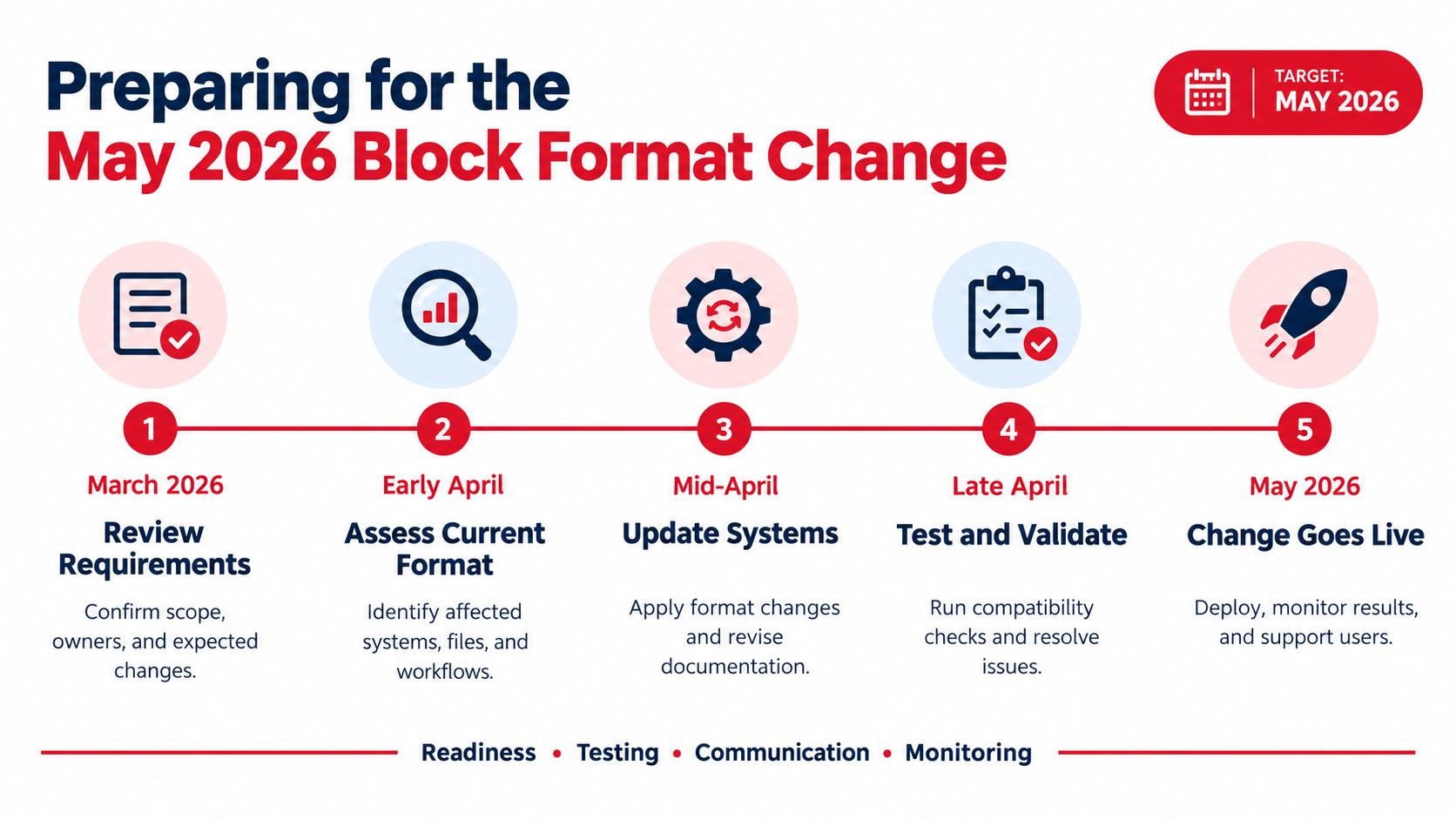
Preparing for the May 2026 Block Format Change
USMLE exams taken on or after May 14, 2026 use 14 30-minute blocks, with no more than 20 questions per block, at least 55 minutes of break time, and a five-minute tutorial, while retaining an approximately eight-hour session and up to 280 items. Exams administered before that date use seven 60-minute blocks, up to 40 questions per block, at least 45 minutes of break time, and a 15-minute optional tutorial. The current format information is available through the USMLE Step 1 resources.
The average question-level rhythm remains approximately 90 seconds when calculated across 20 questions in 30 minutes, but the cognitive demand changes. Shorter blocks require more frequent attention resets, more repeated transitions, and more decisions about whether to take a break. A learner who trained only with long blocks may know how to endure sustained work but still lose time restarting focus 14 times.
Match practice to the test date
Learners should verify the examination date and use practice sessions that match the assigned format. Those testing before the change should rehearse longer blocks, longer periods of continuous concentration, and the pre-change break allowance. Those testing on or after the change should rehearse shorter blocks, frequent resets, and the newer break budget.
A standardized transition routine can be brief and consistent:
- Confirm the block has been submitted.
- Take one controlled breath and relax the hands.
- Reset posture and focus.
- Begin the next block without reviewing the previous block mentally.
Students whose preparation spans the transition should compare performance across both block lengths when possible. The audit should examine not only unanswered questions, but also fatigue after repeated transitions, time lost at block starts, and whether the final blocks show a drop in decision quality. Ace Med Boards' USMLE Step 1 preparation information can be considered alongside official USMLE materials when a learner is organizing format-specific preparation.
Rebuilding Your Schedule When Time Management Breaks Down
A disrupted schedule doesn't require a punishment plan. Illness, clinical rotations, academic delays, caregiving, or a weak practice assessment can reduce available time, but the recovery strategy should preserve the activities that produce evidence of readiness.
Separate fixed constraints from compressible work. The exam date, required practice assessments, question-review time, and sleep need protection. Exhaustive video completion, low-yield rereading, and resource switching can be reduced or postponed.
A minimum viable study day
On a difficult day, the learner can preserve a smaller version of the closed loop:
- Complete one timed set or a defined portion of a block.
- Review the reasoning behind every miss.
- Retrieve a small group of previously missed concepts.
- Record unanswered questions, average time per item, and fatigue.
- Stop at a planned time that protects sleep.
Weekly targets should roll forward rather than depend on a perfect calendar. The learner can review time-management planning for entrepreneurs for general ideas about flexible scheduling, then apply the same principle to question review and recovery buffers. A structured USMLE Step 1 preparation schedule should measure corrected reasoning errors and reviewed questions, not only hours spent at a desk.
The weekly audit can track four practical signals: unanswered questions, average time per item, fatigue across blocks, and full practice tests completed under official timing. Persistent pacing errors may call for a narrower content plan, a different block sequence, or outside accountability. A free consultation with Ace Med Boards can help a learner examine those patterns and decide whether structured USMLE tutoring fits the current preparation plan.
Ace Med Boards offers personalized USMLE Step 1 tutoring that can focus on timed-block analysis, question-review habits, and format-aware pacing. Learners who want a structured discussion of their current timing data can visit Ace Med Boards to explore a free consultation without committing to a particular study approach.