A UWorld review session can start with one missed question and end with a copied paragraph, several screenshots, and another Anki card that feels impossible to answer. After enough sessions, the deck grows faster than the learner's ability to review it. The practical answer to how to make Anki cards from UWorld is selective extraction: turn each missed, guessed, or repeatedly forgotten learning point into one to three small retrieval prompts, not a duplicate of the explanation.
UWorld should supply the clinical reasoning problem, while Anki preserves the decision rule after the question is closed. The workflow below is designed for medical students, osteopathic medical students, international medical graduates, residents, and other board-focused learners who need useful personal cards without creating a second full textbook.
The Selective Card-Making Workflow
The common failure begins with good intentions. A learner misses a question, reads the explanation carefully, and copies nearly everything into Anki because every sentence feels relevant. The result is a deck full of context, distractors, exceptions, and prose that must be reread before an answer can be found.
A better rule is simple: one meaningful UWorld learning point should produce only one to three atomic cards. UWorld supports highlighting text and graphics from explanations, transferring material into customizable cards, and using SmartCards with spaced repetition, but those features work best when the learner edits aggressively rather than transferring entire explanations (UWorld's USMLE features).
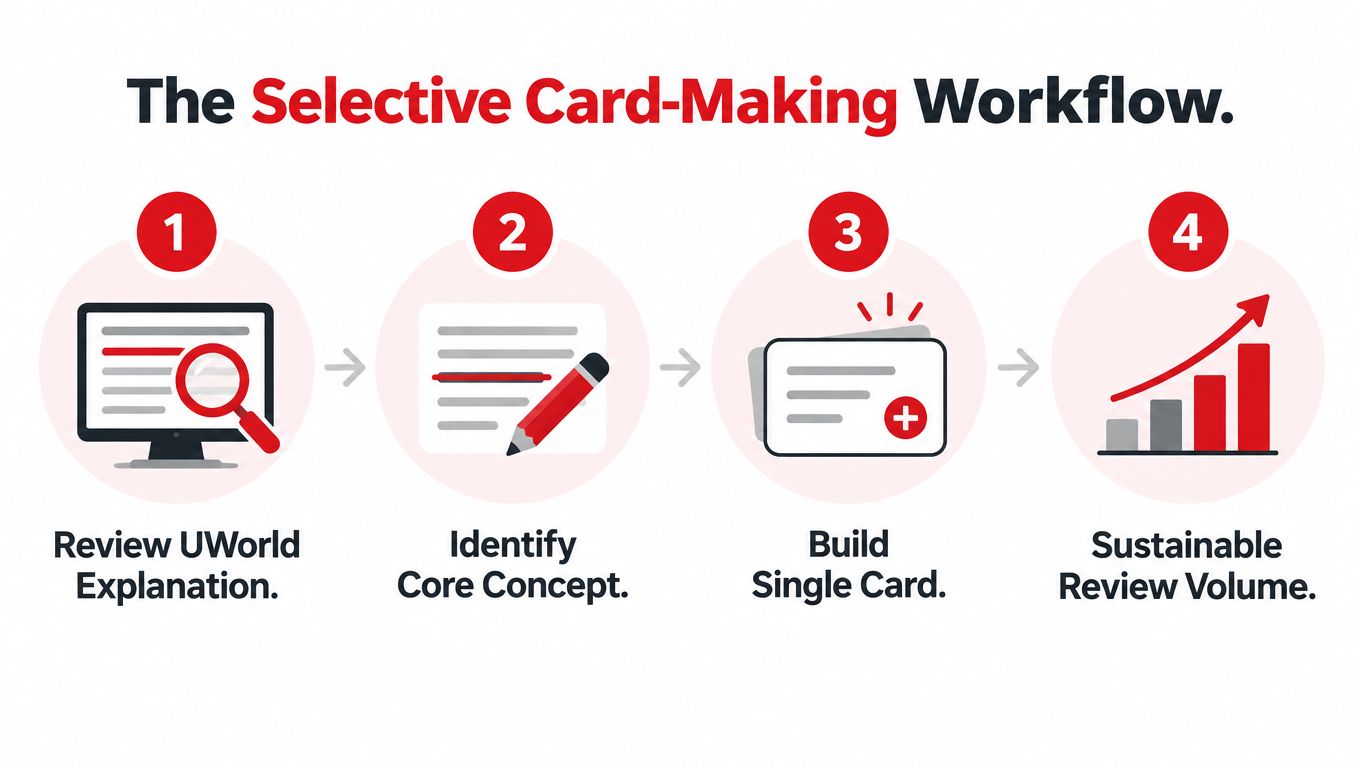
Start with the error, not the explanation
After reviewing the answer, the learner should name the failure in one sentence:
- Knowledge gap: The relevant fact or mechanism wasn't known.
- Misread stem: A key clinical clue was overlooked.
- Reasoning error: The facts were known, but they weren't connected correctly.
- Careless mistake: The correct interpretation was available but not applied.
That label determines what belongs on the card. A knowledge-gap card might ask for a mechanism. A reasoning-error card should preserve the discriminating clue and ask for the diagnosis or next step. A misread-stem card can test the finding that should have changed the answer.
The next filter is deletion. Remove background sentences that don't help answer the prompt, low-probability trivia, repeated distractor explanations, and details that will never be reviewed independently. Keep the clinical cue, the answer, the why, and, when useful, one contrast with the closest alternative.
Practical rule: If the front requires rereading a full explanation before the learner can identify what is being tested, the card is too broad.
A sustainable system also sets a review ceiling before adding new cards. Anki's review statistics can show daily study time, time per card, and total cards reviewed, which helps learners monitor workload instead of treating card production as progress. Learners who want a deeper explanation of the underlying method can review active recall and its role in medical studying.
Converting UWorld Questions into Anki Cards
The technical process can remain quick if the decision about card value happens before formatting. After completing a UWorld question, the learner should use the following sequence.
A practical conversion sequence
Finish the question before opening the explanation. Mark the item as missed, guessed, or uncertain. A correct answer reached by weak reasoning can be more valuable than an easy correct answer.
Read the explanation for the decision point. Ask, “What single clue, mechanism, diagnosis, or management principle would prevent this error next time?” Don't begin by highlighting every unfamiliar sentence.
Search for an existing card. If a personal deck already tests the same learning point, suspend or edit the duplicate instead of creating another version. A pre-made card can be useful when it matches the learner's error, but a custom card is justified when the existing wording doesn't test the actual confusion.
Use UWorld SmartCards when convenient. UWorld describes SmartCards as customizable cards that can be organized into decks and searched by topic. The learner can highlight relevant explanation material, transfer it, and then rewrite the result into a shorter prompt rather than preserving the original paragraph. UWorld's My Notebook also allows learners to combine classroom material with QBank examples and personalize notes (UWorld's Clinical QBank features).
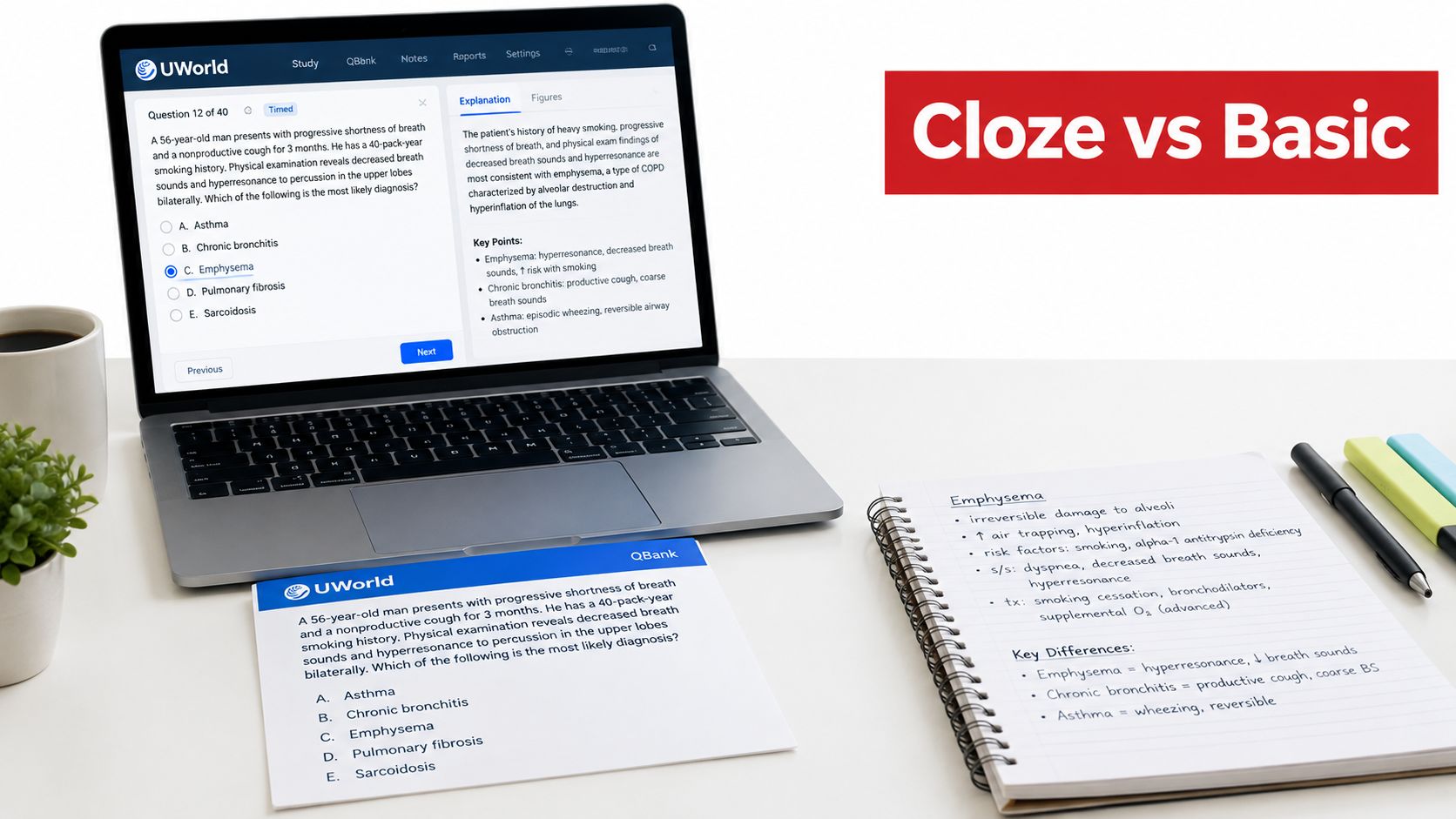
Create the Anki version manually when needed. In Anki, choose a cloze note for a sentence-based relationship or a basic note for a direct question and answer. Paste only the clinically relevant context, conceal the target, and add a concise explanation on the back.
Tag it before leaving the editor. Include the exam, organ system, and error type. Add a question identifier only if it helps the learner find the original review later.
For example, an original educational card might read:
- Weak front: “What is renal physiology?”
- Stronger front: “A patient with persistent vomiting develops metabolic alkalosis. The expected urine finding that helps explain maintenance of the alkalosis is increased {{c1::urinary chloride loss}}.”
- Back: “Volume contraction and chloride depletion sustain bicarbonate retention. The key learning point is the mechanism, not every sentence in the explanation.”
The card preserves a clinical cue while testing one answer. The learner can also consult Ace Med Boards' guide to using UWorld questions for USMLE preparation when building a broader question-review routine.
Building Cloze Deletions and Basic Cards
Card format should follow the type of knowledge being tested. Cloze deletions work well when a meaningful sentence contains a relationship, mechanism, diagnostic clue, adverse effect, or next step. Basic cards work better for a definition, classification, or standalone association that doesn't need a sentence with multiple linked elements.
Anki's official manual defines a cloze deletion as hiding one or more words in a sentence. In the editor, the learner selects the Cloze note type, enters the sentence, highlights the target, and applies the cloze button. Tags can be added in the editing window or browser, allowing cards to be labeled by exam, organ system, question identifier, or study phase (Anki's official editing manual).
Three original card models
| Learning point | Front | Back |
|---|---|---|
| Mechanism | “A patient with severe diarrhea develops a normal-anion-gap metabolic acidosis because of {{c1::bicarbonate loss from the gastrointestinal tract}}.” | “The lost bicarbonate is replaced by chloride, preserving the anion gap.” |
| Diagnostic discriminator | “A patient has episodic wheezing, nasal polyps, and symptoms after taking aspirin. The most useful association is {{c1::inhibition of cyclooxygenase with increased leukotriene activity}}.” | “The clinical pattern points to aspirin-exacerbated respiratory disease. The card tests the mechanism behind the association.” |
| Next step | “A stable patient has a positive screening test but a confirmatory test is pending. The next action is {{c1::to obtain the confirmatory test before definitive treatment}}.” | “The key principle is separating screening from confirmation in a stable patient.” |
Each example gives the learner enough context to retrieve the answer, but not enough text to turn the card into passive rereading. The back should include the decisive clue and one short contrast when confusion with a nearby diagnosis is likely.
A card such as “What is asthma?” is too vague because it can require a definition, pathophysiology, diagnosis, treatment, or complication. A card such as “Reversible airflow obstruction with episodic symptoms suggests {{c1::asthma}}” gives the learner a clear retrieval target. Guidance on using flashcards efficiently in medical school can supplement the card-writing process, but the UWorld explanation should remain the source for the learner's specific error.
Tagging and Organizing for Efficient Review
Tags should answer a future filtering question. A simple three-axis structure is enough:
- Exam:
USMLE,COMLEX - Organ system:
cardiology,nephrology,infectious_disease - Error type:
knowledge_gap,misread_stem,reasoning_error,careless_mistake
A card might therefore receive USMLE nephrology reasoning_error. This makes a focused review possible before a related assessment or after a practice block exposes a recurring reasoning problem. It also prevents the learner from placing long explanations into the card solely because the deck lacks organization.
Keep the system searchable
Tags should be consistent and short. Choosing knowledge_gap for every knowledge problem is more useful than alternating among didnt_know, fact_gap, and content_gap. Question identifiers can be added when they support source review, but a tag list that recreates the entire explanation creates maintenance work without improving retrieval.
Error tagging adds a useful layer to spaced repetition. A learner who repeatedly misses cards tagged misread_stem may need to slow down and identify the discriminating clue before choosing an answer. A learner with many reasoning_error cards may need more scenario-based practice rather than more isolated definitions. The card then becomes a record of how the mistake happened, not only what the correct answer was.
An external knowledge-management system can help learners organize broader notes, diagrams, and source links, but it shouldn't replace Anki's retrieval function. Learners comparing tools may find a guide to best knowledge base software useful for deciding where longer reference material belongs. Anki should hold the prompt that must be recalled; a separate notebook can hold material that needs browsing.
The same principle applies to progress data. A progress-tracking dashboard can help learners compare recurring UWorld errors with review workload, provided the metrics lead to a study adjustment rather than another place to collect information.
Avoiding Common Card-Making Mistakes
Most overloaded decks contain the same preventable problems. The correction is usually not a new add-on or a more elaborate template. It's a narrower prompt and a willingness to exclude material.
| Common problem | Why it fails | Better revision |
|---|---|---|
| Entire explanation on the back | The learner rereads instead of retrieving | Keep the answer, decisive clue, and brief rationale |
| Card for every unfamiliar detail | Unfamiliar doesn't always mean exam-relevant or reusable | Card only missed, guessed, or repeatedly forgotten concepts |
| Vague front | The learner can't tell what kind of answer is expected | Name the task, such as diagnosis, mechanism, or next step |
| Multiple near-identical cards | Similar prompts create redundant reviews | Merge, suspend, or use sibling burying |
| No review ceiling | New cards can crowd out overdue reviews | Set a daily limit before adding more |
Consider the difference between these two prompts:
- Overloaded: “Describe the causes, clinical findings, laboratory results, complications, and treatment of a broad endocrine disorder.”
- Focused: “Low calcium with raised parathyroid hormone after neck surgery most strongly suggests {{c1::hypoparathyroidism only if the hormone is low; a high hormone level points toward impaired vitamin D effect or resistance}}.”
The second example is deliberately framed around a decision point. It also exposes a potential confusion that needs careful review, rather than asking the learner to reproduce a chapter.
A useful exclusion test is: Would this detail change the answer to a future question, explain a recurring mistake, or distinguish the correct option from its nearest competitor? If not, it probably belongs in notes, not Anki. The objective is not to maximize the number of cards. A medical-student flashcard study found that 87% of users considered the cards helpful, while usage itself wasn't associated with higher final-exam scores, so volume alone isn't a valid measure of success (medical-student flashcard study).
Choose cloze when the sentence and relationship matter. Choose basic when the answer is a clean definition or direct association. When neither format produces a prompt that can be understood and answered quickly, the concept may need more learning before it needs a card.
Maintaining Sustainable Review Volume
You finish a block, make cards from every missed UWorld detail, and a few days later the review queue is larger than the lesson itself. That is the usual failure point. The problem is rarely card creation speed. It is adding more cards than your schedule can absorb.
Anki's scheduler helps only when the deck size matches real review time. Set a daily limit based on the time you can protect for due cards, then treat new cards as optional. If due reviews start getting rushed, skimmed, or postponed, card production has already outpaced learning. For a clearer explanation of Understanding spaced repetition and its role in long-term retention, it helps to review how interval scheduling supports recall only when the workload stays controlled.
Anki's current documentation lists 90% as the default desired retention for the FSRS scheduler, meaning the scheduler targets about a 90% chance of recalling a card when it comes due. The manual also explains the tradeoff. Higher retention shortens intervals and raises daily review volume, with workload increasing quickly above 90% and potentially becoming overwhelming above 97% (Anki's official deck-options documentation).
A weekly deck-health check
Once a week, look at the deck the way you would review a patient list. You are not asking whether the deck is large. You are asking whether it is stable.
- Due cards are rising: cut back new cards until the queue returns to a workable level.
- Repeated misses are accumulating: revise cards that hide the key clinical cue or test multiple facts at once.
- Duplicates are appearing: suspend extra versions and keep the card that best captures the original error type.
- Review time is expanding: shorten wordy cards and reconsider whether the retention target is creating unnecessary work.
Sibling burying also matters. It delays related cards from the same note until the next day, which reduces the chance of seeing several nearly identical cloze prompts in one sitting. If a card keeps failing, repeated taps on “Again” usually do not fix the underlying issue. The problem is often card design, an overly broad prompt, or a knowledge gap that still needs first-pass learning.
Pause card creation when reviews stop receiving full attention. A smaller deck reviewed carefully beats a large deck reviewed inconsistently over and over. That general principle fits the evidence. A systematic review and meta-analysis involving 21,415 learners found an overall standardized mean difference of 0.78 favoring spaced repetition over standard study methods, with a 95% confidence interval of 0.56 to 0.99 and P < .0001.
A sustainable UWorld-to-Anki system stays selective, uses tags to track error patterns, and deletes cards that do not earn their place. If review load or missed-question patterns still feel hard to interpret, Ace Med Boards offers USMLE tutoring that can connect question analysis with a focused card-making routine.