

The MCAT total score range is 472 to 528, each of the four sections is scored from 118 to 132, and the average applicant scores around 506. That matters because the number on your report isn't just a raw total, it's a scaled signal that needs percentile context before it tells you anything useful about admissions.
A lot of students fixate on the composite score first. The better question is, how does your score sit within the score range MCAT applicants see, and what does that mean for the schools you want?
Understanding the MCAT Scoring Scale
A score report only makes sense once you know how the MCAT is built. The total score runs from 472 to 528, each section is scored from 118 to 132, and 125 sits at the midpoint of each section, which makes 500 the midpoint of the total scale. The AAMC's score scale page explains that the exam is scaled and equated rather than curved, so the same score is meant to carry the same meaning across test dates. AAMC score scale explanation
That structure is where a lot of confusion starts. The MCAT is not a single raw number with four equal parts tacked on. It is more like four separate signals that are combined into one report, so a student can see the same total score as someone else while having a very different section pattern. For admissions review, that difference matters.
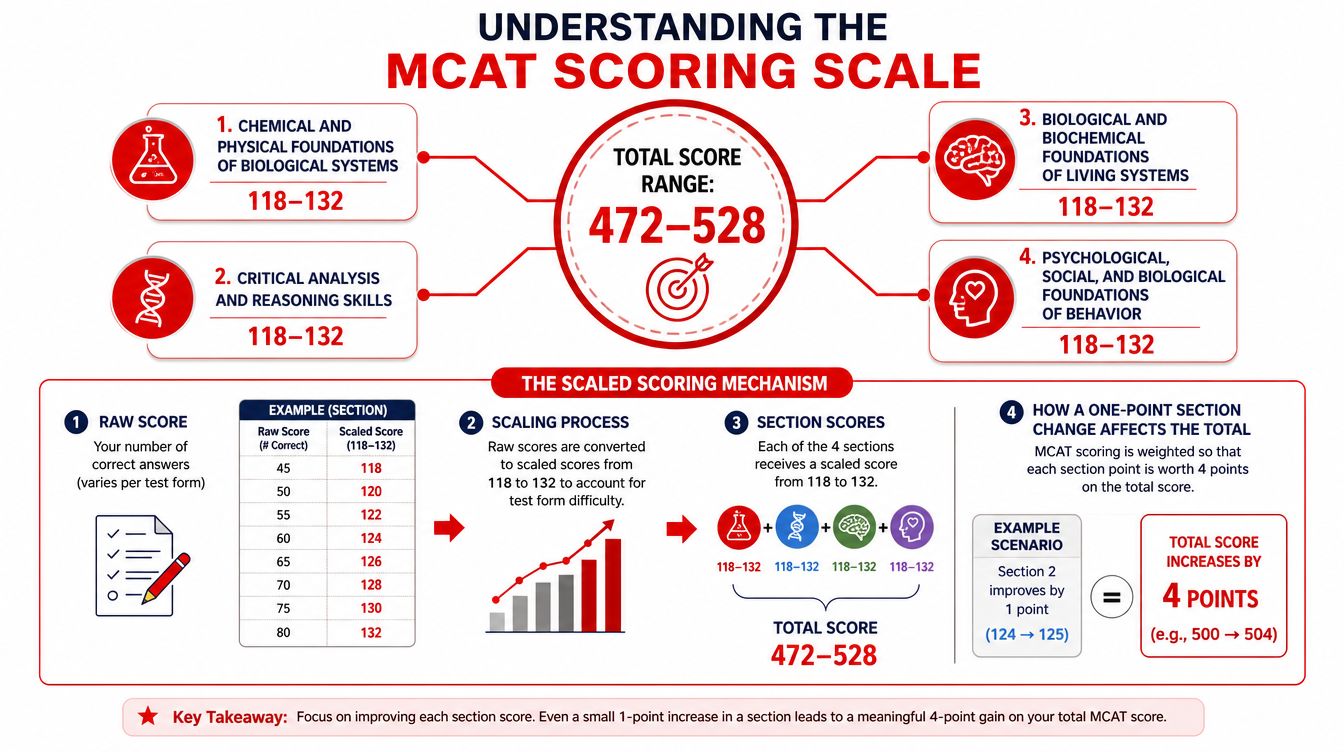
Why the scale feels different from raw points
The score report does not show how many questions you got right. The AAMC converts performance into the scaled score you see, which is why two test forms can feel different without changing what the final number means. That setup is meant to keep scores comparable across administrations, so the number reflects performance on the same scale rather than a simple percentage correct.
If you are trying to read your report, start with the section scores first, then look at the total. The composite can hide a weaker area that schools may notice, especially if your score profile is uneven.
For a plain-language breakdown of what the MCAT is scored out of, Ace Med Boards gives a useful overview.
The safest way to interpret the scale is to treat 500 as the center point, not as a target by itself. A score above 500 is not automatically competitive at every school, and a score below 500 is not automatically disqualifying. The number tells you where you stand on the scale. The admissions meaning comes later, once percentiles and school tier enter the decision.
What Percentiles Reveal About Your Competitiveness
A 500 sits near the middle of the MCAT scale, but the percentile rank shows where that score falls against other examinees. That matters because admissions committees read your number in context, not in isolation. The current AAMC percentile ranks are based on examinees from 2023, 2024, and 2025, so the same total can carry a different competitiveness signal as the testing pool shifts. AAMC percentile ranks
AAMC applicant data also show where the middle of the pool sits. For the 2025–2026 cycle, the average total MCAT score for applicants was 506.3, with a standard deviation of 10.0. Section means were 126.4 in Chemical and Physical Foundations, 125.8 in CARS, 126.7 in Biological and Biochemical Foundations, and 127.5 in Psychological, Social, and Biological Foundations. AAMC applicant data

The chart shows a familiar pattern, most applicants cluster near the middle, while the ends thin out quickly. That is why a small increase in a higher score band can move you up more percentiles than the same increase near the center.
Why a higher total doesn't rise linearly
A 500 is the midpoint of the scale, but it is not the midpoint of competitiveness. Applicant scores bunch around the center, so higher totals represent increasingly larger percentile gains rather than equal steps in admissions strength. A score in the 520s sits far above the typical applicant distribution, not just near the top edge of the scale. AAMC applicant data
The simplest way to read percentile rank is to separate three questions. Is the score average, above average, or rare in the applicant pool? Does that range fit your target schools? If you want a plain-language definition of what counts as a good MCAT score, that can help you place the number on your own list of schools.
- Mid-scale scores can still be ordinary among applicants.
- Mid-500s scores often place you above average, though school context still matters.
- Very high scores separate more sharply because fewer applicants cluster there.
Percentile rank matters because admissions committees compare you with other applicants, not just with the scale itself. A score that looks strong on paper can still be modest for a school with a higher median, while a score that seems average may be fine for a program with a wider admitted range.
Score Benchmarks for Different Medical School Tiers
The same MCAT score can mean very different things depending on the school. A result that is comfortable for one program may sit below the middle of the pile for another, so it helps to read your score through the lens of school tier instead of treating one national number as the finish line. For a general anchor, average MCAT score gives you a useful sense of where the applicant pool tends to cluster.
Here is a practical way to sort scores into safe, target, and reach territory.
| School Tier | Safe Score | Target Score | Reach Score |
|---|---|---|---|
| Top-20 research MD schools | Higher than the school's recent median, often above the applicant mean | Around the school's median | Below the school's median |
| State MD schools | At or above the school's median | Near the school's median | Below the median, especially if other metrics are also modest |
| DO schools | At or above the school's expected range | Near the middle of the admitted range | Below the usual admitted range |
For a top-20 school, the question is whether your score sits in the same zone as the school's recent admits. A recent median at a place like Johns Hopkins makes the comparison concrete, because it tells you what score level the school sees often enough to become its center of gravity. For a state school, the middle of the admitted range is usually the most useful target, especially if your residency, mission fit, and coursework line up well. For DO programs, a score inside the school's usual band can already be a good fit if the rest of the file supports it.
Ace Med Boards has a separate overview of the average MCAT score that can help you anchor your expectations before you compare schools.
How to use the table without overreading it
A safe score does not promise admission, and a reach score does not close the door. It tells you where the MCAT helps your file and where other parts of your application need to carry more weight. That matters most if your GPA, clinical exposure, or service record is stronger than your score band suggests.
Use the table as a decision tree. If your score is above the school's median, the MCAT is more likely to support your case. If it is near the median, your other application pieces need to be steady and coherent. If it is below the median, your application can still work, but the rest of the file has to answer more questions.
As noted earlier, percentile context matters too, because the same raw number can mean something different in the applicant pool than it does on the scale itself.
Setting Your Realistic Target Score
The best target score is not the highest one you can name. It is the score that matches your school list, your timeline, and your current practice results. A goal that is too low can leave you underprepared. A goal that is too high, with no connection to your practice tests, can push you toward burnout and a shaky application plan.

Start with the schools themselves. Med school admission works a lot like aiming at different lanes on a track. If you are trying to get into a highly selective program, your target has to sit comfortably in that school's usual range. If you are building a list with state schools or DO programs, the middle of the expected band may already fit well when your residency, mission fit, and coursework line up.
A three-part target-setting filter
Use this sequence to set a score that makes sense in context:
- Review school averages. Check the median MCAT scores for your target schools in the AAMC's Medical School Admission Requirements database.
- Evaluate your candidacy. Read your GPA, clinical experience, research, service, and writing alongside the score you are trying to reach.
- Set the goal. Choose a score that makes you a credible applicant at your top-choice schools, not just one that sounds ambitious on paper.
Use your practice data honestly. If your full-length scores are not moving, the target should change or the study plan should.
A target score also has to fit your calendar. If test day is close and your practice scores are still far from your school goals, a retake plan may be more realistic than forcing an early application decision. If your academic record is already strong and your list leans toward mission-driven schools, the right target may be less extreme than you first thought.
The score range MCAT planning becomes most useful here. The question is not “What score sounds impressive?” It is “What score gives your application the right shape for the programs you want?”
What Admissions Committees Care About
Admissions committees usually care less about the total number in isolation and more about how the score fits the rest of your file. A score report is a little like a dashboard, not a single speedometer. The overall MCAT score matters, but the section pattern, confidence band, and percentile context help reviewers decide whether the result looks consistent with the rest of your application.
A 510 with four balanced sections can read more cleanly than a 512 with a much weaker subsection. The difference is not that one score is always better. It is that committees are often trying to predict how you will handle the varied demands of medical training, and an uneven profile can raise a question that the total alone does not answer.
Retakes and score trends
Retakes are not automatically a problem, but the pattern matters. An upward trend can show adjustment and persistence. A flat or declining trend can leave reviewers wondering whether the same issue is still present. If you retake, the reason should be clear before you set the next test date.
Three patterns tend to stand out:
- Balanced sections with a stable total usually look straightforward.
- A strong total with one weak section can still prompt concern.
- Clear improvement after a prior attempt can help when the rest of the file supports it.
That is where the AAMC scoring report details matter. The report includes section-level information, a confidence band, and percentile rank, so committees are not limited to the total score when they review your results.
If you are comparing two attempts, ask one simple question: does the later score tell a cleaner story than the earlier one? If it does, the retake may strengthen your case. If it does not, it may make more sense to improve the rest of the application instead of chasing a small score change.
Improving Your Score and Deciding When to Retake
Admissions committees care less about the total number in isolation and more about how the score fits the rest of your file. A score report is like a snapshot, not a verdict. The useful question is whether your practice pattern points to a fixable issue or a ceiling you have already reached.
Before you pick a retake date, break down your full-length exams by section and by error type. Separate content gaps from passage comprehension, timing trouble, and simple mistakes. That review gives you a clearer answer than staring at the composite score alone.
A quick decision tree helps:
- If the same section keeps slipping, the problem is probably specific.
- If scores fall late in sections, pacing may be the core issue.
- If full-length results swing a lot, your current preparation may still be unstable.
- If you can explain each miss, the next plan is probably sharper.
- If a better score would not change your school list, a retake may not be worth the time.
A score trend matters more than a single practice test. Rising section scores usually mean the weak spot is shrinking. Flat or falling results suggest the same issue is still there, even if the total looks close to your target.
From there, match the fix to the cause. Content-heavy misses call for focused review. Passage problems call for more timed reading and question practice. Timing issues respond better to disciplined pacing drills than to another stack of notes. If one section is clearly holding you back, outside feedback can help you see where your reasoning breaks down. Some students use Ace Med Boards for one-on-one MCAT tutoring and score planning.
If you want a structured next step, how to improve MCAT score lays out how to turn practice results into a study plan.
A retake should answer a specific problem. If your practice scores are already moving toward your target and the weak sections are tightening up, another test date can make sense. If they are not, changing the calendar without changing the method usually just repeats the same outcome.
Putting It All Together with a Hypothetical Example
Here's a clearly fictional composite example. A pre-med student gets a 503 and feels unsure because the number sounds close to the middle, but the schools on the list are more selective than that. The student checks the percentile context, reviews recent school medians, and realizes the current score is not enough for the top schools on the list, even though it isn't a bad score in isolation.
The student then audits practice tests and sees a recurring weakness in one section, plus a second issue with timing late in the exam. That changes the plan. Instead of chasing every topic, the student narrows the next study block to section-specific review, timed passage sets, and full-length exams with deliberate error logging. The target gets reset to a score that fits the school list more accurately, and the decision to retake becomes tied to practice data rather than anxiety.
For students comparing study materials, Ace Med Boards has a separate overview of best MCAT practice tests, which can help when you're deciding what to use for that kind of score audit.
A fair interpretation of the example is simple. The score range MCAT applicants see is only the starting point. What matters next is whether your score profile, percentile position, and school list line up well enough to make the next step realistic.
If you want help turning your MCAT score report into a clearer plan, Ace Med Boards offers one-on-one tutoring and personalized score analysis that can help you interpret section balance, practice-test trends, and next-step timing. Visit Ace Med Boards to see how their MCAT support fits into a focused study plan.