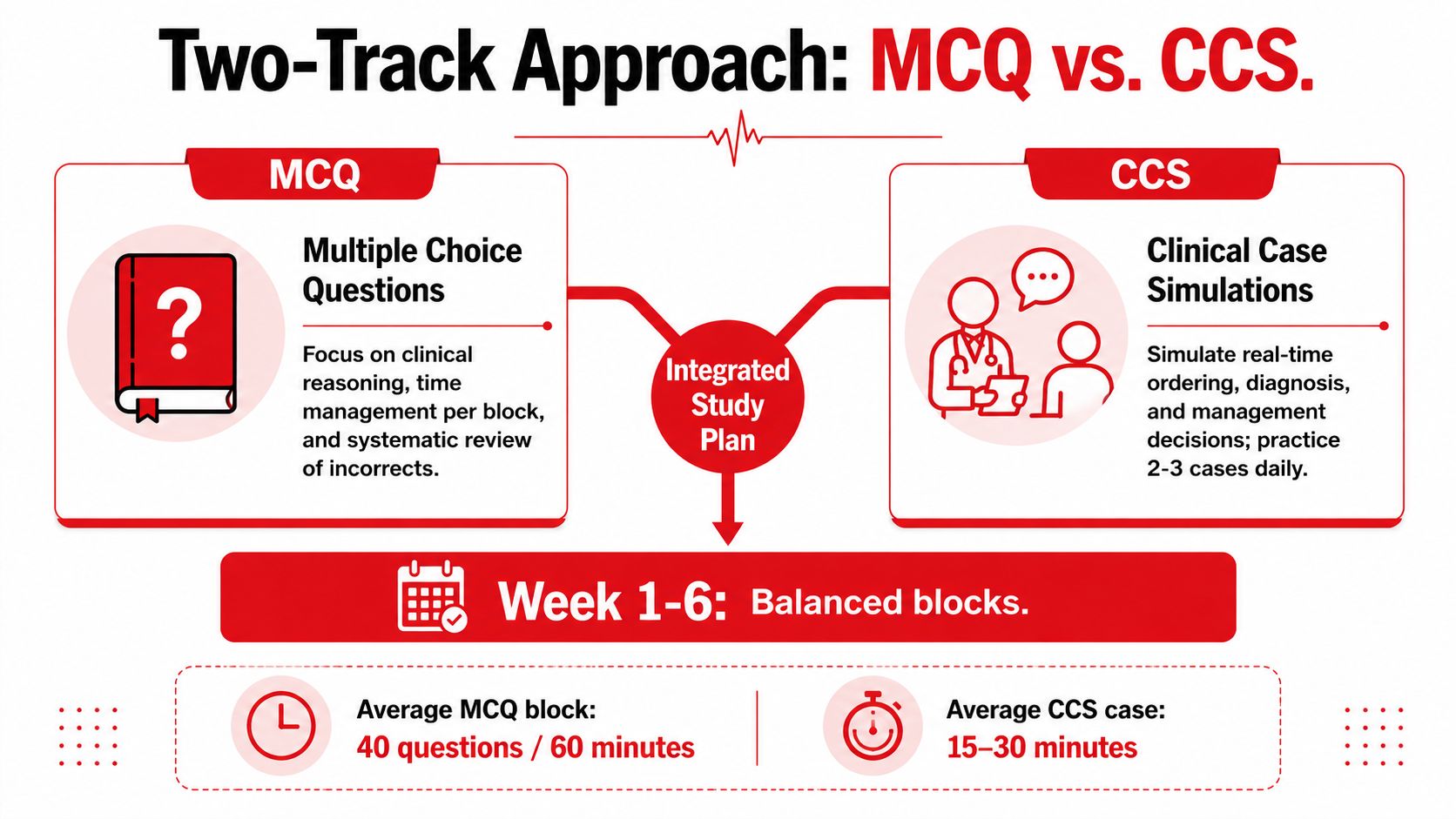
You've just finished a night shift, your exam is six weeks away, and an untouched UWorld subscription is waiting on your laptop. For USMLE Step 3 UWorld preparation, the most reliable structure is a two-track plan: combine multiple-choice questions, or MCQs, with deliberate computer-based case simulation, or CCS, practice from the beginning.
Step 3 is a two-day examination. Day 1 includes 232 multiple-choice items in 12 blocks, while Day 2 includes 180 multiple-choice items in 9 blocks plus 13 to 14 CCS cases according to the official USMLE Step 3 content description. UWorld can support both tracks, but only if you use question review to build clinical reasoning and CCS practice to build real-time management habits.
Why USMLE Step 3 UWorld Demands a Two-Track Approach
Step 3 doesn't test only whether you recognize a diagnosis. It also tests whether you can manage a patient over time, choose appropriate orders, interpret changing information, and act without waiting for a multiple-choice answer list. That combination makes the exam different from a conventional question-bank routine.
The MCQ track develops rapid clinical discrimination. You read a vignette, identify the tested task, compare answer choices, and make a decision under time pressure. UWorld's official Step 3 materials emphasize applying calculations, strengthening core knowledge, and becoming familiar with exam-style clinical vignettes through active question practice (UWorld's Step 3 preparation materials).
The CCS track develops sequential management. You must decide what to order first, which treatment cannot wait, when to change location, and when advancing the clock is appropriate. These actions require a different rhythm from selecting one answer.
Build both skills from the first week
A practical daily structure looks like this:
- MCQ practice: Complete a focused block, then review why the correct answer works and why the alternatives fail.
- Reasoning conversion: Turn recurring mistakes into short management algorithms, not paragraphs copied from explanations.
- CCS practice: Rehearse ordering, treatment, reassessment, disposition, and clock advancement.
- Weekly audit: Review error patterns by organ system, physician task, and cause of error.
Treating UWorld as one large bank of questions can create a misleading sense of readiness. You may recognize clinical concepts in tutor mode yet feel unprepared when a CCS case requires several actions in sequence. A balanced plan prevents CCS from becoming a final-week emergency. Residents who want a dedicated resource for this track can review Step 3 CCS cases and tutoring support as one possible supplement to independent practice.
Practical rule: Every study week should contain both question decisions and management decisions.
The current passing standard is 200 for exams administered on or after January 1, 2024. Step 3 scores are reported on a 1 to 300 scale, with a reported mean of 227, standard deviation of 15, and standard error of estimate of 7 points in the referenced exam guide (Step 3 scoring overview). Near the passing threshold, small score differences can matter, so preparation should target consistency across both examination components.
A Clinical Reasoning Framework for Every UWorld Question
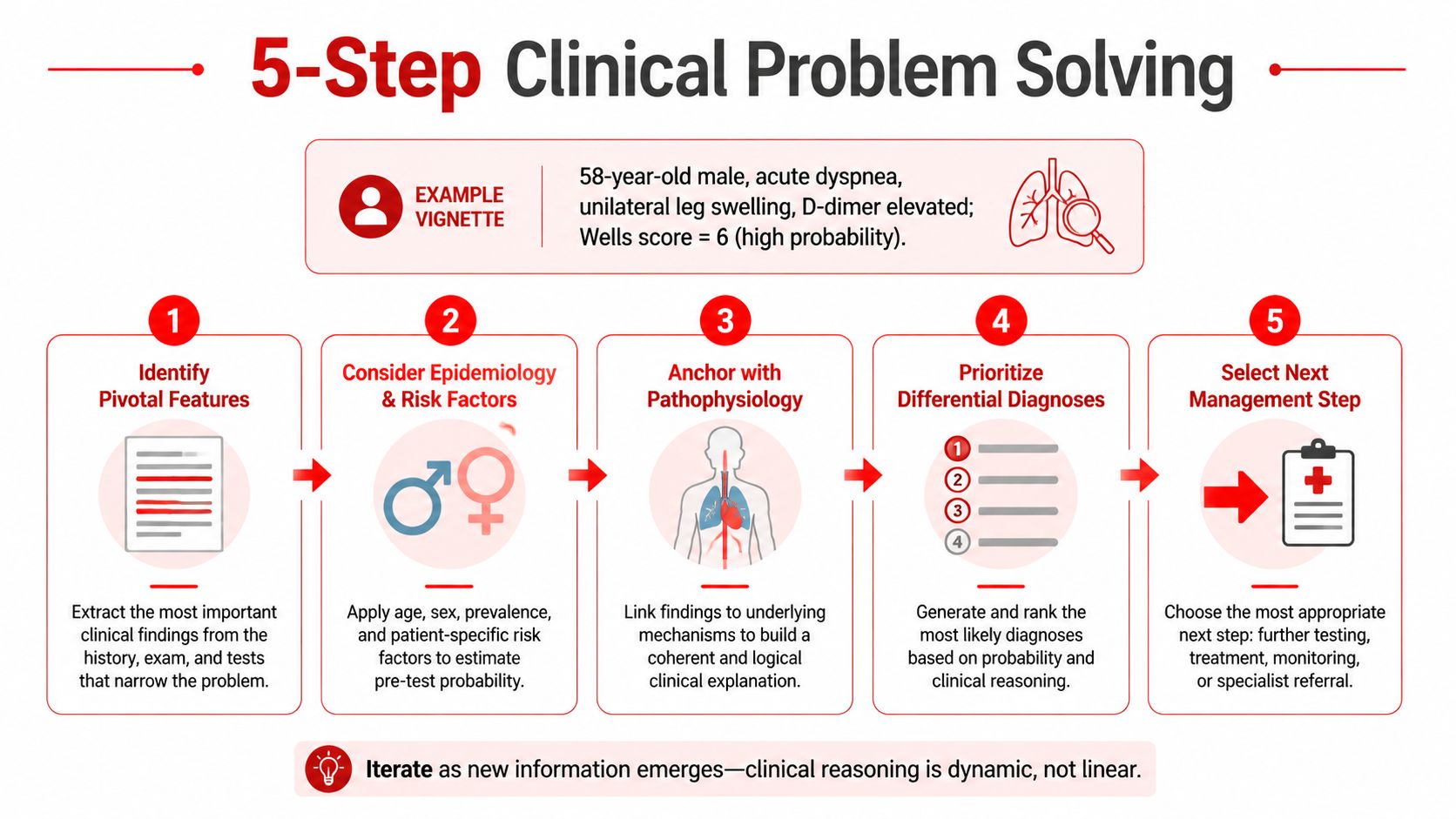
A correct answer is useful, but the reasoning that produced it is more valuable. Use the same sequence for unfamiliar questions:
- Clinical problem representation: Compress the case into its decisive features.
- Tested task: Identify whether the question asks for a diagnosis, next step, treatment, investigation, prognosis, or prevention.
- Decisive clue: Find the finding that changes the probability or management choice.
- Mechanism: Connect that clue to the underlying physiology or disease process.
- Eliminate distractors: Explain why the closest alternatives don't fit the timing, severity, or task.
A clearly labeled hypothetical example
Hypothetical educational vignette: A 58-year-old man develops acute dyspnea and unilateral leg swelling. His D-dimer is high, and his Wells score indicates high clinical probability.
First, extract the anchors: older adult, sudden respiratory symptom, unilateral limb finding, and a presentation that raises concern for a thromboembolic process. A useful problem representation would be: An older man with acute dyspnea and a unilateral leg abnormality has a high-probability presentation for venous thromboembolism.
Next, identify the tested task. If the question asks for the next step, don't answer with a general disease label. Ask what decision follows from high pretest probability and which available test or intervention is appropriate in that clinical context.
The differential may include pulmonary embolism, pneumonia, acute coronary syndrome, pneumothorax, and heart failure. The unilateral leg swelling and abrupt onset prioritize thromboembolic disease, while the question's requested action determines whether you should choose confirmatory imaging, immediate management, or another evaluation.
The point isn't to memorize a single pathway from one vignette. It's to separate the decisive evidence from distracting details, then transfer the reasoning to a nonidentical case. Read more about this approach in clinical reasoning for board preparation.
Convert misses into reusable information
A missed UWorld question should produce an error-log entry with at least these fields:
| Error-log field | What to record |
|---|---|
| Organ system | Pulmonary, cardiovascular, renal, ethics, or another category |
| Physician task | Diagnosis, next management step, biostatistics, prevention, or communication |
| Error cause | Knowledge gap, misread clue, premature closure, calculation error, or pacing |
| Decisive clue | The finding that should have changed your answer |
| Corrective action | A rule, algorithm, flashcard, or timed reattempt |
| Transfer check | A new, nonidentical example solved without prompting |
Hypothetical error-log entry: The learner chose pneumonia because of dyspnea and focused on the symptom rather than the unilateral leg finding. The corrective action is to represent the case before looking at answer choices and to ask which finding most changes pretest probability. The transfer check might use a different presentation of venous thromboembolism and require the learner to identify the management decision independently.
Your log should reveal repeated reasoning failures, not become a second textbook. Review it weekly and look for patterns that cross organ systems, such as premature closure in diagnosis questions or failure to identify the physician task.
Building Your Daily and Weekly UWorld Schedule
A workable schedule must fit residency rather than assume uninterrupted study time. Use the first part of preparation to learn actively, then use later weeks to test pacing, stamina, and decision-making under conditions that resemble the exam.
A six-week plan can shift gradually from learning mode to testing mode:
- Weeks 1 through 3: Use untimed, system-specific blocks when you need to establish foundations. Review each explanation actively and create concise error-log entries.
- Weeks 4 through 6: Increase timed, random blocks. Review efficiently, prioritize repeated errors, and protect enough energy for CCS practice.
- Every week: Reserve at least a half-day for rest. Fatigue can make a strong plan unsustainable.
Sample Six-Week UWorld Step 3 Weekly Schedule
| Day | Morning Block | Afternoon Block | Evening / CCS |
|---|---|---|---|
| Monday | Learning-mode MCQs by weak system | Review incorrects and update error log | One focused CCS case |
| Tuesday | Learning-mode MCQs by physician task | Targeted review of biostatistics or ethics | CCS order-entry rehearsal |
| Wednesday | Timed random MCQs | Review decisive clues and distractors | Rest or brief flashcard review |
| Thursday | Timed random MCQs | Error-log remediation | One CCS case with clock practice |
| Friday | Timed random MCQs | Review only high-yield recurring errors | Brief management-algorithm review |
| Saturday | Practice assessment or timed simulation | Review performance patterns | CCS session with several cases |
| Sunday | Light review or rest | Protected half-day off | Plan the next week |
The table is a framework, not a quota. If review quality collapses after a block, reduce volume and preserve analysis. If accuracy remains stable but pacing is poor, keep the content level constant and emphasize timed execution.
Track more than overall percentage. Independent preparation guidance emphasizes that no official public table maps UWorld percentages to Step 3 scores, so percentages are heuristic rather than predictive (discussion of Q-bank percentage interpretation). Monitor rolling performance after consistent question-volume milestones, separate learning-mode from testing-mode results, and identify whether errors cluster in management, biostatistics, ethics, or CCS.
For a printable planning framework, use this Step 3 study schedule guide alongside your residency calendar, call schedule, and planned test dates.
Mastering CCS Cases Without Losing MCQ Momentum
CCS cases require execution rather than recognition. In an MCQ, the answer choices define the decision space. In CCS, you create the decision sequence yourself.
Start by triaging acuity. Ask whether the patient needs immediate stabilization, urgent diagnostic clarification, routine evaluation, or preventive care. For an unstable presentation, initial actions should address immediate threats while you order focused tests. For a stable presentation, avoid indiscriminate ordering and choose evaluations that answer the leading clinical question.
Use a repeatable case sequence
A useful CCS sequence is:
- Stabilize: Address airway, breathing, circulation, severe pain, altered mental status, or other immediate threats.
- Characterize: Obtain focused history, physical examination, monitoring, and appropriate initial studies.
- Treat: Start management that follows from the working diagnosis and acuity.
- Reassess: Review results and response rather than advancing time blindly.
- Disposition: Choose outpatient follow-up, admission, transfer, or another setting when the case supports it.
- Counsel: Include relevant education, prevention, adherence, or safety instructions.
Bundle sensible orders when the case calls for admission, but don't order everything you can find. The simulation rewards coherent management, not a long list disconnected from the clinical problem.
Advance the clock deliberately
Advancing time is appropriate after you've entered the necessary orders and initiated management. Advancing too quickly can skip results or leave an unstable patient untreated. Waiting indefinitely can also waste the case, particularly when the next step depends on observing response or receiving scheduled data.
Practice two or three CCS cases during the week, then perform a deeper review of one case. Ask:
- Did I identify the acuity correctly?
- Did I order the decisive investigation?
- Did I treat before waiting for every result?
- Did I reassess abnormal findings?
- Did I make a reasonable location or disposition decision?
- Did I include counseling relevant to the case?
The official USMLE notes that Step 3 performance is affected by the CCS portion, which is why MCQ drilling should be paired with deliberate case simulation rather than postponed until the final days. Use Step 3 CCS strategy guidance to reinforce the mechanics, while keeping your error log focused on actions you repeatedly omit or sequence incorrectly.
Interpreting Self-Assessments and Tracking Real Progress
A single self-assessment can describe one performance event. It can't explain whether a learner is improving because of stronger knowledge, better pacing, reduced fatigue, or familiarity with the testing format.
Use three layers of evidence:
- Rolling performance: Compare results across comparable assessments or timed blocks rather than reacting to one percentage.
- Domain pattern: Separate biostatistics, ethics, management, organ systems, and CCS execution.
- Condition match: Record whether the result came from timed random questions, learning mode, fatigue, or a full simulation.
A score trend that rises alongside improved pacing and fewer repeated errors is more informative than a high result achieved in tutor mode. A plateau may indicate a content gap, but it may also reflect weak review, fatigue, or failure to transfer knowledge into management decisions.
UWorld Step 3 Self-Assessment Score Interpretation Guide
There is no verified public USMLE table that converts UWorld self-assessment results into an official Step 3 score or guarantees readiness. Use the following qualitative guide rather than treating a numeric band as a prediction.
| Rolling Average Range | Readiness Signal | Recommended Action |
|---|---|---|
| Rising across recent assessments | Improving consistency | Continue the two-track plan and verify CCS execution |
| Stable but uneven by domain | General knowledge with concentrated gaps | Target the weakest physician tasks and review the error log |
| Falling under timed conditions | Pacing, fatigue, or content concern | Reduce passive review, audit timing, and reassess study load |
| No clear trend | Insufficiently comparable data | Standardize conditions before drawing conclusions |
The current passing standard is 200, and official 2023 performance data show a 97% pass rate for U.S./Canadian MD graduates and a 95% pass rate for DO graduates, with substantially lower pass rates among repeaters, 77% for MD repeaters and 60% for the small DO repeater group (official USMLE performance data). Those figures describe populations, not an individual's readiness. They also support a practical conclusion: repeat candidates should audit the precise source of risk instead of relying on general reassurance.
For an official-style benchmark, compare your MCQ performance with an appropriate practice assessment and evaluate CCS separately. A Step 3 practice exam and NBME preparation resource can help organize that comparison, but no commercial assessment should replace the official score report or current USMLE guidance.
Common UWorld Mistakes and When to Seek Extra Help
A large question count doesn't guarantee learning. Residents often spend hours reading explanations while making the same reasoning error in the next block.
Six common problems deserve direct correction:
- Passive explanation reading: Close the explanation and state the decisive clue from memory before moving on.
- Skipping incorrect-answer rationales: Explain why the closest distractor fails, because that distinction often determines the next question.
- Tutor-mode overuse: Add timed random blocks so your performance reflects pacing and uncertainty.
- No error log: Tag every repeated miss by organ system, physician task, and error cause.
- Late CCS practice: Schedule cases throughout preparation rather than reserving them for the final week.
- Delayed help-seeking: Ask for structured feedback when your review process no longer changes repeated errors.
Supplemental resources should solve a defined problem. A concise reference may help with a specific knowledge gap, while another question bank can become redundant if you haven't reviewed the first one thoroughly. Learners who want to compare focused resources can explore specialty selection question banks when a targeted content need exists.
One-on-one tutoring may be worth considering when your self-assessment trend remains flat across repeated attempts, multiple content domains stay weak despite consistent review, or CCS practice shows the same sequencing failures. Those signals don't mean you lack ability. They mean your current feedback loop may not be specific enough to identify what changes next.
Ace Med Boards offers private USMLE Step 3 tutoring that can help residents audit UWorld patterns, structure MCQ review, and integrate CCS practice. Treat tutoring as a supplement to official materials and independent question-bank work, not as a replacement for either.
Your Step 3 Readiness Checklist and Key Takeaways
Use this checklist during the final two weeks. Mark pass only when you can demonstrate the behavior consistently, not when you merely recognize the topic.
- MCQ consistency: Pass if timed, mixed-question performance is stable and your recent self-assessment trend isn't deteriorating. If results are erratic, review pacing and fatigue before adding volume.
- CCS execution: Pass if you've practiced cases in the simulation format and can explain when to stabilize, order, treat, reassess, advance the clock, and decide disposition. If you still hesitate over basic order entry, keep CCS in the daily plan.
- Error-log closure: Pass if every recurring high-yield error has a corrective rule and a transfer example. If your log contains only copied facts, rewrite it around reasoning errors.
- Test-day logistics: Pass if your Prometric appointment, identification requirements, permitted materials, travel plan, and break strategy are confirmed through current official instructions. The exam's two-day structure makes logistical preparation part of performance preparation.
- Mental readiness: Pass if you're protecting sleep, managing fatigue, and calibrating confidence to evidence. If anxiety is disrupting practice performance or rest, adjust the schedule and seek appropriate support rather than forcing more questions.
The central lessons are straightforward. Use UWorld questions to practice clinical discrimination, convert misses into structured reasoning, and give CCS its own deliberate track. Interpret performance as a trend, not a verdict from one assessment.
If your metrics are difficult to interpret or your study plan has stalled, a free consultation or Board Score Audit can provide an outside review without turning one difficult result into a judgment about your career.
Ace Med Boards offers personalized USMLE Step 3 tutoring focused on question analysis, targeted UWorld practice, and coordinated MCQ plus CCS preparation. Visit Ace Med Boards to learn about the tutoring process or request a free consultation for help reviewing your current readiness data.