
Studying longer is popular advice, but it's incomplete. Medical students improve more reliably when they retrieve information, space reviews, mix problem types, use feedback, and test transfer to unfamiliar questions, rather than extending the clock. This guide turns those study skills and strategies into a practical system for USMLE, COMLEX-USA, and Shelf preparation without promising a particular score or outcome.
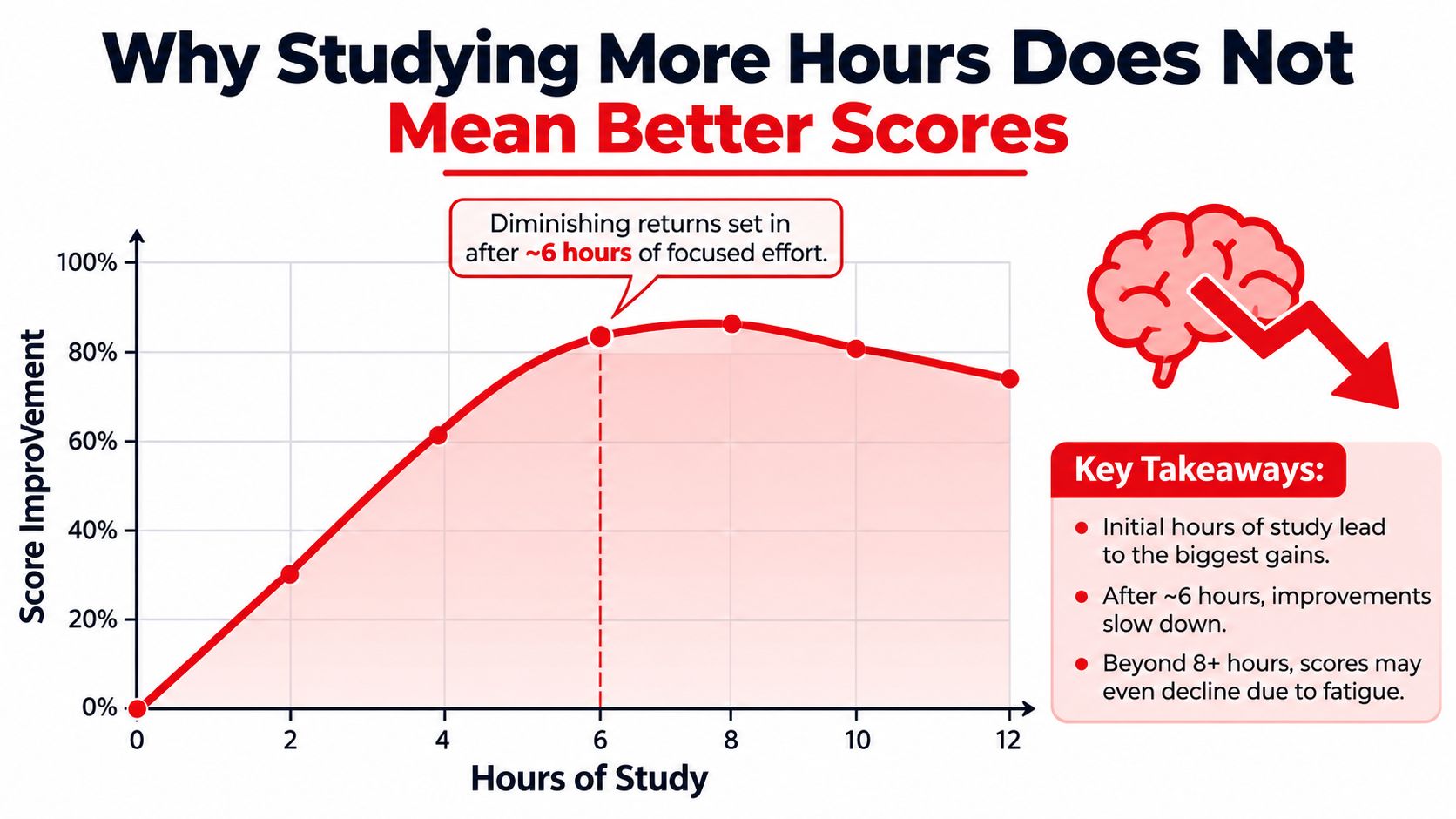
Why Studying More Hours Does Not Mean Better Scores
A twelve-hour study day can look disciplined while producing very little durable learning. The problem isn't effort. It's that prolonged rereading, highlighting, and passive video watching often create familiarity without proving that you can recall or apply the material later.
Cognitive effort matters, but hours alone aren't a useful measure of learning. A shorter session that requires you to answer questions from memory, explain a mechanism, review an error, and revisit the concept later can be more productive than a longer session spent recognizing information on a page. The research history behind spaced learning reaches back decades. By 1989, researchers had already established that distributing presentations over time produced better learning than concentrating the same total study time into one block (Dempster's review of the spacing effect).
Familiarity isn't retrieval
Rereading First Aid, lecture slides, or a pathology summary can make the material feel fluent. You see the heading, recognize the diagram, and anticipate the next line. That feeling can be misleading because an examination asks you to produce an answer when the page isn't visible.
Desirable difficulty describes a useful form of challenge. Recalling a fact before checking it, distinguishing between similar diagnoses, or solving a mixed question block may feel slower than reviewing familiar material. That difficulty strengthens the link between the cue and the answer, especially when feedback follows.
A sustainable study plan therefore prioritizes:
- Retrieval practice, answering before looking at the explanation.
- Spaced practice, returning to material across separated sessions.
- Interleaving, mixing related topics so you must select the right rule or mechanism.
Sleep and recovery support this system. An exhausted learner may spend more time at the desk while producing weaker attention, poorer monitoring, and less accurate review. Use medical student time-management strategies to protect focused work, breaks, sleep, and required clinical responsibilities.
Practical rule: Count successful retrievals, corrected reasoning errors, and later transfer, not just time seated.
Core Learning Science Principles Every Medical Student Should Know
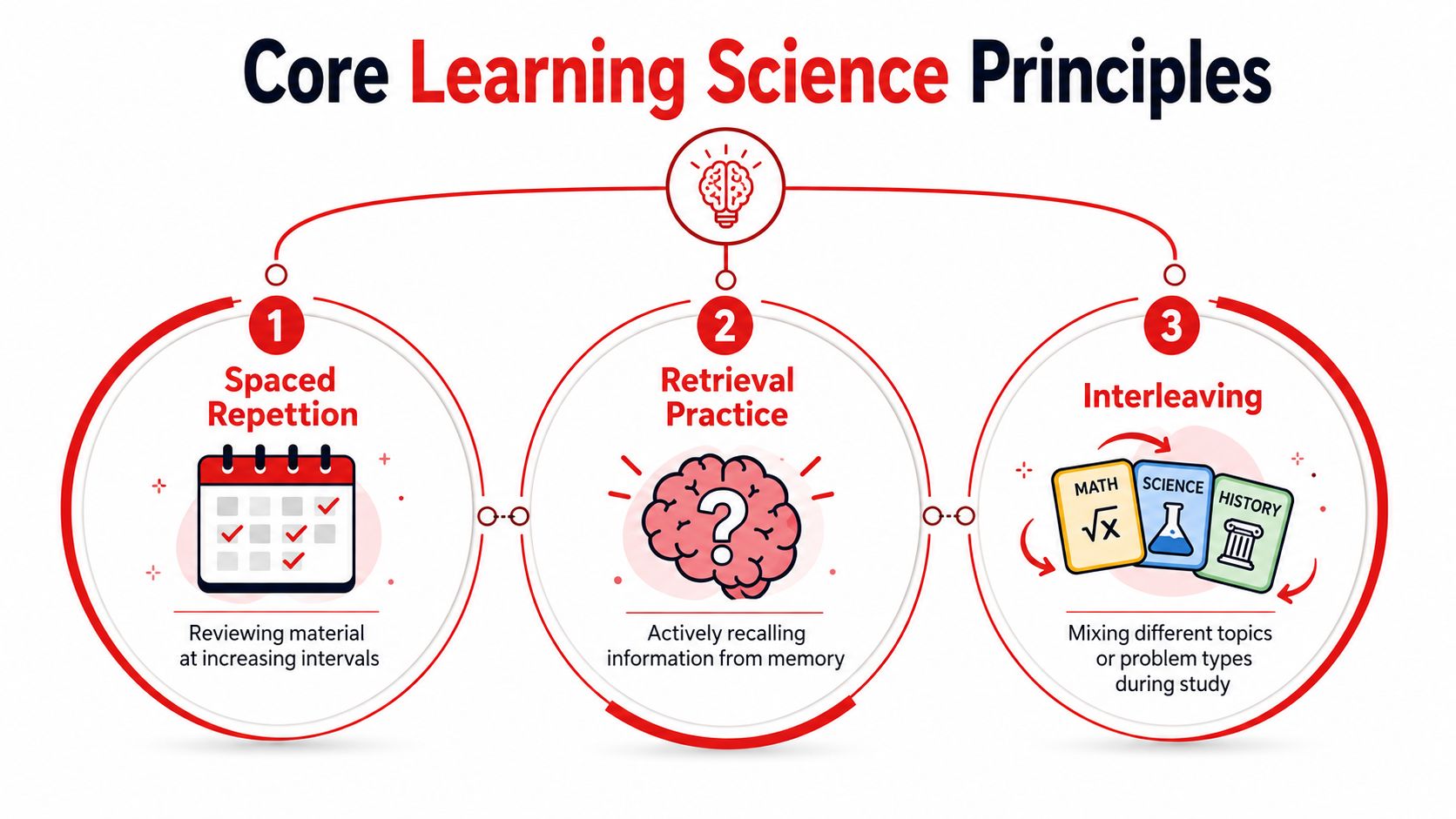
More hours at a desk can produce less exam-ready learning if the hours are spent rereading. Effective study skills and strategies make your brain perform the same kind of work the examination requires: retrieving, distinguishing, applying, and correcting knowledge. Three principles provide the structure, while feedback and recovery determine whether that structure remains accurate.
Spaced practice
Spaced repetition places review sessions across time instead of concentrating them in one sitting. The interval should create some effort during recall without turning every review into a first exposure. Flashcard software can schedule intervals, but it cannot repair vague prompts or inaccurate answers. Check periodically that each card supports clinical application, not recognition alone.
For pharmacology, separate prompts can test a drug's mechanism, characteristic adverse-effect pattern, and reason for avoiding it in a particular context. Answer from memory before viewing the explanation. A card that asks only whether you recognize a drug name gives limited preparation for an unfamiliar vignette.
A 2025 study in practicing physicians followed learners over 18 months and reported better learning and transfer outcomes with spaced repetition. It also reported stronger learning and transfer with double-spaced repetitions than with single-spaced repetitions (Academic Medicine study details). A 2026 systematic review and meta-analysis covering 21,415 learners found an advantage over standard studying, with a standardized mean difference of 0.78, a 95% confidence interval of 0.56 to 0.99, and p < 0.0001 (systematic review summary).
Retrieval practice
Retrieval practice starts with an attempt to answer before reviewing the material. Flashcards, practice questions, blank-page recall, oral explanations, and short-answer prompts all use the same sequence: attempt, check, correct, and revisit later.
Before opening a question explanation, record why you chose the answer, which finding you missed, and what would have changed your decision. A detailed guide on retrieval practice techniques offers broader educational context, although its learner group differs from medical students. The underlying act of recalling before reviewing still applies.
Use active recall for medical exam preparation to turn reading into questions. A question bank should work alongside official examination information and carefully selected content resources, rather than replace either one.
Interleaving
Interleaving mixes topics or problem types so you must identify the relevant rule before applying it. A block combining cardiology, renal physiology, and ethics requires topic selection as well as solution. That resembles examination reasoning more closely than a long sequence of questions with the same hidden structure.
A meta-analysis of interleaved learning reported a moderate overall effect, Hedges' g = 0.42, with memory and transfer benefits remaining after delays ranging from 24 hours to 10 days (interleaved learning meta-analysis).
A practical weekly routine combines all three principles. Retrieve a concept today, schedule its next review after a gap, then place it in a mixed question set where the topic is not announced. Record the error type, such as missing knowledge, faulty reasoning, misreading, or execution. That error log converts evidence-based methods into decisions you can use when planning the next study session.
Matching Study Techniques to Different Types of Medical Content
Not every medical topic benefits from the same tool. A flashcard can efficiently test a discrete fact, but a long management algorithm may require branching decisions, justification, and application. Matching the method to the material reduces wasted effort and improves the quality of retrieval.
| Content Type | Best Study Techniques | Example Resources |
|---|---|---|
| Discrete facts | Spaced-repetition flashcards, short-answer prompts, cumulative recall checks | Anki, personal question sets, course objectives |
| Mechanisms | Diagram drawing, teach-back, causal chains, prediction questions | Physiology notes, original diagrams, whiteboard explanations |
| Visual anatomy | Image occlusion, unlabeled redraws, spatial labeling, 3D exploration | Anatomy atlas, image-occlusion cards, 3D anatomy applications |
| Clinical reasoning | Mixed timed questions, illness-script journaling, differential comparison, error review | Official exam outlines, licensed question banks, original practice cases |
Facts need precise prompts
Use a card for a fact when the answer is relatively compact and stable. Instead of copying a paragraph about a medication, create separate prompts for its mechanism, major toxicity, contraindication, and distinguishing clinical clue. Keep each question narrow enough that a missed answer tells you what needs repair.
Mechanisms need relationships
For a physiological pathway, draw the sequence without looking, then explain what happens when one variable changes. Teach-back exposes gaps that recognition hides. If you can state the endpoint but can't explain the causal steps, your notes are not yet an effective retrieval system.
Visual material needs visual retrieval
Labeling an image from memory is different from recognizing a labeled figure. Use image occlusion or an unlabeled sketch for anatomy, histology, and radiology. Pair the image with a concise verbal explanation, but don't force every topic into a visual format.
Learning-style matching isn't supported by strong evidence. A learner's preference for visual, auditory, or tactile input doesn't justify assigning all instruction to that sensory mode. Choose the representation that fits the content, then combine useful diagrams with precise language.
Clinical reasoning requires transfer. A timed mixed block can reveal whether you recognize a pattern only when the topic is announced or whether you can select and apply a strategy independently. The visual learner study guide can help you use visual tools appropriately without treating a preferred learning label as a prescription.
Building a Weekly Retrieval Calendar and Error Log
A calendar makes evidence-based study executable. It should include new learning, retrieval, mixed application, feedback, and recovery. The schedule below is a sample dedicated-phase framework, not a requirement to copy every block or study for a fixed number of hours.
| Time Block | Monday | Tuesday | Wednesday | Thursday | Friday | Saturday | Sunday |
|---|---|---|---|---|---|---|---|
| First focused block | Spaced reviews and new prompts | Spaced reviews and weak facts | Spaced reviews and mechanisms | Spaced reviews and visual material | Spaced reviews and mixed facts | Cumulative reviews | Light review or rest |
| Question block | Mixed unseen questions | System-focused questions | Mixed unseen questions | System-focused questions | Mixed unseen questions | Longer mixed practice | Error-log retrieval |
| Feedback block | Review every miss and uncertain answer | Correct reasoning errors | Review knowledge gaps | Analyze misread stems | Review recurring patterns | Consolidate high-yield errors | Plan the next week |
| Transfer block | Original short-answer prompts | Explain a mechanism aloud | Unlabeled diagram recall | Differential comparison | Timed application | Unseen cumulative items | Retest selected errors |
Make the calendar phase-appropriate
Before dedicated study, keep question work connected to current coursework and use the error log to guide content review. During dedicated preparation, increase the proportion of mixed, timed, and cumulative retrieval while reducing passive reading. If clinical duties or fatigue limit a block, shorten it and preserve the sequence rather than abandoning the week.
Reviewing for longer isn't automatically better. A manageable routine that you can repeat supports retention more effectively than a plan that collapses after several demanding days. Sleep should remain part of the schedule because attention and recall depend on a functioning learner, not just a full calendar.
Use an error log that explains the miss
Record enough detail to identify the repair. A useful template includes:
| Question Task | Error Type | Correction | Next Review Dates | Transfer Test |
|---|---|---|---|---|
| Mixed renal physiology item | Knowledge gap | Write the causal chain in your own words | Tomorrow, later this week, next week | Explain the mechanism in an unfamiliar context |
| Original anatomy labeling prompt | Misread stem | Circle the structure and state the task before answering | Next study day, following week | Label an unlabeled image |
| Mixed clinical reasoning item | Faulty reasoning | Compare the leading diagnoses and identify the discriminating clue | Tomorrow, later this week | Solve a new case without topic labels |
| Timed practice item | Careless error | Add a final check for units, direction, and requested output | Next timed block | Complete a similar task under time pressure |
Tag errors by knowledge gap, misread stem, faulty reasoning, or careless execution. Then schedule the correction, not merely the original question. A dashboard such as Ace Med Boards' progress-tracking resource can help organize accuracy, retention, pacing, and workload, but your weekly decisions should be based on patterns rather than hours alone.
Common Study Mistakes That Sabotage Board Preparation
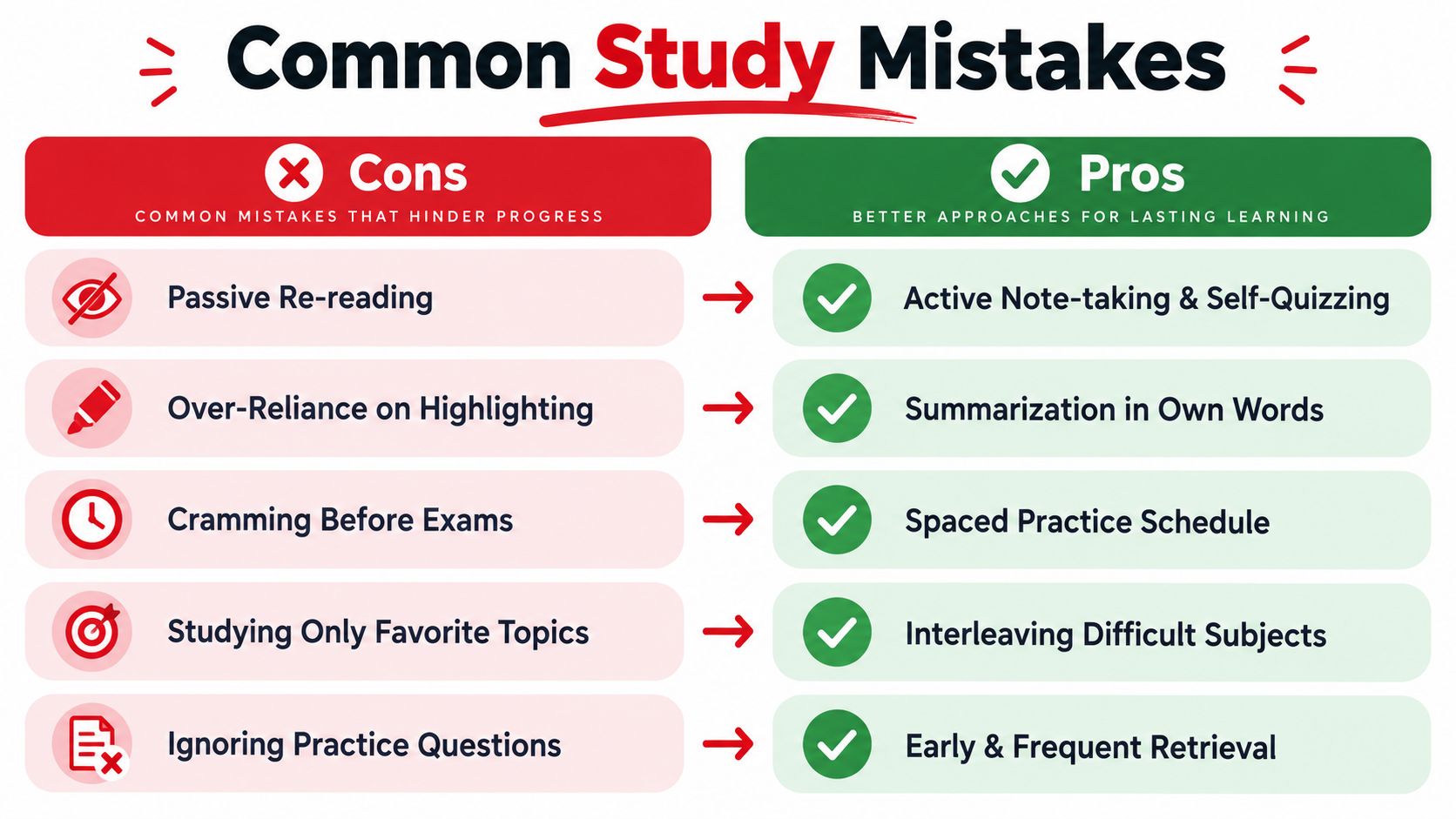
A study session can feel productive while giving you almost no proof that you can perform under exam conditions. The practical test is simple: can you retrieve, explain, and apply the material without the page in front of you? Replace activities that create familiarity with actions that expose what needs repair.
Five common substitutions
- Passive rereading: Familiar wording can feel clear, yet independent recall remains untested. Close the book and answer questions from memory.
- Over-highlighting: Color marks text but does not require an explanation. Write a brief summary or turn the passage into a question.
- Uninterrupted video watching: A lecture may provide an initial explanation, but continuous viewing makes learning consumption. Pause, predict the next step, and explain the concept without the video.
- Skipping incorrect-answer review: A missed question shows more than a score. Record why the distractor seemed plausible and which evidence should have changed your decision.
- Cramming: Massed review can produce short-lived familiarity while limiting retrieval across time. Place cumulative reviews on your weekly calendar before the examination period becomes urgent.
Research generally supports testing and spacing as useful foundations, while showing that results depend on how the methods match the task and how consistently they are implemented. Use that evidence as a decision rule, not as a promise that every flashcard will work. Choose activities that make recall, reasoning, and correction visible.
A missed question is not wasted time if you use it to change the next review.
Let repeated errors shape your schedule. If you read stems too quickly, add a stem-parsing step to your question routine. If facts disappear after several days, adjust the spacing and rewrite weak prompts. If topic-specific blocks feel strong but mixed sets expose gaps, place transfer practice earlier in the week. An error log or a dashboard such as Ace Med Boards' progress-tracking resource can organize these decisions. Review patterns, not hours alone, when setting the next week's priorities.
Converting Passive Notes Into Active Retrieval Questions
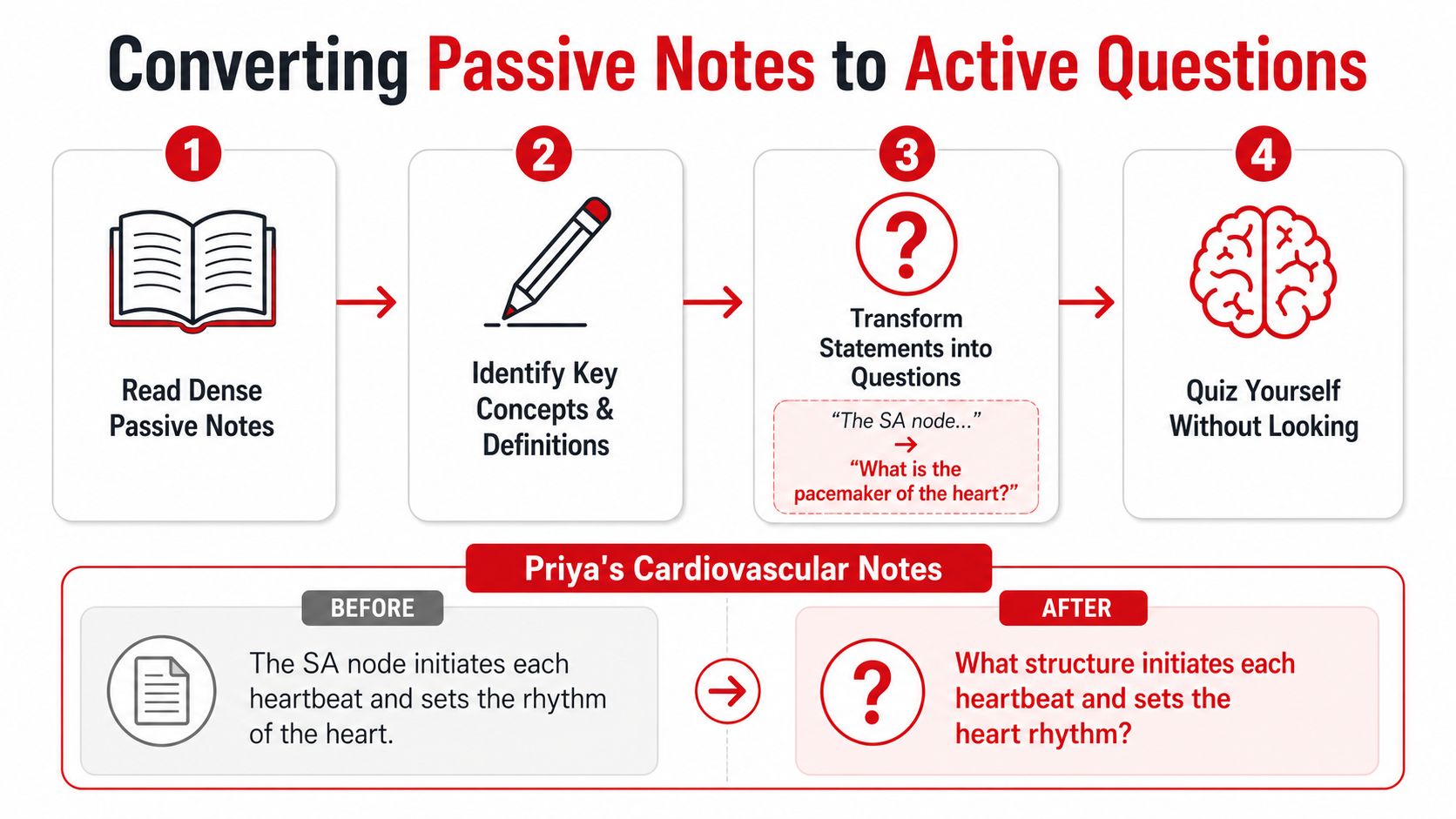
Labeled composite example: Priya, a fictional second-year medical student preparing for Step 1, spends four hours rereading cardiovascular physiology notes. The following day, the pages look familiar, but she can't explain the relationships without looking. This is a teaching example, not a verified student story or measured outcome.
She starts by extracting one claim at a time from the notes. A paragraph about the sinoatrial node, autonomic effects, and conduction becomes several prompts rather than one large card. She then tests herself before checking the answer and records whether the miss reflects missing knowledge, imprecise wording, or confusion between related mechanisms.
A four-step conversion protocol
- Extract: Select a defined fact, relationship, image label, or decision point.
- Question: Rewrite it as a short-answer, cloze, “why,” “what changes,” or “how would you distinguish” prompt.
- Retrieve: Answer without looking, then compare your response with a trusted explanation.
- Schedule and transfer: Revisit the prompt after separated intervals and later test the concept in a mixed, unfamiliar context.
For example, a statement such as “the sinoatrial node initiates normal cardiac rhythm” can become: “Which structure normally initiates cardiac rhythm, and what feature allows it to do so?” The second version requires generation and invites a mechanism, not just recognition of a sentence.
Use Anki and spaced repetition for medical study to build a review queue, but don't outsource judgment to the software. Delete vague cards, split overloaded prompts, and add transfer questions when a fact repeatedly fails in clinical application.
The goal isn't to convert every line of every resource into a card. Choose material that supports your upcoming course or examination objectives, then use questions to expose weaknesses. A question that can't guide a correction is usually too broad to be useful.
Key Takeaways and Your Next Steps
Effective study skills and strategies don't depend on finding a secret resource. They depend on repeatedly performing the behaviors that examinations demand.
- Retrieve instead of rereading: Answer first, then use feedback to correct the gap.
- Space instead of cram: Return to material after meaningful intervals.
- Interleave instead of block: Mix related systems and problem types so you must choose the approach.
- Match method to material: Use precise prompts for facts, diagrams for relationships and anatomy, and mixed cases for reasoning.
- Measure learning directly: Track accuracy, retention, pacing, workload, and the causes of errors, not hours alone.
A 24-hour implementation plan
- Choose one upcoming exam and write a measurable goal, such as improving retention of a defined content area or completing a planned mixed-question routine.
- Run a diagnostic using representative, legitimate practice material.
- Tag each error by cause.
- Convert a small set of passive notes into answerable prompts.
- Place those prompts into the weekly retrieval calendar.
- Review the error log at the end of the week and adjust the next schedule.
If the exam is months away, emphasize building clean prompts, spaced reviews, and broad content coverage. If a Shelf or board examination is close, protect cumulative retrieval, mixed unseen questions, pacing practice, and targeted correction. A recent Australian study found that students could recognize evidence-based methods while still favoring easier approaches, with distracting off-task behavior reported in about 61% of private study sessions (study habits and off-task behavior research). The practical lesson is to design the environment and calendar so the desired behavior is easier to begin.
A review of medical education methods also reports that retrieval practice and spaced repetition are commonly used by high-performing students (review of medical education study methods). That association doesn't promise a result for any individual. It does offer a sensible direction: start small, retrieve consistently, study your errors, and use unfamiliar applications to check whether learning transfers.
Ace Med Boards offers personalized preparation for USMLE, COMLEX-USA, and selected Shelf examinations, with support focused on diagnosing error patterns, building an individualized study plan, and maintaining accountability. If you want help translating your calendar and error log into an exam-aligned routine, visit Ace Med Boards to explore a free consultation.