Could a concise pediatrics review book help more by changing how missed questions are reviewed than by adding more pages to the reading plan? BRS Pediatrics is an outline-based review resource for pediatric rotations, Shelf examinations, and United States Medical Licensing Examination (USMLE) Step 2 preparation. It works best as one part of a study workflow, not as a complete textbook or a stand-alone authority for clinical decisions.
What BRS Pediatrics Covers in Its Third Edition
BRS Pediatrics is a pediatric outline review in Wolters Kluwer's Board Review Series. Its third edition, published in September 2025, is a 608-page paperback with more than 400 board-style questions and a 100-question examination at the end of the book, according to the publisher's third-edition information.
Third edition at a glance
| Item | Detail |
|---|---|
| Series | Board Review Series, Wolters Kluwer |
| Edition | Third, published September 2025 |
| Length | 608 pages, paperback |
| ISBN (third edition) | 9781975216276 |
| Authors | Lloyd J. Brown, Ryan J. Coller, Lee T. Miller |
| Board-style questions | More than 400, each with answers and explanations |
| End-of-book exam | 100-question comprehensive examination |
| Format | Outline-based, with clinical correlations, tables, and full-color illustrations |
Before buying or coordinating page assignments, confirm the third-edition ISBN, 9781975216276, on the publisher page. The 2018 second edition uses a different ISBN, 9781496309754, and the two editions may differ in page references, illustrations, and question sets. Those edition details are listed by the publisher.
The book combines concise disease descriptions with clinical correlations, tables, updated specialty content, and full-color illustrations. Its outline format is designed to help learners retrieve high-yield associations, including age-related presentations, diagnostic distinctions, and management principles, rather than provide the depth of an extensive pediatric reference. The question component offers readers a way to test and explain their understanding after reviewing a topic.
The available product information describes general and subspecialty pediatrics, but doesn't provide a chapter-by-chapter contents list here. Students should consult the publisher's current listing and the contents pages of the edition they have before planning around specific units. For an additional plain-language refresher on developmental milestones, a guide to activities for growing independence may help connect developmental concepts to everyday examples.
BRS Pediatrics is not an all-inclusive reference text, and it isn't official material from the National Board of Medical Examiners (NBME), the National Board of Osteopathic Medical Examiners (NBOME), or the USMLE. Students who need a broader foundation can pair it with a fuller text or a pediatrics study guide, while treating the review book as a structured summary.
Who the Book Fits and How to Pair It
The publisher positions the third edition for medical students preparing for pediatric rotations, pediatrics Shelf examinations, and USMLE Step 2. It presents general and subspecialty pediatrics in a condensed outline format, so it's most useful when the learner needs organized review rather than a complete pediatric textbook or a specialty-board resource, as described on the publisher's book page.
| Study situation | Concise review fits | Pair with or choose instead |
|---|---|---|
| Start of a pediatrics clerkship | Yes, as a topic map | A standard pediatric textbook for unfamiliar topics |
| Daily review during a rotation | Yes, for short outline reviews between patients | Team teaching and rotation notes |
| Shelf preparation, several weeks out | Yes, as the outline spine | A question bank with timed mixed blocks |
| USMLE Step 2 Clinical Knowledge (CK) reasoning | Partially, as a synthesis tool | A large question bank and current guidelines |
| Detailed management decisions | No, not as the sole source | Current American Academy of Pediatrics (AAP) and specialty guidance |
| Weak baseline in pediatrics | Only with a foundational text alongside | Start with a standard textbook chapter first |
The deciding factor is whether the outline helps a learner organize and retrieve material. After reading a section, try explaining its main ideas from memory. If the explanation holds together, move to questions; if it doesn't, add a textbook chapter or other foundational explanation before doing more questions. More pages of dense review won't automatically fix a shaky base.
For osteopathic medical students, the publisher's stated audience is oriented toward USMLE and Shelf preparation. That doesn't rule out using the book, but it does mean COMLEX-USA learners should check the fit against the current NBOME blueprint and official NBOME resources before making it a central resource. A school or clerkship's assigned text and question source should take priority when those requirements apply.
Practical rule: Use BRS as a map when the topic is familiar enough to summarize. When the outline feels like a string of unexplained facts, build understanding first, then return to the review.
A focused guide on how to study for the Pediatrics Shelf can complement the book by helping learners structure their preparation around the exam and rotation.
Strengths and Limits for Shelf and Step 2 Prep
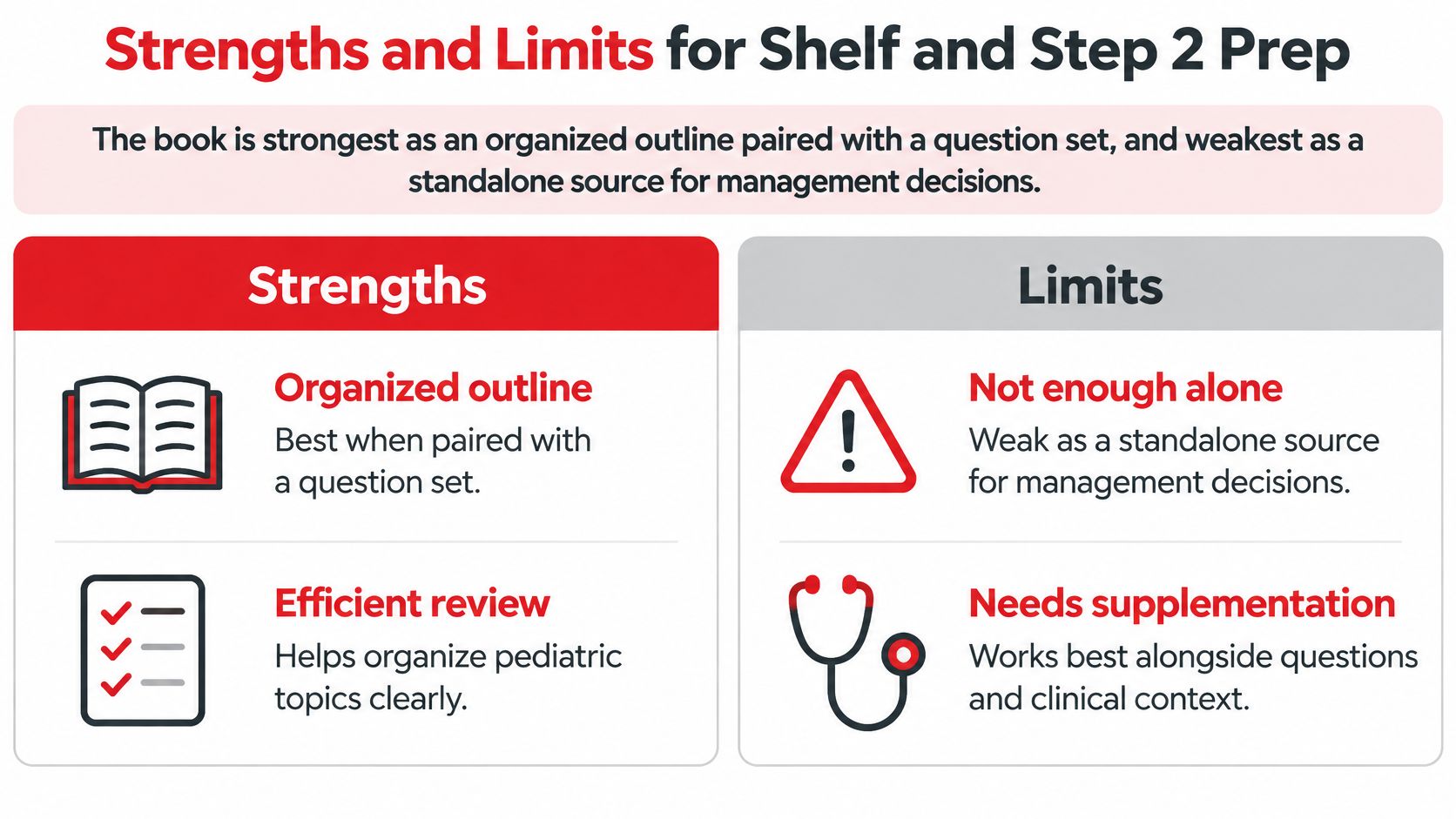
The book is strongest as an organized outline paired with a question set, and weakest as a standalone source for management decisions.
| Criterion | Strength | Limitation |
|---|---|---|
| Coverage breadth | The outline spans general and subspecialty pediatrics | It's condensed and doesn't replace a full textbook |
| Question practice | More than 400 board-style questions plus a 100-question exam | It isn't a large item bank with adaptive feedback or item statistics |
| Explanations | Explanations address correct and incorrect answer choices | Fast-changing content needs checking against current AAP guidance |
| Currency | The third edition was published in September 2025 | Earlier editions may differ in pages and questions |
| Density | A compact outline supports quick retrieval | The presentation can require substantial baseline knowledge |
| Exam alignment | It's positioned for Shelf and USMLE Step 2 preparation | That stated fit doesn't make it an official NBME or USMLE product |
Learner reviews report that the dense presentation can assume background knowledge, and some readers report errors or statements that need checking against current guidance. Those are reader-reported concerns, not an independently established error rate. The reader reviews on Goodreads can be one signal to consider, but a review shouldn't replace checking a clinical claim against an authoritative, current source.
Pay particular attention when a question or summary concerns immunization schedules, febrile-infant evaluation, antimicrobial use, or developmental screening. These areas can involve changing recommendations or context-specific decisions. For exam study, learners should distinguish a simplified test-taking rule from guidance used in current clinical practice and verify the latter against applicable AAP recommendations, specialty guidance, and local protocols.
The question count is useful for retrieval practice and locating gaps, but performance on the book's questions isn't a validated predictor of an examination score. The available sources also don't establish independent evidence that using the book improves scores. Learners who need adaptive feedback, large-scale item statistics, or continuously updated recommendations shouldn't rely on BRS alone.
A separate resource on how to study for USMLE Step 2 CK can help put a concise review text in the context of a broader preparation plan.
A Workflow for Pairing BRS With Question Banks and Rotations
BRS becomes useful when each missed question becomes a reusable rule. The book's chapter questions and explanations support a progression from topic review to error analysis, while a separate question bank can provide mixed practice and feedback beyond the book's scope, as outlined in this bookstore description of BRS Pediatrics.
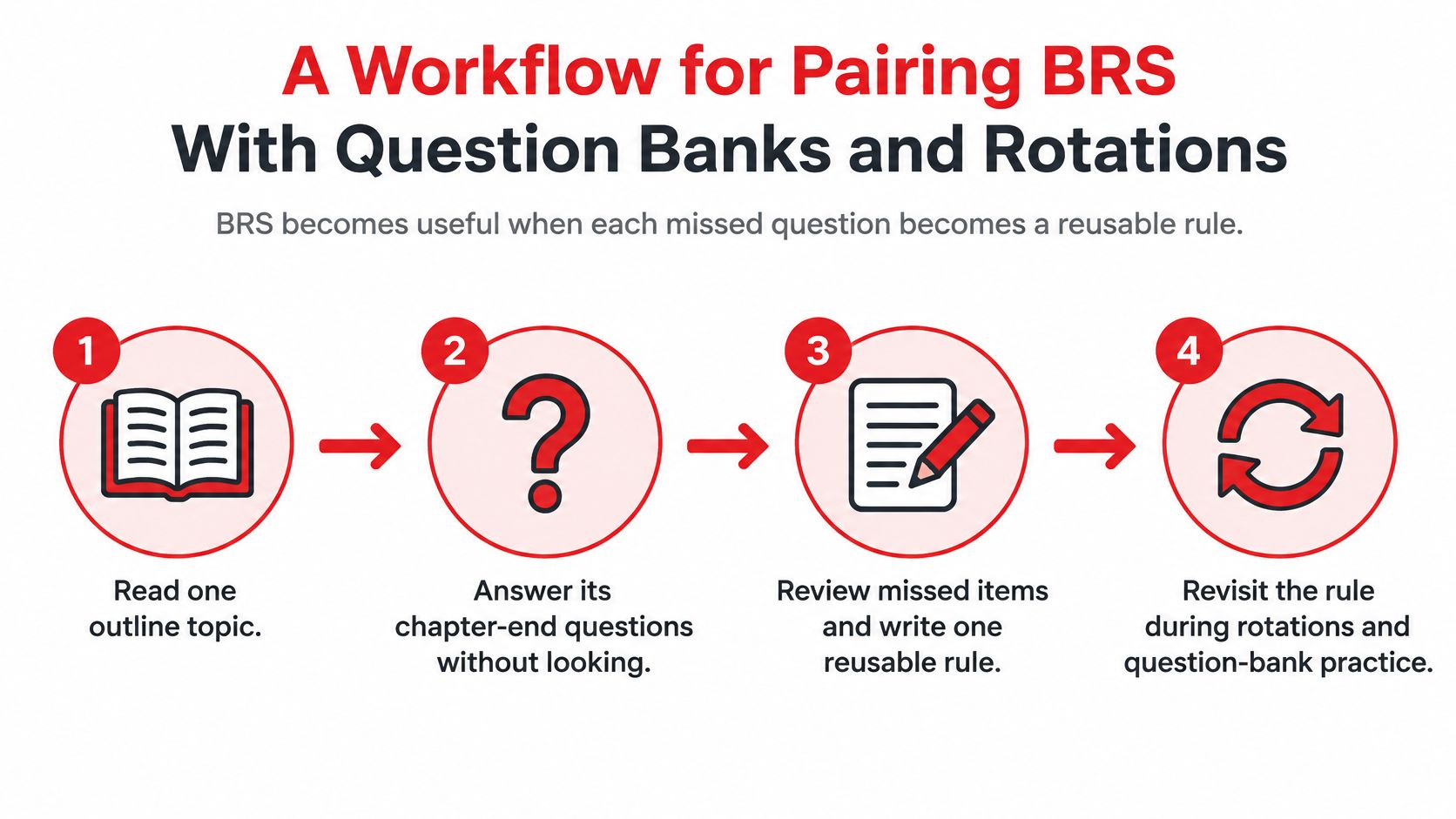
Read one outline topic. Choose a manageable subject rather than trying to cover several unrelated topics in one sitting. The aim is to build a first-pass structure that can be tested, not to memorize every line.
Answer the chapter-end questions without looking back. Commit to an answer before checking the text. This makes it easier to tell whether the outline was understood or merely recognized while reading.
Read every explanation. Check why the correct answer fits and why the alternatives don't. An incorrect choice can reveal a missed age-related clue, a mistaken interpretation, or a faulty sequence of actions.
Classify each miss. Use four categories: a factual gap, an age or normal-range miss, an interpretation error, or a management-sequence error. The category determines what to review next, so a simple list of missed topics isn't enough.
Write a compact rule. Record the patient's age, the discriminating finding, the most likely diagnosis, the next best step, and the main alternative diagnosis. Keep the rule short enough to revisit without rereading the whole chapter.
Retest the rule after spaced intervals. Review it after one day, three days, and one week. Recalling the rule later helps identify what has stuck and what still needs clarification.
Move to mixed, timed questions once topics feel stable. A separate question bank can test whether the rule transfers when the topic isn't announced in advance. Use the results to choose the next outline section rather than restarting the entire book.
An original educational example
Original example, not from any examination: A learner misses a question about a hypothetical four-year-old because the learner notices one abnormal measurement and treats it as decisive without interpreting it alongside the rest of the vignette. That's an interpretation error, not necessarily a missing-fact error. The review rule might read: “Age: four years. Discriminating finding: interpret the abnormal measurement in the context of the child's overall presentation and the other findings. Most likely conclusion: choose the explanation that accounts for the full pattern. Next step: follow the appropriate evaluation sequence. Alternative: reconsider the leading explanation if additional findings point elsewhere.” The rule is a study aid, not a clinical protocol.
During a rotation, when a patient encounter raises a topic covered in the book, reread that outline section the same day and add any question it raises to the error log. The method is more useful than collecting highlights without a plan for retrieval. A question-bank comparison focused on UWorld for Shelf exams can also help learners think about the role of an external question resource.
Question volume exposes weaknesses; reviewing wrong answers builds judgment. Clinical examples in this workflow are for examination education only, not for diagnosing or treating patients.
Sample Study Plans for Rotation and Exam Timelines
Choose a plan by the time available before the exam or the length of the rotation, not by the amount of material in the book. The frameworks below are starting points, not predicted or guaranteed outcomes. After the first week, adjust them using the error log: repeated factual gaps may call for topic review, while interpretation or sequencing errors may call for slower explanation review.

| Plan | Length | Daily BRS block | Question work | Rotation link |
|---|---|---|---|---|
| Shelf sprint | 4 weeks | One outline section plus its chapter questions | Timed mixed blocks from a separate question bank | Map missed topics to patients seen on the rotation |
| Step 2 CK bridge | 8 weeks | One outline section per study day, with weekly chapter-end review | Mixed question-bank blocks, reviewed by error type | Review cases the team discussed, not only rounds |
| Clerkship-long review | Whole rotation | 20 minutes of one chapter | 10 questions daily | Keep a running topic list to map to Shelf |
| Light refresher | 1 to 2 weeks | Skim tables and high-yield summaries | Chapter-end questions on weak chapters only | Spot-check weak chapters against rotation patients |
A short daily block can keep review connected to clinical teaching, while question practice helps reveal whether the learner can use the material without the chapter heading as a clue. For the longer plans, the weekly review should look for repeated error types and adjust the next week's topics accordingly. A study schedule for medical students can provide another planning reference.
One-on-one tutoring can help a learner review an error log, classify missed questions, and set a question-review schedule. It doesn't replace official practice materials, a full question bank, or independent study. Ace Med Boards offers one-on-one online tutoring for Shelf exams and provides tutoring packages of 10, 20, or 40 hours; details are available through its tutoring services.
Two new resources added in the same week can leave neither one finished. Choose one main review text and one question source, then reassess after the first week.
Decide Whether BRS Pediatrics Fits Your Next Exam
BRS Pediatrics fits when a learner needs a condensed, question-supported outline within a specific timeline. It fits less well when it's the only source for building a foundation or checking current management decisions.
Start with three checks:
- Confirm the edition. The publisher identifies the third edition as a 608-page paperback with ISBN 9781975216276, published in September 2025. The 2018 second edition has a different ISBN, so the page references and question sets may not match; confirm the edition in the publisher's listing.
- Check assigned resources. Follow any text or question source required by a school, clerkship, or exam plan.
- Choose a timeline and start an error log. Select the closest fit from the study-plan table, then record the type of each missed question from the first study session.
A quick planning routine can make that choice concrete: note the next exam or rotation end date, rate the pediatrics baseline from 1 to 5, and list any assigned resource. The rating is a personal planning aid, not a standardized measure; use it to decide whether a concise outline is enough or whether foundational reading should come first.
A one-on-one plan may help with error-log review and scheduling. Ace Med Boards offers online private USMLE tutoring, but tutoring complements official materials rather than replacing them; current formats, hours, and terms should be confirmed on its service page. Learners who would benefit from help turning missed questions into a realistic schedule can consider a free consultation without expecting a promised score or outcome.
Students comparing BRS Pediatrics with their own study needs can visit Ace Med Boards to learn about one-on-one tutoring for Shelf examinations and USMLE preparation. A free consultation can help determine whether support with question review and scheduling fits the learner's plan.