What if a decent total on uWISE OBGYN still hides the one pregnancy objective you keep missing? Chasing the overall number is the usual habit, and it is the wrong one.
uWISE is an APGO (Association of Professors of Gynecology and Obstetrics) web-based self-assessment for students in obstetrics and gynecology clerkships. Most learners reach it through their school, not by opening a personal account.
This guide is for allopathic and osteopathic clerkship students, and for international or foreign medical graduates on a U.S. OB/GYN rotation, who need a way in, a way to read results, and a way to turn each miss into a review task. Scenarios below are for exam learning only. They are not instructions for patient care.
Key takeaways
- Get in through your school. Confirm assignment status and dates with the clerkship office, and check the current APGO handbook as of 2026.
- Read by objective. A cluster of misses in one domain matters more than the total.
- Name the error type. A knowledge gap, a misread stem, and a lucky guess need different fixes.
- Keep a same-day log. An unused result does not change the next attempt.
- A low score is information. One uneven sitting does not decide a clerkship or a career.
Ace Med Boards Editorial Team
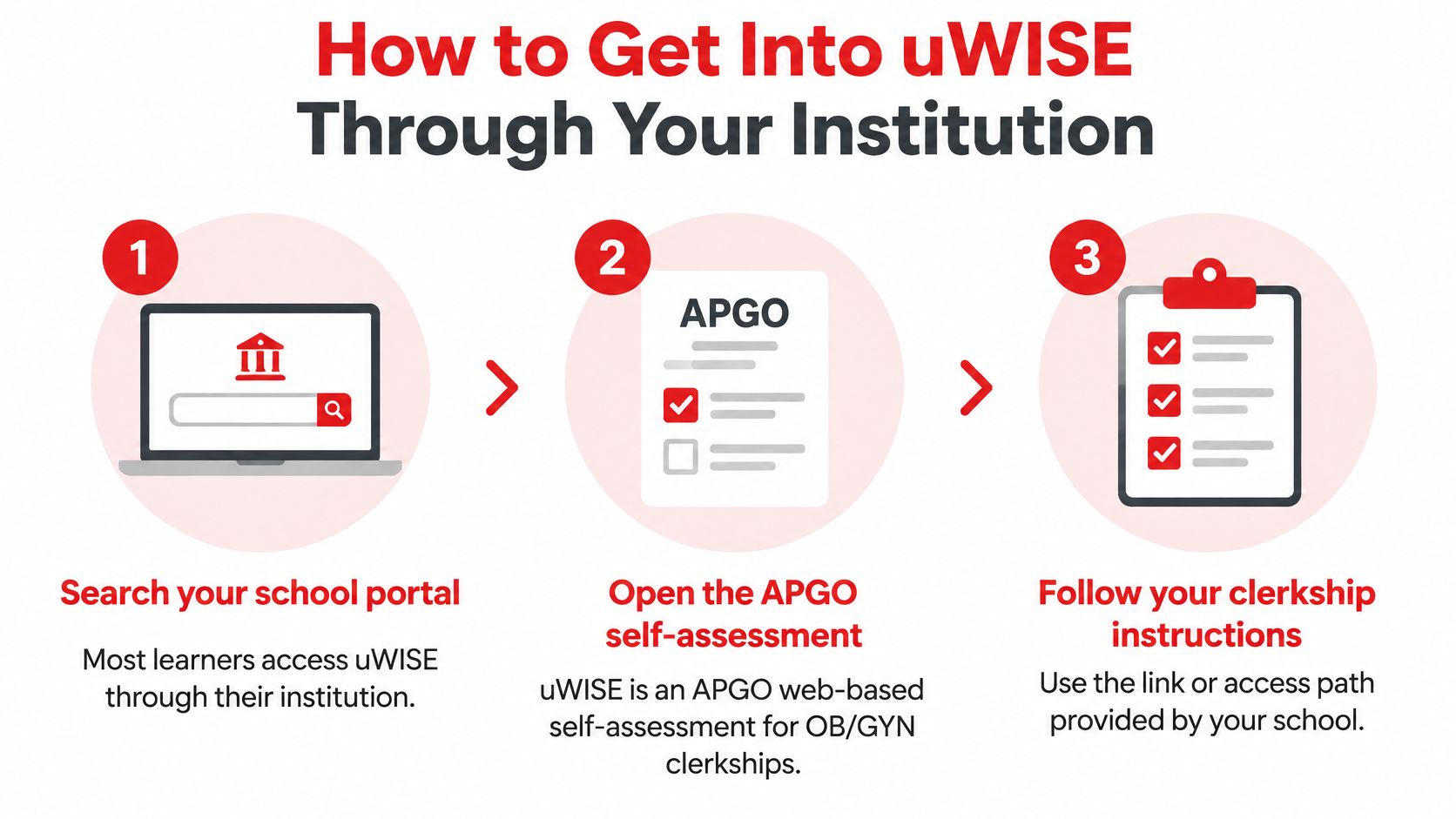
How to Get Into uWISE Through Your Institution
uWISE is an APGO web-based self-assessment built for OB/GYN clerkship students, and most learners open it through their school rather than on their own. The login path, whether the tool is required, and the completion window all depend on that school.
Check the current APGO handbook as of 2026, then confirm dates with the clerkship office. A course page can lag a handbook update by a term.
Six steps before the first item
- Find the course site. Open the OB/GYN clerkship page your school already uses, because coordinators post the correct link there.
- Confirm the assignment. Ask the clerkship director or coordinator whether uWISE is required, optional, or extra credit, and which dates apply.
- Sign in with school credentials. Use the institutional account your school issued, not a personal password you invented for a third-party site.
- Check the first screen. It should name uWISE and APGO. Do not type credentials on a look-alike page.
- Read the on-screen rules. Note navigation, pausing, timing, and when results are released before you answer anything.
- Write two dates. Record the deadline and the day you will review results, so the sitting is not the last step.
If the link fails, contact your library or IT help desk and the clerkship coordinator. Never share a login.
Practical rule: If the page does not name both uWISE and APGO, stop and ask the coordinator before you enter a password.
This is a practical guide for clerkship learners, not a predictor of board performance.
How uWISE Maps to APGO Objectives and What That Means
uWISE is not a random pile of women's health items. The UAB OB/GYN clerkship online resources page describes it as mapped to the APGO Medical Student Educational Objectives, which set out the women's health knowledge, skills, and attitudes expected of general physicians. APGO presents uWISE as an interactive web-based examination for students regardless of intended specialty. Institutional clerkship materials describe approximately 600 questions across 58 topic and objective areas. Confirm that count in the current APGO handbook as of 2026, because a local syllabus can describe the set differently.

One pattern, two readings
Say a learner misses four items tagged to one pregnancy-related objective and answers the gynecologic items on that same sitting correctly. The useful reading is narrow. The gap sits in that pregnancy objective, not in OB/GYN as a whole.
The objective-level reading names the domain to review. The total-score reading only shows distance from a target, and it hides the pattern.
Clinical stems in any self-assessment are simplified for learning. They are not guidance for patient care. Real decisions need the full clinical picture and current professional guidelines.
That objective map is what the later review steps use. A percentage without a tag does not tell you what to open next.
Build a Weekly Self-Assessment Routine Around Clerkship Duties
Short blocks with a written product hold up better than a long session squeezed between clinic and call. Tie each block to one output you can point at when the week ends.
The sample week below is a framework to adapt. It is not a schedule set by APGO or by any board.
| Day | Focus | Time block | Output |
|---|---|---|---|
| Monday | Initial pass in one or two objective areas | 40 min | Miss list tagged by objective |
| Tuesday | Review each miss and its explanation | 45 min | Error log entries |
| Wednesday | Reread lecture notes or handbook section for the weakest objective | 45 min | One-page summary in your own words |
| Thursday | New practice in the weakest area, then a short self-check | 45 min | Updated miss list |
| Friday | Light review of the week's error log | 20 min | Two review tasks for next week |
| Saturday | Mixed review of older misses using your own notes | 30 min | Notes on any topic still unclear |
| Sunday | Rest, or skip if on call | 0 min | None |
Why the order is set this way
Monday finds the miss pattern. Tuesday reads the explanation while the stem is still fresh. Wednesday sends the weakest objective back to lecture notes or the handbook. Thursday practices that area with new items, not a replay of Monday's answers. Friday and Saturday keep the log alive. Returning to older misses is easier if you build a spaced repetition plan around the two tasks you named on Friday.
You do not need to repeat exact items. Revisit the objective through your own notes, the clerkship handbook, and other sources you may use.
Adjust the week to the rotation
- Protect post-call time. Move the review block to after a call night, not before it.
- Cap the sitting. Keep any single session near 60 minutes so clinic days stay usable.
- Keep one lighter day. Use it to catch up, or leave it empty if the week already ran long.
If a shelf exam comes later in the block, a separate shelf exam study approach covers that exam on its own. This week stays on uWISE objectives.
By Sunday you should have an updated objective list, the top two weak areas named, and one review task for each.
Review Every Miss by Error Type, Not Just by Score
An incorrect answer has more than one cause, and each cause needs a different fix. Sorting only by "wrong" sends every miss to the same reread, which wastes the explanation.
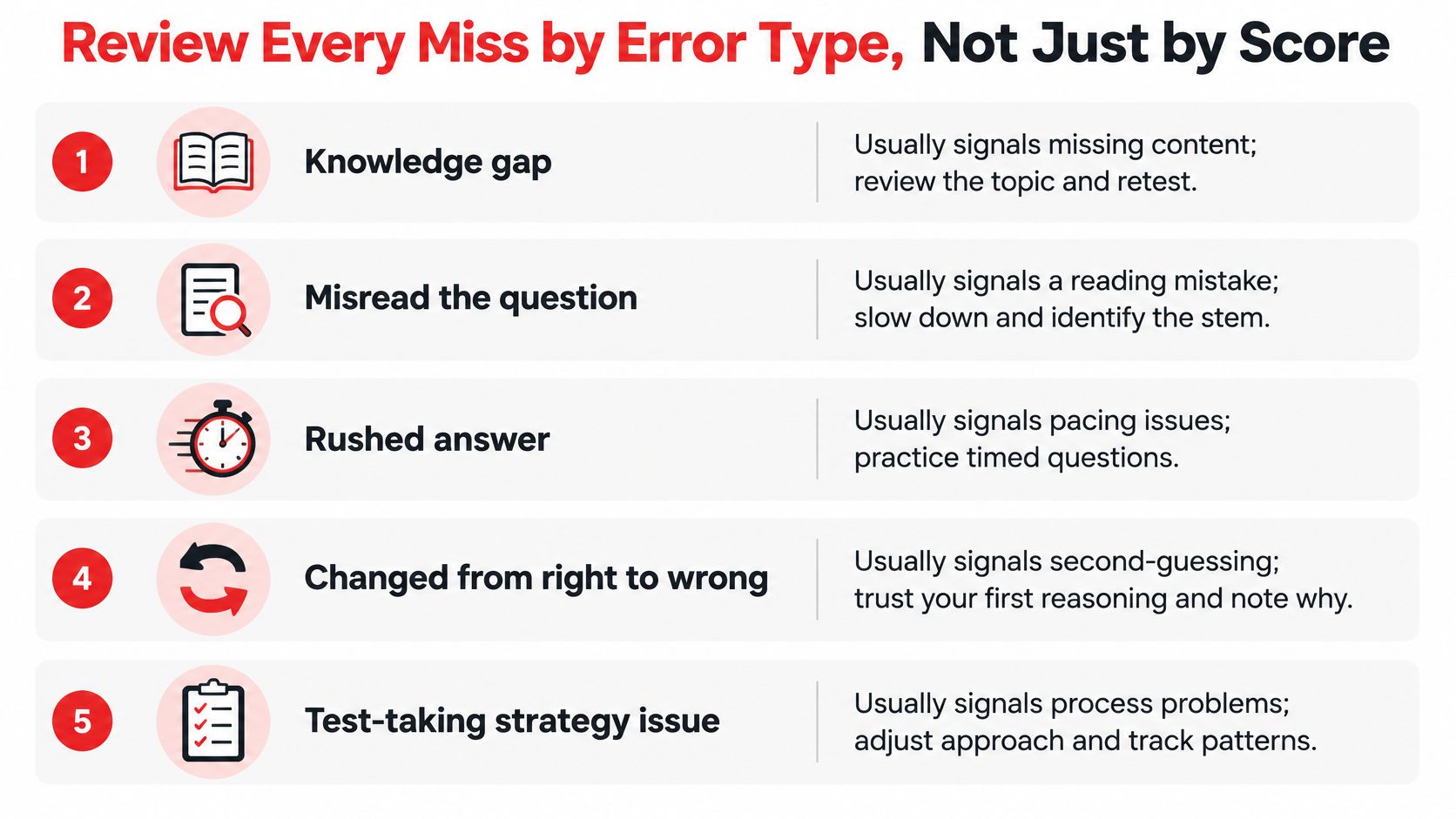
| Error type | What it usually signals | Next action |
|---|---|---|
| Knowledge gap | The content was not learned or has faded | Reread the objective's core content and write a three-sentence summary |
| Misread stem | Key details such as timing, age, or a final finding were missed | Underline key findings before reading the options |
| Reasoning error | Facts were recalled but the sequence of decisions was wrong | Write the most likely diagnosis and the next step in one sentence each |
| Changed answer | A correct first choice was replaced without new evidence | Note whether the change helped, and track it across attempts |
| Lucky guess | The answer was right without a clear reason | Count it as a miss and review it as if it were wrong |
A misread that looks like a knowledge gap
Say the stem describes a stable patient, then adds one late finding that changes the next step. The learner picks a plausible management step and stops reading before that finding. The content may already be known. The error type is a misread stem, and the fix is to underline key findings before looking at options. Treating it as a knowledge gap would send the learner back to a chapter they do not need.
The same sorting shows up in distractor analysis: the tempting wrong choice often matches the sentence you stopped on, not the sentence that decides the item.
Log each miss in five lines
- Objective area: the APGO tag, not a vague topic name.
- Error type: one label from the table.
- Key finding missed: the detail that should have changed the answer.
- Correct reasoning: one sentence, in your own words.
- Single reread: one concept, not a whole chapter.
Count a correct guess as a miss. A right bubble without a reason is unstable knowledge, and it will not hold on a new stem.
A review worked when the same objective shows fewer misses of the same error type on the next attempt, and when you can state the reasoning without looking at the answer key. These stems are for educational reasoning only. Real clinical decisions need full context and current guidelines.
Common uWISE Pitfalls and How to Avoid Them
A careful first pass still fails if the habits around it throw the result away. None of these is a personal failing. Each one has a direct fix.
- Skipping explanations. Reading the key and moving on leaves the reasoning unwritten. Read every explanation the same day and write one sentence on why the correct choice follows.
- Memorizing a prior attempt. Recalling last week's answer is not progress. Judge improvement only on new items in the same objective area.
- Using uWISE as the only source. Lectures, handbook sections, and assigned readings still carry the content. Send each weak objective back to those materials as the second step of review.
- Starting the week before the final. A late first attempt leaves no time to act. Schedule it early enough for at least two review cycles.
- Letting the log lapse. A log you update "later" stays blank. Add the five lines the same day as the session.
A broader look at pacing and answer changes sits in these test-taking strategies. Use them on your own items. Do not export anyone else's.
Never copy, paraphrase, or share questions or explanations in outside notes, group chats, or shared documents, and never share login credentials.
Those limits protect you and the resource. The APGO handbook and your school's policies set the current terms.
Pair uWISE With Your Other OB/GYN Resources
uWISE works best as the diagnostic step in a loop, not as the whole plan. Other materials do the teaching. A later check shows whether the teaching stuck.
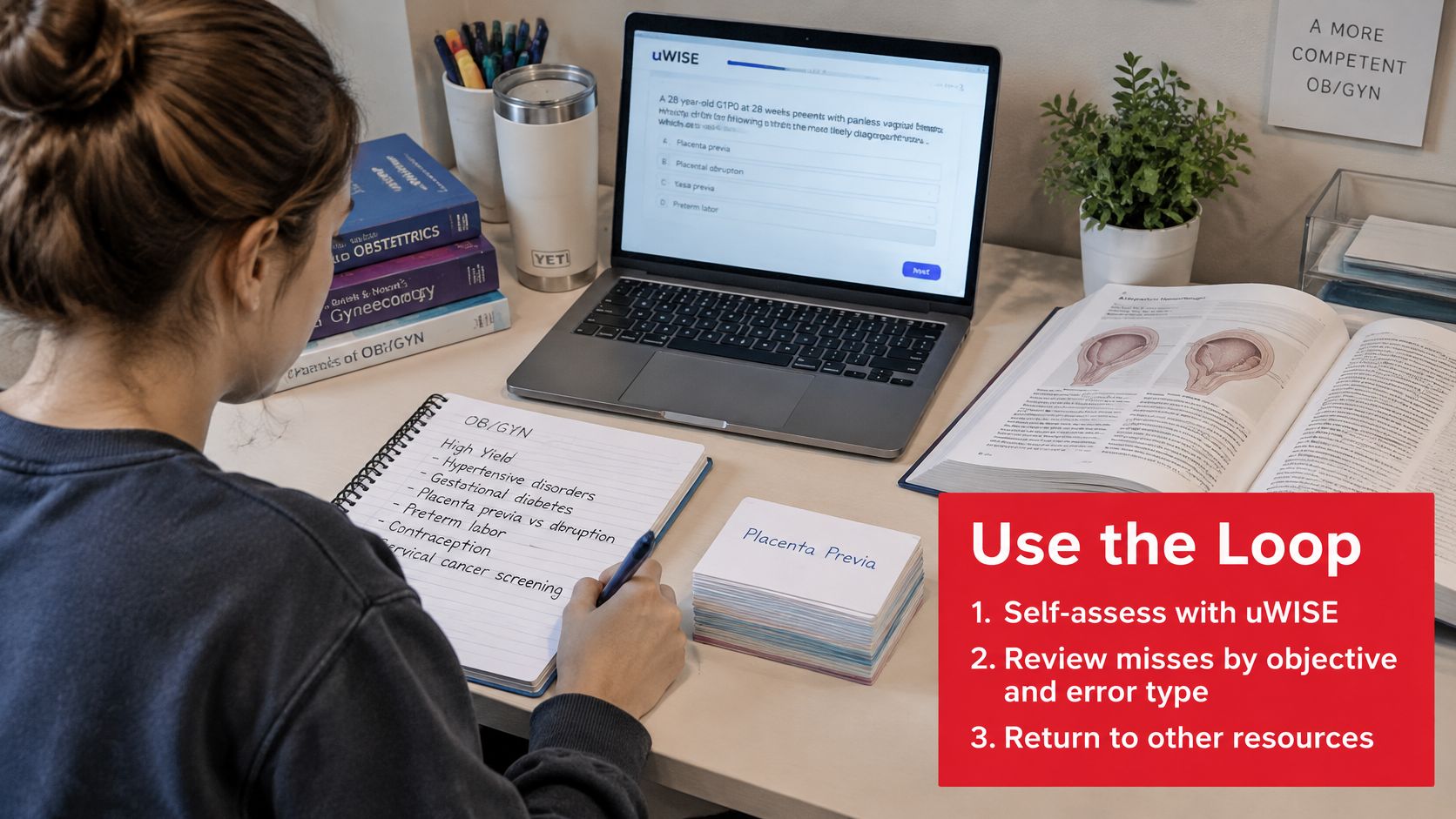
- Tag the miss. After the self-assessment, label each miss by objective and by error type.
- Read the matching section. Use the clerkship handbook, lecture notes, or the assigned textbook, not a second pass of the same items.
- Write a short summary. Keep it in your own words, about half a page.
- Practice the objective again. Later in the week, use new items from a source you can open under your own name.
- Log and compare. Record the result next to the previous attempt on that objective.
For other clerkship materials, the OB/GYN resource roundup lists options students commonly pair with a self-assessment. Confirm that the page still matches what your school assigns before you buy anything.
Where each source fits
NBME (National Board of Medical Examiners) shelf practice, when your school schedules it, belongs at the timing-and-format step. It does not replace the objective tags, and uWISE does not replace those official forms.
Third-party question banks, such as those students already use under their own accounts, can supply the new-item step. They are separate products with their own terms. This guide does not rank them. Do not share a login, and do not move their text into a group document.
A balanced week looks plain. uWISE finds the gap. School materials teach the content. One official or school-provided practice source checks timing and format.
Decide Whether One-on-One Tutoring Fits Your Next Step
Many learners finish this review with independent study alone, and that is a reasonable path. Tutoring is a fit question, not a default next purchase.
Self-study is usually enough when
- Misses are spread out. No single objective stays weak after a normal review cycle.
- Each miss has a clear explanation. You can write the reasoning without the key in front of you.
- Later attempts improve. The same error type shows up less often.
One-on-one tutoring may be worth a conversation when
- One objective stays weak. Two review cycles have not moved it.
- Anxiety or pacing repeats. The same error types show up when the timer is on.
- The rotation is crowded. You need help placing several practice attempts around call and clinic.
Tutoring complements official practice materials, question banks, and independent study. It does not replace them. Customized tutoring can cover both the OB/GYN shelf exam and USMLE Step 2 when those exams are on your schedule. uWISE is not an Ace Med Boards product, and no affiliation with APGO is implied.
Ace Med Boards describes current service areas on its tutoring pages. Details should be checked before you enroll. OB/GYN shelf tutoring is outlined on the OB/GYN shelf tutoring page. A free consultation is the first step for discussing fit. Students can email hello@acemedboards.com or schedule at the Ace Med Boards consultation page. Nothing here promises a score, a grade, or a match.
Sources
Policies, access rules, and item counts change. Check each source as of your publication or study date in 2026, and follow your clerkship office when a local rule is stricter.
- APGO, uWISE description and current handbook. Use the handbook for access rules, scoring, and terms. Do not rely on a secondhand summary.
- APGO Medical Student Educational Objectives. These are the objectives uWISE items are mapped to.
- Your institution's OB/GYN clerkship handbook or syllabus. Local source for login path, assignment status, and completion windows.
- UAB Department of Obstetrics and Gynecology, clerkship online resources. Institutional description of uWISE as an objective-mapped self-assessment, including the approximate question and topic counts cited above.
- NBME, official practice information. Relevant only if your school assigns NBME shelf practice. uWISE does not replace those forms.
Ace Med Boards offers one-on-one online tutoring for clerkship shelf exams, including obstetrics and gynecology, for students who want help turning a self-assessment pattern into a study plan. Tutoring sits alongside your school's materials and your own uWISE review. It does not replace them. If you want to talk through whether that help fits your rotation, visit Ace Med Boards and schedule a free consultation.