

You have six weeks before Step 2 CK, but your evenings are still consumed by clerkship responsibilities, shelf review, and the nagging question of whether you're studying the right material. The USMLE Step 2 CK passing score is now 218, and the exam format changes on May 7, 2026, which means your schedule must prepare you for both the current performance standard and shorter, faster decision-making blocks.
This guide gives you practical 4-, 6-, 8-, and 12-week Step 2 CK study plans. Every version uses the same measurement backbone: an early NBME baseline, focused question-bank blocks, a tagged error log, repeated reassessment, and a controlled final taper. Your clerkship intensity, starting performance, and target specialty competitiveness determine which timeline is appropriate.
What a Step 2 CK Study Plan Has to Cover in 2026
The May 7, 2026 format change keeps Step 2 CK as a one-day, 9-hour examination, but changes the structure from 8 blocks of 60 minutes to 16 blocks of 30 minutes. The total item count remains capped at 318, while the new blocks contain 20 or fewer questions. Before the change, blocks could contain up to 40 questions, with at least 45 minutes of break time and a 15-minute optional tutorial, according to the official Step 2 CK content outline and specifications.
That shift matters because you can't prepare only for knowledge recall. You need to practice making decisions in shorter bursts, resetting quickly between blocks, and sustaining attention across the entire day. Your schedule should include timed practice that resembles the pacing you'll face after May 7, 2026, rather than relying exclusively on long question sets.
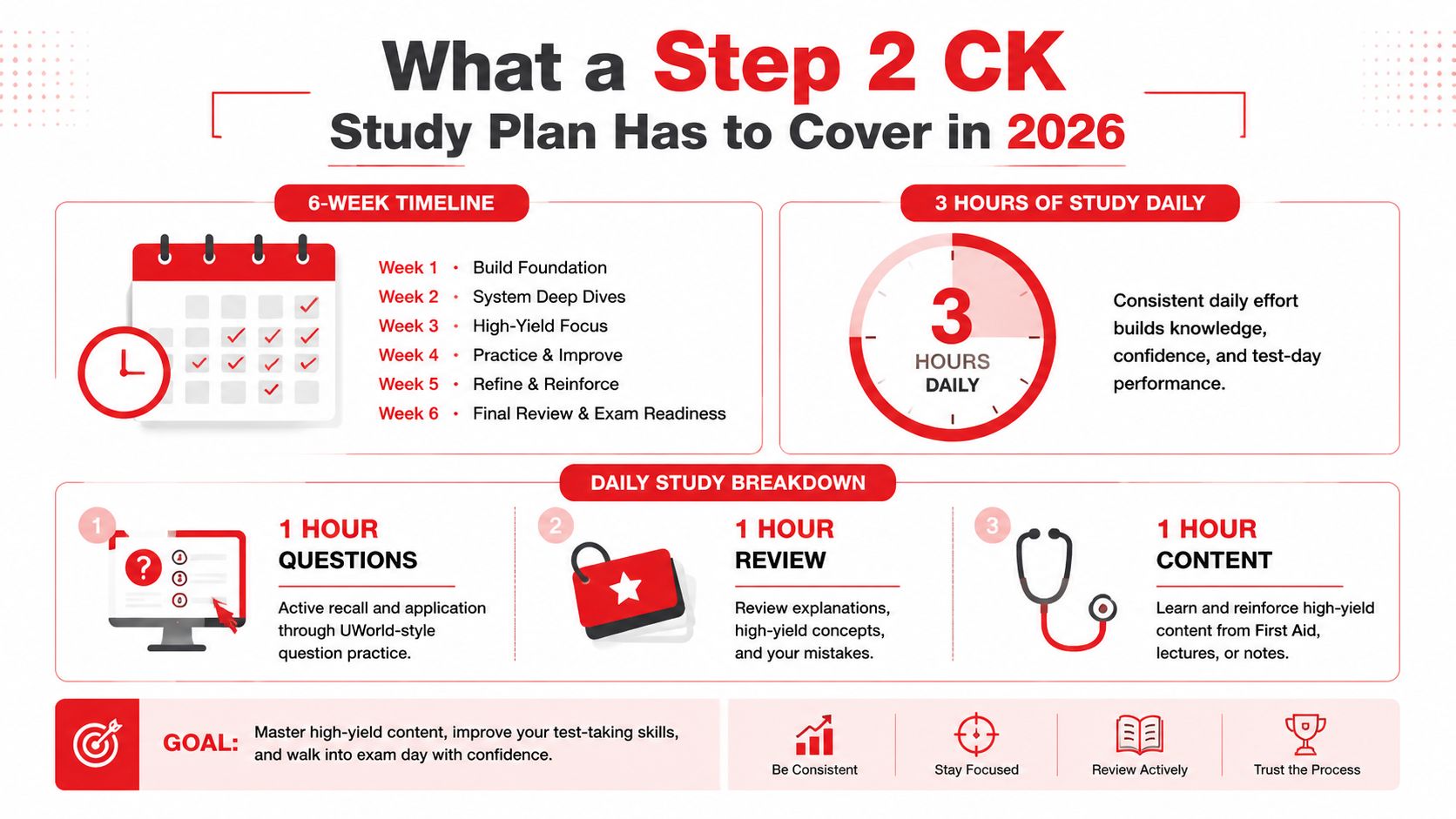
The four elements every timeline needs
- Baseline assessment: Take an NBME under timed conditions before committing to a schedule. A baseline is useful only when it reflects your actual test-taking behavior.
- Question-bank practice: Build around one primary question bank. Question review should occupy more time than answer selection.
- Error-log analysis: Tag misses by knowledge, reasoning, misread, or pacing. Also track the organ system and physician task, such as diagnosis, management, prevention, or ethics.
- Final taper: Reduce new material near the exam. Preserve sleep, review recurring errors, and rehearse logistics instead of chasing unfamiliar facts.
Step 2 CK covers broad clinical knowledge across Medicine, Pediatrics, Surgery, Obstetrics and Gynecology, Psychiatry, and other clinical domains. The USMLE content outline organizes the examination around common content categories and physician tasks, so a mixed, integrated plan is more defensible than a schedule built around memorizing isolated specialties.
Use the Step 2 CK study materials to anchor your official-format practice, then choose the timeline that matches your baseline and available hours. The sections below give you the score-audit method, resource rules, reasoning workflow, and calendar structure needed to select that timeline without guessing.
Baseline Assessment and Score Goal Setting
Your first 48 hours should produce a measurement, not a feeling. Take one NBME self-assessment under timed conditions before opening a new question-bank block, then record the score, completion behavior, unanswered items, and confidence level on uncertain questions.
Turn the result into three separate decisions. First, calculate your distance from the 218 passing standard, which took effect on July 1, 2025, as documented on the official USMLE examination results and scoring page. Second, define a target band appropriate to your application goals, but don't confuse a competitive target with a guaranteed requirement. Third, identify whether your misses mainly reflect knowledge, reasoning, misreading, or pacing.
Build a four-column performance dashboard
Review every incorrect answer and every correct answer you reached by guessing. Assign one primary error cause:
- Knowledge gap: You didn't know the relevant disease, mechanism, guideline, or management step.
- Reasoning error: You knew the facts but connected the presentation to the wrong diagnosis or action.
- Misread: You overlooked a qualifier, timeline, risk factor, laboratory value, or question stem task.
- Pacing: You ran out of time, rushed late questions, or spent too long on low-yield uncertainty.
Add two more tags, organ system and physician task, so your log can reveal patterns such as “cardiology, management, reasoning” rather than merely “missed question.” Reassess those categories on unseen material. Repeating familiar questions can create recognition without demonstrating transfer.
A two-week dedicated period was associated with a higher mean score than longer study in one neutral longitudinal analysis, 251.87 versus 240.81, while both groups had a 100% pass rate. That finding doesn't prescribe a short schedule for every student, but it supports efficient preparation after core clinical learning rather than automatically extending dedicated time. The data are summarized with methodological context in this Step 2 CK study-duration review.
Baseline Score vs Realistic Timeline and Target Band
| Baseline NBME Score | Minimum Timeline | Realistic Target Score | Notes |
|---|---|---|---|
| Below 215 | 12 weeks or longer | Set after diagnostic review | Repair foundational gaps before increasing volume |
| 215 to 229 | 8 to 12 weeks | 230s to mid-240s | Reassess frequently and protect review time |
| 230 to 244 | 6 to 8 weeks | Mid-240s or higher | Use mixed blocks and targeted remediation |
| 245 or higher | 4 to 6 weeks | Maintain or improve current band | Prioritize pacing, stamina, and recurring errors |
These are editorial planning bands, not promises or official score predictions. A 12-week plan can accommodate a lower starting point, while a 6-week plan requires a stronger baseline and consistent clinical foundation. A 4-week plan is appropriate only when your baseline already shows a substantial margin above passing and your error log contains correctable problems rather than widespread content gaps.
Use the NBME Step 2 CK practice exams as checkpoints, not as daily emotional verdicts. Your decision should follow the trend in scores, error categories, timing, and performance on unseen questions.
Choosing the Right Question Bank and Practice Resources
Resource selection should reduce decisions, not create another project. The official USMLE interactive sample materials are the clearest place to rehearse the examination interface and official terminology. The official Step 2 CK materials include sample test questions through the interactive testing experience.
Compare resources by role, not reputation
| Resource | Blueprint Alignment | Difficulty Calibration | Best Role in Plan | Cost Tier |
|---|---|---|---|---|
| UWorld | Broad clinical coverage and integrated explanations | Useful third-party practice calibration | Primary question bank and error review | Paid |
| NBME self-assessments | Written by the examination organization | Primary score-calibration option | Baseline and scheduled reassessment | Paid |
| Official interactive sample materials | Direct interface and official style exposure | Closest source for interface familiarity | Format and navigation rehearsal | Official resource |
| AMBOSS | Broad supplementary clinical coverage | Secondary practice, not a substitute for NBME calibration | Targeted reinforcement for weak areas | Paid |
| Shelf review banks | Rotation-linked consolidation | Useful for clerkship-specific practice | Early clinical foundation building | Paid |
Commercial platforms change their content, pricing, and access terms, so verify current details directly before purchasing. The table's cost tier is intentionally qualitative because a study plan shouldn't depend on an unverified price.
My default recommendation is one primary question bank plus available NBME self-assessments and official sample materials. UWorld is a reasonable primary choice for students who want a large integrated clinical question bank and detailed explanations. AMBOSS can serve as an optional supplement when a concept remains unclear, particularly for repeat test-takers and IMGs who need a second explanation or more targeted practice.
Don't run UWorld, AMBOSS, and another full question bank simultaneously because you fear missing content. A data-driven synthesis cited in this question-heavy Step 2 CK planning guide warns that using three or more question banks can create resource overload and that students who devote 76% to 100% of study time to practice questions outperform those who rely more heavily on passive review. Treat that as planning evidence, not an individual guarantee.
Use Step 2 CK practice questions to support question analysis, but skip any platform that duplicates your primary bank without adding a distinct role. Your review system matters more than the number of logos on your browser.
The Clinical Reasoning Method That Drives Question Review
A missed question should become a reasoning lesson, not a trivia card. Use the same sequence on every difficult item: clinical problem representation, tested task, decisive clue, mechanism, and distractor elimination.
Consider this original hypothetical vignette:
Hypothetical educational vignette: A previously healthy adult develops sudden unilateral leg swelling and pleuritic chest discomfort after a period of reduced mobility. Vital signs are stable. The question asks for the next best step.
Problem representation: Stable adult with acute venous thromboembolism symptoms after a provoking risk factor.
Tested task: Immediate management, not merely diagnosis.
Decisive clue: The patient is clinically stable, so the management pathway differs from one for hemodynamic instability.
Mechanism: A clot-related process requires risk assessment, confirmation strategy, and treatment planning.
Distractor pattern: Options that jump to advanced rescue therapy or ignore stability are mismatched to the clinical context.
The vignette is intentionally simplified and isn't medical advice. In real clinical care, decisions depend on complete history, examination, testing, contraindications, and local protocols.
Apply the five-step review sequence
- Write the problem representation. Include age or life stage, relevant sex when it changes the differential, acuity, syndrome, and the strongest risk factor.
- Name the tested task. Is the question asking for diagnosis, next best step, mechanism, prognosis, prevention, communication, or ethics?
- Identify the decisive clue. Ask which detail changes the answer most. Don't treat every stem fact as equally important.
- Commit to a mechanism or framework. Before scanning choices, state the disease process, management algorithm, or ethical principle you think controls the decision.
- Eliminate distractors deliberately. Look for acuity mismatch, premature closure, an answer that skips a required step, or a choice that solves a different problem.
The closest confounder deserves explicit attention. If two diagnoses seem plausible, write one distinguishing feature for each and identify which stem detail favors one. That act prevents passive rereading and exposes whether the problem is missing knowledge or weak discrimination.
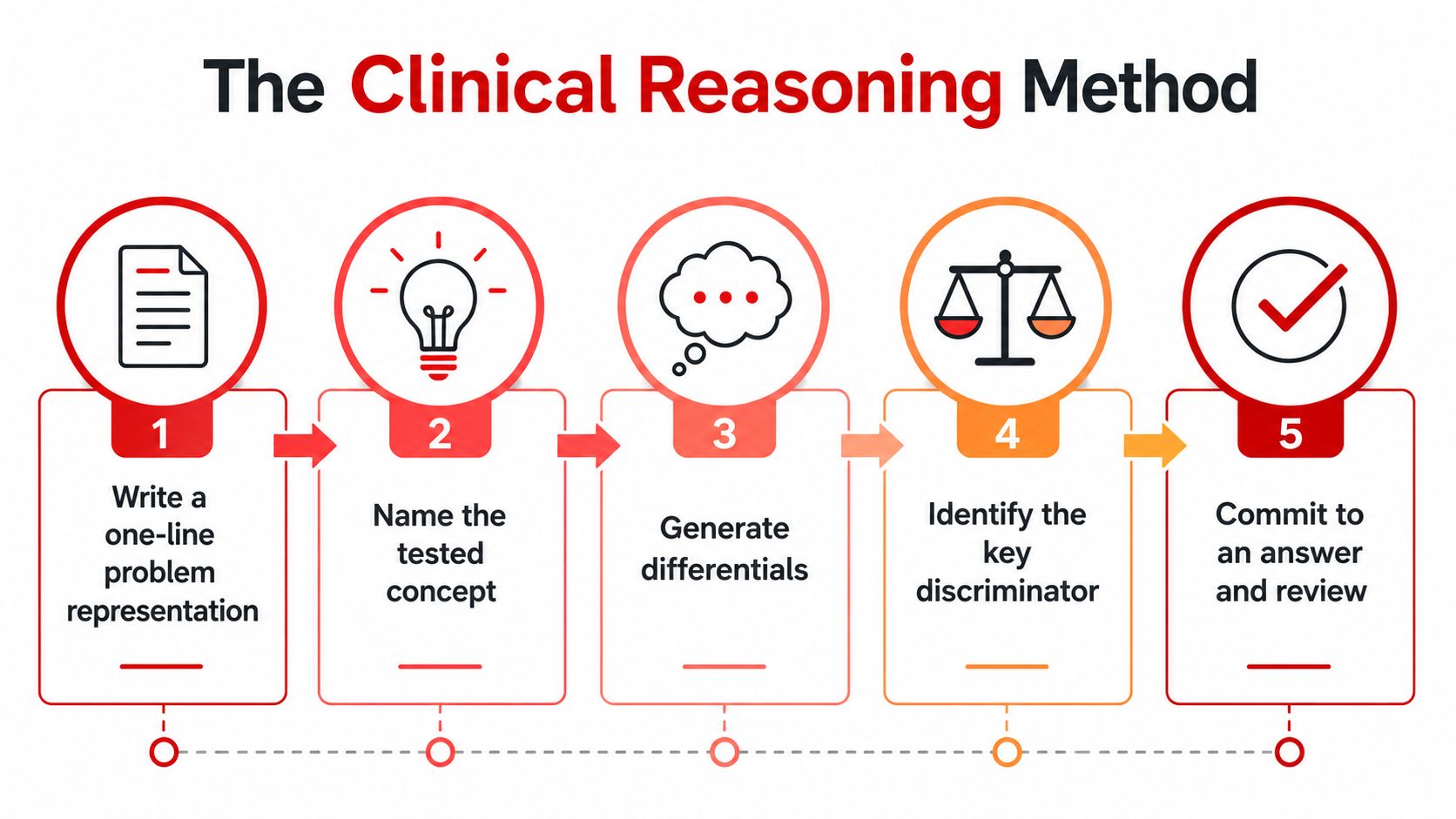
Use the clinical reasoning guide for additional practice with this framework.
Reusable error-log template
| Field | Entry |
|---|---|
| Organ system | Cardiology, renal, pediatrics, and so forth |
| Physician task | Diagnosis, management, prevention, communication, ethics |
| Stem type | Classic vignette, chart synthesis, laboratory interpretation |
| Error cause | Knowledge, reasoning, misread, pacing |
| Decisive clue missed | The fact that should have redirected you |
| Mechanism gap | The rule, pathway, or disease process to repair |
| Distractor pattern | Why the selected option looked attractive |
| Reassessment date | When you'll test the concept on unseen material |
Your log is the review. Question count is only the input.
Sample 4, 6, 8, and 12 Week Schedules
Choose the shortest schedule that allows you to review thoroughly and demonstrate improvement on unseen material. Longer isn't automatically safer if the extra weeks become passive rereading, but a compressed plan is dangerous when your baseline reveals broad gaps.
Four-week intensive plan
Use this only with a strong baseline and full-time availability. Complete 80 to 120 questions per day, review every explanation, and take an NBME around day 5 to verify that your starting assumptions are sound. The final week should focus almost entirely on tagged errors, marked questions, pacing, and official interface practice.
A typical day includes a timed mixed block, detailed review, a second timed block, targeted content repair, and a short reassessment of prior errors. Tutoring fits best as an early diagnostic session and a mid-cycle review of recurring reasoning errors, not as a substitute for independent questions.
Six-week dedicated plan
Weeks 1 and 2 should use a Shelf-oriented rotation through Medicine, Surgery, Pediatrics, Obstetrics and Gynecology, and Psychiatry while you repair gaps from clerkships. Move into mixed, timed question blocks in weeks 3 through 5, then taper during week 6. Place two NBMEs about 10 days apart, giving yourself enough time to act on the first result.
Keep one day each week free from new question blocks. That day can include light error-log review, exercise, logistics, and recovery.
Eight-week default plan
This is the best general-purpose schedule for a student with a solid clinical foundation but meaningful room to improve. Assign one organ-system or clinical-domain emphasis to each week, but include cumulative mixed review on weekends so early material doesn't disappear.
Use three NBME checkpoints across the plan. The first establishes direction, the second tests whether your corrections worked, and the third confirms readiness and pacing. Tutoring can be scheduled after each checkpoint to interpret trends, audit the error log, and adjust the next two weeks.
Twelve-week foundation plan
This timeline suits many IMGs, repeat test-takers, and students returning to clinical material after a longer gap. Weeks 1 through 3 emphasize content refresh paired with lower-volume questions. Weeks 4 through 9 integrate the primary question bank with Shelf-style review and mixed blocks, while weeks 10 through 12 focus on reassessment, error correction, and taper.
On demanding clinical days, preserve a small minimum rather than pretending you'll complete a full dedicated workload. On lighter days, expand the question and review blocks. A tutor can help identify whether the extra weeks should go to knowledge repair, reasoning practice, or test-day pacing.
| Timeline | Daily Questions | NBME Count | Shelf Review Weeks | Final-Week Focus |
|---|---|---|---|---|
| 4 weeks | 80 to 120 | 2 or more | None or brief | Tagged errors and pacing |
| 6 weeks | 60 to 100 | 2 | Weeks 1 to 2 | Mixed review and recovery |
| 8 weeks | 50 to 90 | 3 | Early targeted review | Cumulative weaknesses |
| 12 weeks | Lower on workdays, higher on days off | 3 or more | Weeks 1 to 3 | Reassessment and taper |
These daily ranges are planning recommendations, not official requirements. Review quality should determine whether you increase volume. If you can't explain why an answer is correct and why the closest distractor is wrong, adding more questions is usually the wrong correction.
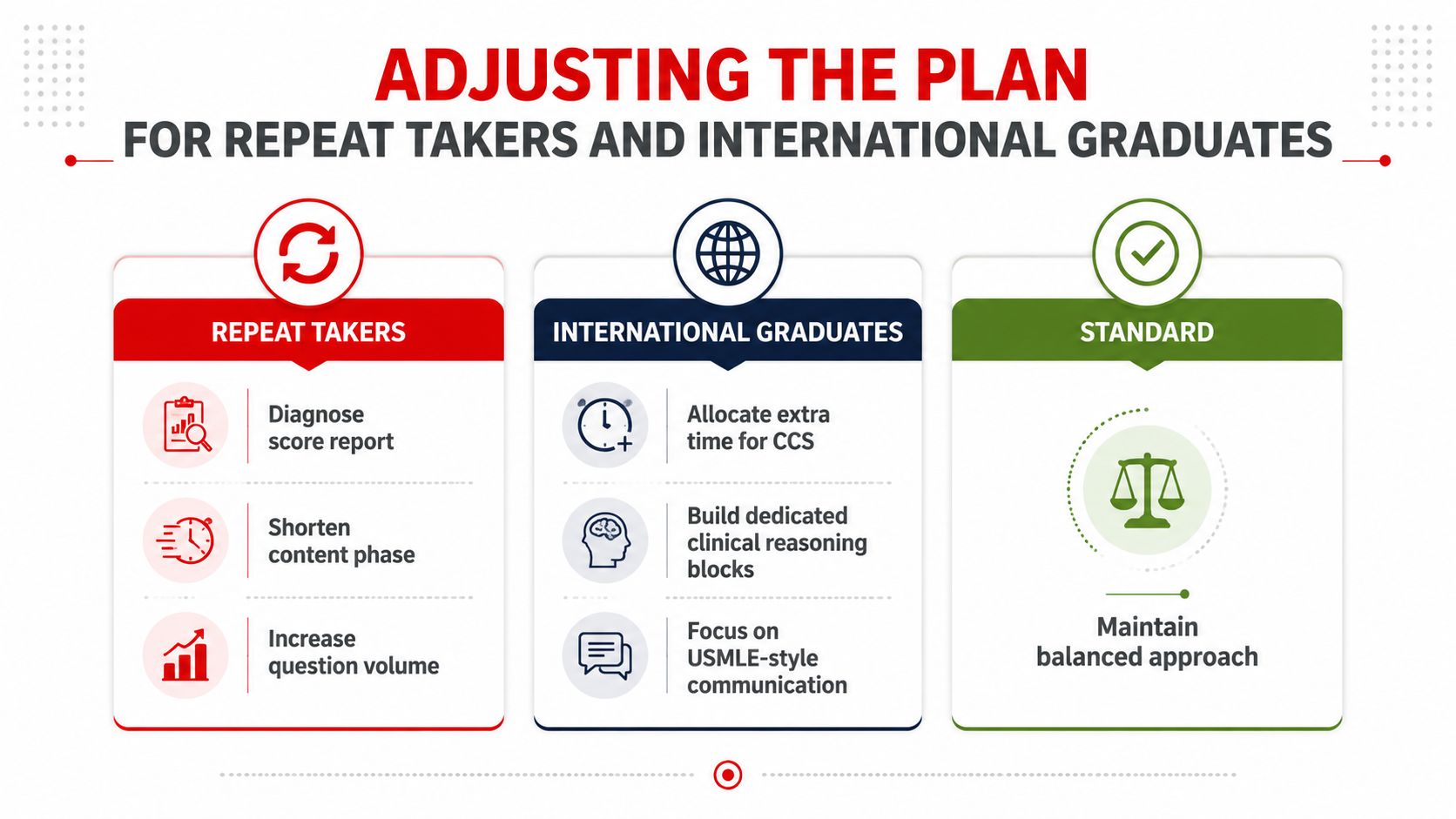
Adjusting the Plan for Repeat Takers and International Graduates
A repeat attempt deserves diagnosis, not punishment. Start with the previous score report and any notes from the prior preparation period. Identify whether the main failure mode was content, reasoning, pacing, endurance, anxiety, or inconsistent execution, then shorten the content phase only when the evidence supports that decision.
For repeat test-takers, use earlier and more frequent reassessment. The prior attempt may have covered much of the basic content, but it may also have reinforced inefficient habits. Your new plan should therefore spend less time rereading familiar chapters and more time proving that the same concepts transfer to unseen questions.
IMGs and foreign medical graduates may need additional adjustment because clinical training, question style, terminology, and exposure to U.S. examination conventions can differ. Independent summaries report repeat-pass rates around 70% for U.S. MD graduates and 64% for international examinees, with another summary placing IMG repeat-pass performance at roughly 64%. These figures come from the University of Colorado Step 2 CK academic-year summary, and they describe groups, not your personal probability.
That gap supports a larger preparation buffer, earlier NBME baselining, and deliberate Shelf-style exposure. Default to the 12-week structure when your clinical foundation or prior score report indicates that a short dedicated block would leave little room for correction.
Osteopathic students should decide early whether they're preparing for Step 2 CK alone or coordinating it with COMLEX-USA. If you're studying for both, OMM preparation must come out of the available daily capacity rather than being added on top of an already unrealistic Step 2 schedule. Keep the Step 2 reasoning framework distinct from OMM-specific review.
For exam stress that interferes with concentration or sleep, the THERAPSY exam stress guide offers general educational strategies. If your baseline NBME is below 215, extend the plan by two weeks regardless of the original calendar.
Common Pitfalls and Mid-Cycle Course Corrections
The most common planning error is confusing more material with more preparation. Running UWorld, AMBOSS, and TrueLearn simultaneously creates duplicated concepts, fragmented review, and a growing backlog of explanations you never revisit. When your NBME trajectory falls or your error tags remain unchanged, retire the extra platforms and return to one primary bank.
A second error is treating twelve-hour study days as proof of seriousness. Long sessions often compress sleep, impair clinical performance, and reduce the quality of explanation review. Reset to six to eight focused hours, take one full day off weekly, and protect an evening cutoff when possible.
The third error is reading First Aid cover to cover during the final week. If your recall has plateaued, new passive review rarely fixes the specific reasoning failure that caused your misses. Re-delete or revisit tagged errors, then test those concepts on unseen material.
| Pitfall | Warning Sign | Concrete Correction |
|---|---|---|
| Multiple full question banks | Falling scores and an expanding review backlog | Use one primary bank and keep overlap near 20% |
| Marathon study days | Rising fatigue and weaker late-day performance | Reset to 6 to 8 focused hours and take one day off weekly |
| Last-minute chapter cramming | Familiarity without improved question transfer | Replace new content with tagged-miss review |
| Delayed reassessment | You can't tell whether corrections worked | Schedule NBMEs and review them before adding resources |
Conduct a 48-hour audit at week 2 and week 5 of any timeline. Check question-bank pacing, the proportion of each error tag, missed content domains, and whether your NBME cadence remains realistic. A simple progress-tracking dashboard can keep those measures visible instead of letting your plan become a vague daily to-do list.
Decision tree for a stalled score
- Did the score fall by more than 8 points? Pause volume increases and review timing, sleep, test conditions, and recent error tags.
- Are knowledge errors dominant? Add targeted content review, then test the same domain with unseen questions.
- Are reasoning or misread errors dominant? Use the five-step method on every missed item and discuss representative examples with a qualified advisor if needed.
- Are pacing errors dominant? Rehearse shorter timed blocks and record where time disappears.
- Is the next assessment still below your target or too close to passing? Reconsider the exam date rather than relying on optimism.
During the final two weeks, stop adding broad new resources. Shift toward 30-question mixed reviews drawn from tagged error categories, take the final NBME by day 10, and reserve the last four days for light review, sleep banking, identification documents, test-center logistics, and a contingency plan for illness.
Printable readiness checklist
- Score trajectory: Recent NBMEs are stable or improving under timed conditions.
- Error categories: The dominant error causes have declined on unseen questions.
- Content repair: Major knowledge gaps have been reviewed and reassessed.
- Clinical breadth: Medicine, Pediatrics, Surgery, Obstetrics and Gynecology, Psychiatry, and other blueprint domains have received intentional coverage.
- Format readiness: You have practiced the 2026 shorter-block pacing model if testing on or after May 7, 2026.
- Logistics: Exam documents, route, arrival plan, breaks, and permitted items are confirmed.
- Contingency plan: You know whom to contact and how you'll respond if illness or a major disruption affects exam day.
If you want an outside review of your baseline, error tags, and timeline, one-on-one calibration is optional, not mandatory. A focused consultation can help you decide whether your next move is more questions, targeted content repair, pacing practice, or a later test date.
Ace Med Boards offers one-on-one USMLE Step 2 CK tutoring focused on study-plan design, question analysis, clinical reasoning, and progress calibration. If you want help interpreting your NBME trend or building a schedule around your specific timeline, visit Ace Med Boards to explore a free consultation.