You may be choosing prerequisite courses, preparing for the Medical College Admission Test (MCAT), adjusting to your first anatomy block, or wondering how a difficult exam result could affect residency. Medical education isn't one exam or one classroom. It's a staged pathway from pre-medical preparation through medical school, licensing exams, supervised residency, optional fellowship, board certification, and practice, with important decisions at every transition.
What Medical Education Actually Covers
A first-year student studies a histology slide in the morning, then enters a simulation center to conduct a standardized-patient encounter. The tasks look different, but both develop the same long-term capability: recognizing information, making a defensible decision, communicating clearly, and responding safely when the situation changes.
Medical education is the structured continuum of training that prepares learners for increasingly independent patient care. It includes undergraduate preparation, medical school, graduate medical education, and continuing professional development. The content changes, but three threads remain constant: curriculum design, assessment, and study strategy.
Four connected stages
Pre-medical preparation develops scientific foundations, clinical exposure, communication, and the application materials needed for medical school. The MCAT is one part of that process, not a substitute for academic preparation or thoughtful career exploration.
Medical school moves from foundational science and early patient skills into clerkships, where learners work with clinical teams under supervision. Students must connect mechanisms of disease with history-taking, physical examination, differential diagnosis, and professional conduct.
Residency turns broad medical knowledge into specialty practice. Residents learn within an accredited clinical environment, receive supervision, and progress toward greater responsibility while meeting specialty and program expectations.
Continuing professional development keeps physicians current after training. It may include continuing medical education, maintenance of certification, new technology, quality improvement, and learning from clinical feedback.
Practical rule: Treat every transition as both an educational stage and a decision point. The study method that helps with anatomy may not be enough for clerkship reasoning, and a strong exam plan won't answer every residency question.
Medical education also includes the hidden curriculum of time management, feedback, teamwork, and professional identity. A learner who understands only the official syllabus may still feel unprepared when the challenge is prioritizing five competing tasks during a busy clinical week.
The Full Pathway From Pre-Med to Practice
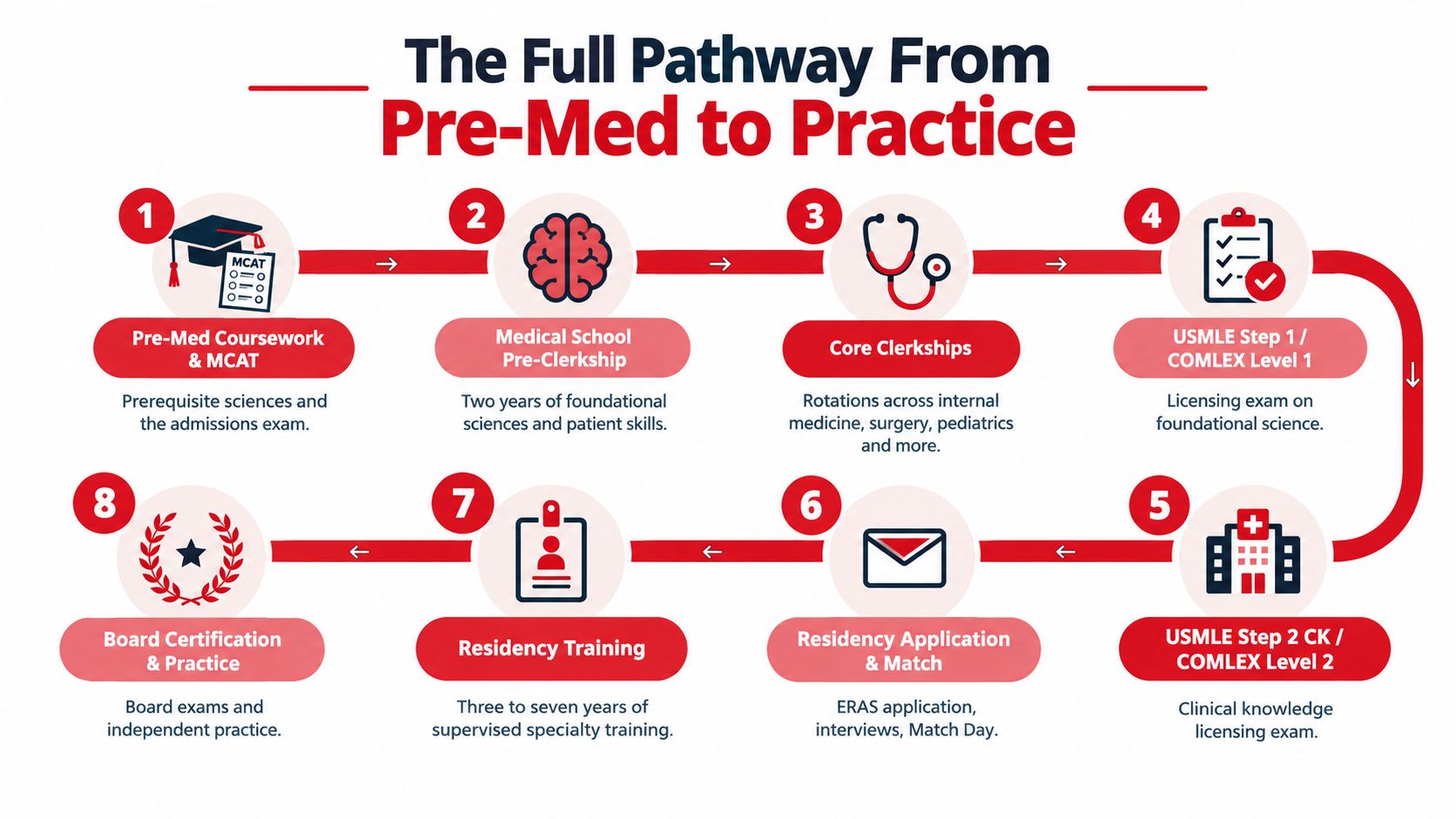
The pathway is easier to manage when you separate eligibility, learning, assessment, and career decisions. Exact requirements vary by school, licensing authority, specialty, and institution, so verify current policies before acting.
Pre-medical coursework and the MCAT. Complete each target school's prerequisites, build a record of academic readiness, gain relevant exposure, and prepare for the MCAT. The Association of American Medical Colleges' medical school preparation guidance is a useful starting point, but each school sets its own requirements.
Medical school pre-clerkship. Early training usually combines biomedical sciences, clinical skills, professionalism, and patient communication. The precise sequence differs by institution. Compare how a school teaches foundational content, provides feedback, and introduces clinical work rather than judging the curriculum by its course titles alone.
Core clerkships. Students rotate through areas such as internal medicine, surgery, pediatrics, obstetrics and gynecology, psychiatry, and family medicine. Clerkships add clinical reasoning, team communication, documentation, and workplace expectations to the knowledge base built earlier.
Foundational licensing assessment. MD-track students take United States Medical Licensing Examination (USMLE) Step 1. Osteopathic students take Osteopathic Medical Licensing Examination of the United States (COMLEX-USA) Level 1, and some osteopathic learners also take USMLE examinations depending on their goals and program requirements. Check the current policies of the USMLE program and NBOME.
Clinical licensing assessment. USMLE Step 2 Clinical Knowledge (CK) and COMLEX-USA Level 2 assess clinical knowledge later in medical school. Eligibility, registration, scheduling, and score-reporting rules can change, particularly for international medical graduates (IMGs) who must also follow current Educational Commission for Foreign Medical Graduates (ECFMG) requirements.
Residency application and Match. Applicants prepare the Electronic Residency Application Service (ERAS) materials, obtain recommendations, complete interviews, and rank programs. The National Resident Matching Program (NRMP) algorithm then produces results for participating programs and applicants. Use the medical education pathway guide to organize the major transitions, then verify each deadline with the responsible organization.
Residency training. Medical school is followed by ACGME-accredited residency, commonly about three to seven years depending on specialty, with optional fellowship afterward. The Accreditation Council for Graduate Medical Education (ACGME) describes the competencies and program expectations that shape this supervised stage.
Board certification and practice. Specialty boards set their own examination, eligibility, and continuing-certification policies. Certification can support specialty practice, but licensing, hospital privileges, employment, and scope of practice also depend on jurisdiction and institution. Check the relevant specialty board directly before treating any general pathway as a personal eligibility decision.
Specialty choice can arise during medical school, but it doesn't need to be finalized at the same moment for every learner. A student may compare an allopathic or osteopathic track before enrollment, evaluate specialties during clerkships, and later decide whether research, personal circumstances, or a community year should shape the application timeline. For career exploration, AAMC Careers in Medicine offers specialty information, while ACGME, NRMP, ECFMG, and the relevant specialty board provide current training and application rules.
Curricula and Pedagogical Models Compared
A curriculum model describes how a school organizes learning, not whether a learner will succeed. Most programs blend approaches. A lecture may introduce renal physiology, a case may require its application, a simulation may test communication, and a clinical supervisor may assess performance in context.
Comparison of core pedagogical models in medical education
| Model | Format | Learner role | Best-fit use case |
|---|---|---|---|
| Lecture-based | Faculty-led presentation, often supported by slides or recorded material | Organize notes, identify principles, and prepare questions | Efficient introduction to a large knowledge domain |
| Problem-based learning (PBL) | Small group works through a problem with guided inquiry | Generate hypotheses, identify learning needs, and teach peers | Integrating science and reasoning around an unfamiliar problem |
| Case-based learning (CBL) | Structured clinical case with focused questions and faculty facilitation | Apply knowledge, explain reasoning, and revise conclusions | Connecting foundational science to realistic clinical decisions |
| Simulation-based education | Standardized patients, task trainers, mannequins, or virtual environments | Perform, communicate, receive feedback, and repeat | Procedures, teamwork, emergencies, and communication |
| Competency-based medical education (CBME) | Progress organized around observable abilities and milestones | Demonstrate skills and use feedback to close gaps | Tracking readiness for greater responsibility across training |
How to identify the model you're experiencing
A lecture-heavy block asks, “Can you understand and recall the material?” PBL and CBL ask, “Can you identify what matters and apply it?” Simulation asks, “Can you perform while communicating and adapting?” CBME asks, “Can you demonstrate the required capability consistently enough for the next level of responsibility?”
The best model depends on the learning objective. A concise lecture may be efficient for a framework. A case is better for prioritizing a differential diagnosis. A simulation is more useful for practicing a procedure or difficult conversation than passively reading about it.
The case-based learning approach in medicine can help learners recognize why clinical context matters. Even so, no single format replaces deliberate study, faculty feedback, or direct patient experience.
Ask a school or course director how students receive feedback, how remediation works, and how classroom performance connects to clerkship expectations. A polished curriculum map matters less than whether learners can see the connection between objectives, practice, assessment, and supervised clinical work.
Assessment Types and High-Stakes Exams
Formative assessment gives information while there is still time to improve. Examples include practice questions, verbal feedback, low-stakes quizzes, and observed skills. Summative assessment makes a formal judgment at the end of a block, stage, or eligibility process.
The distinction matters because learners often use a summative result as their first formative signal. If a student waits for a major examination to discover a weakness in endocrine physiology, the available repair time is smaller than it would have been with regular retrieval and feedback.
High-stakes exams by training stage and pathway
| Exam | Stage | Pathway | Format | Scoring |
|---|---|---|---|---|
| NBME Subject Examination, often called a Shelf | Clerkships | MD and other eligible medical learners, according to school policy | Standardized subject assessment | Score reporting and interpretation follow current NBME policy and school use |
| USMLE Step 1 | Medical school | Primarily the USMLE pathway, including eligible MD and IMG candidates | Foundational science licensing examination | Pass/fail for exams administered on or after January 26, 2022 |
| USMLE Step 2 CK | Later medical school | USMLE pathway | Clinical knowledge licensing examination | Three-digit score reporting under current USMLE policy |
| COMLEX-USA Level 1 | Medical school | Osteopathic pathway | Osteopathic foundational science and clinical application examination | Current NBOME scoring and reporting rules |
| COMLEX-USA Level 2 | Later medical school | Osteopathic pathway | Osteopathic clinical knowledge examination | Current NBOME scoring and reporting rules |
| Specialty board examination | After or during residency, depending on board | Specialty-specific | Board-defined knowledge and certification assessment | Board-specific eligibility, scoring, and certification rules |
USMLE Step 1 changed to pass/fail reporting for exams administered on or after January 26, 2022. During the transition, the minimum passing standard increased from 194 to 196, according to the USMLE examination results and scoring policy. In the 2022 summary data, the pass rate for all examinees from U.S. and Canadian schools was 82%, compared with 88% in 2021. First-time U.S. and Canadian MD examinees had a 93% pass rate, while repeaters had a 71% pass rate. Those figures describe a specific reporting period, not an individual learner's probability.
The practical response to pass/fail reporting isn't to study less. It is to align Step 1 preparation with durable understanding, clinical application, and the requirements of the medical board exam score framework. Confirm current eligibility and score rules with USMLE, NBME, NBOME, and your school before scheduling.
Current Trends Reshaping Medical Education
Medical education is moving toward a more connected view of competence. A learner isn't assessed only on what they can recall. Programs increasingly consider communication, professionalism, systems awareness, teamwork, clinical reasoning, and the ability to use feedback.
Four changes learners should track
Competency-based medical education links progression to observable abilities and milestones. Ask how your program defines readiness, who assesses it, and how remediation works. A competency label is useful only when the learner can see the behavior being assessed.
Virtual, hybrid, and asynchronous learning have expanded the ways students encounter content. Recorded material can support flexible review, but convenience doesn't guarantee learning. Look for active questions, faculty interaction, clinical application, and clear expectations for preparation.
Programmatic assessment uses multiple data points rather than relying on one isolated event. That makes your trend over time more meaningful, so keep a record of feedback, recurring errors, and improvement plans instead of reviewing only final grades.
Responsible artificial intelligence use requires boundaries. Current medical education literature describes growing interest in AI, but also notes that evidence is concentrated in undergraduate education, with less coverage of graduate and continuing medical education. If you use a tool for AI for homework and research, don't enter confidential patient information, don't treat generated explanations as authoritative, and verify medical or examination claims with primary sources.
Spaced learning has stronger support than a simple “technology is helpful” claim. A 2024 systematic review and meta-analysis found improved post-intervention knowledge with spaced online education, with standardized mean difference 0.32 and a 95% confidence interval of 0.13 to 0.51, assessed with moderate certainty in the JMIR review. The review also associated spacing plus active retrieval with knowledge, skills, confidence, and clinical behavior change.
Simulation design matters just as much as the equipment. The AHRQ evidence synthesis on health-care simulation emphasizes feedback, repetition, clinical variation, individualized training, distributed practice, and sufficient training time. Learners should ask whether a simulation includes a structured debrief and another opportunity to perform, not merely whether the center owns high-fidelity equipment.
Practical Study Strategies and Where Tutoring Fits
A practical study plan needs a feedback loop. Start with the material you must learn, test retrieval before rereading, analyze errors, and schedule the weak areas again. This applies differently to an MD learner preparing for USMLE, an osteopathic learner preparing for COMLEX-USA, and a student preparing for a Shelf exam, so keep the examination blueprint and school schedule visible.
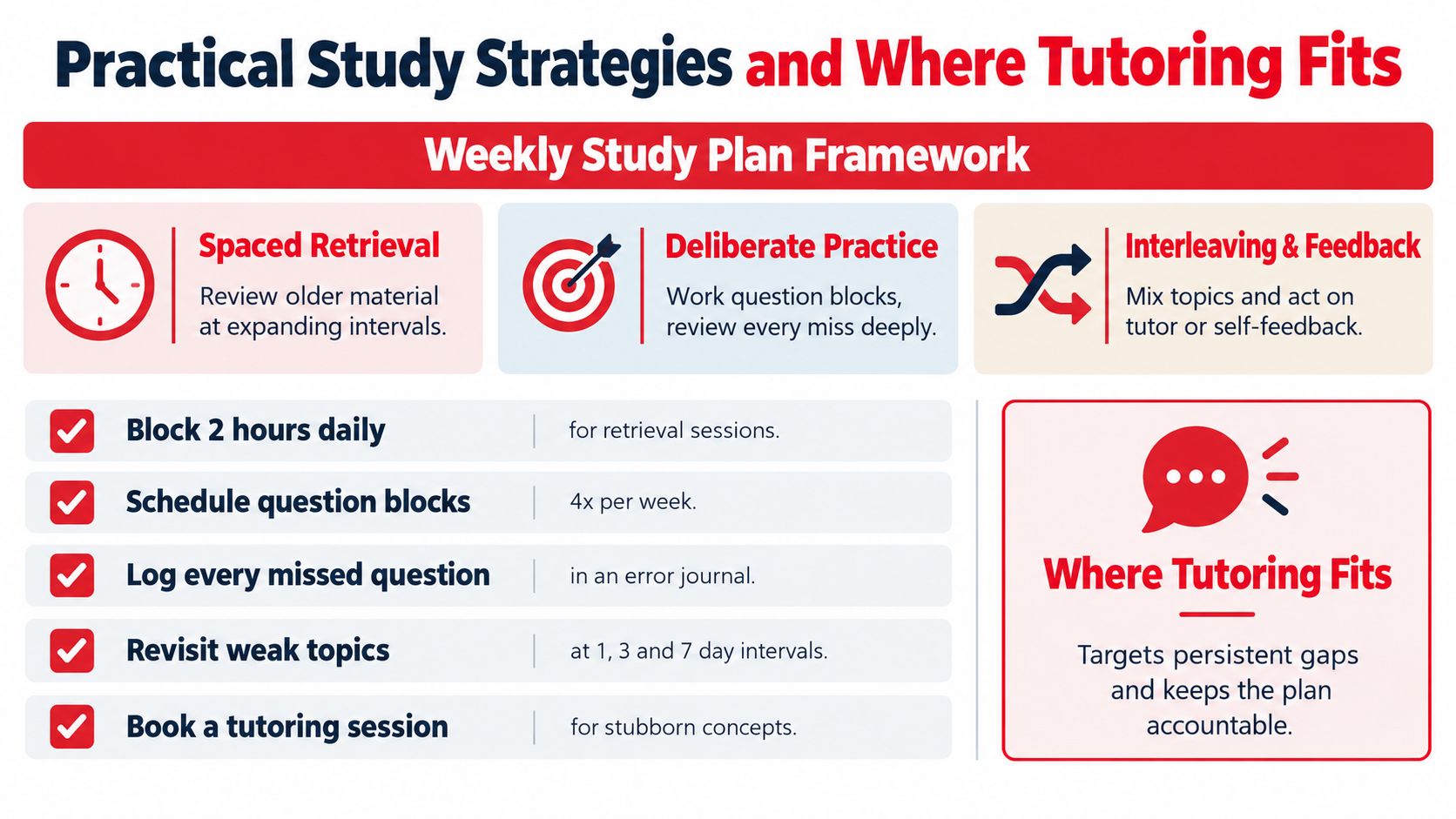
A reusable weekly framework
Use three pillars:
- Spaced retrieval: Review older material at expanding intervals instead of concentrating every review on the newest lecture.
- Deliberate practice: Complete question blocks from an appropriate resource, then explain why each option is right or wrong.
- Interleaving and feedback: Mix topics after the foundation is established, record recurring errors, and use faculty or tutor feedback to correct the reasoning process.
A sample week can include daily retrieval, several question blocks distributed across the week, one longer error-review session, and a protected period for rest. The exact number of questions or hours should reflect your schedule, baseline, exam date, and stamina, not a borrowed quota.
Downloadable study checklist
Daily
- Retrieve first: Write or say what you remember before reopening the notes.
- Review errors: Record the tested concept, your reasoning error, and the corrected rule.
- Protect recovery: Keep sleep, meals, and a short reset in the plan.
Weekly
- Audit patterns: Group errors by knowledge gap, interpretation error, premature closure, or careless execution.
- Revisit older material: Schedule weak topics at increasing intervals.
- Check readiness: Use appropriate practice forms or school assessments according to current policy and access rules.
During an exam block
- Define the target: Identify whether the immediate goal is Step 1 readiness, Step 2 CK clinical reasoning, COMLEX-USA preparation, or a Shelf exam.
- Use primary resources: First Aid, Pathoma, Boards & Beyond, school lectures, and question banks can serve different roles. UWorld, AMBOSS, TrueLearn, and COMQUEST are third-party resources that should be evaluated by fit and current content, not treated as official examinations.
- Change one variable at a time: Adjust review timing, question analysis, or content repair before discarding the entire plan.
Tutoring can add value when the learner has a weak foundation, plateaued practice performance, difficulty interpreting questions, or uncertainty about Step 2 CK readiness. It should complement, not replace, coursework, official guidance, practice forms, or independent review. Ace Med Boards offers one-on-one support for specified USMLE, COMLEX-USA, Shelf, and related preparation needs, and learners who coordinate sessions may also find tutor booking software useful for organizing appointments. Review the benefits of one-on-one tutoring with a specific gap in mind rather than assuming more meetings alone will solve it.
The Residency Bottleneck and Match Strategy
Residency planning requires both personal preparation and structural awareness. In 2025, more than 2,400 applicants reportedly lacked residency slots, while policy groups argued that federal Graduate Medical Education (GME) caps constrain physician workforce development and can skew positions toward higher-reimbursement specialties rather than primary care and behavioral health. The American Hospital Association GME fact sheet presents that policy context.
The 2026 NRMP data provide a more specific applicant perspective:
| Metric | Value | Year | Source |
|---|---|---|---|
| U.S. citizen IMG PGY-1 match rate | 70% | 2026 | NRMP Match reports |
| U.S. citizen IMG overall placement rate | 77.8% | 2026 | NRMP Match reports |
| U.S. citizen IMGs who matched at a top-three ranked program | 80% | 2026 | NRMP Match reports |
A match setback is information, not a verdict on your future. Start with an audit: verify eligibility, review Step 2 CK or COMLEX Level 2 performance, examine letters, assess specialty and geographic reach, and compare the application with program requirements. Reapplicants and IMGs may also need to review clinical experience, documentation, research, timing, and communication of their professional story. SOAP participation and reapplication rules are time-sensitive, so use current NRMP and ECFMG guidance rather than informal summaries.
The residency application planning guide can help structure the review, but it can't replace advice from a dean's office, program director, or official application authority. Specialty signals, away rotations, research, and letters don't carry identical weight across specialties. Build a specialty-specific plan from program criteria instead of applying one universal formula.
Key Takeaways and Frequently Asked Questions
Key takeaways
- The pathway has stages: Pre-med preparation, medical school, licensing exams, residency, optional fellowship, certification, and practice each require different decisions.
- Curriculum models serve different purposes: Lectures organize knowledge, cases develop application, simulation builds performance, and CBME tracks demonstrated competence.
- Assessment should be continuous: Formative feedback is more useful when it arrives before a high-stakes exam.
- Study design matters: Spaced retrieval, deliberate question review, and targeted feedback create a more durable plan than passive rereading.
- Match setbacks need an audit: Review eligibility, specialty fit, application evidence, geography, and timing before choosing a reapplication strategy.
Frequently asked questions
Does Step 1 pass/fail mean I should study less?
No. It changes the role of the result, not the need for foundational knowledge. Step 1 became pass/fail for exams administered on or after January 26, 2022, while clinical reasoning and later assessments remain important.
When should board preparation begin?
Begin by learning course material actively from the start, then increase examination-specific practice as the relevant assessment approaches. Your school calendar, exam eligibility, baseline performance, and target pathway should determine the timing.
How should I evaluate a medical school curriculum?
Ask how the program combines science, clinical skills, simulation, clerkships, feedback, remediation, and competency decisions. Request examples of how students move from classroom objectives to supervised patient care.
What can a tutor add that a question bank can't?
A tutor can observe how you reason, identify a recurring process error, and help you build a targeted plan. A question bank supplies practice and explanations, but it doesn't automatically diagnose why your review process keeps breaking down.
What should an unmatched applicant do first?
Verify current eligibility and deadlines, request a structured application review, and separate controllable gaps from broader capacity constraints. Then choose specialty, geographic, clinical, and timing adjustments using current NRMP and ECFMG information.
Ace Med Boards provides targeted one-on-one preparation for USMLE, COMLEX-USA, Shelf, and related medical education needs, with support focused on study planning, question analysis, and persistent knowledge gaps. If you want help deciding whether tutoring fits your stage and goals, visit Ace Med Boards to explore the service and request a free consultation.