You may be reviewing an ethics question after a long study day, or preparing for a medical school graduation where you'll recite a professional pledge. The Hippocratic Oath is a historic statement of medical responsibility, but it isn't a single legally binding contract that every physician takes. Today, it serves mainly as a professional and ethical benchmark, while enforceable duties come from law, institutional policy, licensing rules, and professional standards.
For board preparation, the practical question is not whether you can recite the classical text. It's whether you can recognize the ethical duty hidden inside a clinical vignette, distinguish patient autonomy from beneficence, protect confidentiality, and choose an answer that respects both the patient and the limits of professional authority.
Understanding the Oath in Modern Medical Education
A student may recite a pledge at graduation, then face a very different test the next morning: a vignette involving an informed refusal, a confidentiality concern, or a colleague's unsafe conduct. The ceremony marks entry into supervised practice, but the wording varies by school. Some graduates use a traditional pledge; others recite a revised statement addressing patient rights, professional boundaries, equity, and physician wellbeing.
Modern curricula often teach the Hippocratic Oath as a starting framework for professional identity. In a professionalism course, an instructor might ask students to compare a pledge's promise of service with a case involving a patient who declines treatment. The discussion turns ceremonial language into a habit of reasoning: identify the patient's preference, clarify the clinician's responsibility, and recognize where competing duties arise. The medical education pathway supplies scientific and clinical preparation, while this reflection connects knowledge to conduct with patients, families, colleagues, and institutions.
The oath is therefore an expression of professional identity. It describes the clinician a graduate intends to become, rather than providing a script for every difficult decision. For residency interviews, applicants can show maturity by explaining how a pledge informs listening, honesty, respect, and accountability in daily practice.
For USMLE and COMLEX-USA preparation, translate familiar phrases into decisions. “Do no harm” supports nonmaleficence, yet it does not settle every case. A patient's informed refusal can outweigh a physician's treatment preference. Confidentiality can restrict what a family member receives. A suspected safety threat can require a different response from an ordinary information request.
Key takeaways
- The Hippocratic Oath is an ancient pledge associated with Hippocrates, though his authorship is not confirmed. (Encyclopaedia Britannica)
- Schools use classical, revised, and international formulations.
- Courses teach the oath through cases, reflection, and professional conduct.
- Board questions test ethical reasoning more often than ceremonial wording.
- Identify the patient's rights, the clinician's duty, and any immediate safety concern before choosing an answer.
Historical Origins and the Classical Text
A resident asked to interpret the Hippocratic Oath in an interview may be tested on a simple distinction: historical wording provides context, while ethical principles guide present clinical judgment. The oath developed within ancient Greek medicine, and its manuscript history shows why the text should be read as a tradition rather than a modern policy manual.
The text likely originated between the 5th and 3rd centuries BC. As noted earlier, the authorship debate remains unresolved. The surviving evidence adds useful detail: the oldest complete manuscript dates to the 10th or 11th century CE and is held in the Vatican Library, while papyrus fragments date from the 3rd century CE. (Hippocratic Oath history)

That gap between composition and surviving copies resembles a clinical handoff across generations. The wording may change as it is transmitted, yet recurring duties remain visible. The oath links a teacher–student commitment with expectations for conduct toward patients and colleagues, including beneficence, nonmaleficence, confidentiality, and professional boundaries. (Encyclopaedia Britannica)
What the classical text emphasizes
The oath presents medicine as a profession with duties among teachers, students, patients, and the wider medical community.
- Beneficence: Act for the patient's benefit.
- Nonmaleficence: Avoid intentional harm and reckless conduct.
- Confidentiality: Protect information learned through professional care.
- Professional boundaries: Do not exploit the patient relationship.
- Transmission of knowledge: Treat medical learning as a responsibility to teachers and future practitioners.
Several clauses do not fit modern clinical practice. The text includes restrictions related to surgery and strong prohibitions involving abortion and euthanasia. These provisions reflect the social, religious, and professional setting in which the oath developed, rather than supplying a current rulebook. (Internet Encyclopedia of Philosophy)
For USMLE and Osteopathic Medical Licensing Examination (COMLEX-USA) preparation, use the historical text like an ethics map. Preserve its concern for patient welfare and professional conduct, then apply contemporary standards to informed consent, reproductive care, genetic testing, artificial intelligence, and electronic health records. Its literal wording cannot resolve every modern vignette, but its underlying duties can help identify the ethical issue before you choose an answer.
Modern Variants and the Declaration of Geneva
A student recites a school's oath at graduation, then faces a board vignette about an impaired resident or a physician protecting patient confidentiality. The wording of that ceremony may differ, but the exam tests how the underlying duty applies to the clinical problem. Medical schools use several modern pledges rather than one universal Hippocratic Oath, including Louis Lasagna's 1964 modern version and the World Medical Association's Declaration of Geneva. The Geneva declaration was first published in 1948 and revised in 2017. (Overview of modern medical pledges)
| Oath version | Origin | Practical emphasis for exam preparation |
|---|---|---|
| Classical Hippocratic Oath | Ancient Greek medical tradition, likely composed between the 5th and 3rd centuries BC | Patient welfare, confidentiality, professional boundaries, and duties between teachers and students. Historical clauses do not function as current clinical rules. |
| Lasagna version | Louis Lasagna, 1964 | Compassion, humility, patient care, and professional responsibility expressed in modern language. |
| Declaration of Geneva | World Medical Association, 1948 | Human dignity, patient welfare, confidentiality, and professional integrity, with later language addressing physician health and wellbeing. |
The 2017 Declaration of Geneva revision makes physician health and wellbeing an explicit professional concern. (American Medical Association discussion of the revision) Read this as a safety obligation, not permission to lower standards. A physician who recognizes fatigue, illness, substance use, or distress affecting performance should seek help, report impairment through the appropriate channel, and protect patients from unsafe care.
The ceremony itself has changed across countries and decades. A 1958 survey found that 69 of 96 responding medical schools used an oath, but only 7 used an unmodified Hippocratic Oath. By 1977, 6 of 128 schools in the United States and Canada used the unmodified version. By 1993, only 1 of 150 surveyed schools still did so. In a 2015 U.S. survey, 67 of 141 contacted schools had students recite an oath, and 29 used the classic or a modified Hippocratic Oath. (PubMed survey)
Another review reported that 80 of 111 U.S. and Canadian medical schools used some oath, while 72 used a white-coat oath. More than half had moved away from classic Lasagna or Geneva wording that became influential after World War II. (Cato Institute review)
For USMLE-style questions, translate a Geneva-based stem mentioning physician wellbeing into a question about impairment reporting and fitness for duty rather than treating it as simple oath recitation. Then separate the ethical principle from any applicable law, institutional policy, consent requirement, or safety exception. The ACGME core competencies connect these pledges to observable conduct during residency, including professionalism, communication, and responsibility for patient safety.
Core Ethical Principles for USMLE and COMLEX Exams
A patient refuses a recommended blood transfusion moments before surgery. The physician believes refusal will cause serious harm, yet the patient explains the risks, answers questions, and clearly maintains the decision. This type of conflict shows how the Hippocratic Oath becomes practical board preparation: its historical promises provide context, while the vignette tests which ethical principle controls the next action. The oath remains one of the earliest formalized medical ethics frameworks in Western medicine, combining duties to teachers and patients with expectations about beneficence, nonmaleficence, confidentiality, and professional conduct (Encyclopaedia Britannica).
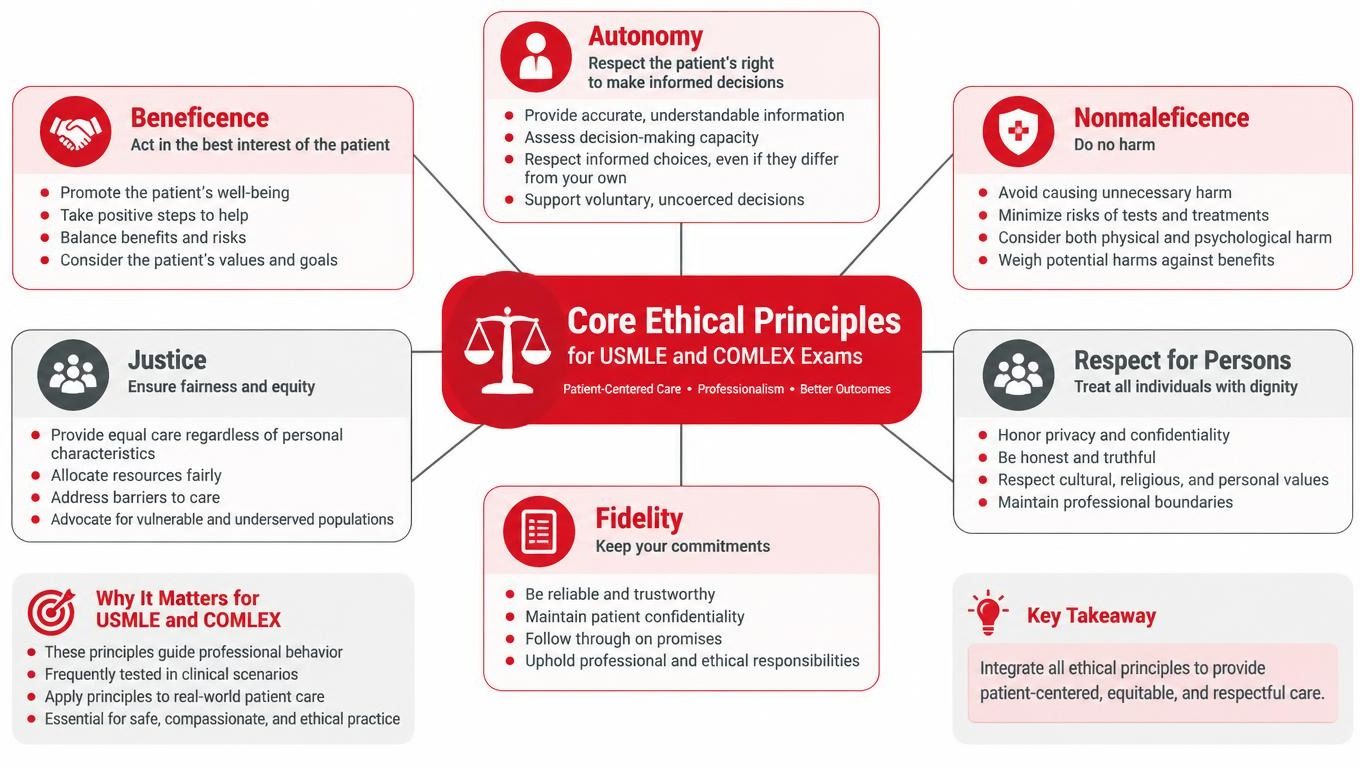
Use the four commonly taught principles as a sorting tool, not as four definitions to memorize in isolation. The wording of the stem usually supplies the decisive cue.
Autonomy
Autonomy protects a capable patient's informed, voluntary choices, including refusal of recommended care. Autonomy cue: look for “patient refuses despite recommendation.” Select the response that assesses understanding and decision-making capacity, explains relevant risks and benefits, and respects the refusal. Do not choose persuasion, threats, or treatment over the patient's objection just because the physician considers it beneficial.
Check for the exception that changes the analysis. A patient who lacks capacity may require an authorized surrogate, while an emergency may permit immediate treatment under applicable rules. The question may also test whether the clinician has confirmed that the refusal is informed and voluntary.
Beneficence
Beneficence directs the clinician toward meaningful patient benefit. Beneficence cue: identify the intervention that improves welfare while fitting the patient's goals, prognosis, and circumstances. An answer that orders every available test is weaker than one that offers a proportionate plan with a clear expected benefit.
Nonmaleficence
Nonmaleficence requires avoiding preventable harm. Nonmaleficence cue: compare the proposed intervention's likely benefit with its risks, alternatives, and the clinician's competence. “Do no harm” does not mean avoiding every intervention with a complication risk. It means recognizing when risk is excessive, avoidable, or poorly managed.
Justice and professional boundaries
Justice concerns fair treatment and fair distribution of benefits and burdens. Justice cue: look for triage, limited resources, disability accommodation, research enrollment, or discriminatory access. Fairness may require responding to relevant differences in need rather than giving every person an identical option.
Confidentiality and professional boundaries connect these principles. Sharing a patient's diagnosis with a relative without authorization can undermine autonomy and cause harm. A financial, sexual, or otherwise exploitative relationship violates the trust and power limits of clinical care.
Exam habit: Name the principle suggested by the cue, identify who has authority to decide, then check for an immediate safety concern or a rule that changes the default response.
The oath is an ethical foundation, not the complete professional rulebook. Licensure boards, courts, statutes, institutional policies, and professional organizations may impose duties involving mandatory reporting, documentation, consent, privacy, or scope of practice. Review this ethics in medical practice guide alongside the principles, then apply the specific law or policy supplied by the question.
Applying Ethical Frameworks to Clinical Vignettes
Ethics questions become more manageable when you separate the emotional pressure of the vignette from the decision structure. A family member may sound urgent, a physician may sound confident, or a patient may appear difficult. Those details matter only after you establish the patient's rights, capacity, preferences, and immediate risks.
A four-step reasoning workflow
- Identify the decision-maker. Is the patient an adult with decision-making capacity? If not, who is authorized to decide?
- State the ethical conflict in one sentence. For example, “The family wants information, but the patient has not authorized disclosure.”
- Separate principle from exception. Confidentiality is the default, but the question may introduce a legally recognized safety exception or a permission to disclose.
- Choose the least intrusive appropriate action. Prefer clarification, private discussion, education, and consent before disclosure or coercive intervention, unless immediate danger requires a different response.
A labeled composite example
Composite educational scenario, not a real patient or tutoring case: An adult patient with decision-making capacity tells a clinician not to discuss a new diagnosis with a sibling. After the visit, the sibling calls the clinic, says the family deserves to know, and asks for the diagnosis and treatment plan.
The first step is to identify the authorized decision-maker. The patient is an adult who can make the relevant decision, so the sibling doesn't automatically receive protected information. The second step is to identify the central conflict. This is a confidentiality and autonomy question, not primarily a question about whether the sibling's concern is sincere.
The best response would preserve confidentiality and invite the patient to decide whether any information should be shared. The clinician could ask the patient about preferred family involvement, clarify what can be disclosed with permission, and offer support in planning that conversation. An answer that discloses the diagnosis because the sibling is worried fails to respect the patient's authority.
The oath helps explain why confidentiality matters, but it doesn't replace applicable privacy law or institutional policy. Board questions often reward the answer that protects the patient while taking a reasonable next step, rather than the answer that makes the clinician appear maximally helpful to the loudest person in the room.
For review, write one sentence explaining why each incorrect answer fails. This turns an ethics question from a vocabulary exercise into a test of authority, consent, risk, and professional boundaries.
Professionalism in Residency Interviews and Clinical Rotations
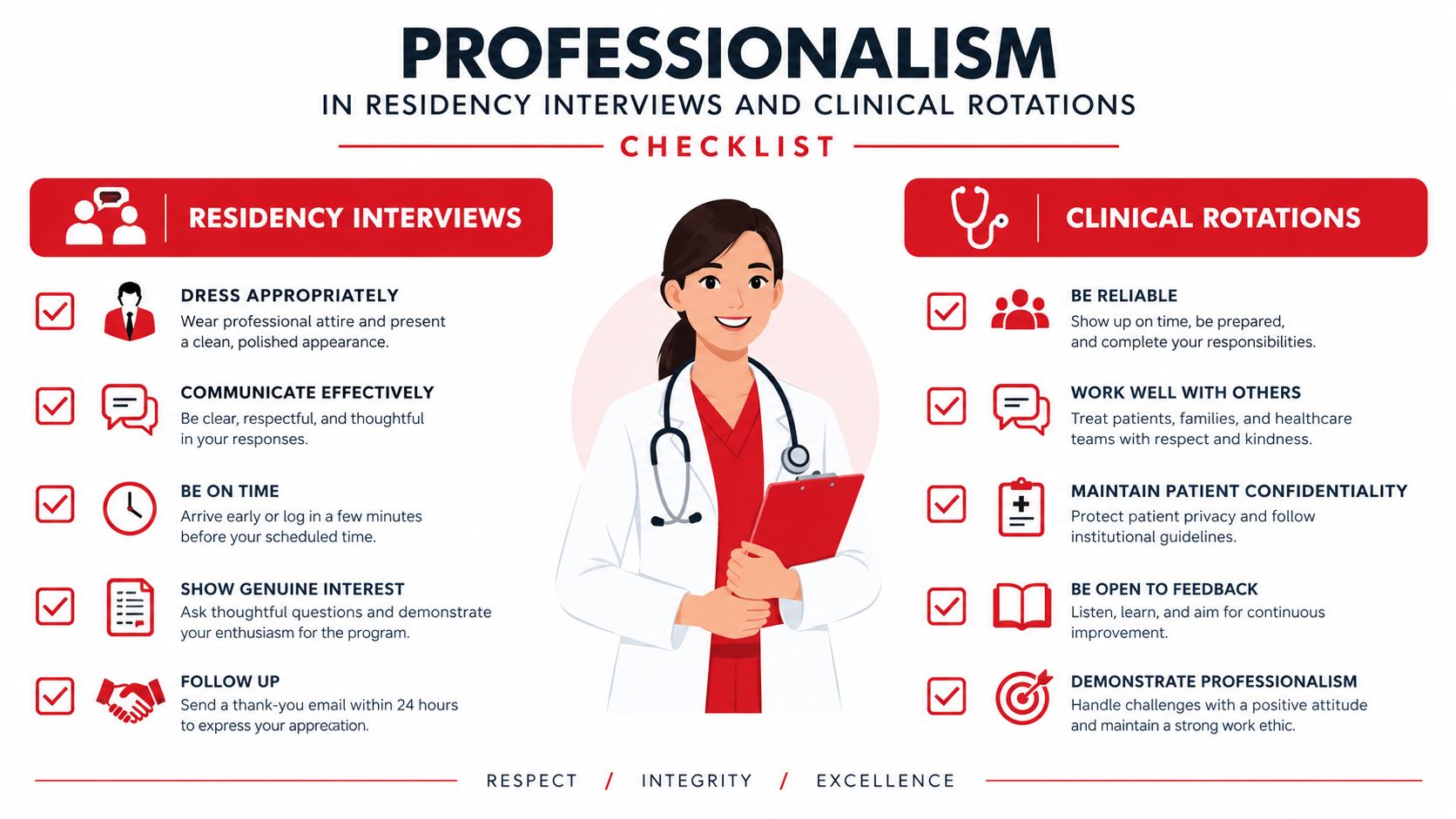
The oath becomes visible in ordinary conduct. A student protects a patient's privacy in a hallway, corrects an inaccurate note, acknowledges uncertainty, and asks for supervision before performing an unfamiliar task. Those behaviors demonstrate ethical reliability more clearly than a polished recitation at graduation.
Residency applicants should also understand the training pathway without treating it as a single universal script. The general sequence moves from premedical preparation to medical school, licensing examinations, supervised residency, possible fellowship training, board certification, and independent practice. The specific sequence, duration, examination requirements, certification pathway, and institutional expectations vary by specialty, jurisdiction, program, and role.
A practical pathway timeline
| Stage | Decision point |
|---|---|
| Premedical preparation | Build academic preparation, clinical exposure, service, and an informed understanding of medicine |
| Medical school | Develop scientific knowledge, clinical skills, ethical reasoning, and professional habits |
| Licensing examinations | Confirm the current examination and eligibility requirements through the responsible official organization |
| Residency | Compare specialty duties, supervision, training structure, and program expectations |
| Optional fellowship | Decide whether additional focused training fits the intended scope of practice |
| Board certification | Review the relevant specialty board's current eligibility and examination policies |
| Practice | Follow licensure, credentialing, institutional, and continuing professional requirements |
Career, salary, ceremony, and oath claims vary by specialty, institution, geography, year, and role. Students should verify program details through AAMC Careers in Medicine, the ACGME, the NRMP, the relevant specialty board, and the institution's own policies. A residency interview is not the place to imply that one path is universally superior.
A decision matrix for professional behavior
| Question | Strong evidence of professionalism |
|---|---|
| Patient communication | You explain uncertainty plainly and check understanding |
| Confidentiality | You discuss patient information only with appropriate people in appropriate settings |
| Accountability | You disclose errors or near misses through the proper supervision pathway |
| Scope of practice | You seek help before acting beyond your competence |
| Team conduct | You treat nurses, students, staff, patients, and families with respect |
| Self-monitoring | You recognize when fatigue, illness, or distress may impair safe performance |
A labeled composite student example can make this concrete. The student feels drawn to a specialty name but hasn't compared daily work, training length, competitiveness, call burden, or personal values. Instead of treating the oath as a slogan, the student schedules informational interviews and creates a weighted decision matrix using those dimensions. The outcome is not a guaranteed specialty choice. It is a more disciplined decision grounded in the actual conditions of practice.
During interviews, describe the reasoning process rather than claiming moral perfection. The residency interview preparation resource can support preparation, but your answer should remain grounded in a specific situation, the people affected, the action you took, and what you learned.
Study Strategies and Ethics Readiness Checklist
A patient refuses a recommended test, while a family member asks you to proceed. In a board-style vignette, begin with the decision process rather than the ceremonial wording of the Hippocratic Oath. Ask who has decision-making authority, what information may be shared, which ethical principle is in tension, and what action protects the patient without exceeding your role.
A focused review cycle
- Classify the scenario: Identify consent, capacity, confidentiality, end-of-life care, professionalism, error disclosure, boundaries, or resource allocation.
- Identify the authority: Record who can decide and whether the patient or another authorized person may receive information.
- Name the conflict: Summarize it briefly, such as “autonomy versus family pressure.”
- Test every option: State whether a choice is premature, coercive, unsafe, unlawful, or outside the clinician's responsibilities.
- Log recurring errors: Keep missed concepts in one review file and revisit them during mixed USMLE or COMLEX question blocks.
This method turns the oath into a decision tool. Its historical language provides context, while modern professional pledges translate similar commitments into patient-centered duties. The Hippocratic Oath history, Encyclopaedia Britannica explanation, and Internet Encyclopedia of Philosophy discussion can support background review. For modern versions, compare the Medscape overview of medical pledges with the American Medical Association's account of the Declaration of Geneva revision. A PubMed survey of medical school oath use adds context for how schools use these ceremonies.
Readiness checklist
Before the exam or a residency interview, confirm that you can:
- distinguish capacity from legal competence;
- explain informed consent and informed refusal;
- protect confidentiality while recognizing valid exceptions;
- separate ethical ideals from enforceable professional standards;
- apply autonomy, beneficence, nonmaleficence, and justice;
- recognize conflicts of interest and boundary violations;
- choose a respectful first step when facts are incomplete;
- explain how the best answer protects patient welfare and authority.
For a vulnerable patient, use a sequence: capacity, consent, privacy, safety, and supervision. In an interview, describe the reasoning, the people affected, the action taken, and the lesson learned. Ace Med Boards offers diagnostic tutoring and study-plan support for this preparation.