If you're staring at a tall stack of MCAT materials and wondering whether the Kaplan MCAT books are enough, the short answer is this: they're a strong content-review foundation, but they shouldn't be your entire preparation system. They work best when you pair targeted reading with passage practice, retrieval practice, timed work, and official Association of American Medical Colleges (AAMC) materials.
The right question isn't whether you can finish every page. It's whether the books help you identify what you know, apply it under pressure, and correct recurring mistakes. That distinction matters for traditional pre-medical students, nontraditional applicants returning to science, and anyone rebuilding confidence after a difficult academic stretch.
Understanding the Kaplan MCAT Book System
A student may begin with good intentions, buy a complete prep set, and then spend weeks highlighting paragraphs without testing whether the information can be retrieved. Kaplan's system is designed to give that student a structured content map. It isn't a single textbook or a replacement for official practice. It's a broad review base that organizes the science and reasoning areas tested on the Medical College Admission Test, or MCAT.
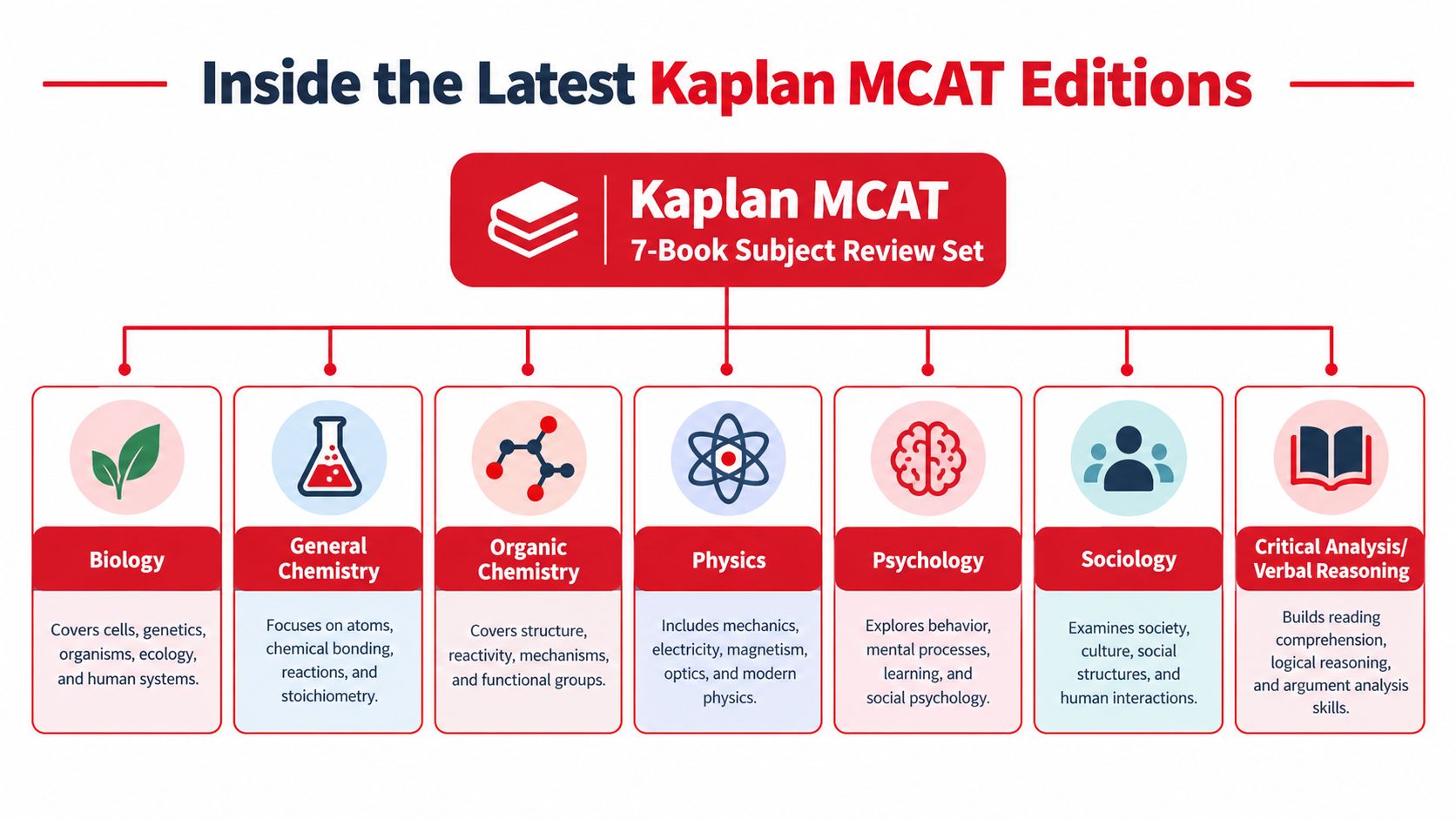
The current Kaplan product is built around a seven-book subject-review set, with separate treatment of major science subjects and Critical Analysis and Reasoning Skills, commonly called CARS. Kaplan describes the current 2027–2028 edition as including 500+ new full-color science images, a rebuilt CARS book, seven subject-review books, three full-length practice tests, and a customizable Qbank with 3,000+ questions on its official MCAT books page. The same page says the books are written by 98th-percentile scorers.
Those features make the set complete, but completeness can create its own problem. A learner with a weak foundation may need the detail. A learner who remembers most prerequisite coursework may lose time reading chapters that don't address current weaknesses.
Who benefits most from the set
Kaplan is usually a sensible starting point when you need to:
- Rebuild science knowledge: Use the books to reconnect concepts from biology, chemistry, physics, biochemistry, psychology, and sociology.
- Follow a defined sequence: A subject-by-subject structure can reduce the friction of deciding what to study next.
- Reference difficult topics: Return to explanations after a passage exposes a specific knowledge gap.
- Study from print: Physical pages can support annotation, margin notes, and a visible map of completed material.
The set may be less efficient as a stand-alone resource if you learn primarily through interactive practice, dislike dense reading, or already have strong content knowledge but weak timing and passage interpretation. A useful independent review of MCAT books and content resources should therefore be treated as a decision aid, not as permission to study passively.
Practical rule: Use Kaplan to answer, “What concept do I need to understand?” Use practice material to answer, “Can I recognize and apply it when the passage is unfamiliar?”
Inside the Latest Kaplan MCAT Editions
You open a Kaplan book after missing a passage question and find several pages that seem relevant. The productive next step is not to reread the chapter from the beginning. Use the print review layer to locate the concept, close the book to retrieve it from memory, then return to practice and test whether you can apply it under passage conditions. The online components connect review with practice, but verify what comes with the specific edition you purchase.
Kaplan describes the 2027–2028 edition as adding more than 500 new images, a fully revamped CARS strategy, and online features that connect print and digital resources, according to its announcement about the updated MCAT books. Treat those features as parts of a workflow: read a focused explanation, write or say the main idea without looking, and then apply it to a question or passage.
The seven-book structure
The seven-volume arrangement separates content into manageable study targets. Use each book to repair a specific gap, not to create a routine of highlighting every page.
| Book area | How to use it |
|---|---|
| Biology | Rebuild biological systems, then connect mechanisms to experimental passages. |
| General Chemistry | Review principles, equations, and relationships before applying them to data. |
| Organic Chemistry | Study reactions and structure while recognizing patterns instead of isolated facts. |
| Physics | Tie equations to units, physical meaning, and the conditions described in a passage. |
| Psychology | Retrieve definitions and distinguish related concepts in context. |
| Sociology | Apply social concepts to scenarios rather than treating them as vocabulary alone. |
| CARS | Establish a passage-reading and reasoning process that does not depend on outside subject knowledge. |
The four official MCAT sections are Chemical and Physical Foundations of Biological Systems, CARS, Biological and Biochemical Foundations of Living Systems, and Psychological, Social, and Biological Foundations of Behavior. Use the MCAT content review guide aligned with the official outline alongside AAMC examination content information and outline resources. This prevents a chapter's organization from becoming your only definition of what the examination covers.
Print and digital components
The Kaplan product page lists three full-length practice tests and a customizable Qbank with 3,000+ questions for the current 2027–2028 offering. Confirm the edition and access terms before buying. Sort Qbank work by subject or difficulty, answer without checking the chapter, and record why each option is right or wrong. Use full-length tests to rehearse endurance and pacing. Official AAMC practice remains useful for learning the organization's question style and score reporting.
Publication history can explain why online listings look different. Kaplan's 2025–2026 edition was published on July 2, 2024, the 2026–2027 edition is listed with a July 2025 release, and the 2027–2028 edition has a street date of July 14, 2026, according to the listed Kaplan edition information. The same listing history includes a Third Edition dated July 5, 2016, indicating continuity in the product line rather than a newly created series.
Evaluating Strengths and Limitations
Kaplan's main strength is scope. The books give students a clear place to begin, a consistent vocabulary for review, and enough explanatory detail to revisit topics that were forgotten after an undergraduate course. The illustrations and chapter organization can also make a large content outline feel more manageable.
The limitation is that reading creates familiarity more easily than it creates retrieval skill. You may recognize an explanation on the page and still struggle to use the concept when a passage changes the variables, presents unfamiliar data, or asks for the best interpretation rather than a definition.
A current discussion of MCAT book strengths and limitations describes Kaplan as thorough while also noting its dense, text-heavy presentation, limited interactivity, weak hyperlinked visual experience, and ambiguity around question-bank depth. Those are practical concerns for students who expect a digital-first learning environment.
Kaplan MCAT Books Evaluation Matrix
| Feature | Strengths | Limitations |
|---|---|---|
| Content coverage | Broad, organized review across the subjects represented in the seven-book system. | The amount of material can encourage over-reading and inefficient rereading. |
| Visual explanations | The current edition emphasizes new full-color science images. | Images support understanding, but they don't test whether you can retrieve or apply the concept. |
| CARS preparation | The updated edition includes a rebuilt CARS book and a stronger stated focus on strategy. | CARS still requires repeated passage reasoning. Reading strategy explanations alone won't create timing fluency. |
| Practice access | The current product description includes full-length tests and a customizable Qbank. | Students should confirm access details and shouldn't assume third-party practice behaves exactly like official AAMC material. |
| Study structure | Separate subject books make it easier to build a sequence and track coverage. | Carrying and managing multiple books can become cumbersome, especially when you need to switch between review and practice. |
| Independent learning | Clear explanations can support self-directed review. | Students who need immediate feedback, adaptive practice, or accountability may need additional tools. |
When the limitations matter
A text-heavy resource becomes inefficient when you read every chapter at the same depth, highlight without recall, or postpone passages until all content review is “finished.” It becomes more useful when you treat it as a searchable reference. Read enough to explain the mechanism, close the book, retrieve the idea from memory, and then test it in context.
Official AAMC materials serve a different purpose. The AAMC Official Prep Hub provides access to official preparation resources, while the AAMC MCAT scores page explains that the MCAT has no curve. Scores are scaled and equated, each section is scored from 118 to 132, and the total score ranges from 472 to 528. Kaplan can teach content, but official material helps you study the test's reasoning environment.
Integrating Kaplan Books Into Your Study Plan
A productive Kaplan session has three parts: learn, retrieve, and apply. If one of those parts is missing, the session may feel busy without showing whether the knowledge is usable.
Start with an official-style diagnostic or an appropriate official practice resource. Then map every missed item by content gap, reasoning error, misread, or pacing problem. That classification prevents you from rereading an entire book when the issue was failing to identify what a question was asking.
A targeted workflow
Read for a defined purpose. Before opening a chapter, write the concept you need to explain. For example, your goal might be to distinguish two related biological mechanisms, not to finish a page range.
Close the book and retrieve. Write the mechanism, variables, assumptions, or sequence from memory. Compare your explanation with the text only after you commit to an answer.
Practice passages untimed first. Untimed work lets you separate reasoning quality from speed. Once you can explain your approach, repeat similar work under time pressure.
Review every option. Don't stop after identifying the credited answer. Explain why it wins, why each distractor fails, and what evidence in the passage supports the decision.
Retest on unseen material. A concept isn't secure just because you corrected one question. Revisit it in a new passage or on a new full-length test under exam conditions.
The AAMC MCAT Essentials, official sample test, and official practice materials can anchor this process. Use Kaplan for targeted rebuilding, not as a substitute for learning how official questions are framed.
Passage-review sheet
Reproduce this sheet for each meaningful passage or question set:
| Field | What to record |
|---|---|
| Tested concept | The specific scientific or behavioral idea being tested. |
| Task | What the question asked you to do, such as infer, compare, calculate, or apply. |
| Evidence line | The passage detail, figure feature, or stated relationship that mattered. |
| Why the credited answer wins | Your reasoning in plain language, not just the answer choice. |
| Why each distractor fails | The assumption, contradiction, scope problem, or calculation error behind each option. |
| Timing | How long you spent and whether speed affected your reasoning. |
| One transfer rule | A short rule for recognizing the same reasoning pattern in a different context. |
A hypothetical original example might involve an experiment where changing one condition alters an observed response. Your review should identify the manipulated variable, the measured outcome, and the passage evidence that supports the best interpretation. It should not copy a recalled or copyrighted MCAT question.
A flexible weekly rhythm
A sustainable week might include:
- Content blocks: Read only the Kaplan chapters connected to diagnostic misses.
- Retrieval blocks: Use blank-page explanations, flashcards, or self-generated prompts.
- Passage blocks: Work through science and CARS passages, first untimed and later timed.
- Review blocks: Complete the passage-review sheet and update a weakness log.
- Simulation blocks: Use full-length material when your schedule allows sustained exam-condition practice.
The exact number of hours depends on your baseline, test date, coursework, employment, and health. A schedule that you can repeat is more useful than an ambitious plan that collapses after a difficult week.
A short video can also provide another explanation of how to sequence review and practice:
For a more detailed planning framework, use this MCAT study schedule guide as a starting point, then adjust it around your actual diagnostic findings.
Are Kaplan Books Enough for a Top Score
Kaplan books alone can't guarantee a particular score, and no honest resource review should promise that reading a set from cover to cover will produce one. A book can improve your understanding of content, but MCAT performance also depends on retrieval, interpretation, pacing, stamina, and the ability to make decisions when the passage is unfamiliar.
That's why “enough” depends on the student's starting point. Someone who needs substantial science review may rely on Kaplan heavily during the foundation phase. Someone with solid knowledge but inconsistent passage reasoning may need less reading and more deliberate practice review.
Content familiarity versus usable knowledge
Consider two learners who read the same chapter. The first can recognize the vocabulary and follow the explanation while the book is open. The second can close the book, draw the process, explain what changes when a variable shifts, and apply that explanation to a new passage. The second learner has moved closer to exam-ready knowledge.
Use this readiness checklist:
- Recall: Can you explain the concept without looking at the page?
- Application: Can you use it when the passage presents new details?
- Discrimination: Can you identify why plausible alternatives don't fit?
- Timing: Can you complete the task without sacrificing evidence-based reasoning?
- Transfer: Can you recognize the same principle in an unfamiliar subject context?
If several answers are no, more reading may help, but only after you identify the exact weakness. You may need a concept explanation, a calculation drill, a CARS reasoning exercise, or a pacing intervention. Treating every miss as a content gap wastes time and can make a prepared student feel unnecessarily behind.
The MCAT practice-test guide can help you distinguish between practice exposure and meaningful review. Official AAMC materials deserve a defined place in your plan because they show how the test makers present passages, questions, and answer choices. Kaplan remains useful beside them as a reference and content-repair tool.
A strong resource combination is not the one with the most pages. It's the one that tells you what to study, tests whether you can use it, and gives you a reliable way to correct mistakes.
Purchasing Guide and Format Choices
Choose a Kaplan format based on how and where you study. Print works well for students who annotate pages, compare diagrams, and build a physical reference system. Digital access suits learners who move between school, work, and home or need to search topics quickly. A hybrid package combines the two, but only if its included practice tools match your plan.
Compare the format to your habits
| Your situation | Format that may fit | What to verify |
|---|---|---|
| You retain information through annotation and page layout | Print set | Edition, included online access, and delivery timing |
| You move between locations or search topics frequently | Digital access | Device compatibility, access duration, and offline availability |
| You want physical reference material plus online practice | Hybrid package | Tests, Qbank access, and digital components included |
| You already own an older set | Keep it as a reference if useful | Content, CARS strategy, images, and online access compared with the current edition |
Treat the format as part of your workflow, not as a simple convenience. After reading a chapter, close the book and write what you remember. Then use a passage or question set to test whether you can apply the idea. Digital tools help you search and review quickly, while print can make annotation and visual organization easier. The format should support retrieval and correction, rather than encourage uninterrupted rereading.
Kaplan's publication cadence makes edition labels worth checking. The 2025–2026 edition was published on July 2, 2024, the 2026–2027 edition is listed with a July 2025 release, and the 2027–2028 edition has a street date of July 14, 2026, according to the edition listing and publication information. Used books require another check: confirm that any included digital access has not already been redeemed.
A simple buying decision
Buy the current set if you need a structured content reset, the updated CARS approach, or one organized reference system. An older edition can work when you already own it and have compared its content outline, images, CARS guidance, and online components with your needs.
Avoid buying several overlapping sets before completing a diagnostic. More explanations rarely fix weak passage review. First identify whether your problem is missing knowledge, ineffective reasoning, or slow execution. Then choose the smallest resource that addresses that weakness.
You can compare preparation options through the MCAT prep bundle information. Keep the purchase tied to a specific study task and a review routine you will follow consistently.
Key Takeaways and Frequently Asked Questions
Key takeaways
- Treat Kaplan as a foundation: The books organize broad content review, but they aren't a complete substitute for passage practice.
- Build around four sections: Chemical and Physical Foundations, CARS, Biological and Biochemical Foundations, and Psychological, Social, and Biological Foundations.
- Study actively: Retrieve concepts, practice passages, review every option, and record one transfer rule.
- Use official materials deliberately: Include AAMC resources so your practice reflects official presentation and reasoning expectations.
- Buy for your actual gaps: A diagnostic should guide whether you need broad review, targeted repair, or more practice and pacing work.
Frequently asked questions
Are Kaplan MCAT books good for beginners?
They can be useful for students who need a structured review of prerequisite science and behavioral science. Beginners should avoid treating the books as novels. Pair each reading session with retrieval and application so you can tell whether the material is becoming usable.
Can I use an older Kaplan edition?
You can use an older edition as a reference, especially if you already own it, but compare it with the current content outline and check whether digital access is still available. Pay particular attention to changes in CARS strategy and online components.
Do I need all seven books?
The complete set is most useful when you need broad review across the subjects it covers. If your diagnostic shows focused weaknesses, you may use selected books more intensively while spending the rest of your time on passages, official practice, and error analysis.
How should tutoring fit with Kaplan?
Tutoring should complement, not replace, independent study and official materials. A focused session can help classify misses, rebuild a difficult concept, practice passage reasoning, or create a schedule that reflects your available time. You should still complete the reading, practice, and review needed to make the strategy your own.
How do I know whether I'm ready to move beyond content review?
Move forward when you can explain a concept without the book, apply it to unfamiliar material, and identify why competing answers fail. You don't need perfect mastery before practicing. Practice is one of the best ways to reveal which content deserves another targeted visit.
Ace Med Boards offers individualized MCAT preparation support that can help you turn Kaplan review into a structured workflow of diagnostic analysis, passage reasoning, targeted content repair, and practice review. If you want help choosing resources or building a plan around your starting point, visit Ace Med Boards to explore a free consultation.