MCAT CARS tests reasoning with unfamiliar humanities and social-science passages, using only the information in the passage. The section contains 9 passages, 53 questions, and 90 minutes, so your preparation must improve both interpretation and decision-making under time pressure.
You may be studying CARS after a frustrating practice session in which you understood the passage but missed several questions. Or you may be reading quickly, reaching the final passages with too little time, and wondering whether the problem is vocabulary, reasoning, or pacing. Those problems look similar on a score report, but they require different fixes.
The most productive approach is diagnostic. Use official material to determine whether you misread the author, failed to connect evidence to an inference, read too slowly, or changed a defensible answer because a distractor sounded more polished. Then choose drills that address that specific bottleneck. More passages alone won't solve a problem you haven't identified.
What MCAT CARS Tests and How It Is Scored
A student can understand a passage, choose answers that sound reasonable, and still lose points because the section measures how accurately they connect ideas under time pressure. The Critical Analysis and Reasoning Skills, or CARS, section is the second MCAT section. It receives its own 118–132 scale, while the complete exam uses a 472–528 range across four sections, as summarized by Kaplan's overview of MCAT CARS scoring.
CARS draws on humanities and social-science material rather than memorized biology, chemistry, or physics. Passages may address philosophy, history, economics, political science, literature, or related fields. The section tests whether you can identify an argument, follow the author's qualifications, connect evidence to a conclusion, and reject an attractive answer that the passage does not support.
The University of Washington's CARS section overview describes a format of 9 passages with 53 total questions in 90 minutes. That works out to roughly 10 minutes per passage and about 6 questions per passage, but those figures are planning tools rather than laws.
| Element | Detail |
|---|---|
| Section position | Second MCAT section |
| Passage count | 9 |
| Question count | 53 |
| Time limit | 90 minutes |
| Main subject areas | Humanities and social sciences |
| Required knowledge | Information supplied in the passage |
| Per-section score | 118–132 |
| Overall MCAT score | 472–528 |
Treat pacing as a budget. A dense passage may require more time than one with a clear thesis, while a familiar-looking passage may reward faster reading. Spending 13 minutes on several early passages leaves fewer minutes for later questions. The useful question is not whether you followed a fixed rule, but whether your decisions protect enough time for the whole section.
Your raw number correct does not appear as the final CARS score. The exam converts it to a scaled result, and the relationship can vary by exam form. For a broader explanation of the exam's scoring range, see what the MCAT is scored out of. Published preparation summaries commonly describe 125 as the national median and 127 or higher as a target for many competitive applicants. Those figures are reference points, not admission rules or guarantees, as discussed in this CARS scoring overview.
Use preparation time to extract arguments, track qualifications, locate textual support, and choose the answer closest to the passage. Subject-area memorization rarely addresses the bottleneck.
The Four Core Competencies Behind Every CARS Question
CARS questions feel unpredictable when you treat every stem as a separate trick. They become more manageable when you classify the work involved. AAMC-aligned preparation organizes CARS around comprehension, reasoning within the passage, reasoning beyond the passage, and discrete reasoning tasks. These categories overlap, but each creates a different reading habit.
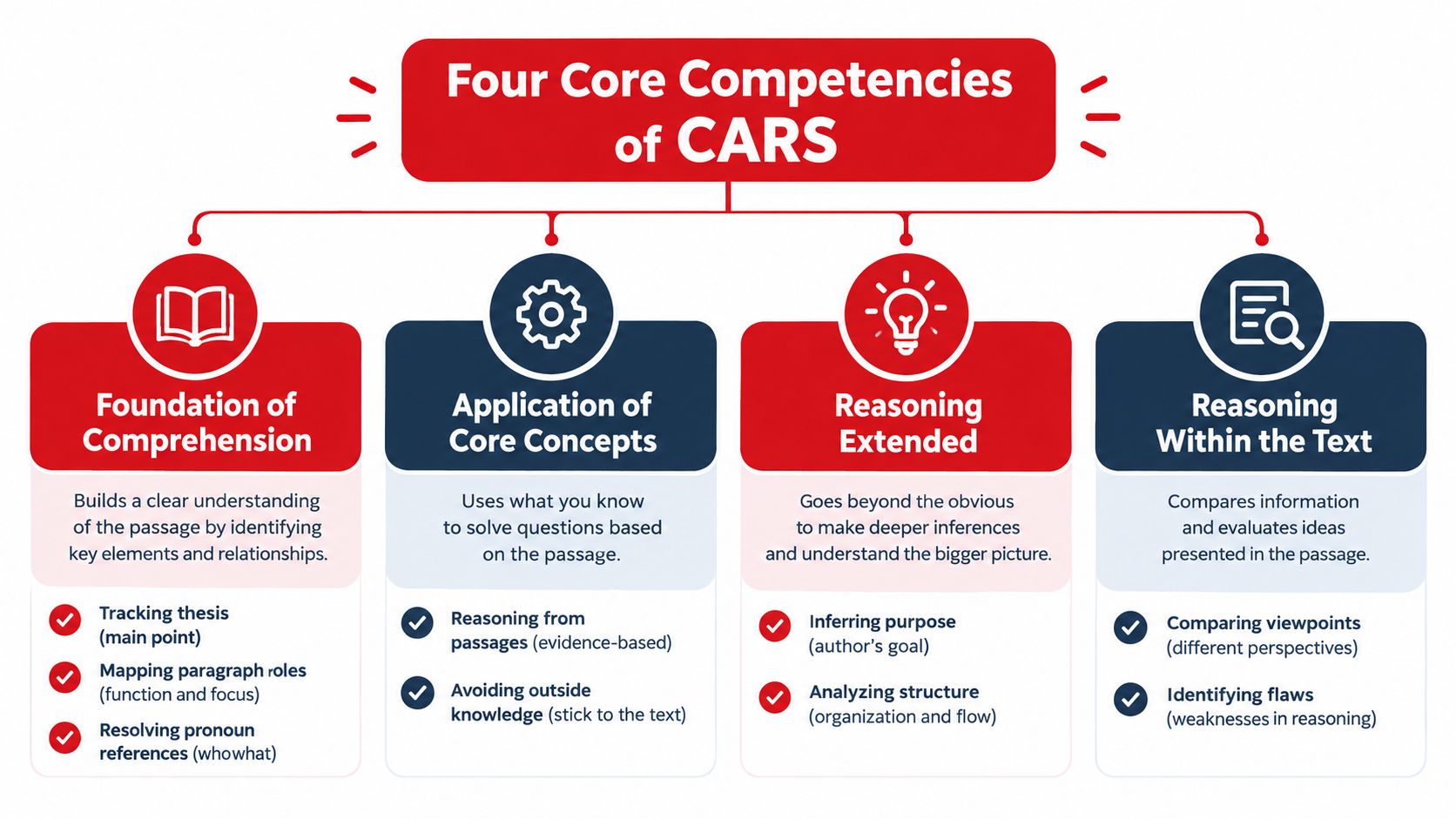
Foundation of comprehension
This competency asks whether you understand what the passage says. Track the central thesis, identify what each paragraph contributes, and resolve references such as “this view” or “they” without guessing. Your annotation should therefore record paragraph function, not a transcript of every detail.
A useful margin note might be:
- P1, problem
- P2, old view
- P3, author's correction
- P4, implication
That map helps with main-idea, detail, and function questions.
Reasoning within the text
Here, you must connect claims, evidence, and viewpoints exactly as the author presents them. Ask whether a conclusion is directly supported, weakly implied, or unsupported. Mark transitions such as however, therefore, although, and rather, because they often reveal how one claim modifies another.
The annotation habit is a short contrast note, such as “criticizes motive, not result”. That distinction can prevent you from selecting an answer that sounds related but changes the author's position.
Reasoning beyond the text
These questions ask you to apply the passage's logic to a new situation, implication, or analogy. “Beyond” doesn't mean outside knowledge. It means extending the author's stated principle without changing its scope.
Write the rule in plain language. If the passage argues that a public ritual matters because it creates shared meaning, an application should involve a different setting that creates shared meaning, not merely another public event.
Foundations of discrete question
Some questions focus on logical analysis without requiring you to retrieve a particular sentence. You may need to identify an assumption, recognize a flaw, or determine what would strengthen an argument. Treat the argument as a small machine: identify its conclusion, identify its support, then ask what connection the author needs the reader to accept.
Practical rule: Every answer should have a reason you can point to, even when the question asks you to extend the argument.
The AAMC description of CARS preparation emphasizes reading comprehension, logical analysis, and critical thinking from the passage itself. Your notes should make those operations visible. If your page is full of highlighted nouns but contains no thesis, paragraph roles, or viewpoint shifts, you're recording content without recording reasoning.
Passage Mapping and Active Reading That Save Minutes
A passage map should be fast enough to help and light enough not to interrupt comprehension. Most students don't need elaborate notes. They need a repeatable record of who is arguing, what changed, and where the author stands.

Use this seven-step sequence:
- Read the opening sentence carefully. Identify the subject and the initial problem.
- Write a one-word label. Use a word such as “debate,” “critique,” “history,” or “proposal.”
- Read the final sentence of the passage. Ask whether it confirms, complicates, or reverses the opening.
- Predict the author's stance. Is the author defending, questioning, qualifying, or comparing?
- Mark transitions and contrasts. Circle words that signal movement, including “but,” “yet,” “therefore,” and “although.”
- Label each paragraph's function. Keep it to two or three words, such as “example,” “counterpoint,” or “rebuttal.”
- Record concrete evidence. Note the example, historical event, or observation the author relies on most heavily.
The first reading should usually fit inside a passage budget of roughly 3 to 4 minutes, leaving time for the associated questions. Don't force that pace before you understand the argument. Start untimed, then add timing when your map reliably captures the thesis and paragraph roles.
Consider this original humanities-style excerpt:
Public monuments are often judged as records of the past, but their meaning depends less on the events they commemorate than on the conversations they invite. A monument that settles interpretation may preserve a single official memory. One that encourages disagreement can make historical remembrance an active civic practice.
A minimal map might read:
- P1, monuments
- Contrast, record versus conversation
- P2, fixed memory
- P3, disagreement creates civic practice
- Author stance, favors active interpretation
That map doesn't replace the passage. It gives you a retrieval structure. If a question asks why the author contrasts a settled interpretation with disagreement, you can return to the relevant paragraph rather than reread every sentence.
A guide to reading faster while maintaining understanding can help you experiment with annotation, but don't adopt a technique just because it looks complex. Highlighting, margin notes, and mental mapping are all acceptable if they improve accuracy without consuming your question time.
Use the following passage-review demonstration after a practice set:
| Review field | Original entry |
|---|---|
| Tested concept | Author's thesis and paragraph function |
| Task | Identify the author's preferred type of monument |
| Evidence line | “One that encourages disagreement can make historical remembrance an active civic practice” |
| Why the credited answer wins | It reflects the author's positive treatment of interpretation and disagreement |
| Why distractor A fails | It treats monuments only as factual records |
| Why distractor B fails | It claims the author rejects public memory altogether |
| Why distractor C fails | It focuses on construction rather than meaning |
| Timing | Record your actual reading and question time |
| One transfer rule | When a passage contrasts two models, identify which model the author develops favorably |
The transfer rule is the part most students skip. It turns one explanation into a future behavior. Mapping is preparation, not a substitute for answering each question against the text.
A Question Approach for Every CARS Item Type
A difficult CARS item often becomes manageable once you identify the task before judging the answer choices. Use a three-step workflow for every item, building on these MCAT test-taking strategies:
- Classify the task. Decide whether the question tests comprehension, reasoning within the text, reasoning beyond the text, or discrete logical analysis.
- Locate the anchor. Find the relevant sentence, relationship, paragraph function, or missing logical connection.
- Pre-phrase the answer. State your answer in your own words before reading the choices. Then remove options that exaggerate, contradict, or exceed the passage's scope.
Apply the workflow to the monument passage.
Comprehension
Question: Which statement best expresses the author's central claim?
A. Monuments should never commemorate specific events.
B. The meaning of a monument depends partly on whether it invites public interpretation.
C. Historical memory is impossible without disagreement.
D. Public monuments are more accurate than written histories.
Best answer: B. It captures the passage's contrast between a fixed record and an active public conversation. A is absolute, C changes “can make” into “is impossible without,” and D introduces a comparison the author never makes.
Reasoning within the text
Question: Why does the author mention a monument that “settles interpretation”?
A. To provide an example of a monument that has been physically damaged
B. To show why official memory is always false
C. To contrast fixed remembrance with interpretive engagement
D. To argue that monuments should be removed
Best answer: C. The example establishes one side of the passage's contrast. A, B, and D add claims about damage, truth, or removal that the text does not support.
Reasoning beyond the text
Question: Which situation most closely follows the author's reasoning?
A. A museum label presents one interpretation and prohibits discussion.
B. A school archives every student essay without inviting responses.
C. A public exhibition presents historical evidence and asks visitors to compare interpretations.
D. A city replaces all monuments with numerical records.
Best answer: C. It applies the principle that remembrance becomes active when people interpret and discuss evidence. A and B present settled information without conversation. D changes the subject and abandons the passage's idea.
Foundations of Discrete Reasoning
Question: The argument depends most on which assumption?
A. Every disagreement produces accurate history.
B. Public conversation can influence how communities understand the past.
C. Written records are less valuable than monuments.
D. Citizens prefer ambiguous historical accounts.
Best answer: B. Without that connection, the conclusion about civic practice does not follow. A is stronger than the passage, C is never argued, and D speculates about preferences.
Wrong choices often sound reasonable because they reuse the passage's vocabulary while changing scope, strength, viewpoint, or task. A familiar paraphrase can still answer a different question.
For a focused mixed drill, complete 10 questions in 17 minutes with original or properly licensed material. Review every miss and every guess. A correct answer selected for the wrong reason belongs in your error log, because it is not yet a reliable skill. Record the task type, the textual anchor you missed, why the credited answer fits, and which wording shift made the distractor tempting.
Your Staged CARS Study Plan With Drills and Error Logs
A good plan increases difficulty in stages. Begin by learning to understand one passage, then add timing, then build endurance across the full section. The official AAMC prep updates matter because the official practice ecosystem has changed. AAMC states that its current official preparation includes 166 new questions plus 409 questions from previously sold CARS products, for 575 questions total, and that the older CARS Diagnostic Tool and CARS Question Packs Volumes 1 and 2 are no longer sold in the AAMC store.
Don't burn your most representative material during the first week. Use third-party passages or broader reading for early skill building, then reserve official material for calibration, mixed review, and final full-section practice.
A 12-week progression
| Phase | Weeks | Passages per Day | Timing | Primary Source | Accuracy Gate |
|---|---|---|---|---|---|
| Foundation | 1–3 | 1 untimed passage, then review | No clock at first | Third-party practice and selected official work | Explain the thesis and every missed option |
| Controlled timing | 4–6 | 2–3 passages | Gradually approach 10 minutes per passage | Mixed practice, with limited official sets | Timed accuracy begins to resemble untimed accuracy |
| Endurance | 7–9 | 3–4 passages on practice days | Timed sets, then 4-passage blocks | Official questions used selectively | Timing remains stable across the set |
| Exam simulation | 10–12 | Full-section work on scheduled days | 9 passages in 90 minutes | Official full-length and remaining high-fidelity material | Review is complete before the next simulation |
The 2–3 timed passages per day recommendation is useful only when review follows immediately. For each question, record the stem type, passage topic, mistake category, and fix. Add the fields required for a meaningful review:
| Passage-review field | What to record |
|---|---|
| Tested concept | Comprehension, within-text reasoning, beyond-text reasoning, or discrete logic |
| Task | Main idea, tone, function, inference, application, strengthen, weaken, or assumption |
| Evidence line | The sentence or relationship that supports the answer |
| Why the credited answer wins | Its exact fit with the passage |
| Why each distractor fails | Scope shift, contradiction, exaggeration, wrong task, or outside assumption |
| Timing | Reading time, question time, and total passage time |
| One transfer rule | The behavior to apply on the next passage |
A workable sample week
On Monday, complete two untimed passages and review every option. On Tuesday, read one long-form humanities or social-science essay, then complete one timed passage. On Wednesday, review your error log and complete two timed passages focused on your most common miss category.
On Thursday, reserve time for Chemical and Physical Foundations, Biological and Biochemical Foundations, or Psychological, Social, and Biological Foundations content review. On Friday, complete a 4-passage timed set. Saturday is suitable for a full-length block when your accuracy and timing have stabilized. Sunday should be lighter, with review of recurring errors rather than a forced high-volume session.
For an accelerated 6-week plan, compress the foundation phase, but don't skip untimed diagnosis. A student who starts with full timed sections may learn only that they panic. The first diagnostic should reveal whether the bottleneck is reading fluency, reasoning, or pacing.
A structured collection of MCAT CARS practice passages can supplement official work, but it shouldn't be treated as a substitute for AAMC calibration. Use the two scored practice exams, the section bank, and remaining official passage material after you know how to review, not as disposable warm-ups.
Common CARS Pitfalls and How to Fix Them
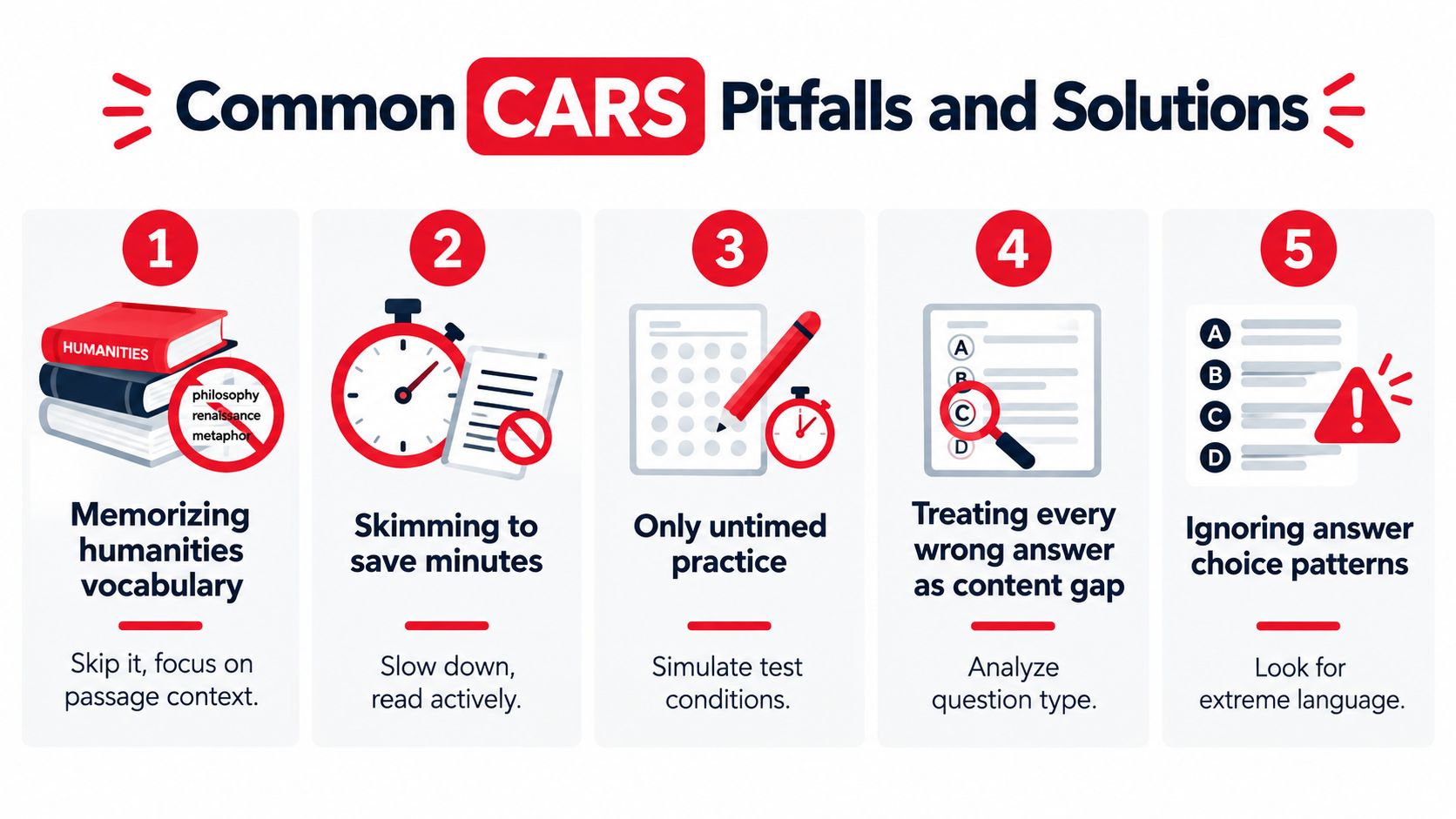
A student finishes a passage feeling productive, then discovers that the misses came from three different bottlenecks: reasoning, reading fluency, and pacing. The right fix depends on which one failed. Memorizing humanities vocabulary, skimming aggressively, or completing only untimed passages may feel safe, but none explains why a particular answer was wrong.
What the common fixes miss
- Memorizing humanities vocabulary: The passage normally provides the evidence needed. Read unfamiliar terms in context, then track the author's claim, support, and qualifications.
- Skimming to save minutes: Skimming can erase the qualification that changes an argument. Read claims and transitions actively, especially words that signal contrast, cause, or limits.
- Doing only untimed practice: Untimed work helps isolate reasoning, but it cannot show whether that reasoning survives pressure. Add timing once you can explain why each answer succeeds or fails.
- Calling every miss a content gap: A wrong answer may reflect a misread, an unsupported inference, a misunderstood stem, or a pacing error.
- Ignoring answer-choice patterns: Extreme wording, unsupported assumptions, and reversals of the author's position deserve scrutiny. An unfamiliar answer is not automatically wrong.
Review each passage as an investigation. Ask What did I misunderstand? and What did the credited answer do that my choice failed to do? Record whether the problem was reasoning, reading fluency, or pacing. Checking only the answer key produces little guidance for the next passage.
When English is not your first language
CARS can add linguistic load to the reasoning task. A peer-reviewed analysis of 239,681 test takers published in the published analysis of MCAT performance found that CARS scores were lower than scores in the other MCAT sections for that cohort, with the difference especially visible among students with English as a second language or international students who immigrated to the United States.
That finding does not indicate weaker reasoning ability. It indicates that a useful review must separate vocabulary friction, reading fluency, inference, and attention. Strong untimed accuracy with a large timed drop points toward fluency or pacing. Accurate passage understanding with misses on tone or implication calls for paraphrasing claims and identifying how strongly the passage supports them.
Translation should not replace reading practice, and isolated idiom memorization will not solve dense prose. For testing accommodations, consult current official policies and use the appropriate application process. Adjustments should reflect documented needs and observed performance, not assumptions about language background.
Run this self-audit on your last three full sections:
- Did misses cluster around one question family?
- Was untimed accuracy higher than timed accuracy?
- Did you choose answers stronger than the passage?
- Did you misidentify who held a viewpoint?
- Did you change answers without new textual evidence?
Let the dominant pattern determine the next drill. Review should make the next decision clearer, not just add more passages.
Tracking Progress and Deciding If You Need a Tutor
A single CARS score can't tell you why performance is stuck. Track several measures under comparable conditions: the scaled score from each full section, accuracy by question family, average time per passage, and untimed accuracy compared with timed accuracy on the same type of material.
Read the pattern, not just the number
If untimed accuracy is weak, reasoning or comprehension needs attention before more speed work. If untimed accuracy is solid but timed accuracy falls, reading fluency or pacing is more likely limiting you. If timing is acceptable but Reasoning Beyond the Text remains weak, practice applications and analogies while writing the passage's governing principle in your own words.
| Check-In Window | Metrics to Record | Healthy Trend | Escalation Signal |
|---|---|---|---|
| Initial diagnostic | Accuracy, timing, question-family misses | Clear baseline | You can't explain why answers are correct |
| After focused drills | Untimed versus timed accuracy | Smaller gap between conditions | Same mistake category repeats |
| Mid-plan review | Full-section score and passage timing | More stable performance across passages | Timing collapses late in the section |
| Five-week check-in | Score trend, confidence calibration, error log | Fewer avoidable errors | Scores plateau despite complete review |
| Final readiness review | Full-section results, pacing, recurring misses | Consistent process under exam conditions | One unresolved bottleneck dominates |
Use a five-week check-in cadence rather than reacting to every passage. At each review, compare your error categories, not only your total correct answers. A student who misses fewer questions but still guesses on the same stem type may need a process correction, even if the score appears better on one practice day.
The MCAT practice-test guidance can help you think about full-length selection and review. Official AAMC material should remain central for calibration, while third-party material can provide additional volume without consuming limited official passages too early.
A calm decision framework
Continue self-study when you can identify your errors, apply a specific fix, and see your timed process becoming more stable. Consider a small group when you need external structure and benefit from hearing how other students classify arguments. One-on-one CARS tutoring may be reasonable when your scaled score has plateaued despite consistent review, when Reasoning Beyond the Text misses remain persistent, or when you can't compress timing below 11 minutes per passage without a substantial accuracy loss.
Ace Med Boards offers one-on-one online MCAT CARS tutoring focused on passage analysis and critical thinking, with a diagnostic conversation available to identify the most useful study focus. A consultation should help you decide whether targeted support adds value, not pressure you into a score promise.
Sources
- AAMC guidance on preparing for the CARS section
- AAMC updates to official MCAT preparation materials
- Peer-reviewed analysis of MCAT performance and language background
- University of Washington overview of the MCAT CARS section
- MCAT section scoring overview
If your CARS practice feels stuck, Ace Med Boards can help you audit the difference between reasoning, reading fluency, and pacing, then build a focused passage-review plan around that diagnosis. Visit Ace Med Boards to learn about one-on-one MCAT support and schedule a free, low-pressure consultation.