You're comparing medical schools, reading about residency match rates, and wondering whether a DO degree will limit your future. The direct answer is no, a DO isn't a lesser version of an MD. Both DOs and MDs are fully licensed physicians, and graduates of both pathways enter the same U.S. graduate medical education system.
The more useful question is whether a school's curriculum, osteopathic manipulative medicine exposure, exam pathway, clinical network, geography, cost, and specialty support fit your goals. A student targeting family medicine may face a different decision from one targeting plastic surgery or neurosurgery. That specialty-specific risk matters more than a broad prestige argument.
What the DO vs MD Question Actually Means in 2026
The most common misconception is that osteopathic medicine is a shortcut. It isn't. MD and DO graduates are physicians with the same broad scope of practice, and the distinction reflects different educational traditions rather than a hierarchy of medical competence. MD schools are accredited through the Liaison Committee on Medical Education, or LCME, while DO schools are accredited through the Commission on Osteopathic College Accreditation, or COCA. Both routes lead to physician training and licensure.
Osteopathic medicine began in 1892, when Andrew Taylor Still founded the first osteopathic medical school. The profession now represents about 11% of U.S. physicians and 28% of U.S. medical students, according to the American Osteopathic Association's 2024 Osteopathic Medical Profession Report. That growth makes the DO pathway a substantial part of the physician pipeline, not a niche alternative.
The residency system changed the comparison
Since 2020, U.S. graduate medical education has operated under a single accreditation system. MD and DO graduates now compete through the same Accreditation Council for Graduate Medical Education, or ACGME, residency structure rather than separate MD and American Osteopathic Association pathways, as summarized in this overview of the single accreditation system.
That change removed the old assumption that DO students must remain in an AOA-only residency track. It didn't erase every difference in residency competitiveness. Specialty demand, board examination strategy, clinical evaluations, research, letters, signaling, and program preferences still affect individual outcomes.
Practical rule: Choose the degree that supports your intended specialty and learning style. Don't choose based on the belief that one degree makes you a “real” physician and the other does not.
What the decision actually involves
Use this sequence:
- Identify your likely specialty direction. Broad primary care and several hospital-based fields present a different risk profile from the most competitive surgical subspecialties.
- Assess your comfort with osteopathic training. DO students study osteopathic principles and manipulative medicine, often called OMM.
- Compare specific schools, not labels. Rotation sites, advising, research access, class structure, tuition, and geography can matter more than the letters after the degree.
- Map the examination burden early. MD students generally follow the United States Medical Licensing Examination, or USMLE, pathway. DO students take COMLEX-USA and may add USMLE depending on their goals.
- Separate identity from strategy. A degree can shape your preparation and application plan, but it doesn't determine your clinical ability.
For a focused overview of osteopathic education and physician training, review osteopathic medicine and its role in medical education.
Accreditation Curriculum and OMM at a Glance
Accreditation identifies the organization that evaluates a medical school's educational standards. It does not predict the quality of a school's rotation network, advising, research access, or specialty preparation. Those factors require school-level comparison, especially if you are targeting a specialty with limited residency positions.
The MD and DO pathways use different accrediting bodies. The LCME accredits MD-granting medical education programs, while COCA accredits colleges of osteopathic medicine. The Association of American Medical Colleges represents the U.S. MD education ecosystem, and the American Association of Colleges of Osteopathic Medicine provides information about osteopathic medical education. Graduates from both pathways can enter ACGME-accredited residency training.
Compare the curriculum, not just the degree title
| Dimension | MD | DO |
|---|---|---|
| Accreditation | Schools are accredited by the LCME. | Schools are accredited by COCA. |
| Curriculum | Medical sciences, clinical reasoning, and supervised clinical rotations form the core curriculum. | Medical sciences and clinical rotations are combined with osteopathic principles and OMM. |
| OMM | OMM isn't a required part of the MD degree. | OMM is a required component of osteopathic education. |
| Exams | Students use the USMLE. | Students take COMLEX-USA, and some also take USMLE. |
| Clinical rotations | Sites vary by school and may include affiliated hospitals, community settings, and academic centers. | Sites vary by school and may include affiliated hospitals, community settings, and academic centers. |
| Residency support | Examine advising, research access, specialty mentorship, letters, and application preparation. | Examine advising, research access, specialty mentorship, letters, and application preparation, with added attention to COMLEX and possible USMLE planning. |
| Cost | Compare tuition, living expenses, fees, aid, and debt at each institution. | Compare tuition, living expenses, fees, aid, and debt at each institution. |
| Geography | MD schools remain more numerous overall. | DO schools have expanded rapidly, but their geographic distribution and rotation structure vary widely. |
| Personal fit | Often suits applicants who prefer a conventional medical curriculum without required OMM. | Often suits applicants who value osteopathic principles and are willing to engage seriously with OMM. |
Use this matrix as a screening tool, not a final verdict. If your specialty list includes highly competitive surgical subspecialties, investigate research opportunities, home rotations, specialty mentorship, and graduate placement before accepting a school. A school with a familiar degree label cannot compensate for weak access to the experiences your application requires.
Medical-school availability has changed substantially over time. A 2020 analysis reported 172 MD schools and 36 DO schools, compared with 125 MD schools and 17 DO schools in 1997. The same analysis calculated growth of 37.8% for MD schools and 112% for DO schools, while more recent summaries report 163 MD schools and 51 DO schools. These figures are compiled in a medical school count comparison.
OMM belongs in your decision
A DO student studies osteopathic concepts and hands-on techniques throughout medical school. That training does not require every DO physician to build a future practice around OMM. It does require a genuine willingness to learn the material, practice the techniques, and prepare for its assessments.
Review osteopathic manipulative medicine and its place in DO training before choosing the pathway. Then ask each school how OMM connects to anatomy, physical diagnosis, and clinical courses; which faculty teach it; and how often students practice.
Your specialty risk assessment also depends on the school's practical infrastructure. Confirm where core rotations occur, how much elective time supports specialty exploration, and what help is available for research, away rotations, recommendation letters, and residency applications. Compare full attendance costs, living expenses, financial aid, and expected debt. For a DO applicant, also ask how the school advises students on COMLEX-USA and any specialty-specific USMLE plan.
Board Exams COMLEX-USA vs USMLE
A DO applicant targeting a broad primary-care field may need only the required COMLEX-USA sequence. A DO applicant targeting a specialty with stronger MD representation may need a deliberate USMLE plan as well. The exam choice should follow the residency list, not peer pressure.
MD students generally take USMLE, while DO students take COMLEX-USA for osteopathic medical licensure. The National Board of Osteopathic Medical Examiners administers COMLEX-USA. USMLE is administered through the Federation of State Medical Boards and the National Board of Medical Examiners.
USMLE includes Step 1, Step 2 Clinical Knowledge, and Step 3. Step 1 is reported as pass or fail. COMLEX-USA includes Level 1, Level 2-CE, and Level 3, with osteopathic content integrated throughout the pathway. Eligibility rules, scheduling procedures, exam formats, and score reporting can change, so confirm current requirements through the official USMLE and NBOME assessment pages.
Choose the exam plan from the specialty backward
A DO student must prepare for COMLEX-USA. Adding USMLE makes sense when the target programs request or prefer it, the specialty is highly competitive, or the applicant needs an additional score for program comparison. It also requires enough preparation time to protect COMLEX performance.
Use this decision matrix:
| Applicant situation | Recommended exam approach |
|---|---|
| DO applicant with a broad specialty list and solid COMLEX preparation | Prioritize COMLEX-USA and add USMLE only for a defined program need. |
| DO applicant pursuing a competitive specialty | Review program requirements early and consider USMLE if preparation can be supported. |
| DO applicant with limited study time or weak foundational knowledge | Strengthen COMLEX readiness before adding another exam. |
| Applicant applying to programs with explicit USMLE expectations | Treat USMLE planning as part of the application strategy. |
Dual testing can divide study time, increase scheduling pressure, and expose gaps that should be addressed before another exam is added. Review the NBOME concordance research before comparing results or setting score goals. The research involved more than 3,500 osteopathic medical students from five colleges who took both COMLEX-USA and USMLE examinations.
Decision test: If USMLE preparation would weaken COMLEX readiness, do not add it. If it supports a defined specialty and program strategy, plan it with your advisor, practice performance, timing, and budget in view.
Use this USMLE versus COMLEX comparison guide to compare exam purpose, preparation demands, and residency expectations.
Residency Match Outcomes and Specialty Access
A DO applicant choosing between family medicine and a highly selective surgical specialty is making two different residency-risk decisions. The degree matters less than the interaction among specialty, examination plan, clinical access, research, letters, and program selection.
In the 2026 NRMP Main Residency Match, 93.2% of U.S. DO seniors matched to PGY-1 positions, compared with 93.5% of U.S. MD seniors, a difference of 0.3 percentage points. The NRMP reported that the DO rate was the highest on record and 0.6 percentage points above 2025 in its 2026 Main Residency Match results. These figures show that DO graduates match through the same residency system. They do not show equal access in every specialty.
Specialty choice changes the risk
A 2023 analysis found cumulative match rates of 52.89% for DO applicants and 73.61% for MD applicants in selected surgical subspecialties. It also reported overall 2023 match rates of 93.1% for MD seniors and 91.6% for DO seniors. Review the peer-reviewed analysis of DO and MD specialty match outcomes alongside the residency match statistics by specialty in the 2025 analysis.
The practical question is specific: what evidence does the target specialty expect from this applicant?
| Specialty pattern | MD senior position | DO senior position | Practical interpretation |
|---|---|---|---|
| Broad residency access | Aggregate outcomes remain strong. | Aggregate outcomes are near parity in recent NRMP data. | Degree alone does not determine the result. |
| Primary care-oriented fields | Strong access across many programs. | Strong access across many programs, with substantial DO participation. | School fit, clinical performance, letters, and application quality remain central. |
| Highly competitive surgery | More favorable aggregate access in selected analyses. | Applicants face greater specialty-specific risk. | Board strategy, research, rotations, letters, and program targeting require deliberate planning. |
| Ultra-competitive specialties | Applicant selection remains rigorous. | The same rigor applies, with less room for an unfocused application. | Build a specialty-specific plan early instead of relying on general match rates. |
The American Medical Association's review of DO match trends also emphasizes that specialty choice changes how aggregate results should be interpreted.
What a competitive DO application must show
A DO applicant targeting a highly competitive field should establish evidence early:
- Board planning: Decide whether COMLEX alone fits the target list or whether USMLE adds useful signaling.
- Clinical access: Check home institutions, affiliated hospitals, audition rotations, and specialty-specific evaluation opportunities.
- Research: Choose projects that provide mentorship, scholarly work, and a coherent application narrative.
- Letters: Build relationships with physicians who can assess clinical work in the target specialty.
- Program selection: Create a realistic list based on requirements, applicant fit, geography, and historical openness to DO graduates.
- Application execution: Coordinate ERAS materials, signaling, personal statements, and interviews around one specialty strategy.
A near-parity overall match rate is encouraging. It does not justify a generic application for a specialty with narrow selection. For DO students, specialty risk should determine board planning and application depth well before residency applications open.
A Labeled Hypothetical Applicant Worked Example
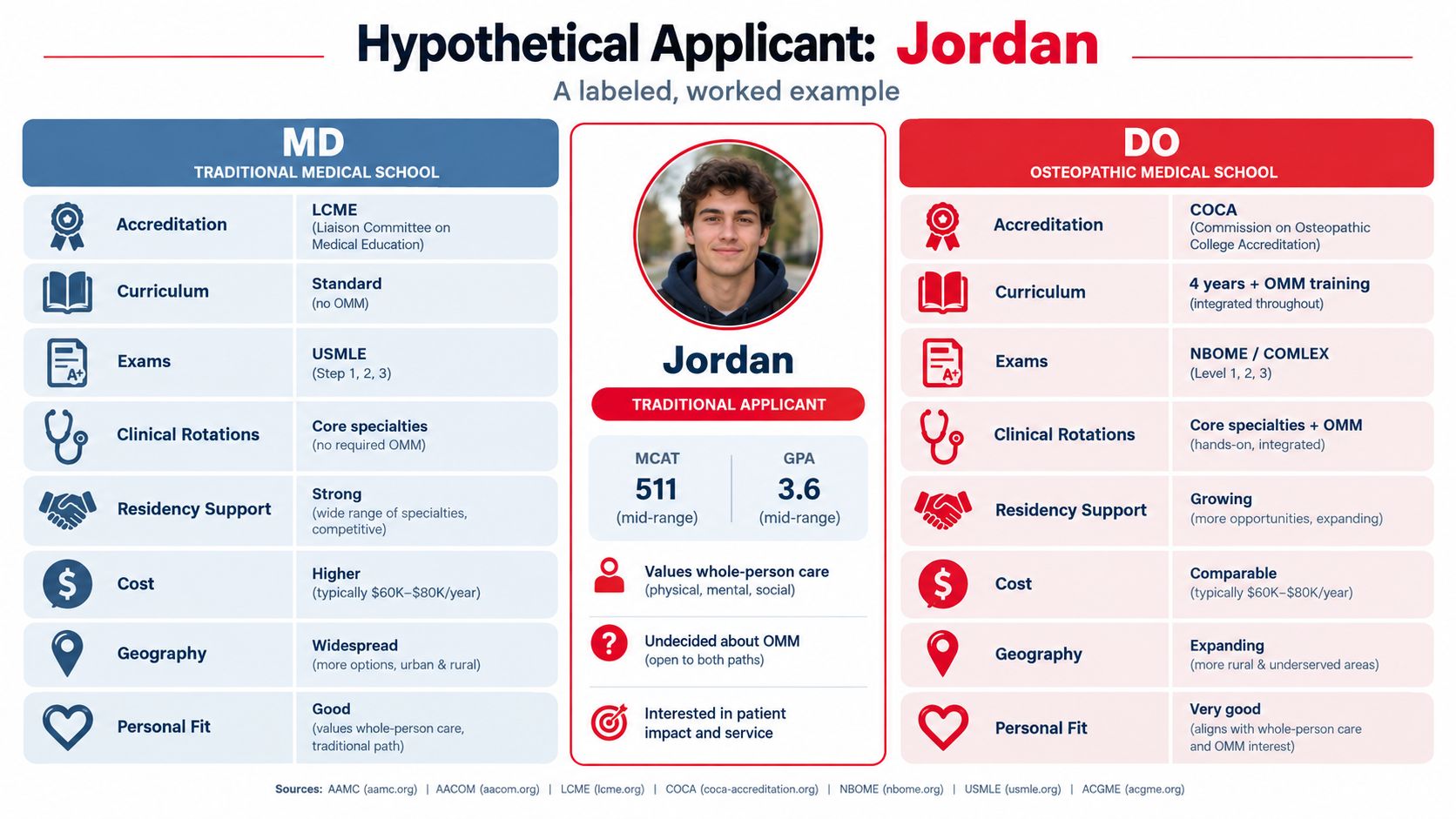
This is a hypothetical composite, not a real Ace Med Boards student or measured outcome.
Jordan is a traditional applicant with a mid-range MCAT and GPA. Jordan values whole-person care but hasn't decided whether learning OMM would feel meaningful or burdensome. Instead of asking which degree is easier, Jordan compares an LCME-accredited MD school in the Midwest with a COCA-accredited DO school in a similar region.
Jordan's school-level audit
Jordan doesn't invent a match prediction from the degree name. Jordan requests and compares:
- Curriculum: The MD program's standard medical curriculum versus the DO program's medical curriculum with required osteopathic principles and OMM.
- Exam sequence: The MD path centers on USMLE. The DO path requires COMLEX-USA and may make USMLE a strategic addition depending on specialty goals.
- Clinical rotations: Jordan checks whether students rotate through stable teaching sites, who supervises them, and how easily they can explore a desired specialty.
- Research access: Jordan asks whether students can find mentors, participate in projects, and obtain specialty-specific guidance without leaving the region.
- Residency support: Jordan reviews advising, away-rotation planning, application review, interview preparation, and alumni reach.
- Cost: Jordan compares tuition, fees, living expenses, aid, and borrowing needs for each school rather than assuming one pathway is cheaper.
- Geography and culture: Jordan visits both campuses if possible and speaks with current students about teaching style, feedback, and clinical placement.
- OMM tolerance: Jordan attends an open house or observes an OMM session. Interest isn't required, but willingness to learn the material is.
The right outcome for Jordan isn't predetermined. If Jordan strongly prefers a conventional curriculum and has a clear plan for an MD school's clinical and specialty resources, the MD option may fit better. If Jordan values osteopathic principles, accepts the COMLEX pathway, and finds the DO school's rotation network stronger, the DO option may be the more coherent choice.
Jordan should also study the application process through a neutral ERAS application example and ask each school direct questions rather than relying on online stereotypes.
The useful comparison is school against school, not stereotype against stereotype.
Board Prep and Application Strategy by Audience
DO versus MD decisions become confusing when applicants mix four separate tasks: choosing a school, preparing for the MCAT, passing licensing exams, and applying for residency. Keep those audiences distinct.
Premedical applicants
Start with the AAMC's admissions guidance for MD applications and review AACOM resources for osteopathic applications. The 2026 AMCAS fee is $175 for the first school and $47 for each additional school, according to the 2025 AAMC medical school admissions guide.
Build an application comparison that includes prerequisite courses, clinical exposure, recommendation requirements, school mission, geography, curriculum, and total cost. Don't treat MCAT preparation as a proxy for choosing MD or DO. Prepare for the exam you need, then choose schools based on fit and competitiveness.
MD students
Use official USMLE guidance first, then select practice materials that match your study phase. NBME self-assessments, question banks such as UWorld, AMBOSS, or other third-party resources can support preparation, but they don't replace content review or careful error analysis.
One-on-one support is most useful after a baseline diagnostic identifies a specific problem, such as weak physiology integration, inefficient question review, or repeated timing errors. Tutoring should clarify the reasoning process and improve your plan, not substitute for independent practice.
DO students
Organize COMLEX preparation around NBOME's official materials and the competencies assessed by COMLEX-USA. Include deliberate review of osteopathic principles and OMM rather than leaving that content until the end. If you're considering USMLE, decide based on specialty and program requirements before committing to a second preparation track.
A useful workflow is simple:
- Complete a baseline assessment.
- Categorize missed questions by knowledge gap, reasoning error, interpretation error, and timing.
- Repair the highest-impact category.
- Re-test with new material.
- Adjust the schedule using evidence, not anxiety.
Residency applicants and international graduates
Residency applicants need a different plan from students preparing for a board exam. Audit your examination history, clinical experience, letters, research, ERAS materials, signaling strategy, geographic preferences, and interview performance. International and foreign medical graduates should also verify current eligibility and documentation requirements through the Educational Commission for Foreign Medical Graduates and NRMP rather than relying on general DO versus MD advice.
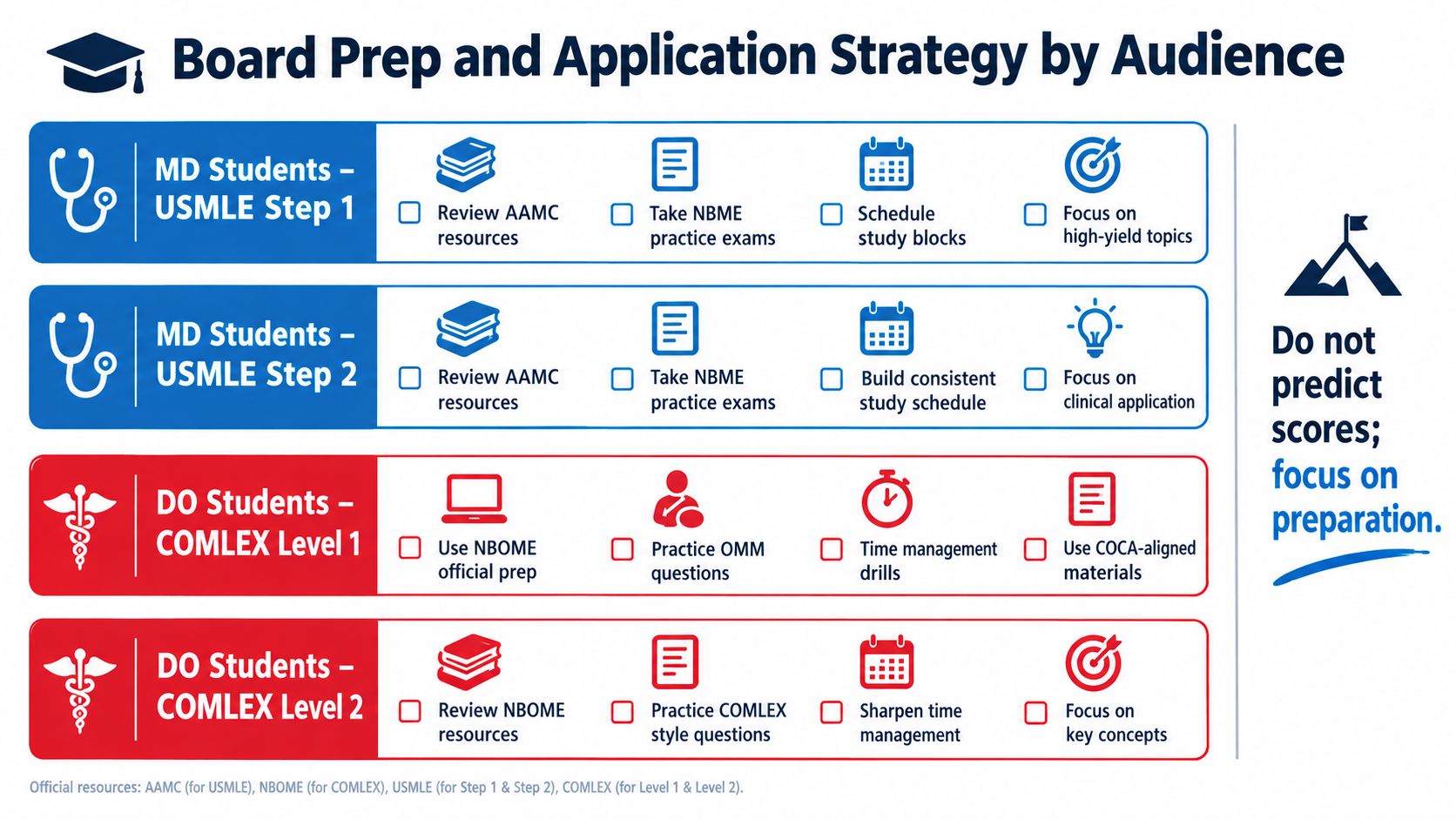
A tutor can complement official practice materials by reviewing a weak baseline, helping with a second-attempt recovery plan, improving clinical rotation study habits, or giving structured feedback on an application document. No tutor can replace the applicant's sustained work or promise a score, admission, pass, or match.
Choosing the Right Path and Next Steps
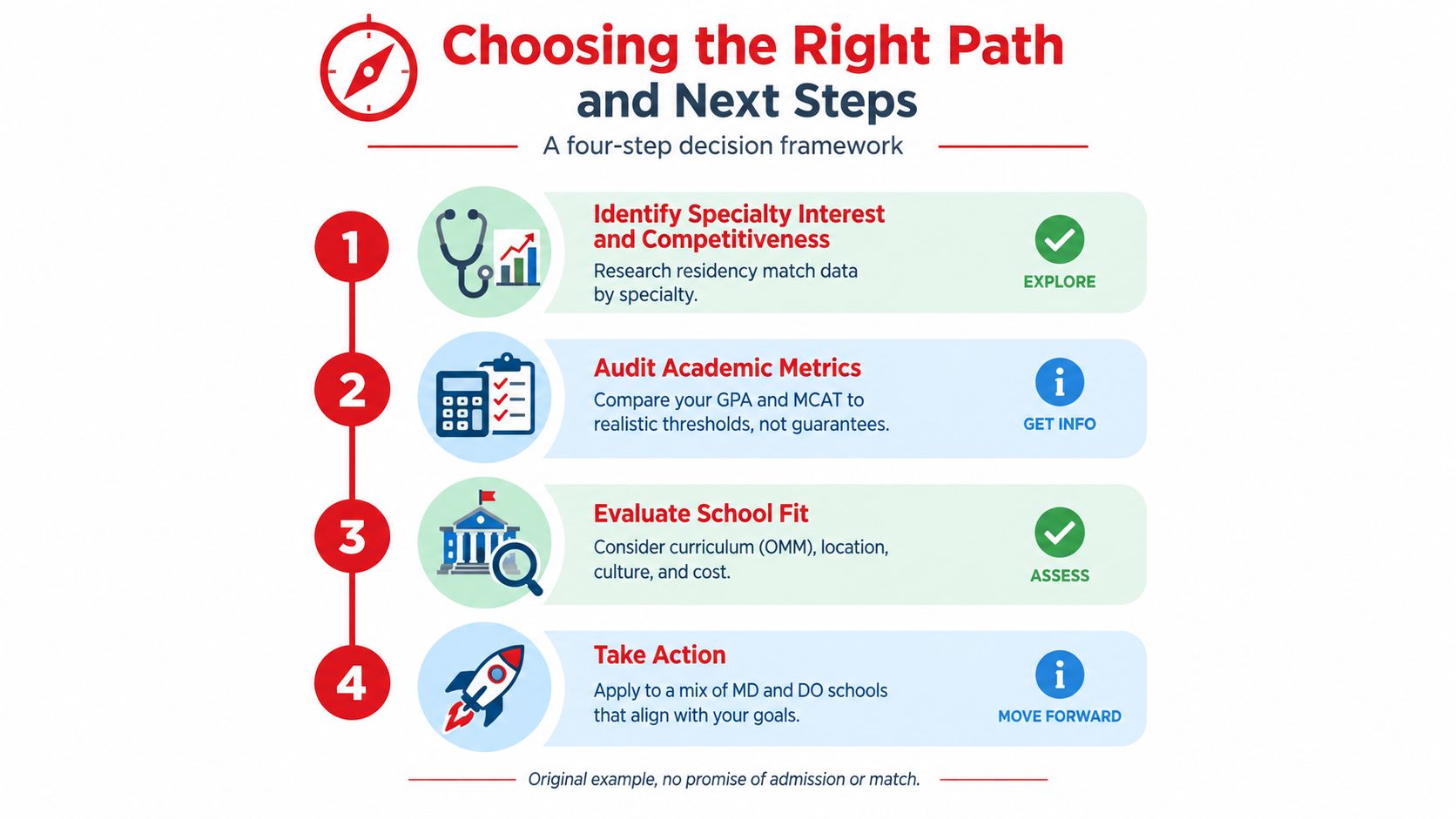
Make the decision in four passes. Start with specialty direction, then test your academic assumptions, evaluate actual schools, and build the examination plan.
A four-step decision framework
Step 1, identify specialty risk. Separate broad interest from a firm target. If you're considering a highly competitive surgical or procedural specialty, investigate specialty-specific outcomes and requirements before choosing a school.
Step 2, audit your academic profile. Verify your GPA, MCAT performance, clinical exposure, prerequisite completion, and letters. Use realistic comparisons, not guarantees. If you're a DO student, include a COMLEX Level 1 study plan and decide whether USMLE belongs in the strategy.
Step 3, evaluate school fit. Compare accreditation, curriculum, OMM, geography, rotation sites, cost, class structure, advising, research access, and residency support. A school with the right degree but weak clinical access may be a poor fit.
Step 4, take action. Build an application list aligned with your profile and goals. Before submitting, confirm your application platform, letter-writer commitments, personal statement, examination timeline, and interview preparation.
Readiness checklist
- Academic record: Confirm GPA, prerequisites, MCAT or AACOMAS-related application information, and any academic gaps.
- Clinical exposure: Document meaningful clinical experiences and be ready to explain what you learned.
- School research: Compare curriculum, OMM expectations, rotation sites, cost, location, and advising.
- Exam plan: Map USMLE, COMLEX-USA, or both to your intended specialty.
- Letters: Confirm potential letter writers and understand each school or program's requirements.
- Research profile: Identify opportunities that fit your specialty interests without inventing accomplishments.
- ERAS preparation: Organize your token, dates, experiences, personal statement, and program list when the application cycle opens.
- Interview readiness: Complete mock interviews and practice explaining your degree choice without criticizing the alternative.
- Financial review: Compare tuition, living expenses, aid, and borrowing needs using current school information.
If graduation is approaching, you may also want a practical resource for choosing a stole for doctors as you plan the ceremony alongside the more consequential academic and residency decisions.
Choose MD if its curriculum, school resources, and exam pathway fit your goals. Choose DO if you accept osteopathic training, including OMM, and the specific school offers the clinical and residency support you need. Neither choice guarantees admission, examination success, or a match, but a well-researched choice gives you a stronger foundation for the work ahead.
Ace Med Boards offers individualized preparation for USMLE and COMLEX-USA, along with medical school admissions and residency application support. If you want help auditing your exam plan, academic profile, or specialty strategy, visit Ace Med Boards to request a focused consultation.