Osteopathic medicine is a fully licensed branch of U.S. medicine whose physicians hold the DO degree, and DOs are trained as complete physicians with added emphasis on whole-person care and osteopathic manipulative medicine. By 2025, the profession had surpassed 207,000 DOs and osteopathic medical students, while 45% of DOs in active practice worked in non-primary-care specialties, so the modern DO pathway is much broader than the old family-medicine stereotype.
If DOs can prescribe, operate, enter competitive specialties, and train in the same residency system as MDs, what exactly remains distinct about osteopathic medicine? The answer isn't that one degree is “better.” The meaningful differences involve accreditation, curriculum, osteopathic principles, hands-on training, board strategy, school mission, and personal fit.
For a premed, the practical question is whether you want the educational model and professional identity that come with a DO program. For an osteopathic medical student, the question becomes how to integrate COMLEX-USA preparation, OMM knowledge, clinical reasoning, and possible USMLE preparation without treating the exams as interchangeable.
What Osteopathic Medicine Is and What a DO Does
Osteopathic medicine is a physician pathway. A Doctor of Osteopathic Medicine, or DO, is a fully licensed physician trained to diagnose illness, prescribe medication, perform procedures and surgery, and practice across medical and surgical specialties. The American Medical Association describes osteopathic medicine in the United States as a full branch of medical practice centered on a whole-person approach to diagnosis, treatment, and care. The AMA's overview of osteopathic medicine also distinguishes DO graduates from nonphysician practitioners.
The osteopathic model is often introduced through four principles:
- The body is a unit. A patient's symptoms should be considered within the context of the whole person.
- Structure and function are interrelated. Anatomy and physiology influence one another, which is why the musculoskeletal system receives particular attention.
- The body has self-regulatory and self-healing mechanisms. This doesn't mean the body can overcome every disease without treatment. It means physicians should recognize and support normal physiologic processes while treating pathology.
- Rational treatment follows those principles. A sound plan combines medical knowledge, clinical evidence, patient context, and, when appropriate, osteopathic techniques.
OMM, or osteopathic manipulative medicine, is an additional clinical tool. The American Osteopathic Association defines osteopathic manipulative treatment as the therapeutic application of manually guided forces by an osteopathic physician to improve physiologic function or support homeostasis affected by somatic dysfunction. The formal OMT definition makes clear that OMT is a specific clinical method, not a vague wellness label.
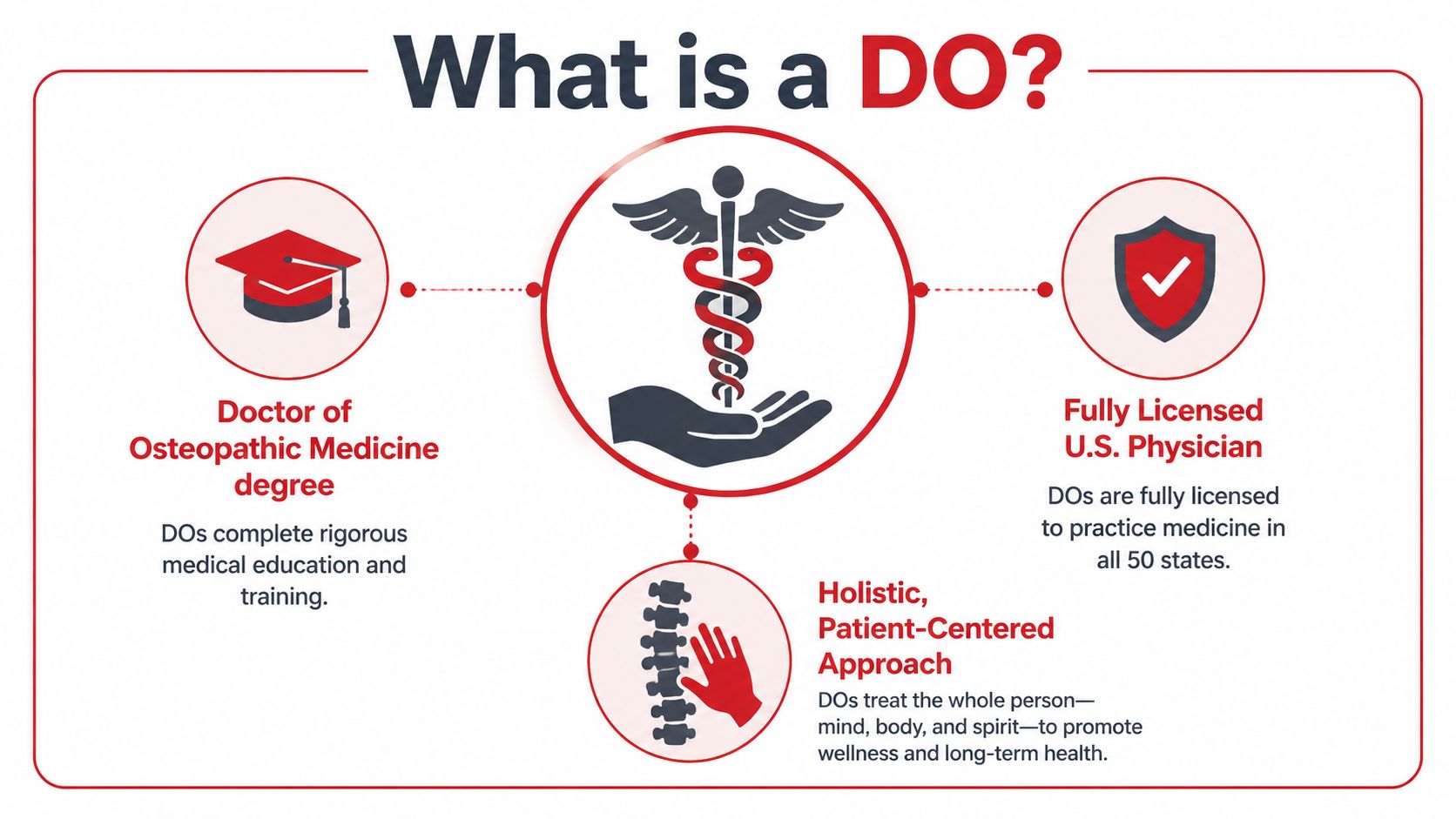
A DO may use OMT when it fits the patient's condition, but OMT doesn't replace antibiotics, imaging, surgery, emergency care, or other standard treatments when those are indicated. Students comparing programs should start with that balanced understanding before reviewing osteopathic medical school options.
How Osteopathic Medicine Evolved Into a Mainstream Pathway
Osteopathic medicine began in 1874, when Dr. Andrew Taylor Still developed the discipline. Still later founded the first school of osteopathic medicine in Kirksville, Missouri, in 1892, establishing a formal educational home for a model that emphasized anatomy, physiology, prevention, and the relationship between structure and function. The AACOM osteopathic medicine quick facts provides the profession's historical starting point and current global context.
Early osteopathic physicians operated in a medical environment where professional boundaries were sharply contested. Recognition developed gradually, and osteopathic education expanded through colleges of osteopathic medicine, often called COMs. The profession's growth wasn't a single event. It came through state recognition, institutional development, physician training, and increasing integration into the broader U.S. health system.
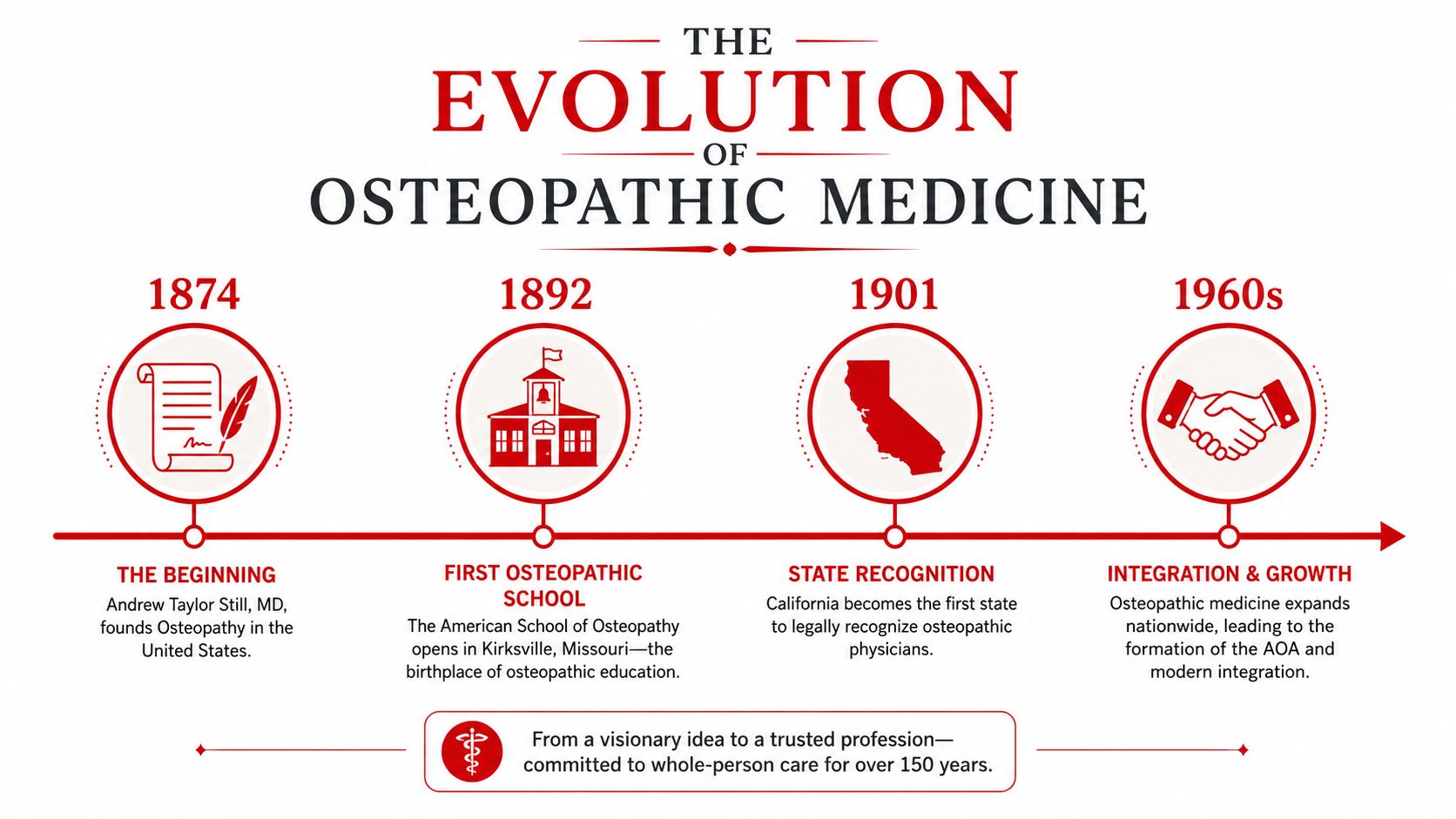
The modern scale of the profession shows how far it has moved from its origins. By 2025, around 172,000 registered osteopathic physicians were practicing in 21 countries, compared with 117,559 registered osteopathic physicians in the 2020 global review, an increase of about 46%. AACOM's quick facts documents those figures and the international expansion.
U.S. medical education has also expanded sharply. Total enrollment in colleges of osteopathic medicine rose from 39,763 in 2024–25 to 41,001 in 2025–26, and first-year enrollment reached 11,686. Graduates rose to 9,019 in 2025–26. Over the longer period covered by AACOM, first-year enrollment grew from 1,163 students in 1977–78 to 11,590 in 2025–26, while graduates increased from 971 to 9,019. AACOM's enrollment and graduate report records this educational expansion.
The key lesson for applicants is simple. Osteopathic medicine retains a distinct philosophy and OMM curriculum, but it has become a mainstream physician pathway with international reach and a large U.S. educational infrastructure.
MD vs DO A Side by Side Decision Matrix
A premed shouldn't choose between MD and DO based on slogans. Compare the programs using the same criteria, then examine the specific schools that would be available to you. MD schools are accredited by the Liaison Committee on Medical Education, or LCME, while DO schools are accredited by the Commission on Osteopathic College Accreditation, or COCA. The AAMC medical school resources and AACOM's osteopathic medical education information help applicants examine each pathway.
| Criteria | MD | DO |
|---|---|---|
| Accreditation | LCME accreditation for U.S. MD-granting programs. | COCA accreditation for U.S. colleges of osteopathic medicine. |
| Curriculum | Biomedical sciences, clinical medicine, clinical skills, and professional development. | The same physician-science foundation, plus osteopathic principles and OMM coursework. |
| OMM | OMM isn't a required defining component of the MD curriculum. | OMM and osteopathic principles are integrated into the DO curriculum. |
| Exams | Students take the USMLE sequence. USMLE publishes the official examination framework. | Students take COMLEX-USA. Some also take USMLE, depending on career and residency goals. NBOME oversees COMLEX-USA. |
| Clinical rotations | Core clinical experiences are arranged through each school's affiliated hospitals and clinical sites. | Core clinical experiences are arranged through each school's affiliated hospitals and clinical sites, with osteopathic education continuing alongside clinical training. |
| Residency support | Graduates enter the ACGME residency system. | Graduates also enter the single ACGME residency system. ACGME accredits the unified system. |
| Cost | Tuition, fees, living expenses, and debt vary substantially by institution and location. | The same cost factors apply. Don't assume either degree is automatically less expensive. |
| Geography | School availability depends on the location and distribution of LCME-accredited programs. | School availability depends on the location and distribution of COCA-accredited programs. |
| Personal fit | Consider mission, teaching style, class environment, clinical network, and your comfort with the MD curriculum. | Consider mission, teaching style, clinical network, class environment, and your willingness to learn osteopathic principles and hands-on OMM. |
The major licensing and scope similarities matter. MDs and DOs are fully licensed physicians, and graduates of both pathways can pursue medical and surgical specialties. The most durable educational distinction is that DO students must learn osteopathic principles and OMM, then incorporate that material into their board preparation and professional identity.
Decision rule: Choose the school whose curriculum, clinical network, mission, location, and learning environment you can support for the full length of medical training. Don't choose a degree because someone promises an easier match.
For a more focused comparison, use this DO degree versus MD guide as a second decision aid, then verify each school's current accreditation, curriculum, tuition, rotation structure, and residency advising directly.
Inside the DO Curriculum and OMM Training
A DO curriculum has the same central academic responsibility as any physician curriculum, students must learn the biomedical sciences, clinical medicine, diagnosis, pharmacology, pathology, ethics, and patient communication. The added layer is osteopathic education, which usually runs beside foundational science rather than replacing it.
During the preclinical period, students study anatomy, physiology, biochemistry, microbiology, pathology, and pharmacology while building clinical skills. OMM labs provide a separate setting in which students use palpation, positioning, movement, and controlled forces to assess and address somatic dysfunction.
What students practice in OMM lab
Students commonly develop skills such as:
- Palpatory diagnosis: Using touch to assess tissue texture, motion, tenderness, asymmetry, and other findings.
- Somatic dysfunction mapping: Connecting physical examination findings to anatomy, biomechanics, and the patient's reported symptoms.
- Muscle energy: Asking a patient to provide a controlled muscular effort against resistance.
- Myofascial techniques: Applying gentle pressure and directional forces to address restrictions in soft tissue.
- High-velocity, low-amplitude techniques: Learning carefully controlled thrust techniques within appropriate clinical and safety boundaries.
The educational value isn't limited to memorizing named techniques. OMM lab forces students to review three-dimensional anatomy, think about mechanical relationships, communicate clearly before touching a patient, obtain consent, and reassess after an intervention. Those habits can strengthen the broader physical examination even when OMT isn't used.
How training continues in the clinical years
Third- and fourth-year students move into hospital and outpatient rotations, including medicine, surgery, pediatrics, psychiatry, emergency medicine, obstetrics and gynecology, and other required experiences. Schools differ in how they organize sites, so applicants should ask where students rotate, how much travel is expected, how schedules are assigned, and whether students have access to specialty electives.
COMLEX-USA preparation runs alongside this curriculum. Students must understand when their school schedules COMLEX Level 1 and Level 2-CE, how dedicated study affects rotations, and whether they intend to add USMLE preparation. OMM knowledge can reappear in classroom assessments, clinical reasoning, and board-style cases, so postponing it until the final review period creates avoidable pressure. Students who need a clearer subject map can use this OMM preparation resource to organize anatomy, diagnosis, technique selection, and question review.
Where OMT Actually Helps and Where Evidence Is Thin
OMT deserves a careful answer, not a blanket endorsement or dismissal. A 2022 overview found promising evidence for musculoskeletal disorders, particularly acute and chronic low back pain and pregnancy-related low back pain, while evidence was limited or contradictory for pediatric conditions and limited for primary headache and irritable bowel syndrome. The BMJ Open review is useful because it separates conditions instead of treating OMT as broadly effective for every complaint.
A 2025 chronic low back pain study reported better pain, function, and health-related quality-of-life outcomes among patients treated by osteopathic physicians over 36 months, but the observed effects were driven more by physician empathy than by OMT itself. The study didn't demonstrate reduced chronic widespread pain or improved recovery. That distinction matters for both examination reasoning and honest patient communication.
| Condition | Evidence strength | Typical clinical role |
|---|---|---|
| Acute low back pain | Promising evidence | May be considered as an adjunct to an appropriate clinical plan when the patient is suitable for manual treatment. |
| Chronic low back pain | Promising but nuanced | Can be studied as part of multimodal care, with attention to communication, function, and usual care. |
| Pregnancy-related low back pain | Promising evidence | May have a supportive role when coordinated with appropriate obstetric assessment. |
| Pediatric conditions | Limited or contradictory | Avoid broad claims. The condition, technique, safety profile, and evidence quality must be considered separately. |
| Primary headache | Limited evidence | OMT shouldn't be presented as a universal headache treatment. |
| Irritable bowel syndrome | Limited evidence | Any role requires cautious interpretation and shouldn't replace standard evaluation. |
Manual therapy research also varies by comparator. Results can look different when OMT is compared with usual care, another active treatment, or no treatment. Students who want to refresh the anatomical foundation behind palpation and biomechanics can explore anatomy fundamentals, then return to condition-specific evidence rather than general wellness claims.
The practical conclusion is measured: OMT may be valuable for selected musculoskeletal presentations, but the benefit of osteopathic care can also reflect empathy, time, examination quality, communication, and integrated planning. OMT is a tool, not the entire identity of a DO.
COMLEX vs USMLE What Students Need to Know
The board decision becomes clearer once you separate licensure from residency signaling. COMLEX-USA is the osteopathic licensing examination sequence and tests osteopathic principles, including OMM. USMLE is the allopathic licensing examination sequence. DO students may take USMLE in addition to COMLEX-USA when that choice fits their intended residency strategy, specialty interests, and available preparation time.
| Dimension | COMLEX-USA | USMLE |
|---|---|---|
| Primary role | Osteopathic physician licensure pathway. | U.S. physician licensure pathway used by MD students and also taken by some DO students. |
| Osteopathic content | Includes osteopathic principles and OMM. | Doesn't serve as the osteopathic-specific examination. |
| Early examination | Level 1. | Step 1. |
| Clinical examination | Level 2-CE. | Step 2 CK. |
| Score status | Verify current reporting policies with NBOME before planning. | Verify current reporting policies with USMLE before planning. |
| Residency strategy | Used within the DO pathway and considered alongside the rest of an application. | May provide an additional exam result for programs or specialties where applicants believe it will be useful. |
| Main planning risk | Underestimating OMM and osteopathic integration. | Adding a second exam without enough time to learn its format and content emphasis. |
USMLE Step 1 and COMLEX Level 1 are not two versions of the same test. Their content blueprints, question styles, terminology, and osteopathic emphasis differ. A student who plans to take both should build a shared foundational science plan, then reserve dedicated time for exam-specific practice rather than assuming one question bank will cover every need.
A practical planning framework
First, identify the target. Review the specialties and programs you may pursue, then check current program information rather than relying on forum anecdotes. The COMLEX and USMLE comparison guide can help organize the questions you need to ask.
Next, audit your bandwidth. Taking both examinations requires additional scheduling, registration, question review, and mental energy. If dual preparation threatens clinical performance or leaves OMM underprepared, the plan needs revision.
Finally, place exams around rotations and applications. Work backward from your school's testing requirements, clinical schedule, and ERAS application timeline. Confirm dates and reporting rules through the official NBOME and USMLE websites because policies can change.
There isn't one universally correct exam plan for every DO student. The strongest plan matches the student's goals, preparation history, academic needs, and realistic study capacity.
Misconceptions About DOs That Deserve to Retire
The old image of the DO as a physician limited to family medicine no longer describes the profession. In 2025, 45% of DOs in active practice were in non-primary-care specialties, with emergency medicine, anesthesiology, obstetrics and gynecology, psychiatry, and general surgery among the leading non-primary-care matches. The 2025 Osteopathic Medical Profession report documents that broader specialty presence.
| Misconception | Current reality |
|---|---|
| DOs are limited to primary care. | DOs practice across primary-care and non-primary-care specialties, including procedural and surgical fields. |
| A DO is a lesser version of an MD. | Both are fully licensed physicians. Their educational pathways differ, but neither degree makes a graduate a nonphysician. |
| DO graduates can't enter competitive specialties. | DO graduates can pursue the full specialty range, although specialty access remains affected by academic performance, clinical evaluations, research, letters, application strategy, and program preferences. |
| OMM is the entire DO curriculum. | OMM is one component of a complete medical education that includes biomedical science, clinical medicine, diagnosis, pharmacology, surgery, and patient care. |
| The accreditation merger erased DO identity. | ACGME accreditation created a single graduate medical education system, but COMLEX-USA, osteopathic principles, and OMM remain part of the DO educational pathway. |
The single accreditation transition changed residency structure, not the foundational identity of osteopathic medical education. ACGME-accredited programs can accept both MD and DO graduates, while AOA-accredited programs historically accepted only DO graduates. This residency pathway overview explains why applicants should evaluate each program's current requirements rather than assume that the degree alone determines access.
One stereotype does contain a question worth asking. Because DO training includes OMM, an applicant should decide whether they're willing to learn hands-on assessment and treatment, even if they later pursue a specialty where they use OMT infrequently. That isn't a reason to avoid the pathway. It is a reason to choose it with accurate expectations.
A Practical COMLEX Study Plan and Readiness Checklist
COMLEX preparation works best when students treat osteopathic content as an integrated thread, not a final-week add-on. The following framework is deliberately flexible because school calendars, prior science preparation, clinical duties, and test anxiety differ.
Phase one builds the foundation
Start by organizing the major systems and disciplines. Pair foundational science review with active recall, then use questions to identify whether a missed item reflects a knowledge gap, a reasoning error, a vocabulary problem, or a timing issue.
- Build the map: Review biochemistry, physiology, pathology, pharmacology, microbiology, immunology, anatomy, and behavioral science by organ system.
- Add OMM early: Link spinal mechanics, autonomics, viscerosomatic relationships, gait, and technique selection to anatomy and clinical presentations.
- Create an error log: Record the tested concept, why your answer was wrong, the clue you missed, and the action that prevents the same mistake.
Phase two turns knowledge into decisions
Use timed question blocks as a reasoning laboratory. Don't measure progress only by the percentage correct. Review every uncertain answer, including correct guesses, because those items reveal unstable knowledge.
A useful review sequence is:
- State the diagnosis or principle tested.
- Identify the decisive clue.
- Explain why each distractor is wrong.
- Write one short takeaway in your own words.
- Revisit the concept later using a different question or recall prompt.
Students preparing for both COMLEX-USA and USMLE should separate shared content from exam-specific work. Use common resources for foundational medicine, then add COMLEX-focused OMM and osteopathic terminology. A tutor or study group can help when you repeatedly miss the same reasoning pattern, but neither replaces official guidance, practice assessments, or independent review. The COMLEX-USA preparation service is one option for students seeking structured support.
Phase three confirms readiness
Use official or school-approved self-assessments according to the current testing guidance. Treat the result as diagnostic information, not a promise about exam day. Review the weakest domains, check pacing, and reduce new-resource switching as the test approaches.
Four weeks out
- Content audit: Identify the highest-impact weak systems and OMM topics.
- Question routine: Maintain timed practice and thorough review.
- Log review: Look for repeated errors rather than isolated misses.
- Logistics check: Confirm registration, scheduling, identification requirements, and testing-center details through current official sources.
Two weeks out
- Simulation: Practice the day structure and breaks you'll use.
- Targeted repair: Focus on recurring weaknesses, not every unfamiliar fact.
- Resource control: Keep a short, stable list of review materials.
- Clinical balance: Protect sleep, required rotations, and recovery time.
One week out
- Light consolidation: Review formulas, OMM patterns, pharmacology associations, and error-log summaries.
- No major overhaul: Avoid replacing your plan because of one difficult practice block.
- Final logistics: Recheck appointment details and required documents.
- Test-day plan: Decide when you'll eat, hydrate, travel, and take breaks.
Readiness check: You're ready to sit for the exam when your process is stable, your review identifies why you miss questions, and your logistics are confirmed. A single practice result shouldn't define your medical career.
If your preparation has been disrupted by a failed attempt, academic gap, low score, or test anxiety, start with an honest audit rather than shame. Identify what changed, use current official policies, and build a plan that addresses the actual barrier.
Ace Med Boards offers one-on-one tutoring for COMLEX-USA preparation, including support with osteopathic content, OMM integration, question analysis, and individualized study planning. If you want help translating this framework into a realistic plan for your next COMLEX milestone, visit Ace Med Boards to learn about the service and request a free consultation.