Why do some medical students know the facts cold, then freeze when a vignette asks them to reason? Critical thinking in a clinical setting means reading the lead-in correctly, weighing clues against the actual task, and checking your own logic before you commit to an answer. That's not a personality trait, it's a trainable exam skill, and the evidence base says it can improve with practice, with training associated with roughly 0.7 standard deviations of score gain in one cited summary (critical thinking statistics).
Why Critical Thinking Trips Up Even Strong Med Students
A lot of smart learners miss questions for a simple reason: they treat a vignette like a recall quiz instead of a reasoning task. They spot one familiar clue, jump to a diagnosis, and never ask whether the stem wanted a mechanism, a next step, or the best explanation.
That's why the same student can do well on content review and still stall on board-style blocks. The bottleneck isn't always knowledge, it's reasoning under pressure.
What the exam is really testing
In clinical learning, critical thinking is the habit of slowing down long enough to ask, “What is this question asking me to do?” That question matters on USMLE-style blocks, COMLEX-style questions, Shelf exams, and MCAT-style reasoning passages, because the stem often rewards the person who matches the task, not the person who recognizes the flashiest clue.
The skill is also measurable, which matters for students who've been told to “just think harder” without being shown how. A cited source reports that the Watson-Glaser appraisal correlates at 0.55 with job performance and 0.74 with intelligence, while the CCTST reports alpha = 0.91, a sign of strong internal consistency (critical thinking statistics). Those numbers don't make anyone a better clinician overnight, but they do show the skill can be assessed rather than treated as vague intuition.
Practical rule: If you can't say what the question is asking in one sentence, you're not ready to answer it yet.
A useful way to think about this is clinical reasoning as a visible workflow, not a vibe. If a tutor can watch your steps and identify where the chain breaks, then you can fix the right problem instead of rereading every page in the book.
For a simple overview of that mindset, see what clinical reasoning is.
What Critical Thinking Actually Means in a Clinical Vignette
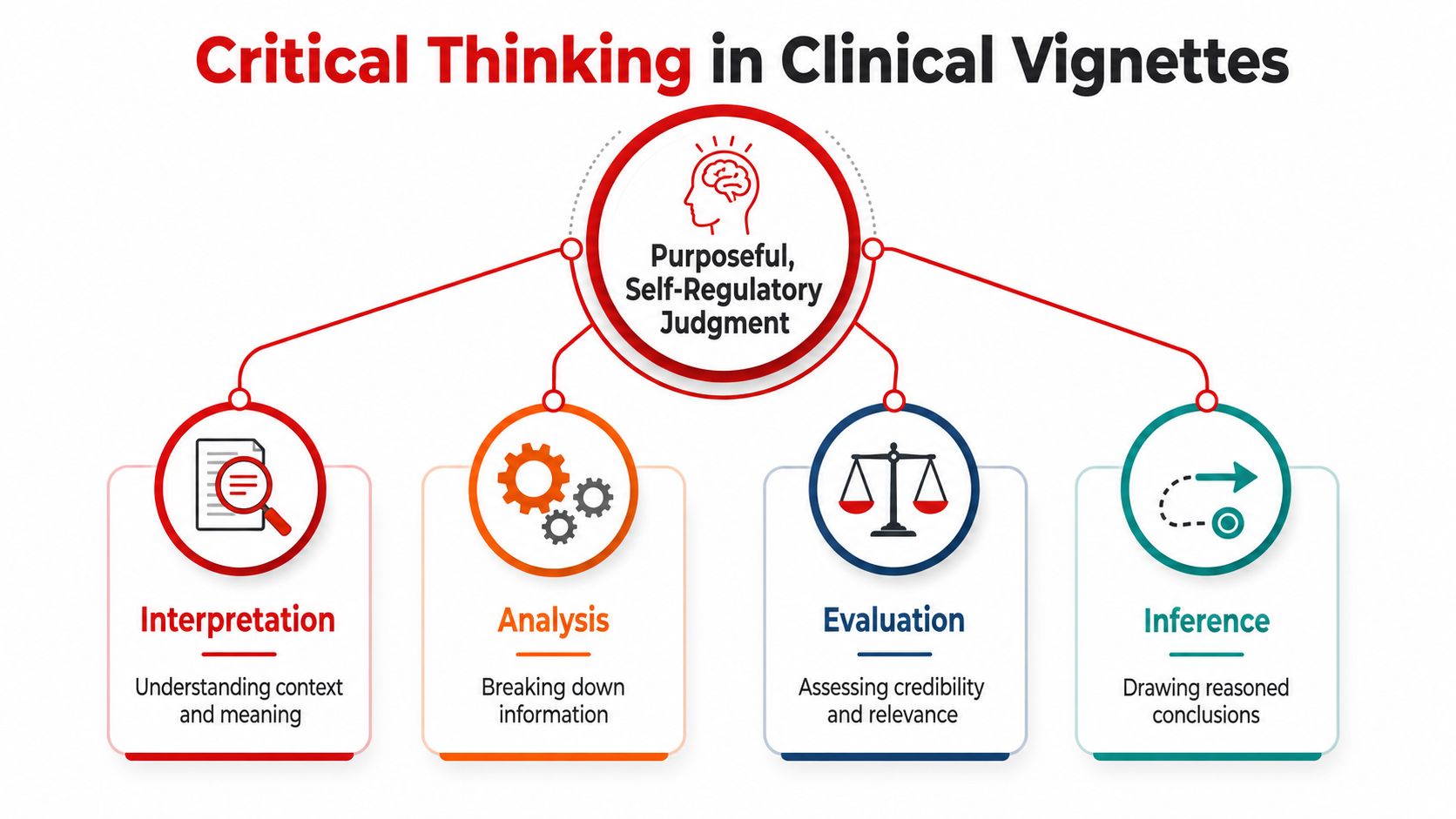
The cleanest definition comes from the Delphi consensus, which frames critical thinking as purposeful, self-regulatory judgment that produces interpretation, analysis, evaluation, and inference grounded in evidence, concepts, and context (Delphi definition). In exam terms, that means you don't just “know” an answer, you can explain why the clue set supports it better than the alternatives.
Turning the definition into moves you can actually make
Interpretation starts with the lead-in. You're identifying the exact task, diagnosis, next best step, mechanism, or interpretation of a lab, before you read the stem like a story.
Analysis means building a one-line problem representation. In plain language, that's the shortest accurate summary of the patient or scenario, stripped of noise but rich enough to guide the differential.
Evaluation is where you test clues against credibility and relevance. Instead of treating every detail as equal, you ask which findings move the probability needle and which ones are there to distract you.
Inference is the final step, drawing the best-supported conclusion and checking whether it survives the counterfactual test. If the opposite answer would still fit the stem, your reasoning probably isn't tight enough yet.
A simple contrast helps here. Pattern recognition is fast and often useful, but it can fail under stress or when the test writer builds a tempting distractor. Deliberate reasoning is slower, but it gives you a chain you can inspect, correct, and defend.
If you want a simple visual way to explain this to yourself or a study partner, practical examples of video for clarity can help you see the difference between a clue list and a reasoning chain. For a case-based teaching approach, case-based learning in medicine fits the same logic.
A Five-Step Reasoning Framework for Board-Style Questions
How do strong students turn a long stem into a correct answer without getting lost in the noise?
Engineering and education literature turns critical thinking into a testable workflow by applying the Elements of Thought against standards like clarity, precision, accuracy, relevance, and logical validity (Niewoehner PDF). That language can sound formal, but it maps cleanly onto the way careful test-takers work. The key move is to break the problem into steps you can follow under time pressure, instead of relying on a vague feeling that the answer is familiar.
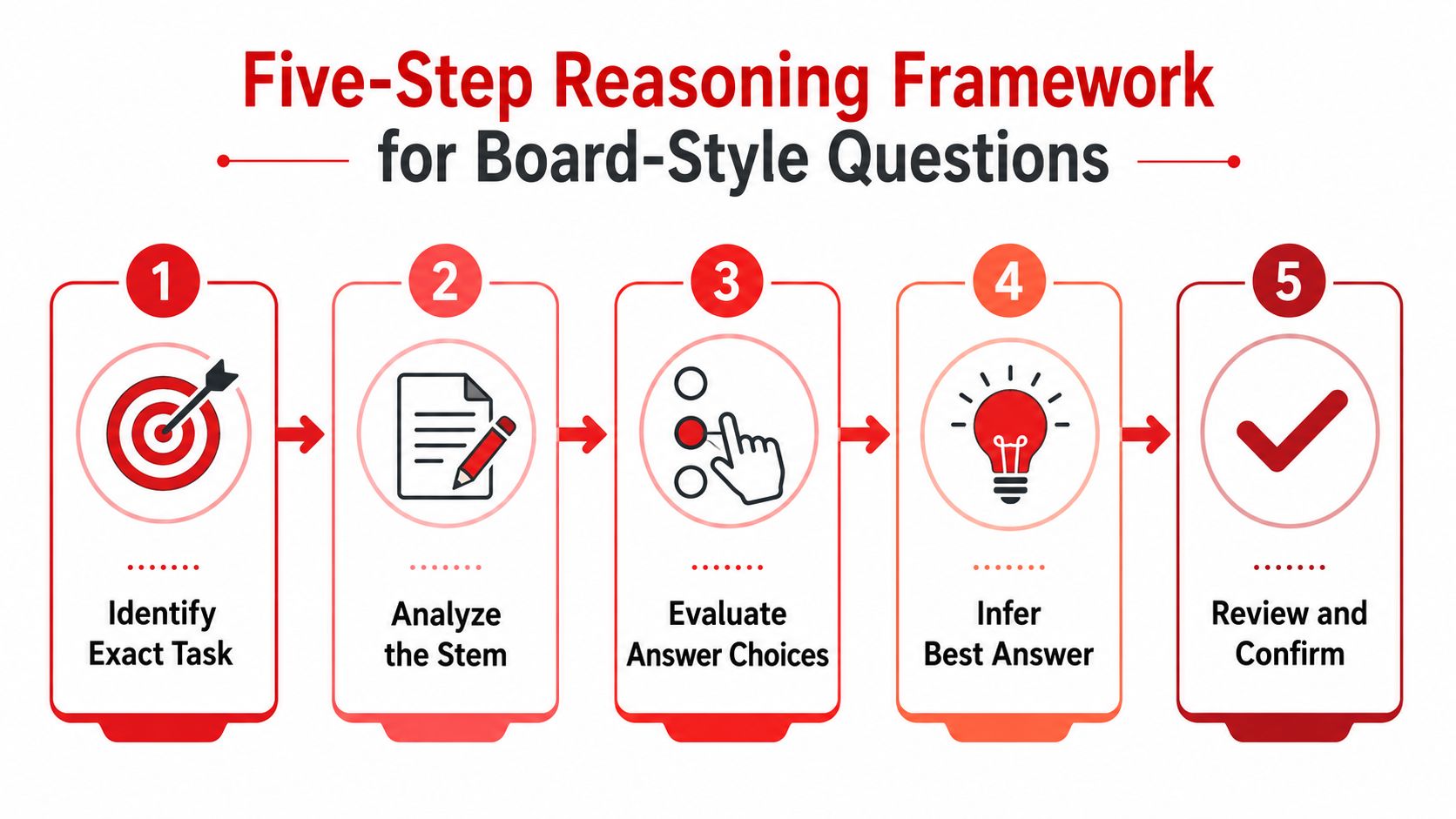
Step 1 Identify the exact task
Before anything else, name what the stem wants. Is it asking for the diagnosis, the next best step, the mechanism, or the interpretation of a result? If the task is wrong, a correct diagnosis can still lead you to the wrong choice.
Step 2 Build a one-line problem representation
Compress the case into one line that captures the key age, setting, problem type, and discriminating clue. A problem representation works like a chart label for your brain. It tells you what kind of case you are holding before you start sorting details.
Many learners skip this step, then feel as if every answer choice could fit. That usually means the stem has not yet been translated into a clear clinical summary.
Step 3 Sort clues by diagnostic value
Separate signal from background. A high-yield clue changes the likelihood of one answer over another, while a low-yield detail may only make the stem feel busier.
A use case identification framework helps in a different setting, as it forces you to define the task before you choose a solution. Board questions require the same habit, only the “use case” is the clinical problem in front of you.
Step 4 Generate and test a short differential
Keep the differential small. Two or three serious contenders are easier to test than seven loose guesses, because the goal is to compare evidence, not to collect diagnoses.
A useful habit here is to ask which option survives the stem after you account for the strongest clues. If one answer needs several assumptions, while another fits the main pattern with less strain, the second answer usually deserves more weight.
Step 5 Eliminate choices with explicit evidence
For each wrong option, state the reason it fails the stem. That turns guessing into visible reasoning and makes later review more useful. If you miss the question, note the specific error so the miss becomes data rather than frustration.
For a closer look at how distractors are built and why they work, see distractor analysis. The point is not just to spot the right answer, but to see why the wrong ones look tempting in the first place.
Practical rule: A correct answer without a reason is luck. A wrong answer with a reason is feedback.
Walking Through an Original Worked Vignette
Here's an original educational vignette, not a recalled exam item.
A 24-year-old man comes to clinic with 3 weeks of fatigue, low-grade fever, and night sweats. He also reports a sore throat that improved, then a diffuse maculopapular rash. Exam shows tender cervical lymph nodes and an enlarged spleen. The lead-in asks for the most likely diagnosis.
At first glance, strep, lymphoma, or a viral syndrome might all feel tempting. A clue-matcher might lock onto “sore throat” and stop too early, but a structured thinker pauses and writes a one-line problem representation, young adult with mononucleosis-like illness, lymphadenopathy, splenomegaly, rash after pharyngitis.
Sorting the clues
The highest-yield findings are the age, the mono-like cluster, and the splenomegaly. The rash matters too, but only if you ask what usually causes rash after certain treatments or in certain infections. The trick is not to overread a single clue and ignore the whole pattern.
A short differential would include infectious mononucleosis, acute HIV, and a bacterial pharyngitis-related process. Each one has to be tested against the stem, not just recognized by name.
Eliminating the wrong choices
- Streptococcal pharyngitis fits sore throat and fever, but it doesn't explain the splenomegaly and the prolonged fatigue pattern very well.
- Lymphoma can cause nodes, fever, and night sweats, but the sore throat at the start and the acute mono-like course push harder toward an infection.
- Acute HIV stays on the list because fever and rash can fit, but the classic mononucleosis-like syndrome with tender cervical nodes and splenic enlargement makes the viral mono pattern more plausible here.
The best answer is infectious mononucleosis. The reasoning is stronger than the recall, because the student didn't just match a buzzword, they matched the whole evidence set.
If you want to see how tutors can walk a stem step by step, this sample question page is a useful nearby reference point.
The Three Reasoning Pitfalls That Sink Shelf and Board Scores
Weak critical thinking often shows up as heuristic and intuitive judgment, emotional or biased thinking, and fear of ambiguity, especially under exam pressure (The State of Critical Thinking 2020). Those pressures explain why the same learner can reason well in conversation and then fall apart on timed blocks.
| Pitfall | Thinking Error | Signal in Review | Corrective Drill |
|---|---|---|---|
| Premature closure | The student grabs the first plausible diagnosis and stops testing alternatives. | The post-block explanation sounds fast, but the wrong option was never truly eliminated. | Force a two-minute pause after every stem, then write two competing diagnoses before looking at answers. |
| Memorable-clue bias | One striking clue outweighs the task, base rate, or full pattern. | The student can point to one detail, but can't explain why that detail should dominate. | Cover the most memorable clue and restate the answer from the remaining evidence. |
| Content-only review | The student reviews the topic but never names the reasoning error. | The same miss keeps returning in different forms. | Tag each miss as content gap, reasoning error, timing issue, or careless read, then revisit the exact category. |
How to tell which error you made
Ask one diagnostic question after every miss, what did I believe that the stem didn't support? That question exposes the moment where your logic left the text and started drifting toward habit.
The goal isn't to become suspicious of every answer choice. The goal is to become disciplined about why one choice survives and the others don't.
For students who want a practical place to work on pressure, performance under pressure is the right kind of study theme to pair with this table.
A Checklist and Drill Sequence for Every Practice Block
Before you lock an answer, run the same five checks every time. This keeps your reasoning honest and gives you a repeatable way to compare blocks over time.
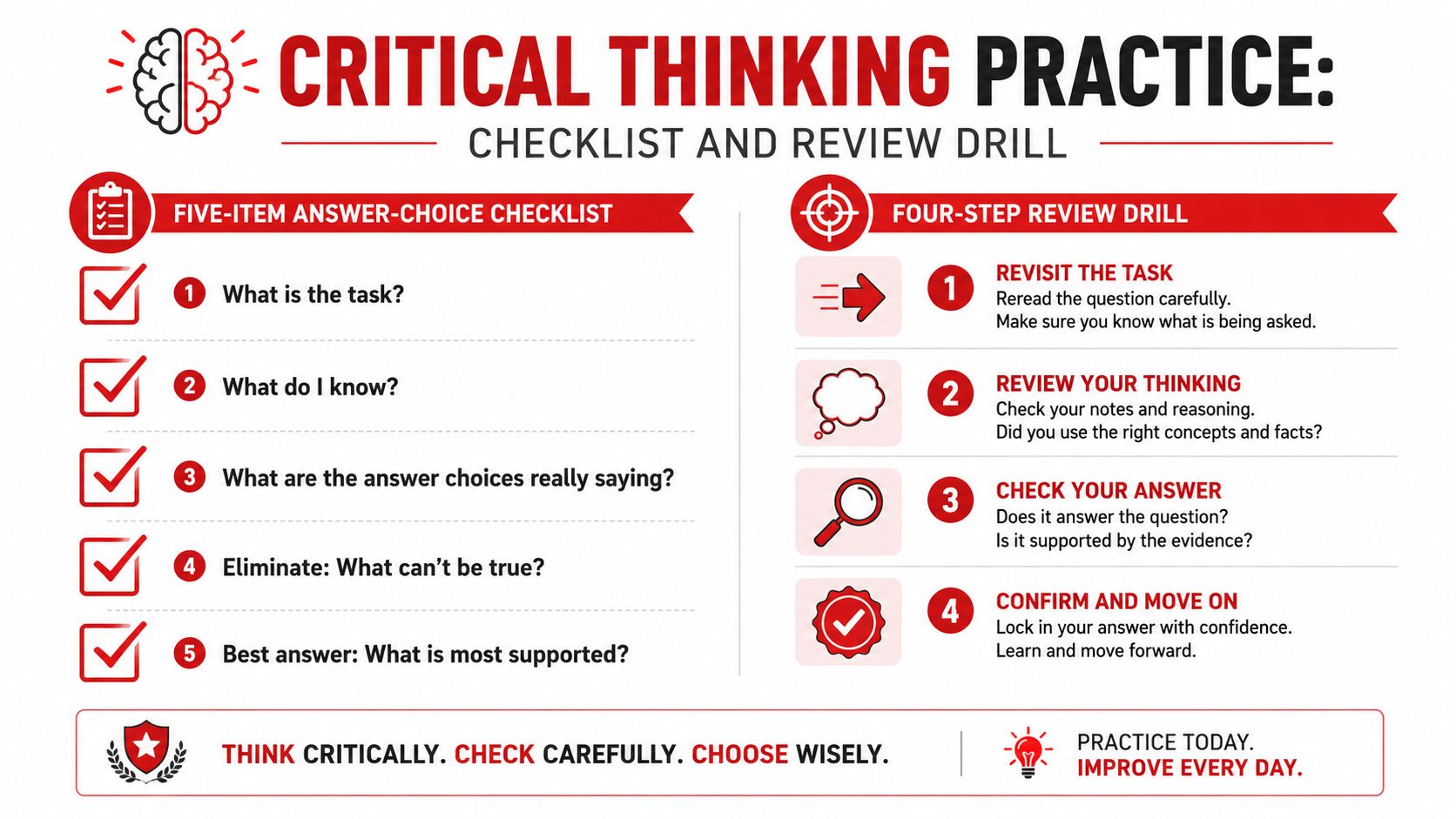
Five-item answer choice checklist
- What is the task? Name it in plain language before you choose.
- Is this on my differential? If not, ask why it got there.
- Would I pick this without the last clue? If the answer is no, check whether the last clue was over-weighted.
- Could the opposite be true? Test the alternative before committing.
- What is my confidence and why? Separate certainty from habit.
Four-step post-block drill
- Classify the miss. Decide whether it was content, reasoning, timing, or a careless read.
- Rewrite the problem representation. If the summary is messy, the reasoning usually was too.
- Re-justify the correct answer in one sentence. Keep it tight and evidence-based.
- Reschedule the exact question. Don't just “move on,” put it back into review.
Newcastle's Academic Skills Kit gives the same epistemic habit in a simpler form, asking every claim, how do you know that? (using evidence to support your argument). That question works on answer choices too.
A Four-Week Plan to Build Critical Thinking on Exam Prep
How do you turn critical thinking into a habit you can use on test day? Start by tracking the reasoning process, not only the score. A reliable measure should reflect the skill you are trying to improve, and one cited source reports that the CCTST has alpha = 0.91, while properly spaced official self-assessments are the clearest way to watch progress over time (critical thinking statistics).
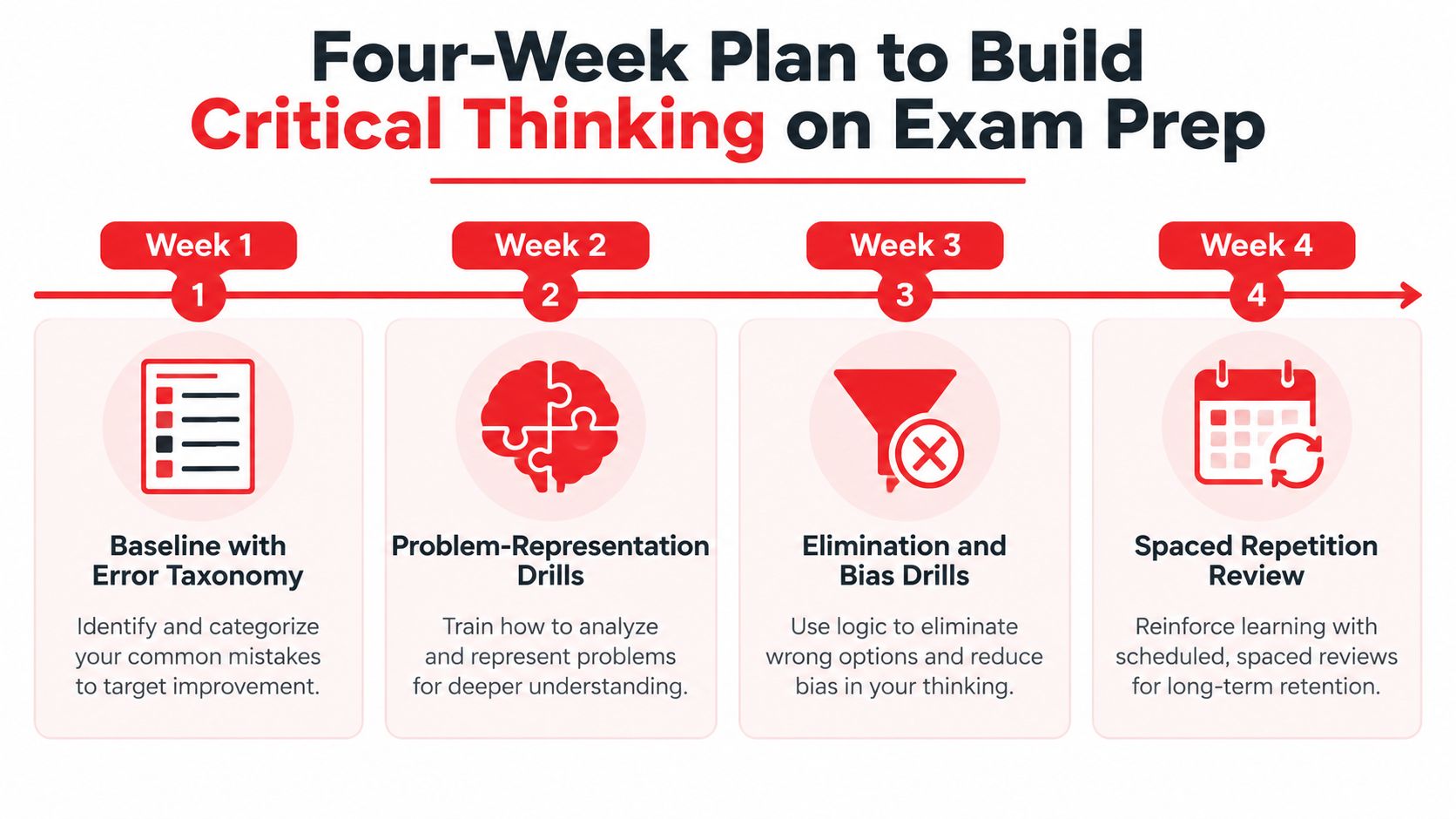
Week 1 and Week 2
Week 1 is baseline work. Log each miss by category, content gap, reasoning error, timing issue, or careless read, so you can tell what kind of problem you are seeing. A score drop with no label is like hearing a diagnosis without the exam findings. It tells you very little.
Week 2 should focus on problem representation drills. Take stems you missed and rewrite them into one-line summaries until the pattern feels automatic. The goal is not prettier notes. The goal is a cleaner summary that makes the next decision easier to justify.
Week 3 and Week 4
Week 3 is for elimination and bias drills. Use the checklist above, then force yourself to defend why the wrong options fail. This slows down premature closure and makes your reasoning visible, which is the point of practice.
Week 4 is spaced review plus one official self-assessment. Watch the trend in your error categories and your confidence calibration, not just the raw score from one day. If the same miss type keeps returning, that pattern matters more than a single strong block.
One-on-one tutoring can fit here as a diagnostic layer, especially when a student keeps missing the same question type but cannot see why. Ace Med Boards can help students analyze question-level errors, build a personalized study plan, and stay accountable to the reasoning process, while still relying on official practice materials for the core exam work.
Frequently Asked Questions About Critical Thinking on Med Exams
Can critical thinking improve without more content review? Yes. If your misses come from task misread, weak problem representation, or premature closure, the fix is usually reasoning practice, not another pass through the same notes.
Does this framework work for Shelf exams and COMLEX or USMLE-style questions? It does, because the lead-in, clue sorting, and elimination steps are the same even when the topic changes.
What should I do after a plateau? Tag the miss type first, then review the exact reasoning breakdown instead of rereading the whole chapter.
Can a tutor help with this? A trained reader can spot where your verbal reasoning chain breaks and help you build a cleaner, more accountable process.
If you're trying to figure out why your scores have stalled, Ace Med Boards can help you review questions, classify errors, and build a more disciplined reasoning process around official practice. Visit Ace Med Boards to explore one-on-one tutoring and decide whether a free consultation makes sense for your prep.