
Cognitive bias is a systematic deviation from sound reasoning that can distort clinical judgment under uncertainty. Studies of medical decision-making have linked cognitive biases to diagnostic inaccuracies in 36.5% to 77% of case scenarios, making debiasing a high-yield skill for USMLE, COMLEX-USA, and Shelf exam takers.
You may recognize the moment: you read the first few lines of a question, decide what the diagnosis must be, and then interpret every later clue through that decision. The problem isn't a lack of knowledge. Often, the problem is that your reasoning stopped adapting before the stem was finished.
This guide treats cognitive bias as a trainable exam skill. You'll learn to recognize the pattern, name the bias, apply a countermeasure, and rehearse the correction until it becomes part of your question-review routine. The examples are original and educational, not recalled examination items.
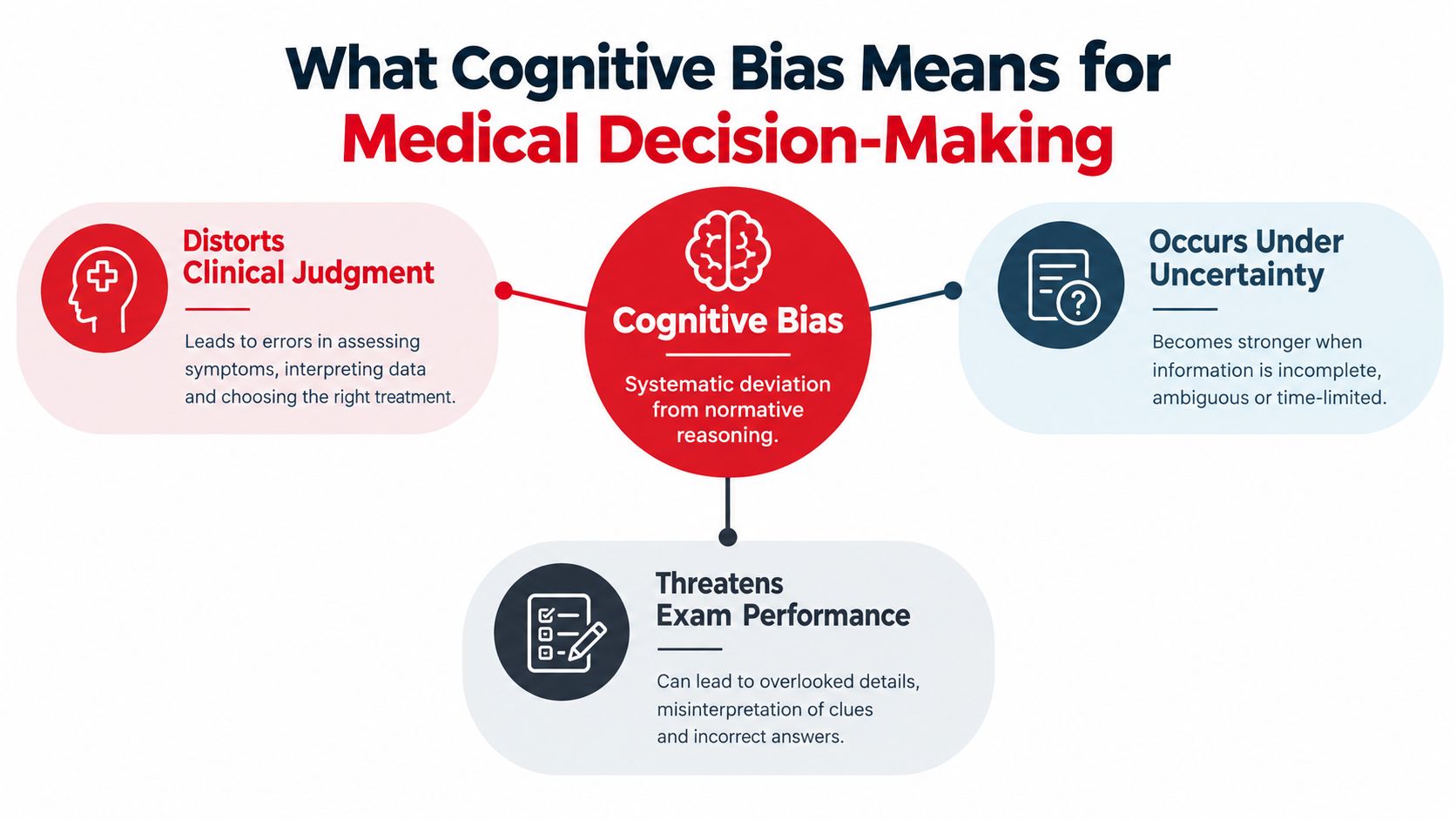
What Cognitive Bias Means for Medical Decision-Making
Cognitive bias is a predictable pattern of thinking that pulls judgment away from a more complete interpretation of the available evidence. In medicine, it becomes especially relevant when information is incomplete, time is limited, and several diagnoses could explain the same presentation.
A systematic review of 213 studies published from 1980 to 2013 identified 19 distinct bias types, with 68% of studies confirming at least one bias or heuristic. However, only 34% examined actual medical personnel, while 77% used hypothetical vignettes, which means the evidence base is substantial but often depends on simulated decision-making rather than direct observation of bedside behavior. The review is useful for students because it supports two conclusions at once: cognitive bias is measurable, and applying research findings to real clinical behavior remains difficult. The systematic review of cognitive biases in medical decision-making provides that important context.
Why bias matters on examinations
A medical vignette tests more than recall. You must identify the task, weigh the clues, estimate what is plausible, and decide whether a new finding should change your working diagnosis. A bias can interfere at any of those points.
Fast, pattern-based thinking is often called System 1. It lets you recognize familiar presentations quickly. System 2 is slower and more analytical. It checks assumptions, compares alternatives, and asks whether the evidence truly supports the initial impression. Cognitive bias often enters when a System 1 shortcut feels convincing enough that System 2 never properly reviews it.
Fatigue, time pressure, anxiety, and individual susceptibility can make that shortcut harder to detect. A learner who knows the definition of anchoring can still anchor on the first diagnosis in a long stem.
Practical rule: Don't ask only, “What diagnosis does this resemble?” Ask, “What new information would make my first diagnosis less likely?”
For exam preparation, use a four-part loop:
- Recognize the moment your reasoning narrows too quickly.
- Name the likely bias, such as anchoring or premature closure.
- Counter it with a deliberate question or comparison.
- Rehearse the correction in your error log and later retrieval sessions.
Students who want a broader framework can review clinical reasoning fundamentals and then apply the same process to practice questions. Cognitive-bias education shouldn't become a glossary exercise. Its value comes from changing what you do during the next unfamiliar vignette.
High-Yield Biases Every Medical Student Should Recognize
The following biases overlap, but they don't enter reasoning at the same point. That distinction matters. If you can identify the stage where the error begins, you can choose a more precise countermeasure.
Anchoring
Mechanism: You give excessive weight to the first impression and make insufficient adjustments when later evidence appears.
Trigger phrase: “The patient has a history of…”
Original vignette: A patient with chest pain had a previous myocardial infarction. The electrocardiogram shows nonspecific changes, but the learner anchors on the prior infarction and interprets the rest of the workup as another coronary event. New pleuritic pain, unilateral leg swelling, and unexplained tachycardia receive less attention than they should.
The bias enters during the initial problem representation. Before choosing an answer, restate the active findings without the emotionally salient history. A clinical review describes anchoring as disproportionate attention to an initial cue followed by insufficient adjustment, and recommends examining whether new information supports the provisional diagnosis. This review of anchoring bias in clinical reasoning explains the adjustment-and-insufficiency mechanism.
Confirmation bias
Mechanism: After forming a hypothesis, you seek or favor information that supports it and discount information that challenges it.
Trigger phrase: “I already know this is…”
Original vignette: A patient has fatigue, arthralgia, and a photosensitive rash. The learner decides on an autoimmune disease and focuses on ordering or interpreting an antinuclear antibody result while overlooking medication exposure, infection clues, or features that point elsewhere.
The bias enters during data selection and interpretation. On a question, deliberately identify one finding that supports your leading diagnosis and one that argues against it. If you can't name a disconfirming feature, you may be defending a conclusion rather than testing it.
Availability heuristic
Mechanism: A memorable or recent diagnosis feels more probable because it comes to mind easily.
Trigger phrase: “I just saw a case like this.”
Original vignette: After reviewing a recent Lyme disease case, a learner sees a patient with headache, fatigue, and a mild fever. The learner overweights Lyme disease and misses the significance of acute dyspnea, pleuritic chest pain, and risk factors for pulmonary embolism.
The bias enters during differential diagnosis generation. Ask whether the diagnosis is likely because of the actual stem or because a similar case is unusually available in memory. A vivid diagnosis deserves evaluation, not automatic priority.
Premature closure
Mechanism: You stop the diagnostic search after finding one plausible explanation.
Trigger phrase: “That explains everything.”
Original vignette: A patient with recurrent unilateral headaches, nausea, and photophobia appears to have migraine. The learner stops reading the pattern carefully and fails to respond to a sudden maximal-onset headache with neck stiffness, which should reopen the differential for subarachnoid hemorrhage.
The bias enters at differential closure. Before committing, identify the most dangerous alternative that the current findings could still support. This isn't a demand to list every possible diagnosis. It's a short pause to check whether a high-consequence alternative remains plausible.
Framing effect
Mechanism: Your judgment changes because the same information is presented positively, negatively, numerically, or comparatively.
Trigger phrase: “The prognosis is 90% survival” versus “The mortality is 10%.”
Original vignette: Two descriptions communicate the same outcome, but a learner feels more comfortable recommending an option described as having a high survival rate than one described as having a corresponding mortality rate. The underlying data haven't changed, but the presentation influences the decision.
The bias enters during risk interpretation. Translate the statement into a neutral format before choosing. On an exam, focus on the clinical outcome and the relevant population rather than the emotional tone of the wording.
Base-rate neglect
Mechanism: You overweight an individual test result or vivid feature and underweight the condition's pretest probability.
Trigger phrase: “The test is positive, so the patient has the disease.”
Original vignette: A positive stress test appears in a patient from a population where the target disease is uncommon. The learner treats the positive result as definitive without considering pretest probability, test characteristics, or the possibility of a false-positive result.
The bias enters during probability updating. Review the prior probability, sensitivity, specificity, and the question's clinical context before interpreting the result. An AHRQ PSNet review on diagnostic error and anchoring recommends explicitly considering base rates, sensitivity, and specificity while seeking information that could refute the provisional diagnosis. The AHRQ discussion of anchoring and diagnostic error offers a practical clinical reasoning safeguard.
These biases can also affect treatment decisions after diagnosis. A systematic review found that five of seven studies reported an association between cognitive biases and therapeutic or management errors, and another review found that overconfidence, anchoring, risk tolerance, and information or availability biases were linked to diagnostic inaccuracies across case scenarios. The systematic review of cognitive biases in medical decisions shows why students should review not only why an answer was wrong, but also where the reasoning process went off course.
Biases at a Glance with Practical Countermeasures
Use this table during question review. The trigger phrase is not a diagnosis. It's a signal that your reasoning may need a deliberate System 2 check.
| Bias | Mechanism | Trigger Phrase | Countermeasure |
|---|---|---|---|
| Anchoring | The first impression remains disproportionately influential. | “The patient has a history of…” | Restate the current findings without the initial anchor and reassess the differential. |
| Confirmation | You favor evidence that supports your existing hypothesis. | “I already know this is…” | Write one supporting clue and one disconfirming clue before committing. |
| Availability | A memorable or recent case feels more probable than it is. | “I just saw a case like this.” | Ask whether the stem supports the diagnosis independently of your recent memory. |
| Premature closure | You stop searching after finding one plausible explanation. | “That explains everything.” | Name one dangerous alternative and identify the finding that would support it. |
| Framing | Presentation style changes how you perceive the same information. | “The prognosis is…” | Convert the wording into neutral outcomes or comparable risks. |
| Base-rate neglect | You overweight a test or feature and underweight prior probability. | “The test is positive, so…” | Consider prevalence, test performance, and post-test probability. |
These countermeasures are deliberate overrides, not facts to memorize once. A learner who writes “anchoring” beside a missed question but never practices changing the next decision hasn't yet built the skill. Metacognitive awareness in medical learning can help you examine not only what you answered, but how you arrived there.
Keep the card short enough to use under time pressure. Your goal isn't to narrate an entire textbook chapter in your head. Your goal is to interrupt one predictable error at the point where it begins.
A Composite Case Vignette Showing Bias in Action
The following is a hypothetical composite vignette, written for educational practice and not taken from a live or recalled examination.
A 58-year-old man presents with chest discomfort and dyspnea. He mentions a vague history of a prior cardiac event, and an emergency department handoff describes him as having “recurrent cardiac-type pain.” His initial troponin is borderline. The learner sees the prior event, accepts the handoff label, and begins reasoning toward acute coronary syndrome.
Anchoring appears first. The history of a prior myocardial infarction becomes the organizing feature, even though the current presentation may not match it. Confirmation bias follows when the learner gives extra weight to the chest discomfort and borderline troponin while treating dyspnea and any atypical features as secondary.
Suppose the learner recently studied a pulmonary embolism case. Availability bias now pulls the reasoning in the opposite direction. The learner notices the dyspnea and begins to favor pulmonary embolism because that diagnosis is easy to retrieve, not because the complete evidence makes it most likely.
The learner then chooses a cardiac explanation and stops expanding the differential. That's premature closure. The handoff's wording has also framed the case as recurrent cardiac pain, so the learner interprets ambiguous findings within that label. Finally, if the stem includes abrupt severe pain, pulse asymmetry, or a new mediastinal abnormality, ignoring aortic dissection would illustrate base-rate neglect, because the learner is allowing a familiar cardiac narrative to outweigh a dangerous alternative supported by the current data.
The corrected reasoning sequence
Start again without the handoff label: an older adult has chest discomfort and dyspnea with an uncertain prior history and a borderline biomarker. The prior event is relevant, but it isn't the diagnosis.
Then use a structured reread:
- Separate current from historical data. Which findings belong to this episode?
- Identify the task. Is the question asking for the most likely diagnosis, the next step, or the best test?
- Generate competing categories. Consider cardiac, pulmonary, vascular, and other immediately dangerous causes.
- Check the strength of the evidence. A borderline result may not resolve the case by itself.
- Search for disconfirming clues. Look for findings that make the favored diagnosis less coherent.
- Re-read the stem once. Ask whether the answer still fits the full presentation rather than the first few lines.
A learner who wants to practice this kind of structured reasoning can use case-based medical learning as a format for explaining each decision point aloud. The aim isn't to eliminate fast thinking. It's to know when fast thinking needs a deliberate review.
Study Habits That Actually Reduce Bias on Practice Questions
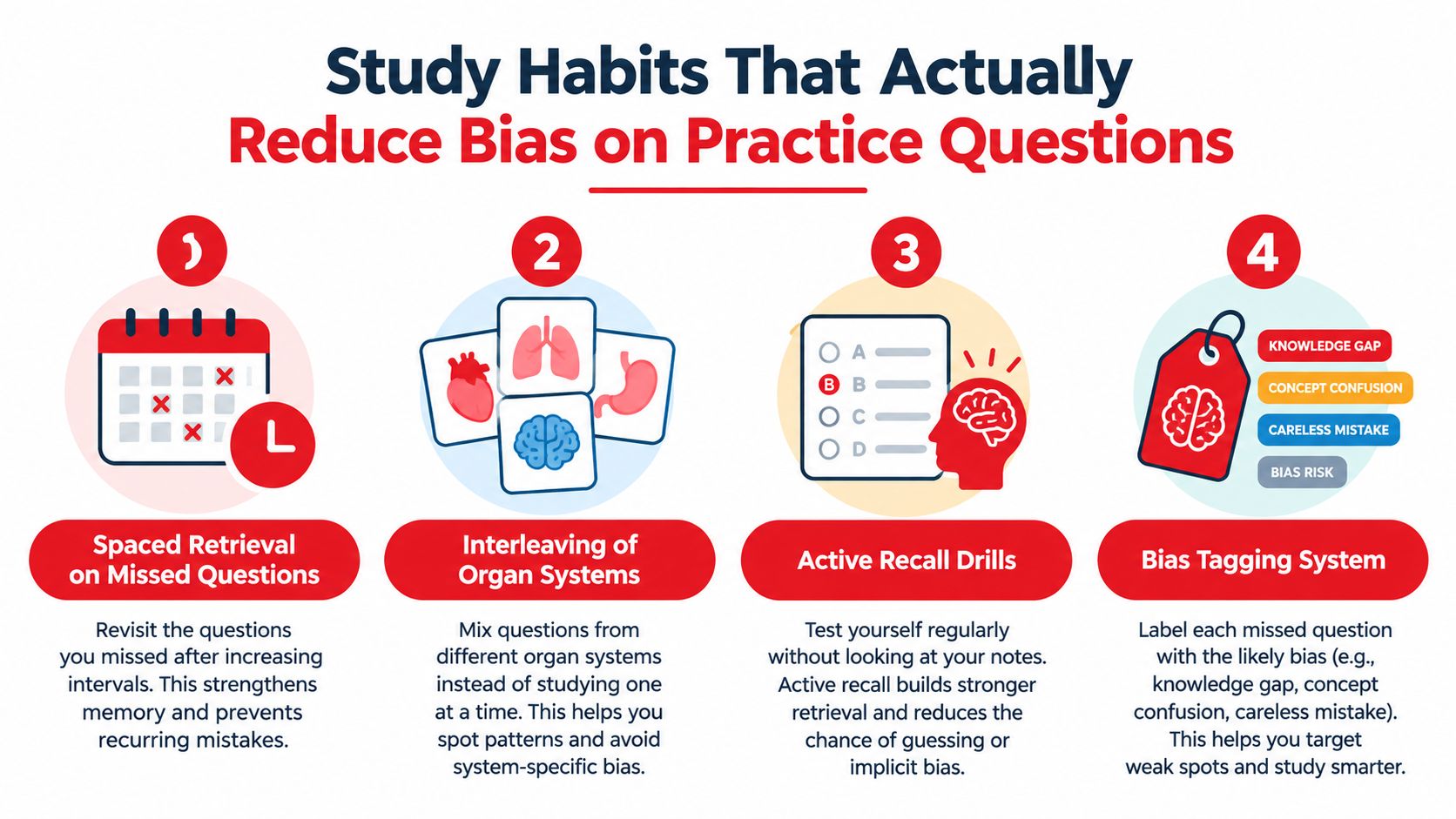
Bias reduction improves when it becomes a repeated study behavior rather than a list of definitions. Four mechanics are especially useful during a dedicated USMLE or COMLEX-USA block, and they can be adapted for Shelf preparation.
Spaced retrieval on missed questions
Return to a missed concept after a delay instead of rereading the explanation immediately and assuming it will stick. The retrieval attempt exposes whether you can reconstruct the reasoning without the original answer choices.
Countered failure mode: anchoring and premature closure.
Working test: Can you explain the diagnosis and the rejected alternative before opening your notes?
Interleaving organ systems
Mix organ systems and task types instead of grouping every similar question together. A cardiology-only block may make the pattern obvious, while a mixed set requires you to identify the problem before applying the content.
Countered failure mode: availability and pattern overreliance.
Working test: Can you identify the task and relevant system without using the order of your study materials as a clue?
Mixed unseen questions
Use unfamiliar questions after reviewing a topic. Repeating the same item can create recognition without transfer. An unseen question tests whether the correction survives a different presentation.
Countered failure mode: confirmation bias and framing.
Working test: Does your reasoning hold when the same concept is presented with different wording, distractors, or clinical context?
Explicit error tagging
After each missed or guessed question, record the cause. Possible tags include knowledge gap, anchoring, confirmation, availability, premature closure, framing, base-rate neglect, misread task, or pacing error.
Countered failure mode: unexamined repetition of the same mistake.
Working test: Does your error log show a specific next action, rather than only the correct answer?
A simple weekly cadence keeps the workload realistic:
| Day | Main task |
|---|---|
| Monday | Complete a new mixed block and tag every missed or uncertain item. |
| Tuesday | Retrieve Monday's errors without looking at explanations first. |
| Wednesday | Complete an interleaved set from different systems and task types. |
| Thursday | Revisit bias-tagged items and write one-sentence corrections. |
| Friday | Complete a mixed unseen set with deliberate bias prompts. |
| Saturday | Run a cumulative mini-test and review reasoning, not only content. |
| Sunday | Reflect on accuracy, retention, pacing, and workload, then adjust the next week. |
One-on-one guidance, a question bank, flashcards, and independent review can all play different roles. Distractor analysis for medical questions is useful when you need to explain why an attractive wrong answer gained your attention.
Don't use “learning styles” as a reason to match instruction to a preferred sensory mode. Choose representations that fit the material, and combine words with useful diagrams when a visual structure clarifies relationships. The better test is whether you can retrieve, explain, and transfer the idea to an unseen question.
Your Error Log and Weekly Retrieval Calendar
An error log should capture the reasoning task, not just the subject area. “Cardiology” tells you what content appeared. “Anchored on the prior diagnosis and ignored a disconfirming clue” tells you what to change.
Copy the following structure into Anki, Notion, or a plain spreadsheet:
| Date | Question Task | Error Type / Bias | What Went Wrong | Corrected Reasoning | Next Review Date | Transfer Test |
|---|---|---|---|---|---|---|
| Diagnosis, next step, mechanism, or management | Anchoring, confirmation, availability, premature closure, framing, base-rate neglect, knowledge gap, or misread | Identify the exact reasoning step that failed | Write one sentence that would have prevented the error | 1, 3, 7, or 14 days later | Write a new prompt that changes the presentation but tests the same reasoning |
The correction should be behavioral. “Review pulmonary embolism” is too broad. “Before accepting a cardiac diagnosis, compare the current symptoms with the prior event and identify one finding that argues against recurrence” gives you a repeatable action.
A reusable Monday-through-Sunday calendar
- Monday, new block: Complete a mixed question set. Log every incorrect, guessed, or changed answer.
- Tuesday, bias-tag review: Retrieve the logged cases from memory. State the bias and corrected reasoning aloud.
- Wednesday, interleaved set: Mix organ systems and question tasks. Avoid studying only the bias you saw Monday.
- Thursday, second-pass retrieval: Reconstruct the explanations without reopening the source until after your attempt.
- Friday, weak-bias drill: Select the bias that recurred most often and write several original prompts that would expose it.
- Saturday, cumulative mini-test: Use unseen questions and track accuracy, retention, pacing, and workload.
- Sunday, reflection: Review the log, select the next week's focus, and schedule tagged items for 1, 3, 7, and 14 days after the initial error.
The spacing interval matters less than keeping the appointments visible and repeatable. A digital dashboard such as a progress-tracking system can organize the data, but a spreadsheet works if it contains the same fields.
Review standard: Every missed question should produce one bias label, one corrected reasoning sentence, and one transfer prompt.
Key Takeaways for USMLE, COMLEX, and Shelf Prep
Cognitive bias is not a character flaw or proof that you lack clinical ability. It is a predictable vulnerability in reasoning under uncertainty, and structured practice can improve recognition. In one educational study, preclinical medical students scored 41%, near a 42% chance level, on an inventory of cognitive biases, while practicing physicians scored 49%. A targeted seminar improved preclinical students' performance to 55% versus 41% among peers without the intervention, with p<0.001. The study of bias recognition in medical students and physicians supports a balanced message: expertise helps, but it doesn't remove susceptibility, and instruction can improve performance on bias-sensitive tasks.
Keep these definitions available during review:
- Anchoring: Staying too close to the first impression.
- Availability: Overweighting a memorable or recent example.
- Confirmation: Seeking evidence that supports an existing hypothesis.
- Framing: Reacting differently to equivalent information presented in different ways.
- Overconfidence: Giving too much trust to the accuracy of your own judgment.
- Premature closure: Ending the search after finding one plausible explanation.
- Status quo bias: Preferring the current assumption or plan because changing it requires reconsideration.
Use the system in three steps:
- Tag missed questions by cause. Record the specific bias or reasoning failure.
- Schedule spaced review. Revisit the corrected reasoning on a fixed cadence rather than relying on recognition.
- Practice on mixed unseen questions. Test whether the correction transfers to a new stem.
Read explanations for the trap, not only for the correct answer. Then write one sentence describing what you should have done differently. That sentence turns a vague regret into a retrieval cue.
A recent scoping review of technological debiasing identified 100 interventions across 91 biases, with 80% of the identified strategies reported as effective, while also noting that the evidence was uneven and concentrated more heavily on information-design interventions than on group-structure or procedural approaches. A separate review reported that a brief 30 to 60 minute training session could produce measurable reductions lasting at least 2 to 3 months, although the durability and practical transfer of interventions remain important questions. The review of technological debiasing interventions is a useful reminder to evaluate a method by whether it changes repeated decisions, not by whether the label sounds familiar.
Consistency over weeks is more useful than a single intense review session. Apply the same error-log habit across Step 1, Step 2 Clinical Knowledge, COMLEX-USA Level 1, COMLEX-USA Level 2, and clerkship Shelf questions, while keeping each exam's official blueprint and question style distinct. This is examination education, not individualized medical advice, and no study system can promise a particular score or outcome.
If you want structured help applying bias tagging, retrieval practice, and question analysis to your USMLE, COMLEX-USA, or Shelf preparation, Ace Med Boards offers online tutoring and test-preparation support with individualized study planning. You can review your current approach and decide whether a free consultation fits your needs, without treating tutoring as a replacement for official exam guidance or independent practice.