USMLE Step 3 is the final two-day licensing exam required for unrestricted medical licensure in the United States, testing whether you can apply medical knowledge and biomedical science independently in the context of unsupervised practice. Day 1 includes up to 232 multiple-choice items in 12 blocks, while Day 2 includes up to 180 multiple-choice items in 9 blocks plus 13 to 14 computer-based case simulations.
If your preparation still looks like Step 2 CK review, you may be working on the wrong skill. Can you explain a diagnosis, or can you decide what to do next, follow a patient over time, recognize risk, communicate safely, and manage uncertainty? Step 3 rewards the second ability.
The exam can feel intimidating because it comes during residency, credentialing, relocation, or a demanding transition in your medical career. A systematic plan makes the task more manageable. You need to understand the rules, practice the decision-making format, review errors precisely, and build enough stamina for both testing days.
What Is USMLE Step 3 and Why It Matters
The United States Medical Licensing Examination, or USMLE, Step 3 evaluates whether a physician can use biomedical and clinical knowledge in the setting of independent practice. It is not just a longer recall test. The exam asks you to integrate diagnosis, treatment, prevention, prognosis, patient safety, and systems-based decisions across common clinical situations. The official Step 3 content description describes the exam as a clinical management assessment that uses one-best-answer questions, patient scenarios, drug advertisements, and abstracts.
Step 3 is generally taken after the earlier licensing milestones. Applicants must have passed Step 1 and Step 2 Clinical Knowledge, or Step 2 CK, and must hold an eligible MD, DO, or international equivalent degree. International medical graduates also need the required Educational Commission for Foreign Medical Graduates, or ECFMG, Certification and an eligible medical-school credential. The USMLE eligibility requirements should be checked before registration because documentation and administrative rules can change.
The shift from knowledge to management
Step 2 CK often asks you to identify the most likely diagnosis or the next best step in a defined clinical encounter. Step 3 still tests those foundations, but it adds a broader question: Can you manage the patient as the situation evolves?
That means you should practice decisions such as:
- Prioritization: Which problem requires action first?
- Treatment selection: What intervention fits the patient's current status?
- Follow-up: What result, response, or complication changes your plan?
- Disposition: Is outpatient care, admission, transfer, or consultation appropriate?
- Prevention and safety: What reduces future risk or protects the patient?
Passing Step 3 matters because it represents a major licensing threshold before unrestricted practice in many state systems. It doesn't define your value as a physician, and a difficult score or unsuccessful attempt can be analyzed and addressed. Your score report, preparation history, and clinical context can help you build a more focused plan. For a score-focused explanation, review this USMLE Step 3 score guide.
Practical rule: Study each missed question by asking, “What decision was the test asking me to make?” before asking which fact you forgot.
Detailed USMLE Step 3 Exam Structure and Format
Step 3 is administered over two days. The official 2026 structure gives Day 1 up to 232 multiple-choice items in 12 blocks, with approximately 7 hours of testing time and 55 minutes of break time. Day 2 gives you up to 180 multiple-choice items in 9 blocks, followed by 13 to 14 computer-based case simulations, or CCS, with approximately 9 hours of testing time and at least 45 minutes of break time. These details are provided in the official Step 3 exam content and format information.
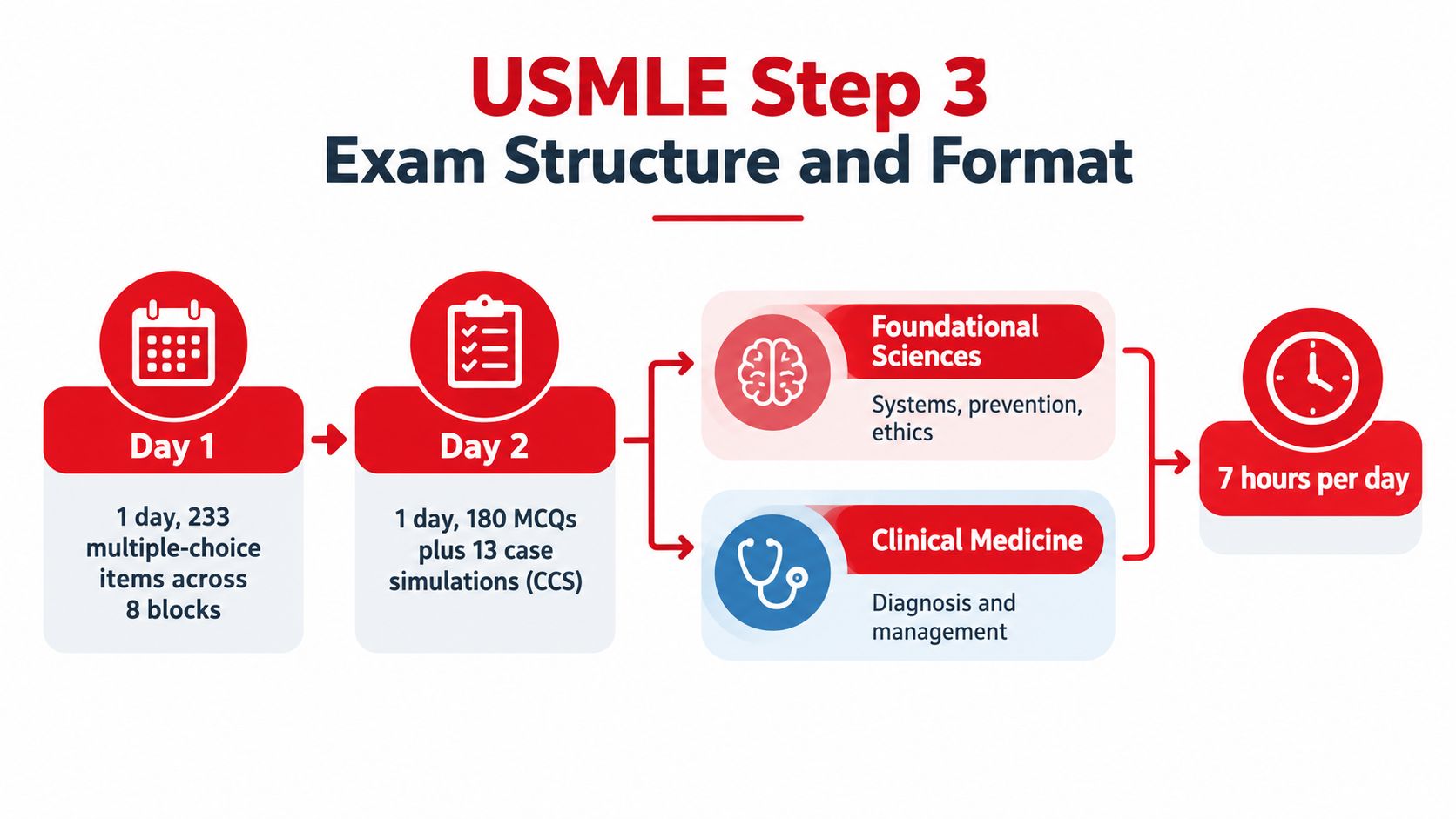
USMLE Step 3 Exam Schedule Overview
| Day | Question Type | Number of Blocks | Total Time |
|---|---|---|---|
| Day 1 | Multiple-choice items | 12 | About 7 hours |
| Day 2 | Multiple-choice items followed by CCS | 9 MCQ blocks plus 13 to 14 simulations | About 9 hours |
The content matters as much as the clock. Day 1 includes foundational material, including biomedical science, biostatistics, ethics, and interpretation of clinical information. Day 2 emphasizes advanced clinical medicine, where you must combine findings, choose management, and respond to changing patient conditions.
The official outline also assigns meaningful attention to categories that many candidates underprepare. Patient Care: Management represents 32 to 35%, Prognosis/Outcome represents 8 to 11%, and Communication/Professionalism/Systems-based Practice and Patient Safety represents 7 to 9% of the content outline, according to the official Step 3 materials. Those categories explain why diagnosis-only review leaves a gap.
How the format changes your preparation
For multiple-choice questions, read the task before diving into every detail. “Most likely diagnosis,” “next best step,” “best initial therapy,” and “best follow-up” require different reasoning. For CCS, the interface adds actions, timing, reassessment, and disposition.
Review the Step 3 practice test resources as part of your preparation plan, but use official sample materials to learn the exam interface and expectations. Practice should reproduce the mental sequence of clinical care, not just the sensation of answering questions quickly.
High-Yield Topics and Question Types
The most useful distinction in Step 3 preparation is memorizing medicine versus managing patients. Memorization still supports performance, but isolated fact collection doesn't teach you when to act, what to monitor, or how a patient's prognosis changes after an intervention.
The content outline places management, outcome prediction, communication, professionalism, systems-based practice, and patient safety alongside diagnosis. That distribution favors candidates who can translate information into a plan. A patient with a known condition may still generate a difficult question if the actual issue is treatment urgency, contraindication, follow-up, counseling, or escalation.

Compare the two study modes
| Rote-focused preparation | Clinical-application preparation |
|---|---|
| Recalls disease features | Connects findings to an illness script |
| Asks, “What is the diagnosis?” | Asks, “What decision is required now?” |
| Reviews the correct answer only | Examines why alternatives fail |
| Treats each question as isolated | Transfers the reasoning to a new patient frame |
| Underuses prognosis and safety | Includes monitoring, follow-up, and disposition |
One-best-answer items remain central, but Step 3 also uses drug advertisements and abstracts. These formats test whether you can interpret evidence and apply it to a clinical decision. Biostatistics preparation should therefore focus on recognizing the question task, identifying the study design or measure, and calculating or interpreting only what the prompt requires. This biostatistics resource for USMLE Step 3 can fit into a targeted review block.
CCS cases add a different demand. You aren't selecting one answer and leaving the patient. You're expected to order appropriate evaluations, begin management, reassess the response, and decide what happens next in a simulated clinical timeline.
Watch the following educational video only as a supplement to official materials and interface practice:
A useful content filter is simple: for every disease you review, write the diagnosis, immediate management, major complication, expected course, preventive intervention, and disposition. That method turns a list of conditions into a patient-management map.
Vignette Decision Worksheet for CCS
CCS can feel unfamiliar because it tests sequencing and follow-through, not just recognition. Use the following original worksheet after each case or vignette. It isn't an official exam form, and it doesn't reproduce recalled content.
The decision worksheet
- Patient frame: Identify age group, setting, acuity, relevant history, and the central problem. Write one sentence that summarizes the case.
- Task: State what the case requires now. Is the priority stabilization, diagnosis, treatment, monitoring, counseling, or disposition?
- Decisive positives and negatives: Separate findings that change management from background details. Record one or two findings that argue against the leading alternative.
- Mechanism or illness script: Connect the presentation to a short causal model. For example, identify the process causing instability, obstruction, infection, ischemia, or medication toxicity.
- Best answer: Choose the immediate action or order that addresses the highest-risk problem. In CCS, translate that decision into the appropriate order or intervention.
- Distractor autopsy: For each tempting alternative, write why it is premature, unsafe, incomplete, or aimed at the wrong task.
- Transfer rule: Finish with a reusable rule. Example: “When a patient has progressive instability, stabilize first, then refine the diagnosis.”
During case practice, add reassessment to the worksheet. Ask what result should improve, what finding would trigger escalation, and what would justify discharge or follow-up. The Ace Med Boards Step 3 CCS cases guide can serve as a supplemental explanation of the case format.
For a hypothetical example, a patient with worsening shortness of breath may require immediate stabilization rather than an extended diagnostic workup. The worksheet forces you to name the immediate task, distinguish decisive findings from distracting history, select an action, and define what you'll do if the patient doesn't improve.
Step 3 Study Schedules and Resource Strategy
A useful schedule begins with a baseline assessment, not with an arbitrary question quota. Use the result to decide whether your main need is broad review, management reasoning, CCS mechanics, biostatistics, or pacing. The current passing standard is 200, and the official guidance says examinees typically need to answer roughly 60% of questions correctly, but there is no fixed pass-fail percentage because performance varies by form and cohort. See the official USMLE scoring guidance before interpreting any practice result.
A flexible planning framework
| Starting position | First priority | Daily study emphasis | Readiness signal |
|---|---|---|---|
| Strong recent clinical foundation | Mixed management questions | Review reasoning, not just answers | Errors become narrow and explainable |
| Uneven foundation or long gap | Rebuild common clinical scripts | Focused content plus targeted questions | Repeated weaknesses begin to stabilize |
| Limited time during residency | High-yield error correction | Short timed blocks and CCS workflow | You can sustain decisions without rushing |
| Borderline or failed attempt | Formal score and error audit | Remediate the specific failure pattern | New mixed practice confirms transfer |
A practical weekly rhythm can combine mixed questions, focused remediation, CCS interface practice, and one review session for ethics, biostatistics, and systems-based decisions. Don't measure progress only by completed items. A thoroughly reviewed question can expose a task error, evidence error, illness-script gap, or pacing problem that several shallow reviews would miss.
Resource selection
Use official USMLE sample questions and interactive tools to understand the test environment. Use an established question bank for repeated clinical reasoning practice, but treat its content as proprietary. Never copy or circulate question-bank stems, answer choices, explanations, or recalled exam material. NBME official assessment materials can provide an additional external checkpoint, while your own error log shows why you missed questions.
If your schedule is compressed, reduce resource switching. Choose one main question source, one CCS practice environment, official materials, and a review system you'll revisit. The Step 3 study schedule can help you adapt that structure to your available time.
How Targeted Tutoring Supports Step 3 Prep
Targeted tutoring works best when it identifies why an error occurred. A learner who knows the disease but misses the task needs a different intervention from a learner who cannot recognize the illness script. More questions alone won't reliably correct either problem.
A structured tutoring workflow can look like this:
- Start with the official content outline and sample interface.
- Take a baseline assessment.
- Tag each error as knowledge, illness-script, question-task, evidence, or pacing.
- Remediate the narrow cause with focused teaching and original practice.
- Retest on unseen mixed blocks.
- For a failed or borderline attempt, complete a formal readiness review plus an eligibility and timing check.

For CCS, the same process applies. A tutor can ask you to narrate the patient frame, identify the immediate task, state decisive positives and negatives, select the management action, explain why alternatives are weaker, and write a transfer rule. That makes your reasoning visible and gives the next practice case a specific purpose.
Ace Med Boards offers private USMLE Step 3 tutoring that can be used alongside official materials, independent question practice, and CCS preparation. Tutoring should complement those resources, not replace them, and no preparation service can promise a particular score or outcome.
Common Pitfalls and Exam-Day Logistics
The assumption that Step 3 is only a knowledge test creates several avoidable problems. Candidates may spend too much time rereading basic facts, neglect management and prognosis, or delay CCS practice until the end. A better approach treats every study session as a rehearsal for independent clinical decisions.
Administrative checks for 2026
The registration pathway changed during the January 2026 service transition. U.S. MD and DO students and graduates register through NBME, while eligible international graduates register through FSMB, subject to the applicable requirements. Confirm your pathway and documentation in the 2026 USMLE Bulletin and Addendum before submitting an application.
Step 3 is administered only in the United States, which affects international and traveling examinees. Build travel, scheduling, eligibility-period, and document checks into your plan rather than treating them as last-minute details. Policies can change, so the official registration entities and USMLE publications should control your decisions.
A final readiness checklist
- Clinical management: You can explain why an intervention is appropriate now, not merely name a diagnosis.
- Question tasks: You distinguish diagnosis, next step, treatment, prognosis, prevention, and follow-up prompts.
- Error log: You can identify the cause of recurring errors and the remediation that addresses it.
- CCS workflow: You can move from patient frame to orders, reassessment, and disposition without guessing at the interface.
- Stamina: You have practiced timed blocks and planned breaks for both days.
- Eligibility: Your Step 1, Step 2 CK, degree, ECFMG, and registration requirements are confirmed through the appropriate official pathway.
Manage stress with concrete routines. Sleep, meals, breaks, and a written test-day plan won't replace preparation, but they reduce unnecessary decision load. If you've failed before, treat the result as information about performance under a specific exam format, not as a verdict on your future. A careful score audit and readiness review can show what to change.
Educational content about Step 3 is for examination preparation, not individualized medical advice or patient treatment. Use official USMLE materials for current rules and consult your program or licensing authority for requirements that apply to your circumstances.
If you want structured help shifting from memorization to patient-management reasoning, Ace Med Boards offers individualized USMLE Step 3 tutoring with error tagging, focused remediation, and CCS decision practice. You can review your preparation needs in a free consultation before deciding whether tutoring fits your schedule.