
The first Monday of a clerkship can leave a student with a packed schedule, unfamiliar expectations, and a UWorld tab open beside a stack of textbooks. UWorld for Shelf exams works best as the main clinical question bank, organized around the active rotation and paired with deliberate review and official practice assessments. It isn't a complete clerkship syllabus, and finishing it doesn't establish readiness by itself.
Byline: Ace Med Boards Editorial Team
Product and examination details reflect the cited materials available as of October 2026. Students should confirm their school's assigned examination, current product interface, and applicable testing arrangements before building a schedule.
Why UWorld Earns a Central Spot in Shelf Prep
The strongest reason to make UWorld central to Shelf preparation isn't its reputation. It's the opportunity to practice interpreting clinical information, choosing between plausible alternatives, and defending a decision repeatedly throughout a rotation.
A student can read a chapter and recognize its terminology without being able to distinguish competing diagnoses in a vignette. Question-based work makes that gap visible. The useful output isn't merely a correct answer, but a clearer understanding of which finding changes the decision.
What the QBank should accomplish
A productive question session serves several purposes:
- Expose missing knowledge. An unfamiliar concept becomes a specific study task rather than a reason to reread an entire textbook.
- Challenge reasoning. Plausible distractors force the student to distinguish between recognizing a diagnosis and selecting the requested action.
- Connect classroom knowledge with clinical exposure. A topic encountered during clerkship learning becomes an opportunity for focused examination review.
- Generate feedback. Missed and uncertain answers identify what the next study session should address.
This makes the QBank a retrieval and reasoning tool, not a checklist of material that automatically becomes mastered once viewed.
Practical rule: A completed question earns its place in the study plan only when the student can explain the decision it tested.
What it cannot establish alone
Students shouldn't assume that multiple-choice practice covers every aspect of clinical reasoning. The NBME community report on assessment development describes validity work on SHARP, a short-answer format requiring a rationale, alongside separate work on communication assessment. That doesn't establish that these formats have replaced ordinary Shelf examinations; it does reinforce the distinction between choosing an answer and explaining a judgment.
Key Takeaways
- Start with the active clerkship. Broad clinical review belongs in a different phase of preparation.
- Preserve review quality. Volume without explanation produces an incomplete picture of learning.
- Use an external benchmark. Official materials help calibrate preparation to the assigned subject.
- Add targeted support when needed. Persistent reasoning problems deserve focused intervention, not indiscriminate extra questions.
A student starting behind doesn't need an elaborate resource collection. A manageable question routine, a clear review method, and a realistic feedback checkpoint are a stronger starting point.
Choosing the Right Mode Inside the QBank
Shelf Review should be the default content selection during an active clerkship. Step 2 CK Review serves a broader licensing-examination purpose and shouldn't displace rotation-specific preparation because both options appear inside the same subscription.
UWorld's Step 2 Clinical Knowledge (CK) question bank contains more than 4,250 clinically focused questions and separates content into Shelf Review and Step 2 CK Review. Its Shelf categories include ambulatory medicine, clinical neurology, emergency medicine, family medicine, internal medicine, obstetrics and gynecology, pediatrics, psychiatry, and surgery, according to the official UWorld Step 2 CK product page.
Shelf Review vs Step 2 CK Review
| Feature | Shelf Review | Step 2 CK Review |
|---|---|---|
| Immediate purpose | Preparation aligned with the active clerkship | Broader preparation for Step 2 CK |
| Content selection | Select the corresponding Shelf category | Select content for cumulative clinical review |
| Recommended use | Primary question pool during the rotation | Main review pool during the later licensing-exam phase |
| Mixing strategy | Mix topics within the selected discipline | Mix clinical content across disciplines |
| Main caution | Familiarity with one subject isn't overall board readiness | Broad blocks can crowd out the current Shelf subject |
Content selection and testing conditions are separate decisions. Selecting Surgery determines the relevant pool; choosing timed or explanation-led work determines how the student practices.
Learning mode versus testing mode
For an unfamiliar topic, Tutor Mode can support an explanation-led learning session. That session should be treated as instruction, not as a clean measure of independent performance.
For routine first-pass work, the stronger default is a timed block completed without consulting explanations until the block ends. Block size should match the protected study window and leave enough time for review. A smaller block reviewed thoroughly is preferable to a larger block abandoned after checking the score.
Most core clinical Shelf examinations contain 110 questions in 2 hours 45 minutes, approximately 90 seconds per question, according to the NBME subject-examination timing chart. Other examinations and approved accommodations can differ, so pacing practice should match the assigned format.
Early topic-focused blocks can help address a defined weakness. As the rotation progresses, the student should mix topics within the clerkship category so the filter no longer supplies the likely diagnostic domain.
Mapping Each Clerkship to a Realistic QBank Plan
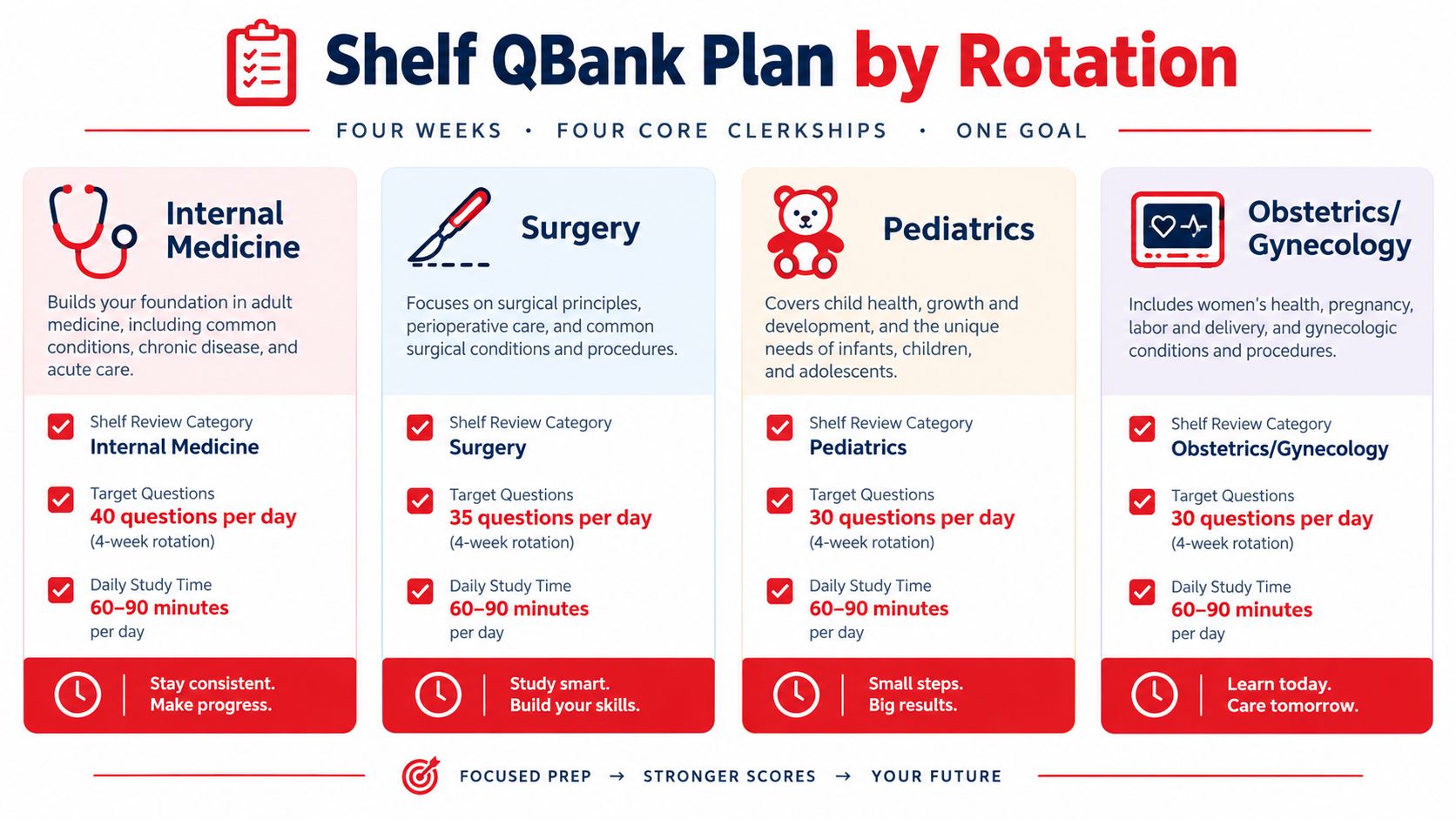
A workable question target comes from the current category count and available study sessions, not a fixed daily quota copied from another student. Rotation length, call responsibilities, commuting, and school assignments all affect what can be reviewed.
The planning calculation is straightforward: divide the remaining unique questions in the relevant category by the protected new-question sessions available before the final review period. The resulting block size is a starting target, not a requirement to sacrifice sleep or skip explanations.
The visual below offers an example planning layout. Its daily quotas are illustrative, not verified category counts or evidence-based minimums, and its time allowance should be adjusted when explanations require longer review.
Clerkship QBank Targets
| Clerkship | UWorld category | Suggested block plan | NBME practice timing |
|---|---|---|---|
| Internal Medicine | Internal medicine | Distribute unique questions across protected sessions; use focused remediation between mixed blocks | After broad initial coverage, while remediation time remains |
| Surgery | Surgery | Use shorter sessions on demanding operative days and protected catch-up sessions elsewhere | Before the final review period |
| Pediatrics | Pediatrics | Maintain steady category coverage rather than studying only topics seen clinically | After an initial pass through the major outline areas |
| Obstetrics and Gynecology | Obstetrics and gynecology | Alternate focused learning with mixed category blocks | Early enough to revisit weak areas before the exam |
| Psychiatry | Psychiatry | Keep regular question sessions even when the category feels familiar | Before committing to a final review strategy |
| Neurology | Clinical neurology | Use targeted blocks for identified gaps, then return to mixed practice | While additional reasoning practice is still possible |
| Family Medicine | Family medicine | Follow the school's assigned examination and content expectations | After sufficient breadth for meaningful feedback |
Build around the rotation, not an ideal calendar
Each clerkship needs a different distribution of effort, even when the underlying study method stays the same. A student with unpredictable surgical hours may need shorter weekday sessions; a student with more predictable outpatient hours may protect a consistent evening block.
The weekly plan should include:
- Protected sessions. Count genuine study opportunities rather than every calendar day.
- A buffer. Leave room for missed evenings, required assignments, and unexpectedly difficult reviews.
- An assessment checkpoint. Schedule feedback before the remaining calendar becomes too crowded to act on it.
- An adjustment rule. If the review backlog grows, reduce new-question volume before abandoning review.
The medical student clerkship planning guide provides related context for organizing the clinical year. The central recommendation remains simple: each rotation should have its own filtered pool, feasible workload, and feedback date.
A Daily and Week-by-Week Workflow
A rotation schedule needs a default day and a fallback day. Without a fallback, a late dismissal can turn a manageable interruption into an accumulating backlog.
An illustrative default is 60 to 90 minutes of daily UWorld work, divided between a shorter question session and a longer review session. This is a scheduling recommendation, not a proven minimum or a guarantee that a particular block will fit. New material may require substantially more explanation time.

A realistic rotation week
| Part of the week | Main task | Fallback when clinical work expands |
|---|---|---|
| Start of the week | Set the category, workload, and protected sessions | Preserve the next available session rather than doubling every later assignment |
| Ordinary weekday | Complete new questions, then review the block | Reduce the block and finish its review |
| Heavy clinical day | Review an existing error set | Keep the session short and avoid opening an unreviewable block |
| Lighter day | Complete delayed work and inspect recurring errors | Prioritize the oldest unresolved concepts |
| Weekend | Revisit weak areas and prepare the next week | Protect recovery rather than planning an exhausting catch-up marathon |
The first pass should generally be timed and forward-only, with no explanation checks during the block. The second pass should concentrate on incorrect, guessed, and low-confidence items in Tutor Mode, where the student can investigate the reasoning without treating speed as the objective.
A second pass through already-comfortable material isn't the priority while unresolved questions remain. Repeated exposure should have a purpose.
The final stretch
An illustrative two-week endgame should shift attention toward mixed timed blocks within the clerkship, unresolved errors, and a complete official practice assessment under its stated conditions. The assessment needs enough distance from the actual examination for the student to investigate the results.
The final days shouldn't become a contest to raise the completion percentage. They should consolidate material already identified as consequential and protect a workable sleep schedule.
For calendar design, the medical student study-schedule guide offers related planning support. General student time management strategies from Tinymoose can also help with organizing protected study periods, although they aren't an authority on examination preparation or scoring.
A sustainable fallback session is more useful than an ambitious schedule that stops working after a difficult clinical day.
Active Review of Missed and Guessed Questions
A correct answer chosen by guessing belongs in the review queue. Recognition can produce the right selection without a durable explanation, and the score alone won't distinguish the two.
Active review begins with the student's reasoning before the explanation is reread. The student should identify what seemed decisive, what was overlooked, and why the chosen alternative appeared reasonable. That reconstruction makes the explanation easier to use selectively.
The compact error note
Each missed or uncertain item should generate a concise record:
| Component | What the student records |
|---|---|
| Underlying diagnosis or concept | The central problem being assessed |
| Discriminating clue | The finding that separates the correct interpretation from the nearest alternative |
| Requested decision | The diagnosis, investigation, management step, or other judgment the question actually asked for |
| Error type | Knowledge gap, misread stem, premature closure, or management-sequence error |
For questions that don't ask about diagnosis or management, the same structure can be adapted to the relevant ethical, epidemiologic, or communication principle. The note should capture the decision rule rather than reproduce copyrighted question-bank wording.
Review should cover every option, but not every sentence deserves a flashcard. The student needs to understand why the distractors fail and preserve only the distinction likely to matter again.
Turn the note into retrieval
The next encounter with the note should start with an attempt to answer from memory. The student can hide the explanation, state the decisive clue, and reconstruct the requested decision before checking the record.
Revisit the concept in later sessions, separated by time, and then test it in fresh practice where possible. Rereading the same explanation repeatedly isn't equivalent to retrieving the reasoning independently.
The medical-student Shelf preparation study also supports caution about prescribing any single self-reported strategy as a reliable predictor of performance. The recommendation here is an actionable review method, not a claim that this particular note format guarantees a score increase.
The guide to reviewing UWorld questions faster complements this approach. Faster review should mean removing transcription and repetition, not skipping the reasoning that caused the error.
Review standard: A concept leaves the active queue when the student can explain it without borrowing the explanation's wording.
Layering NBME Practice and Tutoring on Top of the QBank
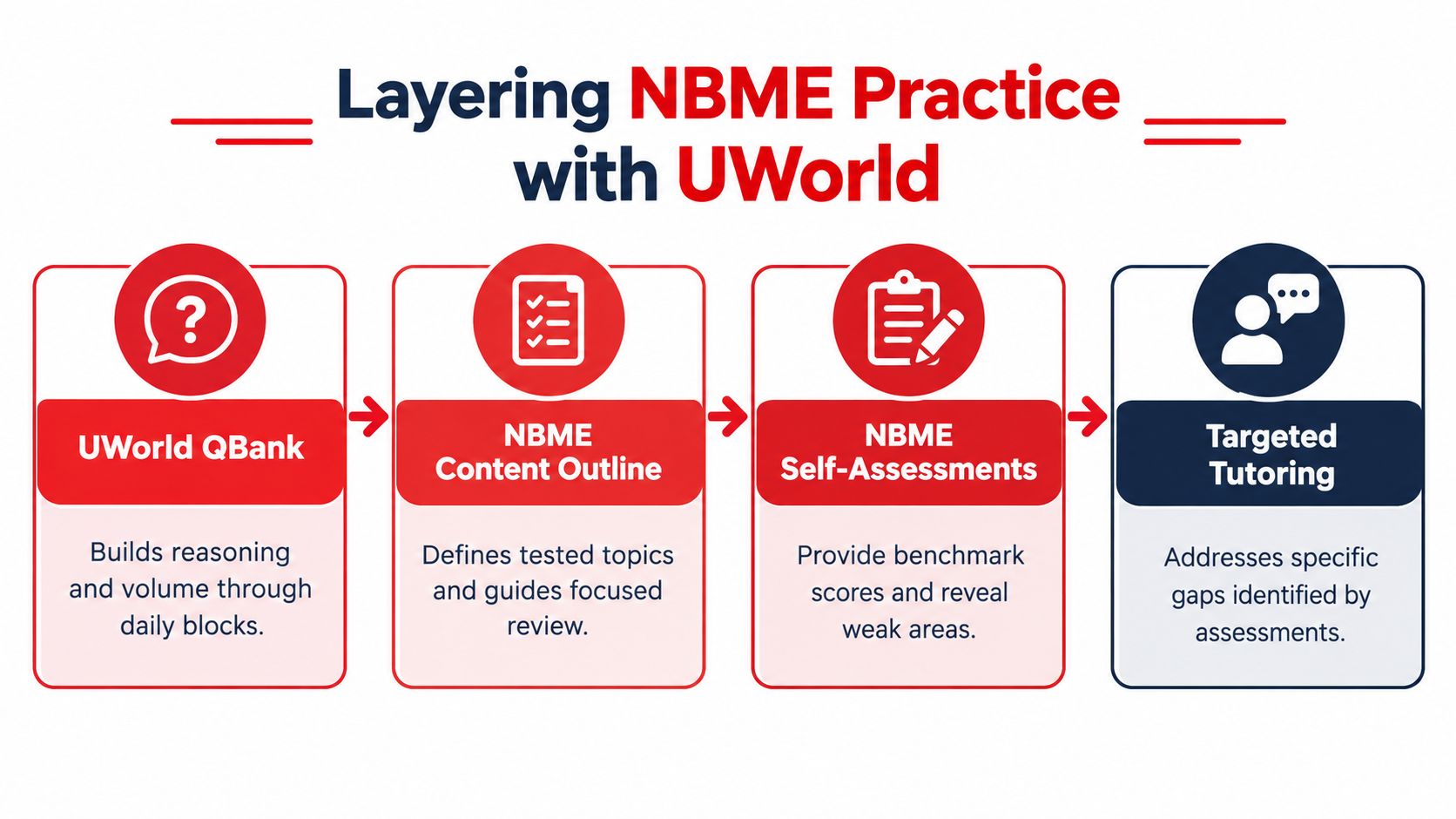
UWorld, official content materials, and self-assessments should answer different questions. Using them well means assigning each a role instead of treating them as interchangeable sources of additional questions.
The National Board of Medical Examiners (NBME) describes Subject Examinations as assessments following courses, clerkships, or instructional units, with expert-developed content outlines used to construct the tests. The NBME Subject Examination Information Guide supports aligning preparation with the actual subject rather than assuming broad licensing-exam review is an adequate substitute.
Assign each resource a distinct job
- UWorld provides practice and feedback. Blocks expose the student's approach to unfamiliar clinical problems.
- The official outline defines coverage. It helps identify areas underrepresented in the student's clinical exposure or chosen study topics.
- Official sample items clarify expectations. They provide direct examples from the examination organization without relying on recalled content.
- A self-assessment supplies an external checkpoint. Its results should inform the remaining plan rather than merely decorate a spreadsheet.
After an assessment, the student should compare weak areas with the QBank error log. A shared weakness deserves immediate attention; a discrepancy deserves investigation into content coverage, timing, confidence, or question interpretation.
A strong Shelf-mode percentage isn't a formal prediction of United States Medical Licensing Examination (USMLE) readiness. During the transition to Step 2 CK, the student should carry forward unresolved concepts and error patterns, then broaden practice across disciplines rather than repeatedly rehearsing only the strongest clerkship.
When targeted tutoring makes sense
A recurring reasoning failure needs a different intervention from a missing fact. Diagnostic uncertainty may benefit from oral comparison of alternatives; premature closure may require explaining what would disprove the leading choice; sequencing errors may need a verbal reconstruction of the decision pathway.
One-on-one tutoring should complement independent study and official materials, not replace them. Its useful role is to examine the student's reasoning, identify the recurring failure, and assign focused practice that addresses it.
The NBME practice Shelf exam guide provides related assessment-planning guidance. Students considering additional support can review selected Shelf exam tutoring services with a specific error pattern in mind rather than a vague request for more content.
Pitfalls, Metrics, and a Final Readiness Check
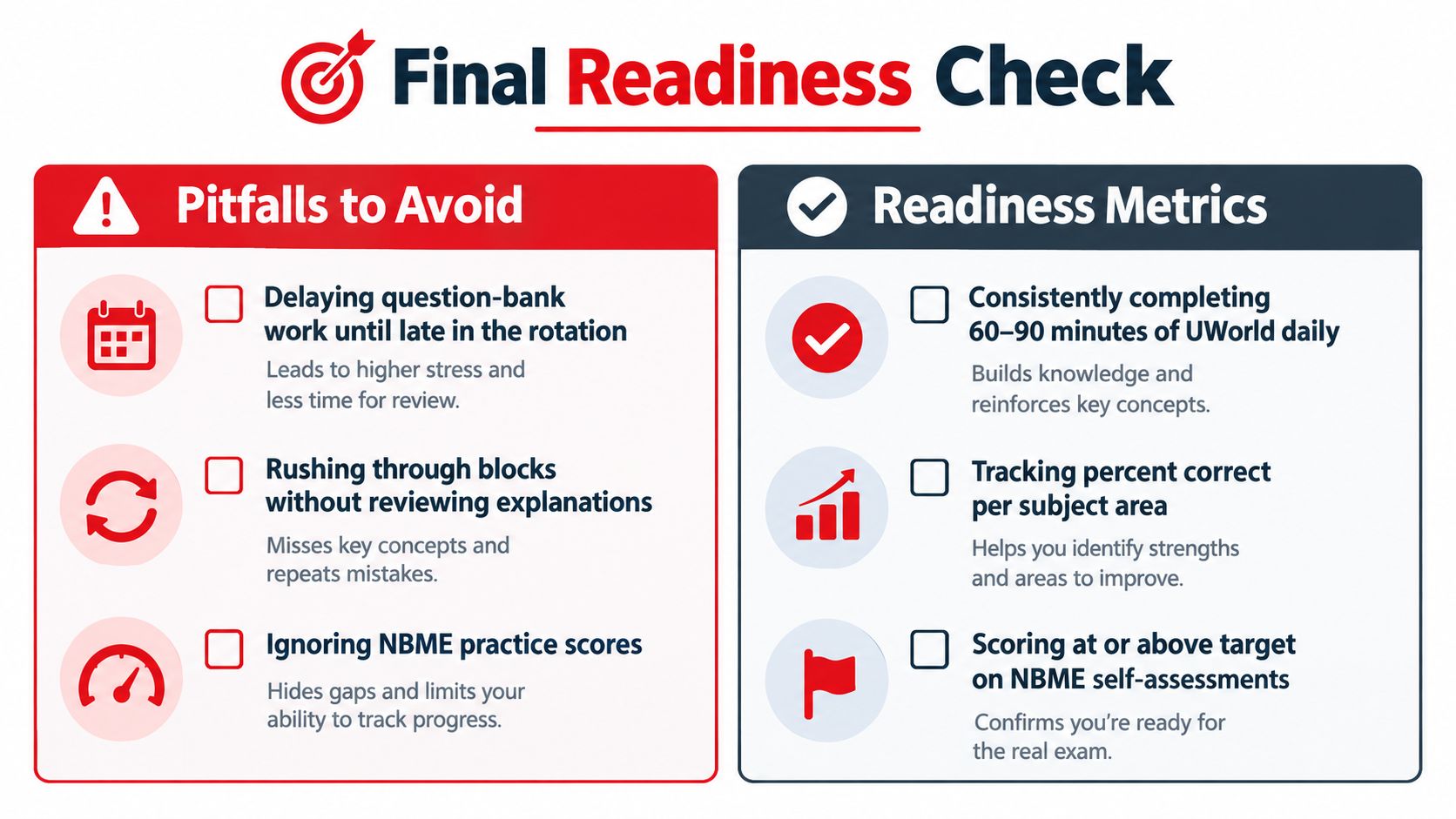
A finished QBank is a record of exposure, not a readiness certificate. Delaying questions until late in the rotation, counting repeats as new exposure, and treating a high percentage-correct as proof of mastery can all obscure what remains unresolved.
The final audit should also distinguish selecting the answer from articulating the rationale. A familiar item may feel easy even when the student can't transfer its principle to an unfamiliar presentation.
A useful readiness dashboard
| Metric | What it helps reveal |
|---|---|
| Unique questions completed | Breadth of new exposure |
| First-pass accuracy | Performance before repetition |
| Timed-block accuracy | Performance under pacing constraints |
| Marked-question accuracy | Progress on uncertain material |
| Error-category mix | Whether remediation should target knowledge, reading, or reasoning |
These measures belong beside official assessment feedback, not in place of it. No universal UWorld percentage in this plan establishes passing, honors, or readiness for every school.
The final readiness checklist
During an illustrative final 48-hour review, the student should confirm:
- Format and logistics. The assigned examination, timing, and approved arrangements are understood.
- Coverage. Major outline areas haven't been omitted.
- Reasoning. Previously difficult concepts can be explained without answer recognition.
- Feedback. Practice-assessment weaknesses have received targeted attention.
- Recovery. The remaining plan allows sleep rather than an unreviewable final question sprint.
An unresolved pattern is a reason to seek clarification, not a judgment about the student's potential. The Shelf exam tutoring information page is a relevant next step when the dashboard points to a persistent reasoning gap.
Sources
Primary references include UWorld's Step 2 CK product information, NBME's timing chart, Subject Examination Information Guide, and community report. The peer-reviewed Shelf preparation study provides additional methodological context; each reference is linked where its relevant claim appears.
Ace Med Boards offers personalized online Shelf tutoring that can complement a clerkship-specific QBank plan and official practice assessments. Students whose error logs reveal recurring reasoning gaps can visit Ace Med Boards to schedule a free consultation and discuss whether targeted support fits their needs.