
The night before a pediatrics shelf can feel weirdly familiar, a little clinic day, a little fire drill. The safest move is to stop treating it like a memory contest and start treating it like a workflow exam, because the NBME Pediatrics Subject Examination rewards diagnosis, management, and age-based reasoning far more than isolated fact recall. For a student asking how to study for peds shelf, the answer is to anchor preparation to the blueprint, then use repeated question review to train the exact decisions the test keeps asking for.
What the Peds Shelf Actually Tests
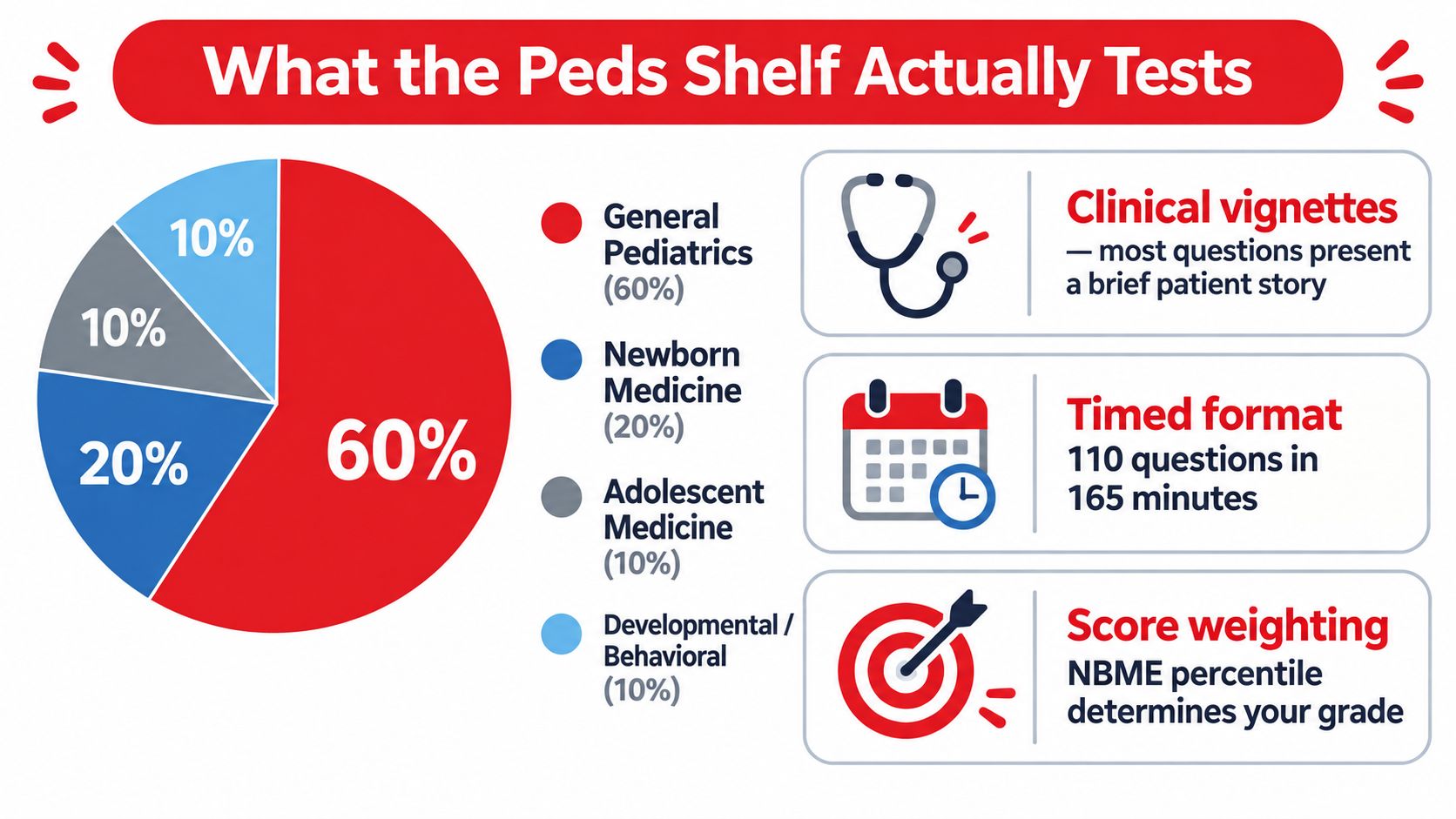
A pediatrics shelf question usually feels like a short chart note with a decision attached. The exam is built around clinical reasoning, and the NBME content outline places most of the test in diagnosis, including history, physical examination, diagnostic studies, and expected outcomes, with smaller shares in health maintenance, pharmacotherapy, intervention, management, and foundational science concepts (NBME Pediatrics Subject Examination).
Why the blueprint changes the study plan
That weighting matters because the exam asks you to use age, history, exam findings, and test results to choose the next right step. The care-setting mix points the same way, since most cases are ambulatory, with smaller emergency department and inpatient shares (NBME Pediatrics Subject Examination).
Practical rule: if a study resource keeps drifting into disease-definition flashcards, it is drifting away from what the shelf rewards.
The high-yield topics follow the same pattern. Developmental assessment, vaccination and preventive care, pediatric emergencies, common outpatient complaints, and initial management deserve more attention than trivia because they match the way the exam frames real vignettes (NBME Pediatrics Subject Examination). The system blueprint also highlights gastrointestinal disorders at 8% to 12%, multisystem processes at 10% to 15%, and several other major areas, including cardiovascular, respiratory, renal/urinary, endocrine, neurologic, and newborn/congenital disorders, in roughly 5% to 10% ranges (NBME Pediatrics Subject Examination).
A Pediatrics shelf plan works best when it trains the same decisions the exam is written around: why the stem points to one diagnosis, why another option is less likely, and what the next step should be. For disease-specific review, the existing Pediatrics study guide is the better place to review the individual conditions, while this page stays focused on the rotation workflow.
Building Your Week-by-Week Rotation Plan
A strong shelf plan is less about heroic study marathons and more about small, repeatable blocks. That works especially well in pediatrics, where clinic days, rounding, and call schedules can change the amount of time available from one week to the next.
Phase one, map the territory
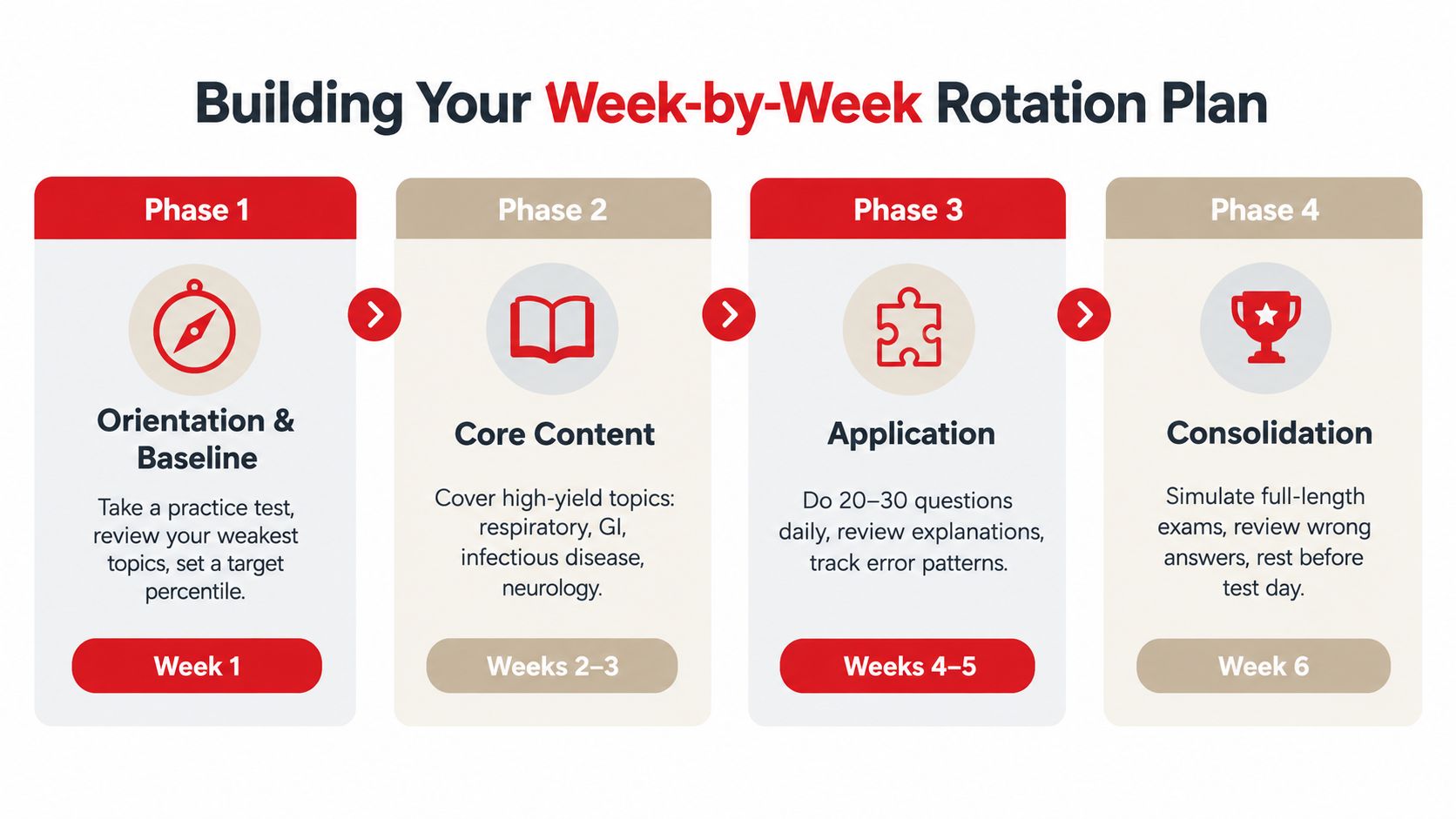
The first week should be a baseline week. That means identifying weak areas, deciding which topics match the clerkship's pace, and setting a realistic question goal for the rest of the rotation. A student who waits until the end of the month to discover weak spots usually loses the chance to fix them while the material is still fresh.
A simple way to organize the rotation is by domain cluster. Newborn care and growth, infectious disease and respiratory illness, gastroenterology and nutrition, cardiology and emergency care, plus adolescent and preventive medicine, cover most of what shows up repeatedly. On heavier inpatient weeks, short evening question blocks and brief error review are enough. On lighter clinic weeks, a longer mixed block and a targeted content review session fit better.
A clerkship calendar that respects rounding is more sustainable than a calendar that pretends rounding does not exist.
Phase two, study by clinical cluster
Weeks two and three should be built around topic clusters rather than random reading. A learner can spend one block on newborn and infant issues, another on respiratory and infectious complaints, then move to GI, cardiology, and adolescent care in a planned sequence. That keeps study time aligned with the exam's age-based framing instead of turning the rotation into a pile of disconnected notes.
The most useful habit here is to track completion, not just hours. One finished question block, one review pass, and one short recap note are more meaningful than a vague promise to “study more tonight.” The study schedule for medical students page can help with broader time-blocking ideas, but the key pediatrics move is to pair that structure with age-specific content.
Phase three, shift toward application
Weeks four and five should lean harder into application. At that point, mixed timed blocks matter more than single-topic reading because the shelf tests decision-making under uncertainty. The student should still review content, but only in response to patterns that keep showing up in missed questions.
A workable evening routine looks like this:
- Short weekday block: one mixed set after rotation duties, followed by immediate review.
- Longer weekend block: one focused content catch-up session plus a second mixed set.
- Daily closeout: one brief note on the day's main miss, especially if the error came from age mismatch or management sequencing.
That pacing leaves room for sleep, which matters because tired students start choosing answer options for familiarity instead of for reasoning.
Using Questions as a Measurement System
Practice questions work best when they function like a diagnostic tool. A shelf block should tell the learner not only what was missed, but why it was missed, because different error types call for different fixes.
The first pass should be timed and honest. After that, each miss belongs in one of four buckets: knowledge deficit, interpretation of a clinical finding, premature closure, or management-sequence error. Those categories keep the review focused. A student who writes "wrong" beside a question learns very little, but a student who labels the failure type can see patterns after a few days.
The strongest evidence for this approach comes from health-professions education research on distributed practice and retrieval practice. A 2023 systematic review found that these methods improved examination performance in most included studies, and retrieval practice was the most frequently studied intervention, appearing in 33 studies (systematic review). A later review in medical students also found that spaced repetition and retrieval practice were associated with better academic outcomes when repeated across weeks to months (medical student review).
A simple reattempt workflow
The point is not to do more questions for their own sake. The point is to build closed-book recall and then test whether the explanation sticks.
- Do a timed baseline block.
- Classify each miss into one of the four error types.
- Write a one- to three-sentence explanation for each miss.
- Reattempt the missed item after 48 to 72 hours without notes.
- Revisit the same item one to two weeks later.
- Keep only recurring gaps as flashcards.
A corrected answer that feels familiar is not the same as a retrievable answer. If a learner keeps getting questions right only after reading the explanation, the issue is recognition, not retrieval. That pattern usually means the next study session should include more closed-book recall, not more passive rereading.
Checkpoint: a high corrected-answer rate with weak first-pass accuracy usually means the learner is recognizing material without being able to generate it independently.
The NBME practice shelf exams page fits well with this workflow because the exams become the measurement system, not just a pile of facts to consume.
Reasoning Through an Age-Specific Vignette
A six-month-old with fever and poor feeding looks simple until the age details start doing the work. At 6 months, the differential is not the same as it would be at 2 weeks or 4 years, and that is exactly why pediatrics questions punish generic thinking.
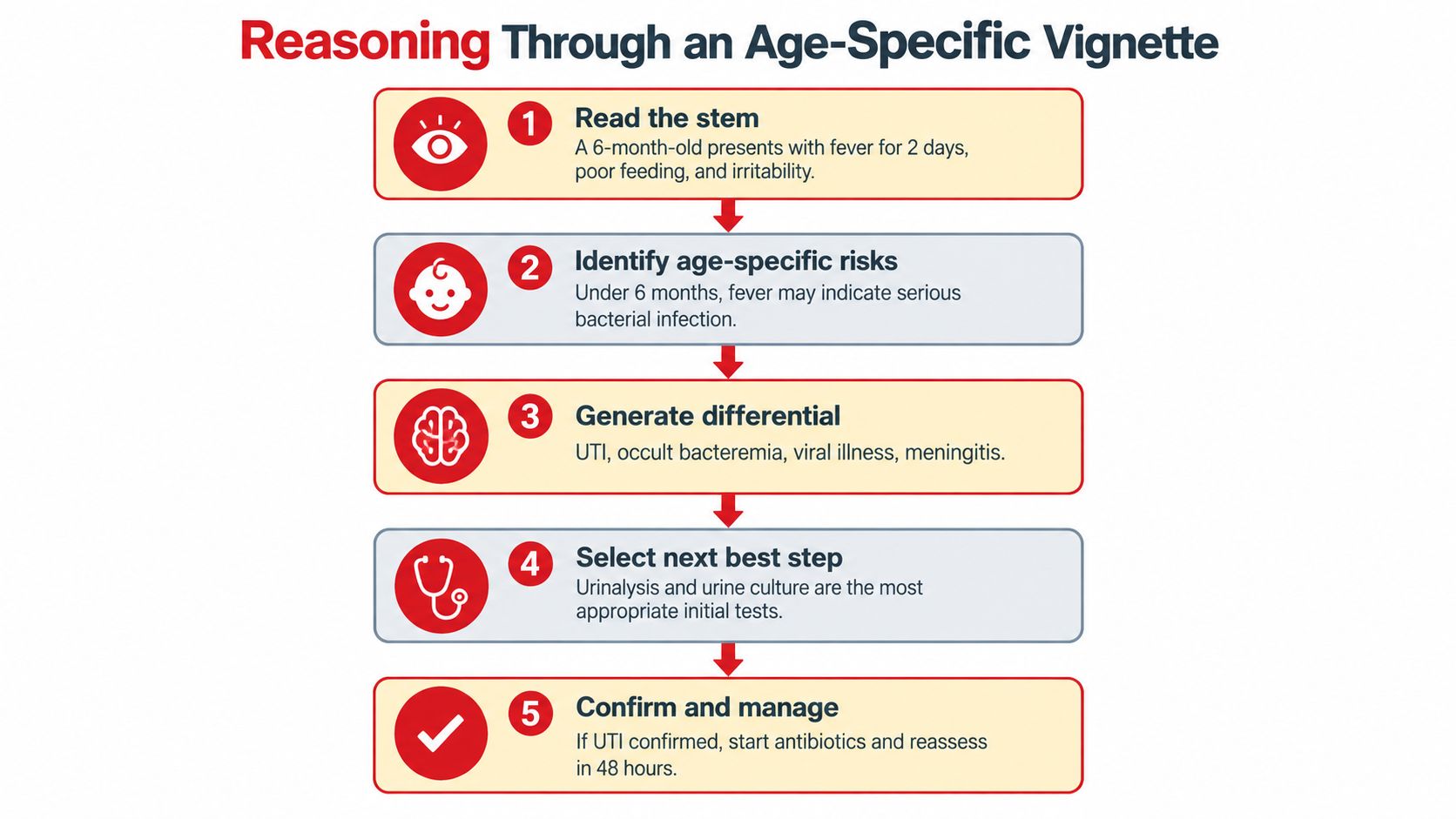
A realistic stem might say: a 6-month-old has fever for 2 days, poor feeding, and irritability. The first move is to notice the age. Fever in a young infant changes the threshold for concern, because urinary tract infection, occult bacteremia, meningitis, and viral illness remain on the table. The learner who jumps straight to “viral syndrome” without checking age and next-step testing is usually closing too early.
What to write in an error log
The best error note format is short and specific. It should include the discriminating finding, the next best step, and the key alternative diagnosis that seemed tempting. For the 6-month-old example, the discriminating finding might be poor feeding with fever, the next step might be urinalysis and urine culture, and the alternative diagnosis might be a self-limited viral process.
That same finding means something different at other ages. A 2-week-old with fever raises a very different concern than a 4-year-old who looks playful and drinks well. The logic is the same, though. Age changes risk, risk changes the differential, and the differential changes the first test or action.
| Age Band | Common Presentation | Key Discriminating Detail | High-Yield Next Step |
|---|---|---|---|
| Newborn | Fever or poor feeding | Very young age with nonspecific symptoms | Evaluate urgently for serious infection |
| Infant | Fever, irritability, feeding changes | Age plus hydration and appearance | Targeted urine and infection workup |
| Toddler | Fever, cough, limp, rash | Exposure history and exam findings | Decide between observation, testing, or treatment |
| Preschool child | Abdominal pain, wheeze, vomiting | Localizing symptoms and severity | Focused workup based on the presentation |
Two short drills help reinforce the same skill. What changes in the differential when a febrile infant is 2 weeks old instead of 6 months old? Which finding moves a child from outpatient observation to urgent stabilization? Those questions train the habit the shelf keeps rewarding, age-adjusted reasoning rather than isolated fact recall.
The clinical reasoning guide is a useful companion if the decision process still feels fuzzy after reviewing missed questions.
Self-Study, Group Study, or Targeted Tutoring
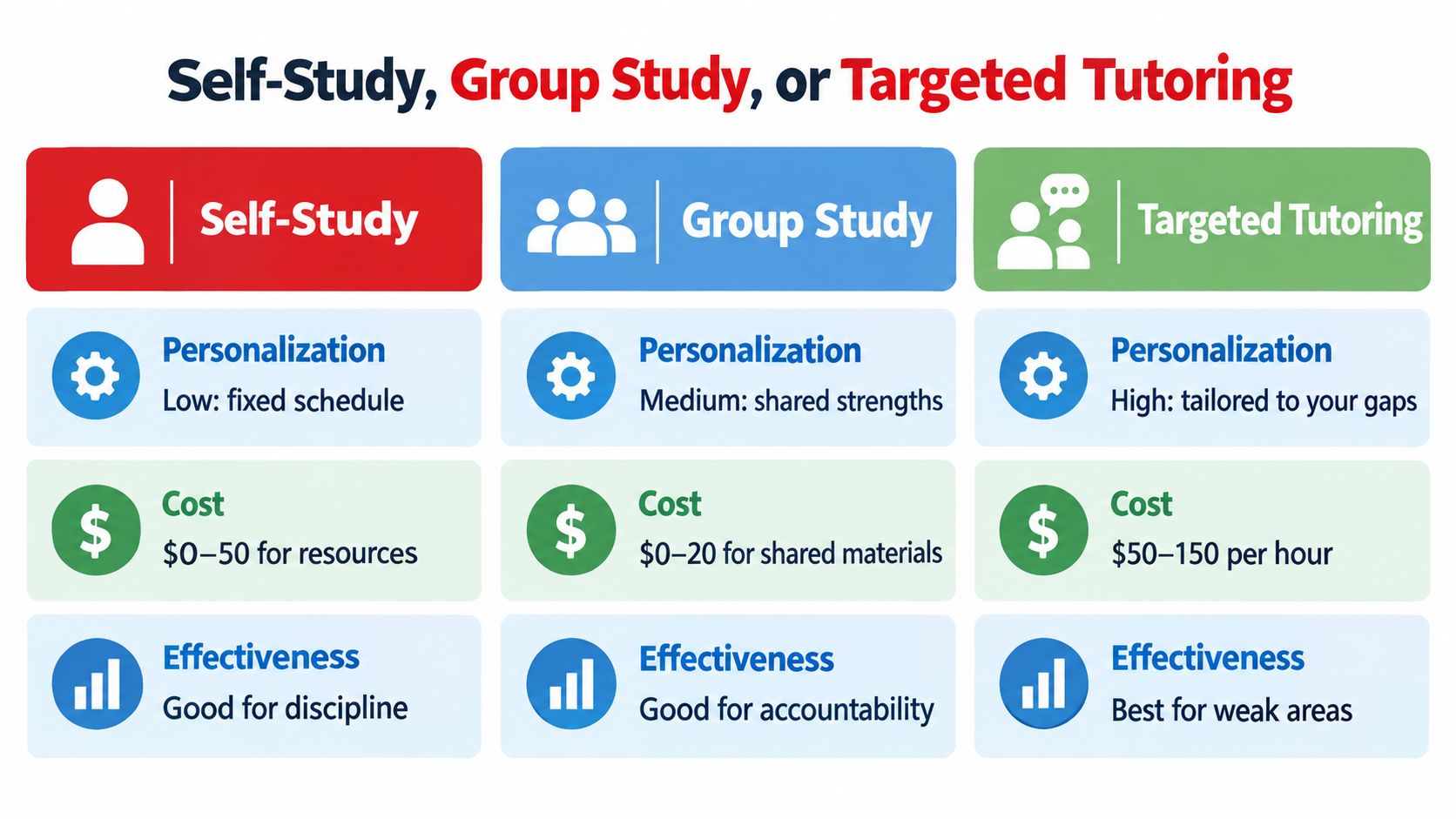
The best support method depends on the kind of miss, not on a vague promise that more help will solve everything. A learner who keeps missing developmental milestones or vaccination facts needs a different fix than a learner who understands the content but misreads the stem or picks the wrong management sequence.
What each option really adds
Self-study works well when a student needs structure and repeated exposure to questions. It is flexible, but it also leaves room for procrastination and blind spots if review is too passive.
Group study adds accountability. It helps when motivation is uneven or when a few classmates can keep one another on track with question blocks and error review. It becomes less useful when discussion drifts into trivia or the group spends too long on low-yield details.
Targeted tutoring fits best when the error log shows a pattern that self-study keeps missing. One-on-one feedback can help with interpretation errors, premature closure, or management-sequence problems, since those usually come from reasoning gaps rather than missing facts. Ace Med Boards offers one-on-one pediatrics shelf tutoring and a focused shelf exam tutoring option for learners who want structured feedback around the rotation workflow.
Decision rule: if the same kind of mistake shows up in several question blocks, the issue is usually not more passive reading. It is the way the learner is processing the vignette.
A simple decision guide
The clearest way to choose support is to look at the error log.
- Mostly knowledge gaps: keep using a question-bank cycle, then tighten the review notes.
- Mostly interpretation or management-sequence errors: add targeted tutoring or structured feedback.
- Mostly motivation or accountability issues: a small study group may be enough.
- Mixed errors across several categories: combine self-study with one-on-one help for the recurring patterns.
Clerkship life is unpredictable, so no support method replaces the official practice materials or the learner's own question review. It should make the workflow more precise.
Exam-Day Logistics and Common Pitfalls
The day before the shelf should feel boring, not dramatic. The essentials are simple, sleep, hydration, ID, confirmation notice, and a plan for packing the night before so the morning does not become a scavenger hunt.
The pacing rule is equally simple. A student should not get trapped on one stem because the exam is a sequence of decisions, not a single rescue attempt. Flagging a question and moving on is often smarter than burning too much time on one uncertain answer, especially when the stem is built around age details that can be sorted later if there is time.
What tends to go wrong
The most common pediatric shelf mistakes are predictable. Students anchor on a disease name and forget to check age. They miss immunization status clues. They confuse outpatient management with emergency stabilization. They also give too much weight to rare zebras when a common pediatric pattern is right in front of them.
Each one has a prevention move.
- Anchor-checking: ask what the child's age changes before committing to a diagnosis.
- Immunization awareness: scan the stem for missing or relevant vaccine context.
- Setting awareness: decide whether the child is stable enough for outpatient care or needs urgent action.
- Common-first thinking: choose the most plausible pediatric pattern before entertaining a rare one.
The NBME reports Pediatrics subject-exam scores as equated percent-correct scores on a 0 to 100% scale, which means a practice percentage is a progress marker, not a direct copy of the final score (NBME score interpretation guide). The published 2021 Pediatrics grading-guideline document also shows that minimum passing recommendations can vary by method, with an Angoff value of 56, a Hofstee value of 65, a Hofstee acceptable range of 57 to 68, and a proposed honors range of 80 to 94 (NBME Pediatrics grading guidelines). Those figures are useful for context, but the learner's actual readiness target should still be set by the school's current policy.
Key Takeaways and Next Steps
A strong Pediatrics shelf plan starts with the blueprint, then turns that blueprint into a repeatable workflow. The exam rewards diagnosis and management decisions, so each study block should train you to ask what the child's age changes, what setting you are in, and what the next step should be.
Use questions as your feedback loop. Read the stem, answer it under time pressure, then sort each miss by the reason you missed it, such as weak recall, rushed reading, or confusion about management. That makes review more useful than just collecting wrong answers.
Two practical checkpoints help near the end of the rotation. First, use the school's grading policy to set your own readiness target, since the passing line can vary by program. Second, in the last 48 hours, keep the work simple, one mixed timed block, a short review of missed concepts, and a quick pass through the most common age-based patterns.
The topic-level Pediatrics guide linked earlier covers disease detail. This workflow covers how to study across the rotation. If the same reasoning error keeps returning, targeted tutoring can help you correct it before exam day.