

Private MCAT tutoring can be worth it when it targets a specific performance bottleneck with measurable tracking, and it's not worth it as a generic study purchase. The Association of American Medical Colleges, or AAMC, reported a mean total score of 500.6 for 2023 to 2025, which gives students a neutral baseline for judging a diagnostic result.
What if the true question isn't whether a tutor knows more content, but whether paid help fixes the exact reason study hours aren't becoming correct answers? That distinction separates a rational purchase from an expensive form of reassurance.
A Direct Answer to Whether Private MCAT Tutors Are Worth It
The direct answer to Are Private MCAT Tutors Worth It is yes for a narrow, well diagnosed problem, and no for broad content delivery that duplicates official materials. Tutoring earns its cost when a tutor identifies why a student misses questions, assigns work tied to that cause, and proves progress on later full length practice.
A student who's plateauing because of passage reasoning, timing, or weak review habits has a different case from a student who hasn't yet learned foundational biochemistry. The first student may benefit from targeted feedback. The second usually needs structured content study first, often at lower cost.
The strongest neutral benchmark is national performance, not a provider promise. Across 305,494 MCAT exams administered in 2023 to 2025, the mean total score was 500.6, according to AAMC national testing data for 2023 to 2025. That figure doesn't set a personal target, but it prevents a single diagnostic from being judged in isolation.
Key Takeaways
- Buy diagnosis, not hours: Tutoring is most defensible when sessions target a documented bottleneck.
- Require a baseline: A full length diagnostic should come before any large package.
- Protect official practice: Paid help should complement AAMC questions, not replace them.
- Set a stop rule: Continued spending needs evidence from error patterns and timed performance.
Worth also depends on the rest of an application. Admissions outcomes involve grade point average, experiences, essays, interviews, school mission, and applicant pool, not MCAT score alone. A realistic score gain matters most when it materially improves an otherwise credible application profile.
Practical rule: If a tutor can't name the bottleneck, the intervention, and the reassessment date, the purchase isn't ready.
No neutral evidence in the verified material establishes a universal score increase from one on one instruction. That's the honest starting point. Students should therefore judge tutoring by measurable gains in diagnostic weaknesses, timing, question analysis, and consistency across full length exams, rather than by confidence alone.
How MCAT Scoring Shapes the Tutoring Question
The Medical College Admission Test, or MCAT, produces four section scores and one total score, covering Biological and Biochemical Foundations of Living Systems, Chemical and Physical Foundations of Biological Systems, Psychological, Social, and Biological Foundations of Behavior, and Critical Analysis and Reasoning Skills, as described in the AAMC explanation of the MCAT score scale. Each section ranges from 118 to 132 with a midpoint of 125, while the total ranges from 472 to 528 with a midpoint of 500, according to that same scale guidance.
That structure changes the tutoring decision. A weak total caused by one section calls for focused intervention, while weakness spread across sections may signal unfinished content foundations or a general pacing problem. A tutor who only discusses the total is missing the diagnostic value of the score report.
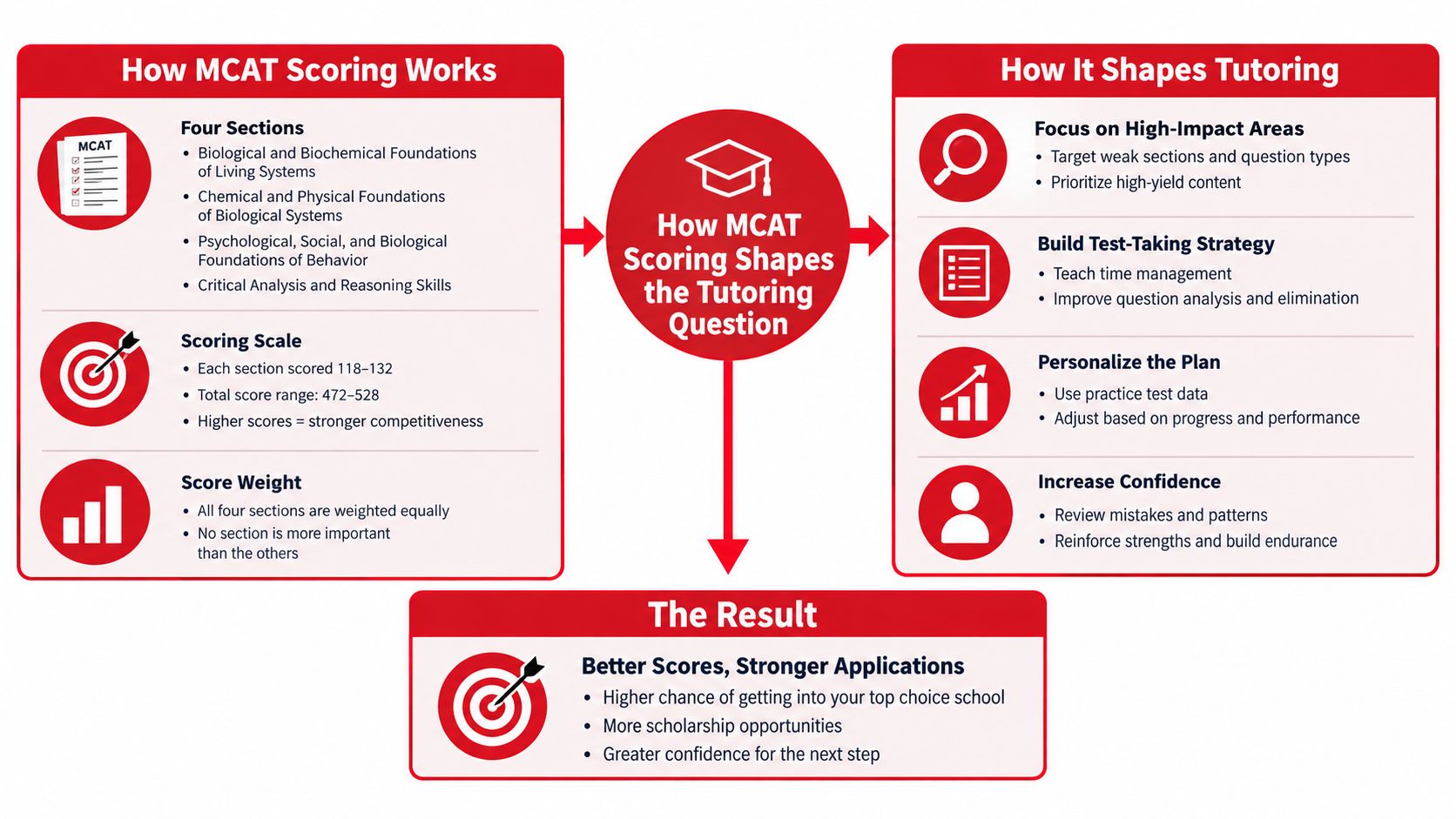
Percentile position also matters because admissions interpretation isn't based on raw points alone. In the 2023 to 2025 cohort, a total score of 508 corresponded to the 74th percentile, based on AAMC percentile ranks calculated from 305,494 examinees. Small point changes can therefore carry different percentile meaning depending on starting position.
What Scoring Means for Tutoring Sessions
The exam is scaled and equated, not graded on a curve, and incorrect answers receive the same treatment as unanswered questions with no additional wrong answer penalty, according to AAMC guidance on how the MCAT exam is scored. A sound tutoring plan should consequently emphasize answering every question, pacing, error classification, and question volume analysis.
Score reports include section scores, confidence bands, percentile ranks, and a score profile, and percentile ranks show the percentage of test takers who earned the same or a lower score, as explained in AAMC resources for interpreting MCAT scores. Students comparing options can use a guide to MCAT scores and score interpretation alongside official reports to set section level targets.
A single diagnostic shouldn't trigger a large purchase. Confidence bands and repeated practice trends give a better picture of whether performance is stable, improving, or distorted by one difficult testing day.
What Private MCAT Tutoring Actually Costs
Cost is where vague value claims become concrete. Broader market estimates place private tutoring at approximately $75 to $250 per hour, and a modest 20 hour plan could cost about $1,500 to $5,000 before books, question banks, or official practice materials, based on the University of Arizona MCAT preparation and market cost summary. A university affiliated program at the University of Arizona lists private tutoring at $75 per one hour session, according to that same program summary.
Those figures are time sensitive and should be checked as of the purchase date. Students should review current MCAT tutoring pricing and package information directly rather than relying on general market ranges for any specific provider.
MCAT Prep Options at a Glance
| Option | Typical cost range | Best fit |
|---|---|---|
| Review books and practice tests | $20 to $120 in the market summary cited above | Early content review and low cost supplementation |
| Online preparation courses | $160 to $2,000 in the market summary cited above | Students needing structure with schedule flexibility |
| Private tutoring | $75 to $250 per hour in the market summary cited above | Targeted diagnosis, pacing, and error analysis |
Price variation usually reflects tutor credentials, session length, delivery format, package size, included materials, and cancellation terms. A lower hourly rate isn't automatically better value if sessions lack diagnosis or follow up. A higher rate isn't justified by confidence or branding without a clear method.
A Personal Break Even Check
- Required change: What section or total score movement would materially improve the application?
- Time available: How many weeks remain for practice between sessions?
- Current trend: Are scores already improving under self study?
- Opportunity cost: What paid work, coursework, or rest would tutoring displace?
- Budget ceiling: What's the maximum spend before reassessment?
Tutoring makes financial sense only if focused hours prevent unfocused study, expose recurring reasoning errors, or help a student reach a meaningful threshold. Students who already diagnose weaknesses accurately and maintain discipline may get adequate preparation from official AAMC resources and lower cost materials. The rational comparison is expected benefit against rate, credentials, objectives, and cancellation policy, not prestige.
Tutoring Compared to Self-Study, Group Courses, and Online Courses
Every paid option competes with a baseline that costs almost nothing. Official practice exams were used by 90.5% of respondents in 2025, while official free sample tests were used by 69.0%, according to AAMC data on MCAT preparation resource use in 2025. Any money spent beyond those tools has to buy something they cannot provide: diagnosis, accountability, or pacing.
Self study is the cheapest and most flexible path, but it makes the student responsible for planning, error analysis, and honesty about progress. It works for someone who sets a baseline, drills questions, reviews every miss, and adjusts without outside pressure. It fails when study turns into rereading notes with no timed evidence.
Group courses sell scheduled coverage and peer momentum. That structure helps students who need a calendar more than customized feedback, though the pace often runs fast through strengths and slow through the exact weaknesses that need attention. Students weighing structured options can compare different MCAT prep course formats and features before deciding whether a fixed curriculum matches their problem.
Online courses sit between self study and live instruction. Recorded lessons deliver content efficiently, but no video watches a student reason through a passage. When errors come from misreading stems, weak elimination, or timing choices rather than missing facts, recorded explanations rarely catch the cause.
Where Each Option Wins
Self study wins for disciplined students with a clear baseline and an improving trend. A group course wins when broad content organization and external scheduling are the missing pieces. An online course wins when structured lessons must fit around work or location constraints. Private tutoring wins when one specific bottleneck survives honest, consistent practice, because its real advantage is individualized error diagnosis rather than exclusive content.
That last point matters for budgeting. Tutoring is the most personalized option and usually the most expensive per hour, so buying it for content delivery overpays for what cheaper formats already supply. A hybrid plan tends to make the most sense: self study carries content and question volume, a group or online course adds structure if needed, and a limited tutoring block handles diagnosis and full length review.
A Needs-Based Decision Matrix for Choosing Tutoring
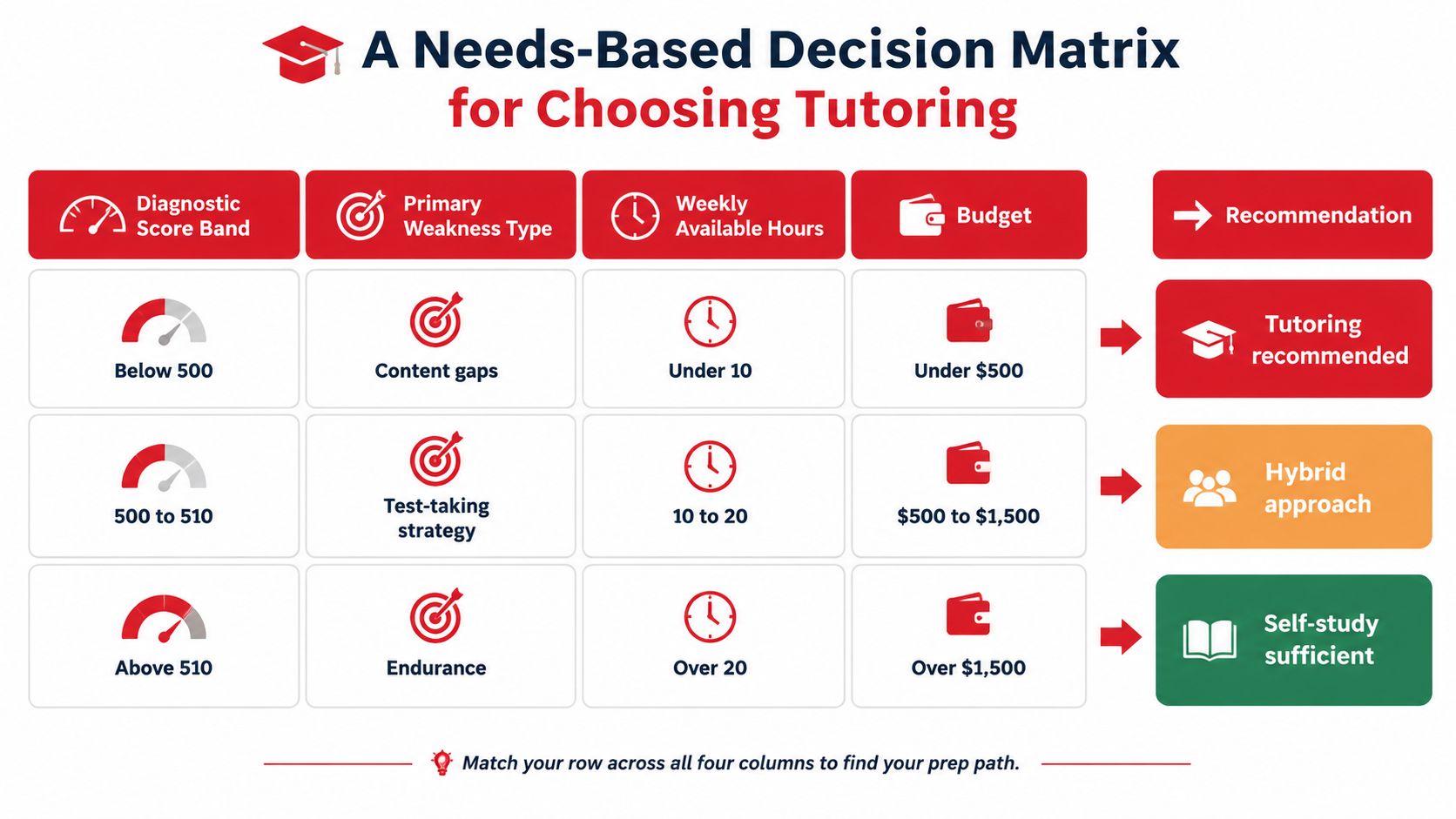
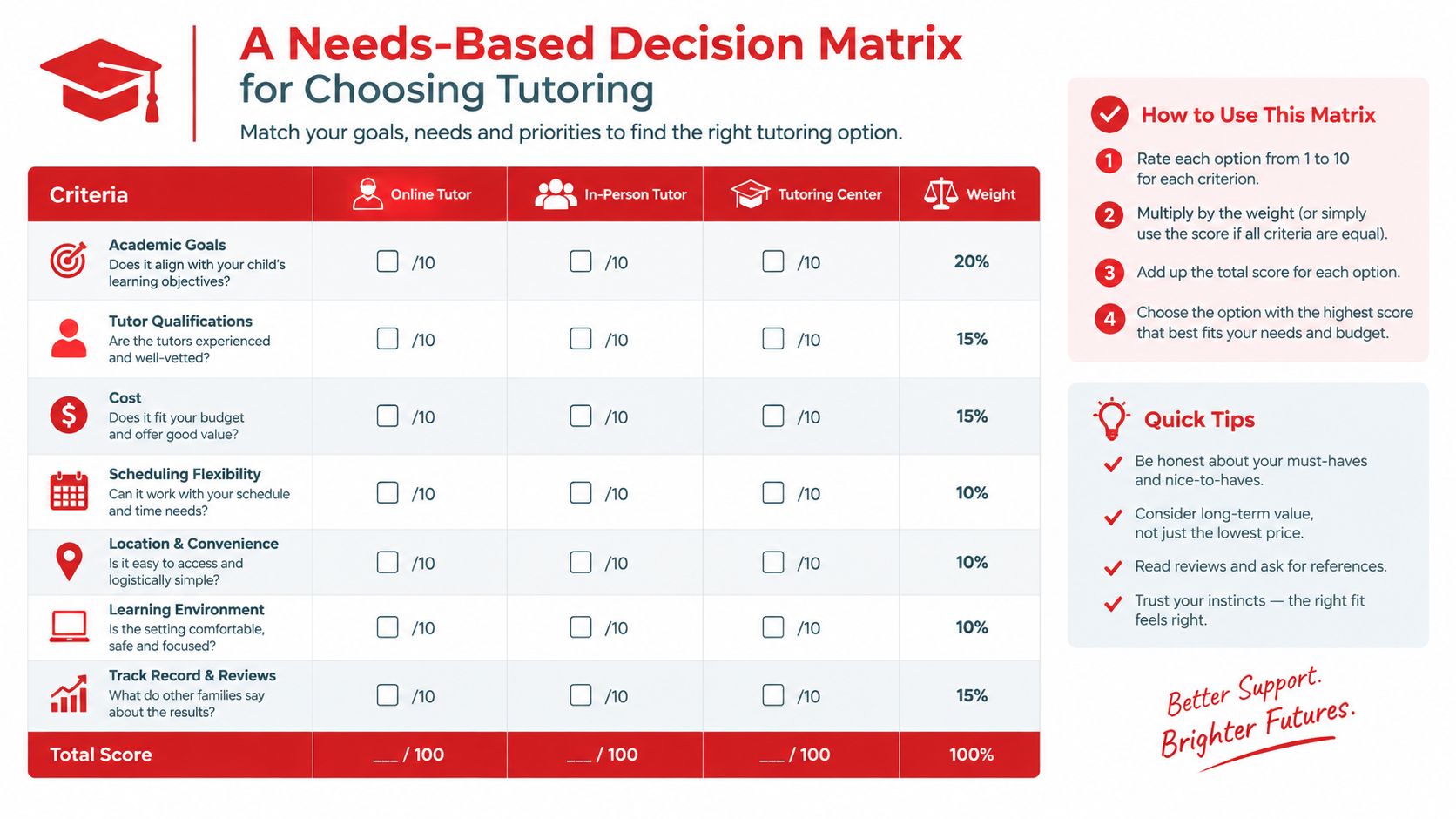
A useful decision starts with four inputs, diagnostic score band, primary weakness type, weekly available hours, and budget. No single input should decide the purchase. A student near a target with a timing problem needs a different plan from a student below target with unfinished prerequisite content and very limited study time.
The matrix below is a planning tool, not a prediction of score gains. Students should place themselves in the closest row, then test the recommendation against a recent full length taken under timed conditions. A current MCAT practice test for establishing a baseline can supply that starting evidence.
Four Reader Profiles
Near target, pacing bottleneck. Practice scores are close to the goal, content errors are limited, and unfinished questions or rushed final passages explain much of the loss. A small number of targeted sessions focused on timed passage review may be the highest-impact spend.
One section content gap. Three sections are serviceable, but one section shows repeated prerequisite weaknesses. Structured content study should come first, followed by tutoring only if question errors persist after the material has been learned and practiced.
Working student, limited hours. Weekly time is scarce, so efficiency matters more than adding resources. A tutor could help prioritize topics and build a realistic schedule, but only if sessions reduce wasted study rather than becoming another obligation.
Lower income student balancing work and access barriers. A 2025 analysis of 3,240 lower socioeconomic status MCAT examinees found that lower scoring students were more likely to struggle with material outside coursework, concrete exam information, and reliable or affordable internet access, according to peer reviewed research on lower socioeconomic status MCAT examinees. For that profile, free official materials, peer advising, campus support, and a tightly limited diagnostic session may offer better value than a large package.
Tutoring is least defensible when it duplicates widely available official practice resources. It's most defensible when it solves a specific bottleneck that independent study hasn't fixed.
Equity matters in this decision. Higher scoring students in that lower socioeconomic status analysis were more likely to establish a baseline, practice with questions, take practice exams, and discuss preparation with advisors or peers. Those behaviors don't require an expensive package, and students shouldn't be shamed for choosing a lower cost route that produces steady evidence of progress.
Students whose profile doesn't match neatly should score each input separately. If two or more inputs point toward self study, starting there with a reassessment date is the disciplined choice. If a persistent reasoning or timing bottleneck remains after that trial, targeted tutoring becomes easier to justify.
How to Evaluate a Private MCAT Tutor Before You Pay
Ask a tutor one question before anything else: "Show me how you would diagnose my last full length exam." The answer reveals almost everything. A tutor who starts naming content topics before seeing your results is selling lectures, and lectures at private rates are a bad purchase when recorded versions cost a fraction of the price.
Credentials come second. Verify actual MCAT performance, teaching experience across all four sections, and fluency with official AAMC materials. A high personal score shows someone can take the test. Teaching another person to do it is a separate skill.
Score guarantees deserve the same skepticism you'd give any marketing claim. The AAMC's own validity research found median correlations of 0.42 to 0.61 between MCAT total scores and outcomes including preclerkship performance, clerkship performance, United States Medical Licensing Examination Step 1 and Step 2 Clinical Knowledge results, and progression outcomes, according to the AAMC MCAT validity report. Group level correlations can't guarantee any individual's result, and a tutor who promises a specific number is promising something no one controls.
What to Ask and What a Weak Answer Sounds Like
| Ask the tutor | Walk away if you hear |
|---|---|
| How will you classify my errors from a recent full length? | "We'll figure it out as we go." |
| Which official practice questions anchor your sessions? | A proprietary bank with no AAMC material. |
| What metrics do we track between meetings? | Nothing specific, or "you'll feel more confident." |
| What should the first session produce? | "A general overview of the exam." |
| What are the cancellation and refund rules? | Pressure to buy a large package first. |
| When would you recommend stopping sessions? | The question has never come up. |
Treat the first session as an audition. It should end with a written plan that sorts your misses into content gaps, passage reasoning, timing, and test anxiety, plus assignments aimed at the dominant category. Every session after that should return to the same categories and to timed passage metrics.
Three red flags outweigh any polished sales pitch: package pressure before diagnostic data exists, a teaching method the tutor can't explain, and hours that keep increasing while assignments stay identical. Paid tutoring cannot substitute for independent practice, and a plan that pretends otherwise will drain a budget without moving the score.
Ace Med Boards offers one on one online MCAT tutoring with individualized study planning and tutor matching based on learning needs and schedule. Judge it by the same standard as any other provider: if the first meeting doesn't produce a specific, testable plan, the name on the invoice doesn't matter.
A Sample 12-Week Plan With and Without Tutoring
Two students can follow the same 12-week calendar and get opposite results. Effort explains less than targeting does: whether each week attacks the error type costing points. The calendar works either way. What changes is where the paid hours land.
Weeks 1 to 4: build the base. Content foundations, untimed to lightly timed questions, and a first timed full length. A self-studier handles all of this alone. A tutored student typically needs a single early session here, the one that sorts misses into content gaps, passage reasoning, timing, and anxiety, and nothing more.
Weeks 5 to 8: attack the dominant error. Passage practice and error analysis take over. Self-study means a written error log, timed sets, and content review tied to actual misses. One mid-cycle tutoring session can audit whether the assignments are fixing the dominant category or just keeping the student busy.
Weeks 9 to 12: simulate and review. Full length exams, test day pacing, and analysis of performance under timed conditions. Tutoring earns its cost here only when sessions dissect recent exams rather than reteach content a book covers cheaper.
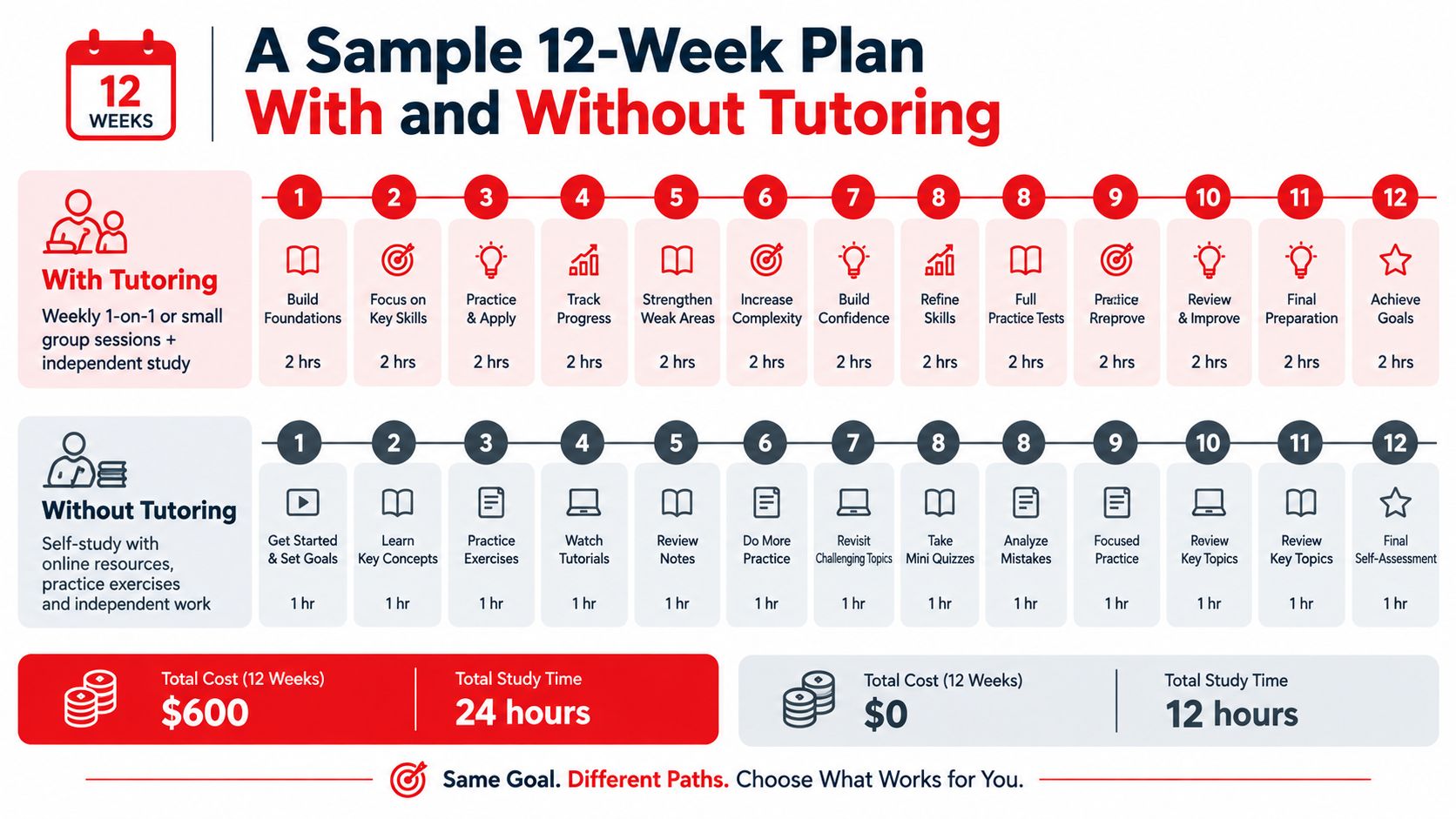
Students who want a ready-made framework can adapt a sample MCAT study schedule organized by week instead of drafting one from scratch, keeping official practice at the center either way. Those who struggle to protect weekly study blocks can use Pretty Progress to stay on track as a planning aid alongside the error log.
Reassess at week four by comparing section performance and dominant error categories against the baseline. Decide at week eight whether sessions continue, narrow, or stop. Judge the final result on consistency across recent full lengths, never on one best score. If a self-studier can't hold the review cycle, the fix is often a smaller schedule rather than a tutor. Any version of this plan bends around coursework, employment, health, and test date, and tutoring that can't bend with it isn't worth its rate.
Your Decision Checklist and Common Follow-Up Questions
A final decision should take minutes once the evidence is organized. Students can read about the practical benefits of one on one tutoring and then test those benefits against the checklist below.
- Baseline recorded: A recent timed full length shows section scores, not just a total.
- Target defined: The needed improvement is specific and admissions relevant.
- Bottleneck named: Errors are classified as content, reasoning, timing, or anxiety.
- Hours realistic: Weekly independent practice time exists between sessions.
- Budget capped: Spending stops at a preset reassessment point.
- Tutor vetted: Credentials, method, materials, and terms are documented.
- Progress defined: Error patterns and timed metrics will decide whether sessions continue.
Common Follow-Up Questions
How many tutoring hours are reasonable? There's no verified universal number. A limited block tied to a reassessment is more rational than an open ended package because it forces evidence before additional spending.
What if error patterns don't improve? Sessions should pause or change focus. Continuing the same intervention after repeated practice shows no movement isn't persistence, it's poor allocation.
Should nontraditional or international applicants weight tutoring differently? The same evidence rule applies, although returning students may need content rebuilding before private feedback becomes useful. A low diagnostic or interrupted preparation doesn't end a medical career, and it shouldn't be used to pressure a purchase.
Students who want a personalized review of diagnostic scores, error patterns, and study time can request a free consultation through Ace Med Boards to discuss MCAT preparation options without a guaranteed score claim. That conversation should produce a clear baseline, a targeted plan, and an honest recommendation, including self study when tutoring isn't the right spend.