
MCAT performance is driven more by accumulated focused study hours and timed practice quality than by whether instruction is self-study or course-based. Start with the AAMC's free full-length practice exams and MCAT Official Prep Hub before paying for an MCAT prep course, then choose the structure that best protects your study time and exposes your mistakes.
The conventional question is, “Which MCAT prep course is best?” A more useful question is, “What will make me complete the right work consistently?” A course can organize content, but it can't replace passage reasoning, retrieval practice, careful review, and a realistic weekly schedule. The right choice depends on your baseline, available hours, budget, learning habits, and need for accountability.
What MCAT Prep Course Options Actually Exist
You may be comparing a self-paced platform, a live online class, an in-person course, a study group, and private tutoring as if they were competing versions of the same product. They aren't. Each one solves a different preparation problem.
The Medical College Admission Test, or MCAT, is organized around four official sections: Chemical and Physical Foundations of Biological Systems, Critical Analysis and Reasoning Skills, commonly called CARS, Biological and Biochemical Foundations of Living Systems, and Psychological, Social, and Biological Foundations of Behavior. A useful course should connect all four sections to passage interpretation, experimental reasoning, retrieval practice, and timed work, rather than treating the exam as a reading assignment.
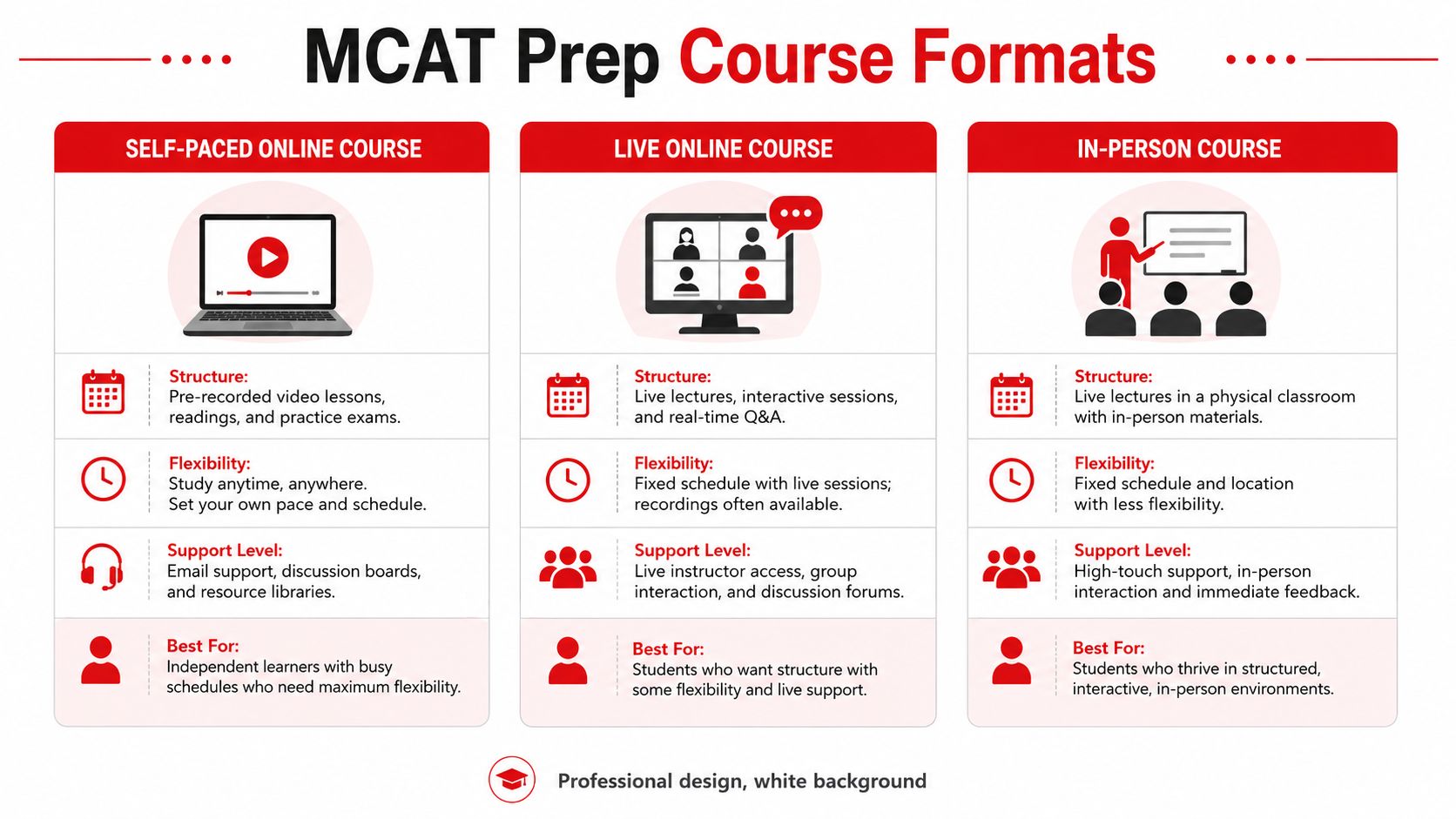
Self-paced preparation
Self-study gives you maximum control. You choose the books, videos, question bank, flashcards, and practice tests, then build the calendar yourself. This format fits students who can identify weaknesses accurately, protect study blocks without external supervision, and review missed questions instead of just counting completed questions.
Its weakness is also its defining feature. Nobody automatically notices that you spent a week rereading biology while avoiding timed CARS passages or full-length review. Self-study works best when you create fixed milestones, maintain an error log, and use official AAMC materials as an anchor. The MCAT preparation resources from Ace Med Boards can be considered alongside those official materials when you're deciding what level of structure you need.
Live online and classroom courses
Live online courses provide scheduled instruction without requiring travel. They can help students who need a recurring appointment, instructor explanations, and the ability to ask questions in real time. In-person courses add a physical classroom, peer presence, and a more rigid routine.
Both formats can become passive if the schedule emphasizes lectures over application. Ask how much time the program expects you to spend completing passages, reviewing every answer choice, and taking timed exams outside class. A polished lecture calendar isn't evidence of a complete preparation system.
Groups and one-on-one tutoring
A group program offers shared accountability and discussion. It may suit students who learn through explanation and benefit from seeing how peers approach a passage, but group pacing can leave some learners behind or move too slowly for others.
One-on-one tutoring is more targeted. A tutor can examine whether a miss came from a content gap, a reasoning error, a misread, or pacing, then assign work accordingly. It tends to make the most sense when you have a narrow weakness, an uneven baseline across sections, or difficulty converting independent practice into a repeatable process.
Practical rule: Choose the format that solves your main failure point, not the format with the longest list of features.
You can also mix formats. For example, a student might use free official materials and self-paced content review, join a structured study group for accountability, and seek targeted help with CARS reasoning or physics fundamentals. That hybrid approach is often more rational than paying for a full course whose instruction duplicates material you already understand.
How Each MCAT Prep Path Works and Who It Fits
The modern MCAT market has moved toward official and low-cost digital preparation, not only private classroom instruction. The AAMC's official MCAT preparation resources include two free full-length practice exams, the free “What's on the MCAT Exam” content-outline course, 120 practice questions, and study-plan tools. The Khan Academy MCAT Collection adds about 1,100 video lessons and 3,000 review questions, creating a substantial free study ecosystem.
That changes the buying decision. A paid course shouldn't be judged by whether it contains information. It should be judged by whether it helps you use information under time pressure and correct recurring errors.
A practical comparison
| Prep path | What the week usually looks like | Best fit | Main limitation |
|---|---|---|---|
| Self-study | Reading or video review, flashcards, question practice, and scheduled full-length exams | Students with reliable discipline and clear self-monitoring | You must design the system and detect your own patterns |
| Live online course | Scheduled lessons, assignments, group discussion, and instructor questions | Students who need external deadlines but require location flexibility | Fixed pacing may not match your weaknesses |
| In-person course | Classroom instruction, assigned work, and peer accountability | Learners who study better in a physical routine | Travel and rigid scheduling can reduce usable study time |
| Group program | Cohort meetings, shared practice, and collaborative review | Students who benefit from social accountability | Group feedback may not address individual reasoning errors |
| One-on-one tutoring | Diagnostic review, targeted teaching, guided passages, and customized assignments | Students with specific weaknesses or inconsistent independent work | It requires active participation between sessions |
A self-paced course becomes more effective when you treat it as a project-management system. Put every section on a calendar, assign review blocks after each practice set, and reserve time for full-length exams under realistic conditions. Without those behaviors, “flexibility” can become indefinite postponement.
Live instruction is valuable when the instructor's feedback changes what you do next. Before enrolling, ask whether sessions include passage walkthroughs, whether questions are answered between classes, and how the program handles students who are ahead or behind. The same questions apply to classroom programs, with the added concern of commute time.
When personalization matters most
Private support is most useful when your problem isn't “I need more content.” Perhaps you know the biology but miss questions because you don't identify the experiment's variable. Perhaps you understand equations but lose time deciding which relationship applies. Perhaps your CARS misses come from importing outside assumptions into the passage.
In those situations, one-on-one tutoring benefits come from feedback on the reasoning process, not from receiving another set of notes. A tutor should help you name the error, practice the correction, and test whether the correction transfers to an unfamiliar passage.
The best path may change during preparation. You might begin with self-study, add a group for accountability, and later use targeted tutoring when your error log reveals a persistent issue. That isn't evidence that your first decision failed. It means your preparation system responded to evidence.
Cost, Time Commitment, and Evidence of Effectiveness
How much should you spend on MCAT preparation, and how much time can you protect? Price is only one part of the answer. The market includes free official resources and paid programs costing several thousand dollars, with roughly a five-fold spread among paid courses. Recent market data place the average course at about $1,985. Score-guarantee courses average about $2,299, compared with about $1,006 for courses without guarantees. These figures from MCAT market pricing data provide market context, not proof that a higher price produces a better result.
Your budget must also cover registration. For 2026 testing, the standard MCAT registration fee is $355, while the Fee Assistance Program registration fee is $145. Examinees testing outside the United States, Canada, or U.S. territories pay an additional $130 international fee, which is nonrefundable if registration is canceled, according to the AAMC scheduling and fee information.
Time investment matters more than course format
MCAT preparation is commonly planned around 300 to 350 total study hours over three to six months. At 15 to 20 hours per week, that workload can fit without forcing practice review into the final weeks. A compressed plan requires 25 hours per week for 12 weeks to reach the 300-hour benchmark, according to this MCAT study-hours calculator.
A course earns its cost only when its assignments help you protect that time. Count content review, passage work, full-length exams, answer-choice analysis, error-log maintenance, and spaced retrieval, not just scheduled lectures. A lower-priced format that you complete may serve you better than an expensive program whose workload never fits your week.
What effectiveness evidence can and cannot show
Preparation should change as your needs change. Early study is often content-heavy, while the second half should become practice-heavy, with at least half of total study time devoted to completing and reviewing questions rather than passively reading or watching. Independent summaries report gains of only about 3 to 5 points among students who spend most of their time on content review. Students who combine content review with timed practice and error analysis see larger gains. The same summary describes highly engaged course users clustering around 510 to 515 after roughly 300 to 450 hours, but those observations do not prove that the course caused the results. Review the discussion in this analysis of MCAT self-study and course outcomes.
Selection bias complicates comparisons. More motivated students may choose intensive programs and complete more assignments, making raw score averages look stronger than the program's independent effect. Examine the mechanism instead: diagnostics, repeated practice, useful feedback, sufficient question volume, and a process that makes you review mistakes thoroughly.
For a broader view of education spending, read this discussion of investment in education, then compare the cost with the specific support you will use.
How to Choose an MCAT Prep Option Based on Your Baseline and Schedule
Which prep path matches your available hours, starting point, and learning style? Answer that question before comparing providers. A diagnostic gives you a clearer map than a sales call. Classify each missed question as content, reasoning, misread, or pacing. A content-heavy course may be the wrong purchase if your real difficulty is extracting evidence from passages.
The AAMC's validity research reports median correlations of around 0.42 across outcomes between MCAT performance and later medical school performance. It also reports that MCAT scores predict preclerkship and clerkship performance, as well as USMLE Step 1 and Step 2 CK performance, better than undergraduate GPA alone. Combining MCAT and GPA improves prediction for several later outcomes. Read the AAMC MCAT validity research as a reason to prepare deliberately, not as evidence that one score determines your medical future.
Use this decision tree
Can you protect your planned weekly hours?
If yes, self-study may be sufficient. If no, choose scheduled accountability. A study plan works like a gym appointment: the structure matters when independent follow-through is inconsistent.Are your weaknesses concentrated in one section or skill?
Targeted tutoring or a focused group may use your time better than a standard course. Broad weaknesses may justify a wider structured program.Do recorded explanations help you learn?
If yes, self-paced or hybrid preparation may fit. If no, live instruction can resolve confusion while it is still affecting your practice.Will the schedule survive classes, work, caregiving, or your timezone?
If not, reject the program regardless of its reputation. A schedule you cannot follow has no practical value.Does the price purchase feedback, or mainly more content?
Look for diagnostics, passage review, progress checks, and clear assignment expectations. Those features address different problems than another video library.
A baseline score is a measurement, not an identity. A weak diagnostic may reflect unfinished coursework, unfamiliar timing, anxiety, or test strategy. Identify the cause first, then choose support that addresses it.
Use a two-week trial plan before committing to a more expensive format. Complete the planned retrieval, passage practice, and review. Repeatedly skipping work suggests a need for accountability. Completing the work without explaining missed questions suggests a need for feedback. If the plan fits and your review improves, self-study or a lighter hybrid option may be enough. The course-versus-self-study market analysis discusses why simple provider comparisons can mislead when hours, structure, and engagement differ.
For help estimating the time your plan requires, use this MCAT preparation time guide.
Sample MCAT Study Timeline and Weekly Milestones
An effective study timeline begins with honest self-assessment, not wishful planning. Use an official-style diagnostic, classify missed questions as content, reasoning, misreading, or pacing problems, then match your weekly work to the pattern. Rebuild only the content you need, practice passages untimed before adding time limits, review every answer choice, and retest with unseen full-length material under exam conditions.
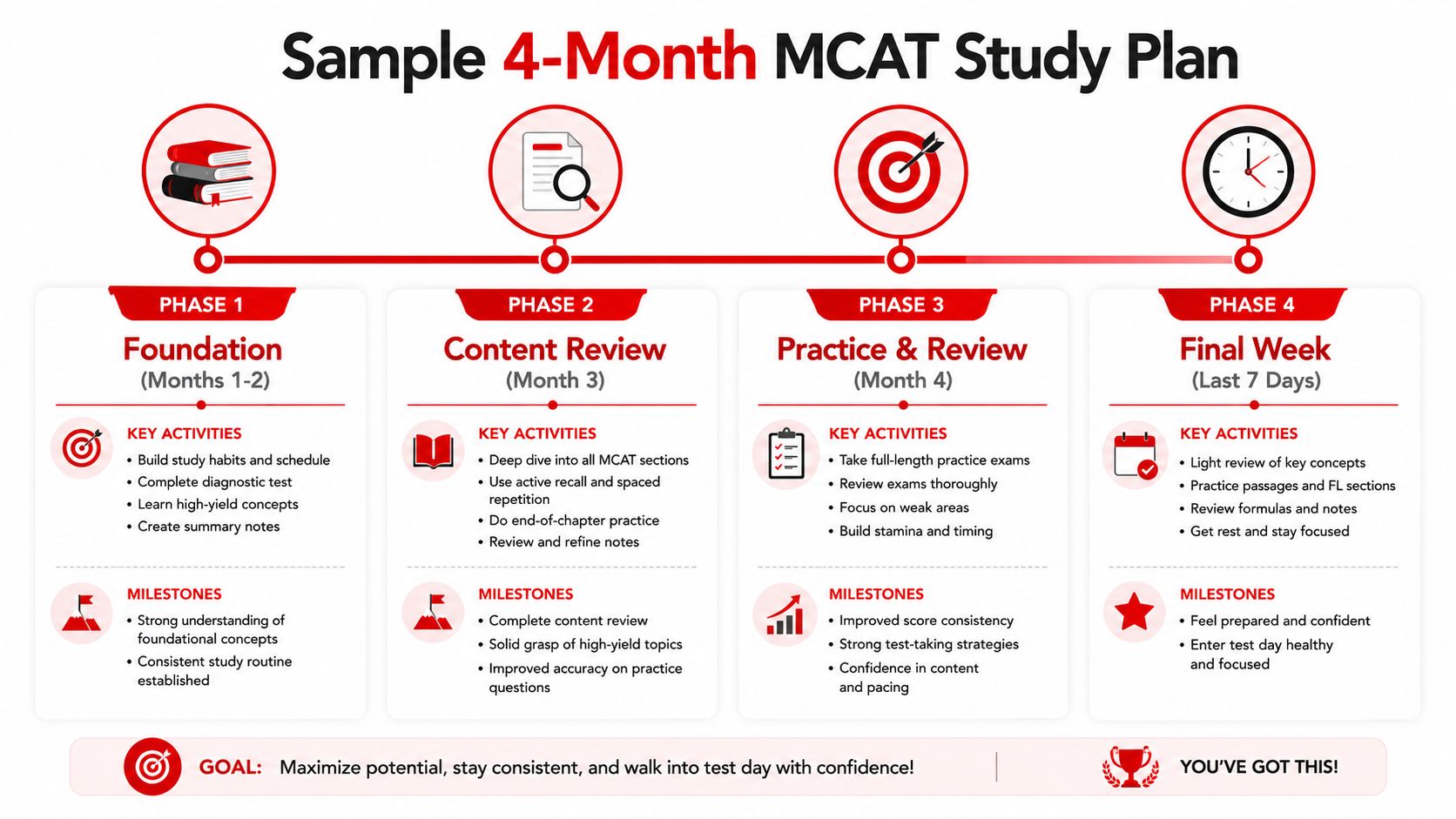
A four-month framework
| Phase | Main work | Milestone |
|---|---|---|
| Foundation | Diagnostic, content map, retrieval practice, and foundational review | You can name your recurring weaknesses |
| Targeted rebuilding | Focused content repair paired with untimed passages | You can explain why each answer choice succeeds or fails |
| Timed application | Mixed passages, timed sections, full-length practice, and detailed review | Your pacing decisions become deliberate |
| Final review | Official-style testing, error-log maintenance, and light retrieval | You can execute the routine without adding unnecessary new material |
Treat these phases as adjustable checkpoints, not fixed rules. A major knowledge gap calls for more rebuilding. Adequate content knowledge with weak reasoning calls for less passive review and more passage analysis. Students balancing demanding coursework may need a longer calendar, because an achievable weekly load leaves room for review and correction.
The passage-review sheet
Use the following template after every meaningful practice set. It works across Chemical and Physical Foundations, CARS, Biological and Biochemical Foundations, and Psychological, Social, and Biological Foundations.
- Tested concept: Identify the principle, relationship, or reading issue.
- Task: State what the question required, such as interpreting a graph, identifying an assumption, or applying a definition.
- Evidence line: Record the exact location in the passage, figure, or question stem that supports your reasoning. Don't reproduce copyrighted question text.
- Why the credited answer wins: Explain the logic in your own words.
- Why each distractor fails: Name the unsupported assumption, scope error, reversed relationship, or irrelevant fact.
- Timing: Record how long you spent and whether the time was lost during reading, calculation, or decision-making.
- One transfer rule: Write a reusable rule for a new passage, such as “Separate the variable measured from the variable manipulated before interpreting the result.”
This process reflects the purpose of official MCAT content outlines and preparation materials. It also prevents a common mistake: treating an answer key as feedback. Learning occurs when you can explain both the correct choice and why every alternative fails.
Here is a visual reminder of how the phases fit together:
Review your diagnostic and weekly log to judge whether the timeline is working. High completed hours with repeated errors points to a feedback problem. Frequent schedule disruptions may require fewer simultaneous commitments or a longer preparation window. A consistent plan with time for review usually serves you better than a compressed schedule that leaves no room to learn from mistakes.
Next Steps and Final Decisions Before You Commit
Before enrolling, ask what the package includes. Confirm access to official practice materials, the number of full-length exams included, the expected weekly workload, schedule-adjustment rules, refund terms, tutor qualifications, and the expected feedback process. Don't treat a score guarantee as proof of instructional quality, especially when eligibility conditions are difficult to compare.
A short readiness checklist can prevent an expensive mismatch:
- Diagnostic clarity: You know whether your main issue is content, reasoning, misreading, or pacing.
- Calendar fit: You can protect the required weekly hours.
- Practice balance: The plan includes timed work and deep review, not only lectures.
- Resource fit: You know which official AAMC materials will anchor your preparation.
- Support gap: You can name the specific problem a paid program will solve.
The MCAT prep hub can be one place to review preparation support before deciding whether you need a full structure or focused help. If your needs are limited to CARS reasoning, chemistry and physics fundamentals, or accountability, targeted support may be more sensible than purchasing an entire course.
Keep application timing in view. The AAMC reports that official scores are released 30 to 35 days after the exam date, and all MCAT scores from 2003 to the present are automatically released to AMCAS unless a score was voided, as explained in AAMC score reporting guidance. Most medical schools require scores to be no more than three years old, though schools generally accept scores dating back two or three years and set their own cutoff policies, according to AAMC score-validity guidance.
Ace Med Boards offers one-on-one online MCAT tutoring with individualized study plans and diagnostic review focused on MCAT preparation. If you want help comparing self-study, a course, or targeted tutoring against your baseline and schedule, visit Ace Med Boards to request a consultation without treating any preparation path as a guaranteed outcome.