

MCAT scores include four section scores from 118 to 132 and a total score from 472 to 528, centered at 500. A good score is context-specific, so compare your total and section profile with the current AAMC percentile table and the ranges reported by your target schools in the Medical School Admission Requirements database, or MSAR.
A single total can hide an important difference. Two applicants may both earn the same total while showing very different section strengths, percentile positions, academic histories, and school lists. The most useful way to read MCAT scores is as a five-number profile plus context, not as one universal cutoff.
What MCAT Scores Mean at a Glance
The Medical College Admission Test, or MCAT, reports five scores: one total score and one score for each of its four sections. The total is the sum of the section scores, while the section scores show how evenly your performance was distributed.
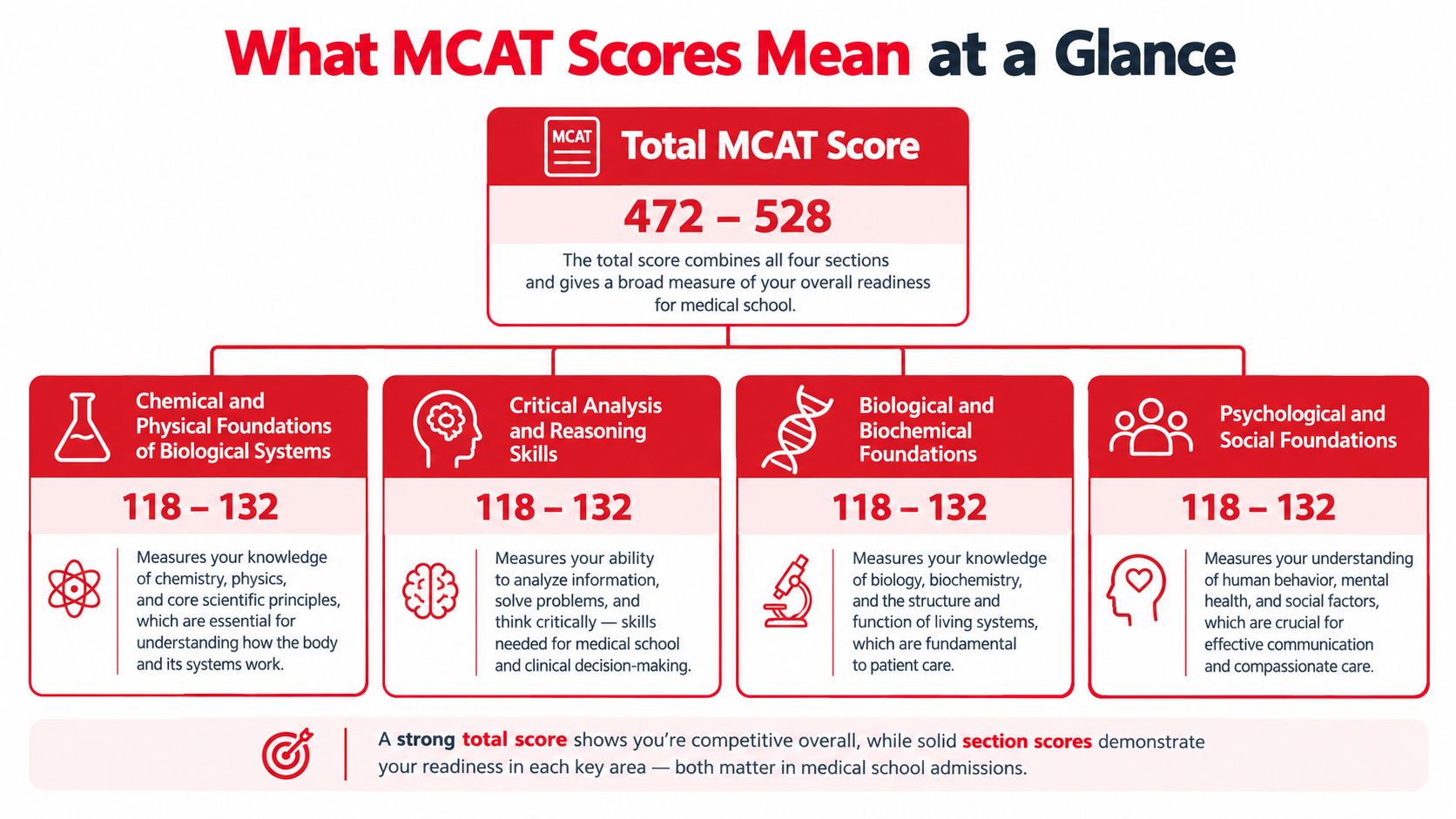
The four sections are:
- Chemical and Physical Foundations of Biological Systems, which tests scientific reasoning across chemistry, physics, and related biological systems.
- Critical Analysis and Reasoning Skills, usually called CARS, which measures analysis and reasoning through passages.
- Biological and Biochemical Foundations of Living Systems, which focuses on biological and biochemical reasoning.
- Psychological, Social, and Biological Foundations of Behavior, which examines behavioral and social science concepts in relation to health and behavior.
Each section has a 118 to 132 scale, with 125 as its midpoint. Because there are four sections, the total midpoint is 500. The scale itself tells you the absolute result, while the percentile tells you how that result compares with other examinees.
The five-number profile
Start with these questions:
- What is the total score?
- How are the four section scores distributed?
- What percentile does the current AAMC table assign to each result?
- How does the profile compare with the ranges for your target schools?
- What do your GPA, coursework, experiences, and timeline add to the picture?
This framework also helps international applicants, foreign medical graduates considering U.S. medical education, and pre-medical applicants avoid importing an outdated benchmark from a different admissions system. The meaning of a score depends on the pathway and the schools evaluating it.
Practical rule: Treat your total as the headline, your section scores as the detail, and your school list as the context.
If you're also evaluating English-language readiness for academic study, a separate Cathoven CEFR test guide can help clarify how language proficiency frameworks differ from standardized admissions exams. It shouldn't be used as a substitute for MCAT score interpretation.
How the MCAT Scoring Scale Actually Works
MCAT scoring becomes easier to understand when you separate three stages: raw performance, scaled scores, and equating.
At the raw stage, the test records how many questions you answered correctly in each section. The AAMC states that there's no penalty for incorrect answers, unanswered questions, or guessing, so leaving a question blank doesn't create an advantage.
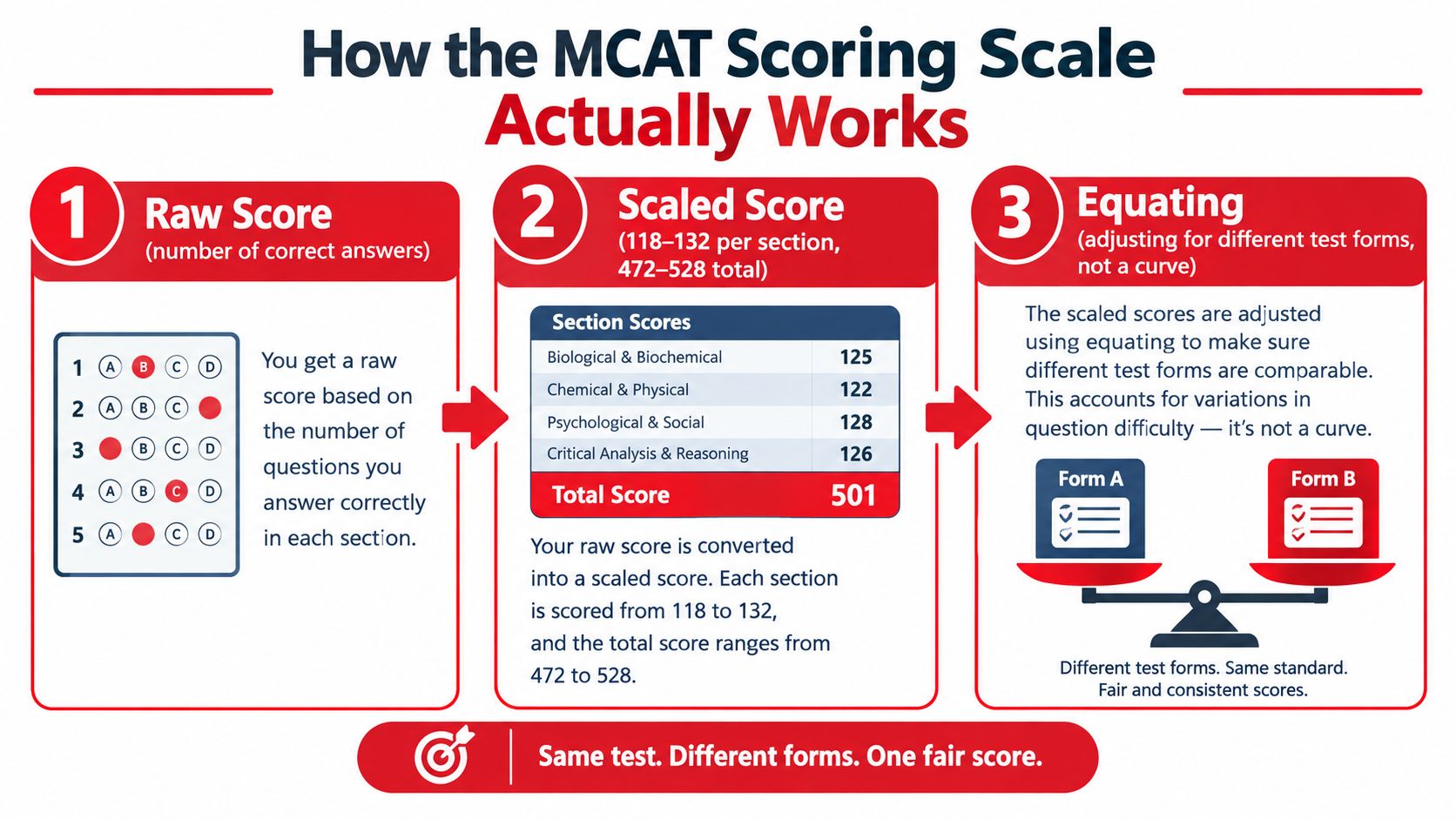
From raw answers to scaled scores
The number correct is converted into a scaled section score from 118 to 132. The AAMC explains that raw scores are converted after the test form has been evaluated and equated, so the same number correct may not produce exactly the same scaled value across different section forms. That doesn't mean the scoring is arbitrary. It reflects differences in form difficulty.
Think of equating as calibrating measuring instruments. If one test form is slightly more difficult than another, the scoring process accounts for that difference so the final scaled score has a consistent interpretation.
The MCAT is not curved. A curve would imply that your score depends on how other examinees perform on your test date. Instead, scores are scaled and equated so that a given score has the same meaning across administrations, as explained in the AAMC MCAT scoring guidance.
Why this matters for planning
A practice result based only on raw correct answers isn't enough for a reliable comparison with an official score. Use scaled scores from official practice materials when possible, then review the underlying errors to identify content gaps, reasoning problems, timing issues, or avoidable mistakes.
The Ace Med Boards explanation of what the MCAT is scored out of provides a concise reference for the scale. For a visual explanation of the scoring process, review the following educational video.
Your score isn't a direct percentage-correct result. It's a standardized interpretation of section performance, which is why raw-score comparisons across forms can mislead you.
Understanding Percentiles and Why They Change Each Year
A scaled score answers, “What result did I earn on the MCAT scale?” A percentile rank answers, “How did my result compare with other test takers?”
The AAMC defines a percentile rank as the percentage of scores equal to or lower than a given score. It's a relative measure, not a percentage of questions answered correctly.
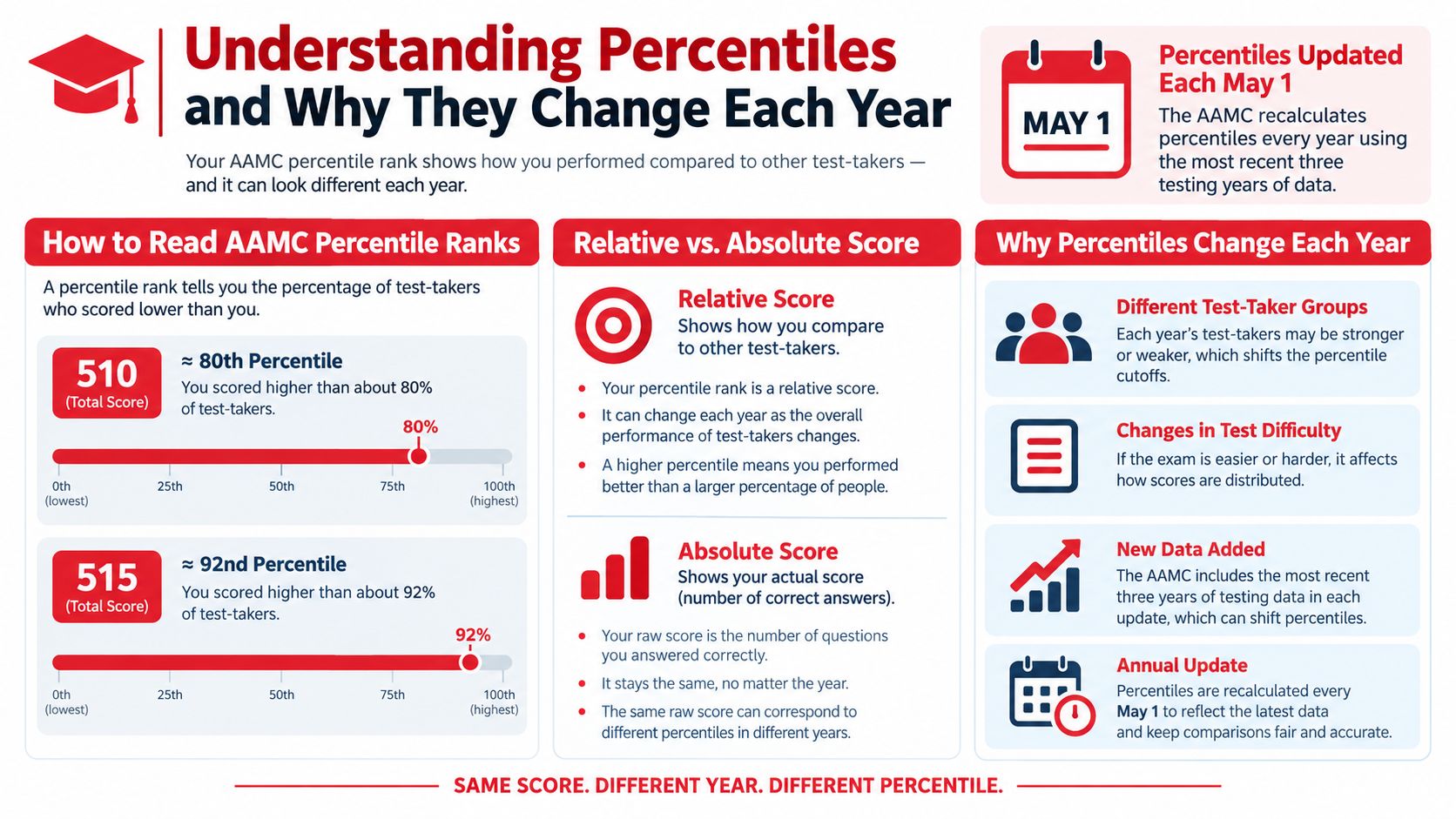
Why the reference group matters
AAMC updates percentile ranks annually on May 1, using results from the most recent three testing years, according to its official percentile-rank guidance. The score doesn't change, but its displayed relative position can shift when the reference pool changes.
A clear example appears in AAMC's historical tables. The 2024 percentile table stated that 73% of total scores were at or below 508, using combined results from 2021, 2022, and 2023. The 2023 table stated that 72% were at or below 508, using 2020, 2021, and 2022 results, as shown in the AAMC percentile table.
That one-point movement doesn't mean the exam became easier or that the applicant became stronger or weaker. It shows that percentiles describe a changing reference group. In recent cycles, 508 has been around the low-70th percentile, but applicants should always check the table for the relevant reporting period.
How to use percentiles correctly
Use the current percentile table for national context, then compare the result with each school's current MSAR information. Don't treat a percentile as an admission probability, and don't treat a historical percentile as permanently fixed.
Near the center of the distribution, a single point can move a score across several percentile bands. That makes small numerical differences worth reviewing carefully, but it doesn't make one point a complete judgment of readiness or potential.
The Ace Med Boards guide to MCAT percentiles can serve as a practical companion while you interpret both total and section percentiles.
What Counts as a Good MCAT Score for Your Goals
There isn't one universal “good” MCAT score. A result near the overall mean can have a different implication for an applicant targeting Doctor of Medicine, or MD, programs than for someone applying to Doctor of Osteopathic Medicine, or DO, programs.
AAMC data summarized for current selection contexts report an overall mean around 500, an MD applicant average of 506.3, and an MD matriculant average of 512.1. The same source reports a DO applicant average of 502.43 and a DO matriculant average of 502.97. These are group averages, not individual thresholds or predictions, as described in the current MCAT statistics summary.
MCAT score context by pathway
| Group | Average Total MCAT | What It Means for You |
|---|---|---|
| Overall test-taker context | Around 500 | Use this as a broad midpoint, not as an admissions target. |
| MD applicants | 506.3 | A score near the national midpoint may sit below the average for applicants pursuing MD programs. |
| MD matriculants | 512.1 | This describes a group that entered MD programs, not a guaranteed benchmark for every school or applicant. |
| DO applicants | 502.43 | The same total can be interpreted differently in an osteopathic application context. |
| DO matriculants | 502.97 | This group average may provide useful context, but schools still evaluate the full application. |
The reported applicant average for 2025 to 2026 is 506.1, compared with about 499.6 in 2016 to 2017, indicating that older score advice may not reflect current applicant conditions, according to the same data summary. Because admissions decisions include more than MCAT scores, don't convert any group average into an individual probability.
Build a school-specific comparison
Use the current Medical School Admission Requirements, or MSAR, profile for each MD school on your list. Compare your total and each section with the reported school ranges, then add GPA, coursework, experiences, state or regional factors, and your application timing.
For DO programs, review each school's current admissions information directly and apply the same principle. A lower score deserves analysis, not shame. Ask whether the section pattern reflects a fixable content gap, unstable practice performance, test anxiety, limited preparation time, or a broader application-context issue. The Ace Med Boards guide to what makes a good MCAT score offers another way to organize that comparison without reducing your future to a single number.
How to Read Your Official AAMC Score Report
What does your official AAMC report reveal beyond the total score? Read it as a five-number profile, then add confidence bands, section balance, and percentile context. That fuller picture supports school comparisons and retake planning.
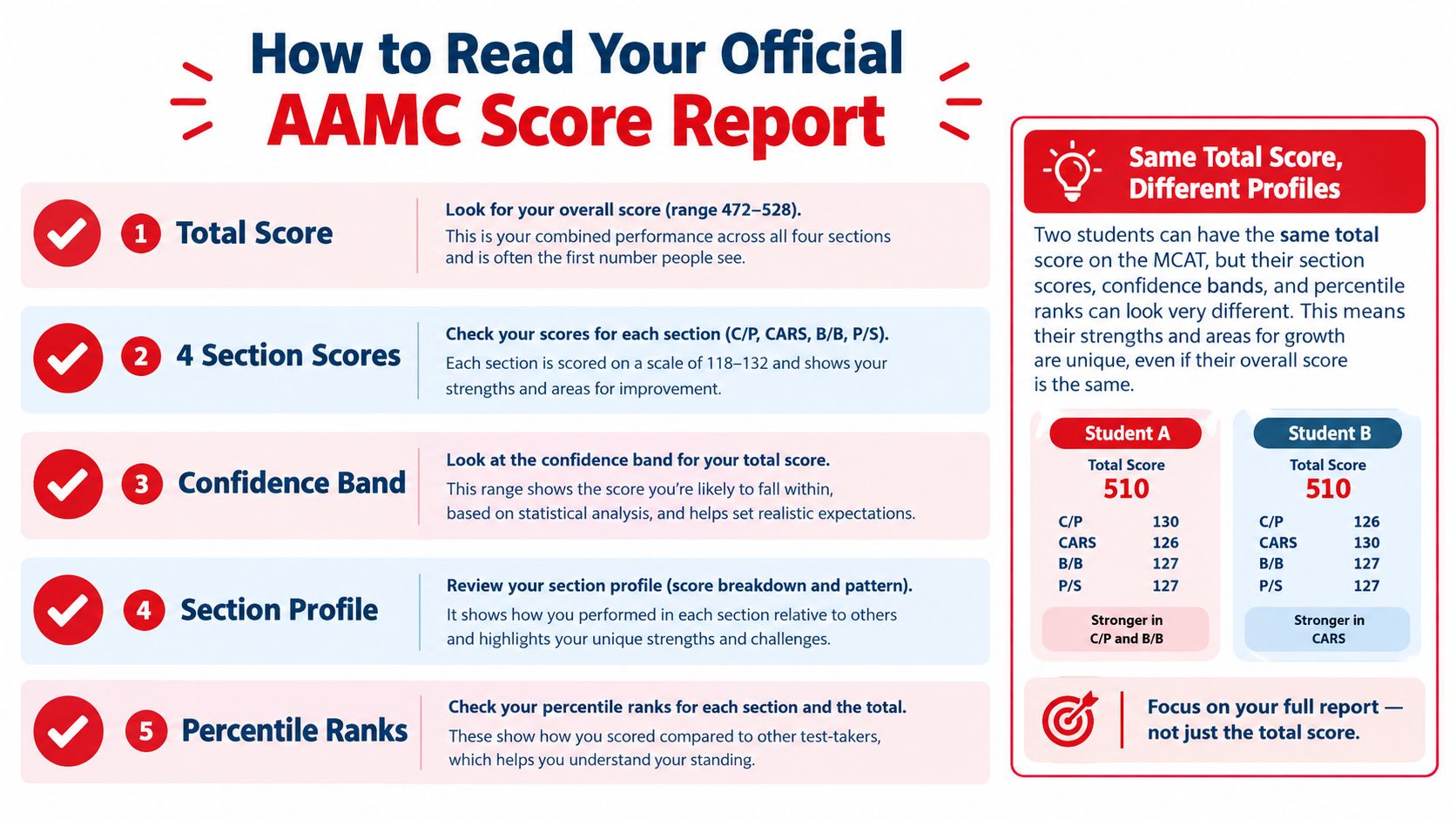
Read the report in order
- Total score: Record your result on the 472 to 528 scale.
- Four section scores: Write each section separately, including CARS.
- Confidence bands: Use them to understand the uncertainty around each result, not to predict an exact future score.
- Section profile: Identify balance, clear strengths, and any section that needs explanation or targeted improvement.
- Percentile ranks: Check the current AAMC table and record the period it covers.
The total is the headline, while the section profile shows how that headline was produced. Two applicants with the same total may have very different patterns. One might perform evenly across sections; another might pair a strong area with a noticeably weaker one. Record all five numbers before comparing your profile with each school's current MSAR information.
Plan around score release
AAMC states that scores are typically released about 30 to 35 days after the exam and are guaranteed to be available by 5:00 p.m. Eastern Time on the scheduled release date. Review the AAMC MCAT calendar and score-release guidance. For a fuller walkthrough of release windows and what to expect, see the Ace Med Boards guide to MCAT score release dates.
Most applicants use the American Medical College Application Service, or AMCAS, to send application information to participating MD programs. Schools and programs that do not receive results through AMCAS may use the electronic MCAT Score Reporting Service, described in the official score-reporting service guidance.
Save the report, note the percentile-table period, and place your total and section scores beside your target-school MSAR ranges. That worksheet makes your profile easier to discuss and keeps an older percentile chart or screenshot from becoming your only reference.
Retake Rules Score Reporting and Application Strategy
A retake shouldn't be an automatic response to disappointment. It's a decision about whether additional preparation can address a clear problem while preserving your broader application timeline.
Because MCAT scores are equated across test dates, a retake gives you another opportunity to demonstrate performance on the same underlying scale. It doesn't erase the earlier result, and the best decision depends on the complete record.
A practical decision table
| Situation | Questions to ask | Reasonable next step |
|---|---|---|
| Total and sections align with target-school ranges | Does the current percentile and profile fit the schools on your list? | Consider applying if the rest of the application is ready. |
| One section is materially weaker | Is the weakness outside several target-school ranges, or does it reflect a temporary issue? | Investigate a focused section plan before deciding. |
| Practice scores are inconsistent | Are errors caused by content, reasoning, timing, or test-day conditions? | Delay the decision until your practice trend is stable enough to evaluate. |
| The score is below your preferred range | Do you have enough time for meaningful preparation without harming coursework or application quality? | Compare a retake timeline with a broader, realistic school list. |
| Test anxiety or difficult circumstances affected the attempt | Can you identify specific conditions and support needs? | Address the cause before scheduling another attempt. |
The AAMC percentile table for May 1, 2025 through April 30, 2026 is a time-specific reference, not a permanent conversion chart. Use the table that applies to your application planning period.
Don't interpret a low score as proof that you can't become a physician. It may signal that you need more content review, better passage reasoning, improved pacing, a different study structure, or more time. The Ace Med Boards guidance for a low MCAT score can help you frame that result as a planning problem rather than a personal verdict.
If you're rebuilding your preparation approach, a general Kohru test preparation guide may offer useful study-structure ideas. Apply any general method selectively, because MCAT preparation should be based on your own section data and official practice results.
Your Next Steps Score Context Worksheet and Focused Improvement Plan
Use this worksheet before choosing a retake date or finalizing a school list. Complete it with your official report, the current AAMC percentile table, each target school's current MSAR range, and your broader application information.
Score-context worksheet
| Field | Your information |
|---|---|
| Total score | |
| Chemical and Physical Foundations score | |
| CARS score | |
| Biological and Biochemical Foundations score | |
| Psychological, Social, and Biological Foundations score | |
| Current total percentile | |
| Current section percentiles | |
| Target-school MSAR ranges | |
| GPA and prerequisite coursework context | |
| Clinical, service, research, and other application context | |
| Time available before application deadlines | |
| Practice-test trend | |
| Retest decision factors |
A clearly labeled composite example
Composite example, not a verified student case: An applicant has a competitive total but one materially weaker section. Rather than calling the score good or bad, the applicant compares that section with target-school ranges, reviews practice-test trends, considers time available, and evaluates GPA and the rest of the application.
The resulting plan focuses on the weak section without abandoning the stronger areas. The applicant might audit missed questions by content gap, passage interpretation, timing, and careless error, then use official practice material to check whether the pattern changes. No improvement should be promised in advance, and no group result should be treated as an individual prediction.
A short planning checklist
- Confirm the scale: Record the total and all four section scores.
- Update the percentile: Use the current AAMC table, not an old screenshot.
- Compare schools: Enter each target school's current MSAR range.
- Audit the profile: Identify imbalance and likely causes.
- Protect the timeline: Consider coursework, application quality, and available preparation time.
- Choose deliberately: Apply, retest, broaden the list, or seek individualized guidance based on the complete picture.
This worksheet is designed for planning as of 2026. Recheck AAMC score-report guidance, current percentile ranks, and MSAR information before making a time-sensitive application decision.
Ace Med Boards offers MCAT preparation and medical school admissions consulting, including structured review of score profiles, percentiles, target-school context, and retest decisions. If you want help turning your MCAT scores into a practical plan, visit Ace Med Boards to learn more or request a free consultation.