The COMLEX Level 1 blueprint is NBOME's two-dimensional outline, with Application of Knowledge for Osteopathic Medical Practice accounting for at least 60% of the examination and foundational biomedical sciences specified at 75% within that domain, not across the whole exam. Its seven competency domains and ten clinical presentations describe examination content from complementary angles.
Does a completed question-bank dashboard show blueprint coverage, or only how many questions a student has finished? A personal item audit helps distinguish the two. By mapping practice questions to both dimensions, a student can identify underrepresented content without assuming that every weak tag requires more study time everywhere.
By Ace Med Boards Editorial Team
COMLEX Level 1 Blueprint Competency Weights
The Osteopathic Medical Licensing Examination of the United States (COMLEX-USA) is developed by the National Board of Osteopathic Medical Examiners (NBOME). Its Level 1 blueprint separates what a candidate must do, the competency domain, from the clinical context in which that task appears, the clinical presentation.
The NBOME Level 1 blueprint identifies seven competency domains and ten clinical presentations, with Application of Knowledge for Osteopathic Medical Practice carrying a minimum 60% allocation and foundational biomedical sciences specified at 75% within that domain. The competency-domain minimums below belong to that same published framework.
Level 1 competency-domain minimums
| Competency domain | Minimum share | Planning note |
|---|---|---|
| Application of Knowledge for Osteopathic Medical Practice | At least 60% | Foundational biomedical sciences are specified at 75% of this domain |
| Osteopathic Principles, Practice, and Manipulative Treatment | At least 12% | Required osteopathic content, not an optional add-on |
| Osteopathic Patient Care and Procedural Skills | 6% | Patient-care and procedure competency |
| Practice-Based Learning and Improvement | 4% | Learning from evidence and performance |
| Interpersonal and Communication Skills | 3% | Communication competency |
| Professionalism | 3% | Professional behavior competency |
| Systems-Based Practice | 2% | Systems and practice context |
The important distinction is the denominator. The biomedical-sciences specification describes a component inside the knowledge-application domain. Treating it as a separate whole-examination allocation would misread the hierarchy and distort a study audit.
These categories also aren't a list of courses that must be reviewed in isolation. A student may study anatomy, physiology, and pathology separately, but a practice question can require those concepts to be combined before an answer becomes clear.
How a question receives both kinds of tags
Consider an original educational mapping example rather than an examination question: a musculoskeletal stem asks the learner to explain a functional finding using a biomedical mechanism. The clinical-presentation tag is Musculoskeletal System, while the competency tag concerns application of knowledge.
If the task also requires interpreting a somatic finding through osteopathic principles, the student's audit may add an osteopathic competency tag. That additional tag records a genuine reasoning requirement, not the appearance of an osteopathic term somewhere in the stem.
This is a personal study classification, not a claim about NBOME's internal item-coding process. The purpose is to identify what the learner practiced.
A useful safeguard is to tag the task required to choose the answer, rather than every subject mentioned. Otherwise, a question with a long history can accumulate so many tags that the audit stops distinguishing meaningful exposure from background detail.
For targeted osteopathic review, the osteopathic manipulative medicine board-review guide offers a related starting point. It complements the audit rather than replacing the need to inspect question-level reasoning.
Planning rule: A blueprint minimum is a floor for examination design, not an instruction to divide study hours mechanically or a separate passing hurdle for each domain.
A weaker area therefore calls for investigation, not an automatic conclusion about the overall result. The useful question is whether the learner lacks exposure, misunderstands a concept, or struggles to apply it under time pressure.
Key Takeaways
- Both dimensions apply to the same content. Competency and presentation are complementary labels, not separate examinations.
- Biomedical reasoning receives the greatest emphasis. Memorizing isolated facts isn't the same as applying them.
- Osteopathic principles require deliberate coverage. They shouldn't be treated as optional material after general science review.
- Specifications need a version check. These figures reflect the NBOME materials discussed here; the current official page should be checked for the candidate's testing cycle.
Clinical Presentation Shares to Prioritize
Which clinical contexts appear in the COMLEX Level 1 blueprint, and how can you compare them with the tags in your question bank? Competency tags describe the task a question tests; presentation tags describe the patient or community context. Because question banks may use different labels, map each practice tag to the closest official category rather than copying vendor labels directly.
The NBOME COMLEX Level 1 blueprint lists clinical presentations and their blueprint shares. The ten presentation categories are:
- Musculoskeletal System
- Community Health and Patient Presentations Related to Wellness
- Nervous System and Mental Health
- Gastrointestinal System and Nutritional Health
- Circulatory and Hematologic Systems
- Respiratory System
- Human Development, Reproduction, and Sexuality
- Endocrine System and Metabolism
- Genitourinary/Renal System and Breasts
- Integumentary System
Rank exposure without confusing it with mastery
A blueprint share describes the expected representation of a category on the exam. It does not mean that every diagnosis within that category has equal importance, or that completing the same share of questions proves mastery.
For a personal audit, record the number of questions you have practiced under each presentation category. Then compare those counts with the blueprint shares. Treat the comparison as a guide to sampling, not a formula for assigning study hours: an underrepresented category needs more practice, while a frequently practiced category with repeated errors needs closer review of the reasoning.
A question bank's musculoskeletal tag, for example, does not automatically mean the question tests osteopathic principles. Apply an osteopathic competency tag only when answering requires that reasoning. This distinction helps keep the audit focused on what the question asks.
The COMLEX Level 1 question guide can help you choose practice questions. For each question, note the presentation category and the competency needed to answer it. A coverage gap describes your practice sample; a knowledge gap points to reasoning that needs work.
Personal audit worksheet: Map each practice tag to an official presentation and competency. Count the questions in each category, then compare your distribution with the blueprint shares.
Worked example: If a question bank tags a case as “joint pain,” map it to Musculoskeletal System. If the answer also requires applying osteopathic principles, record that competency separately. If it tests diagnosis without osteopathic reasoning, do not add that competency tag.
| Practice tag | Official clinical presentation | Competency tested | Number of questions |
|---|---|---|---|
Test Day Length and the 2026 Format Change
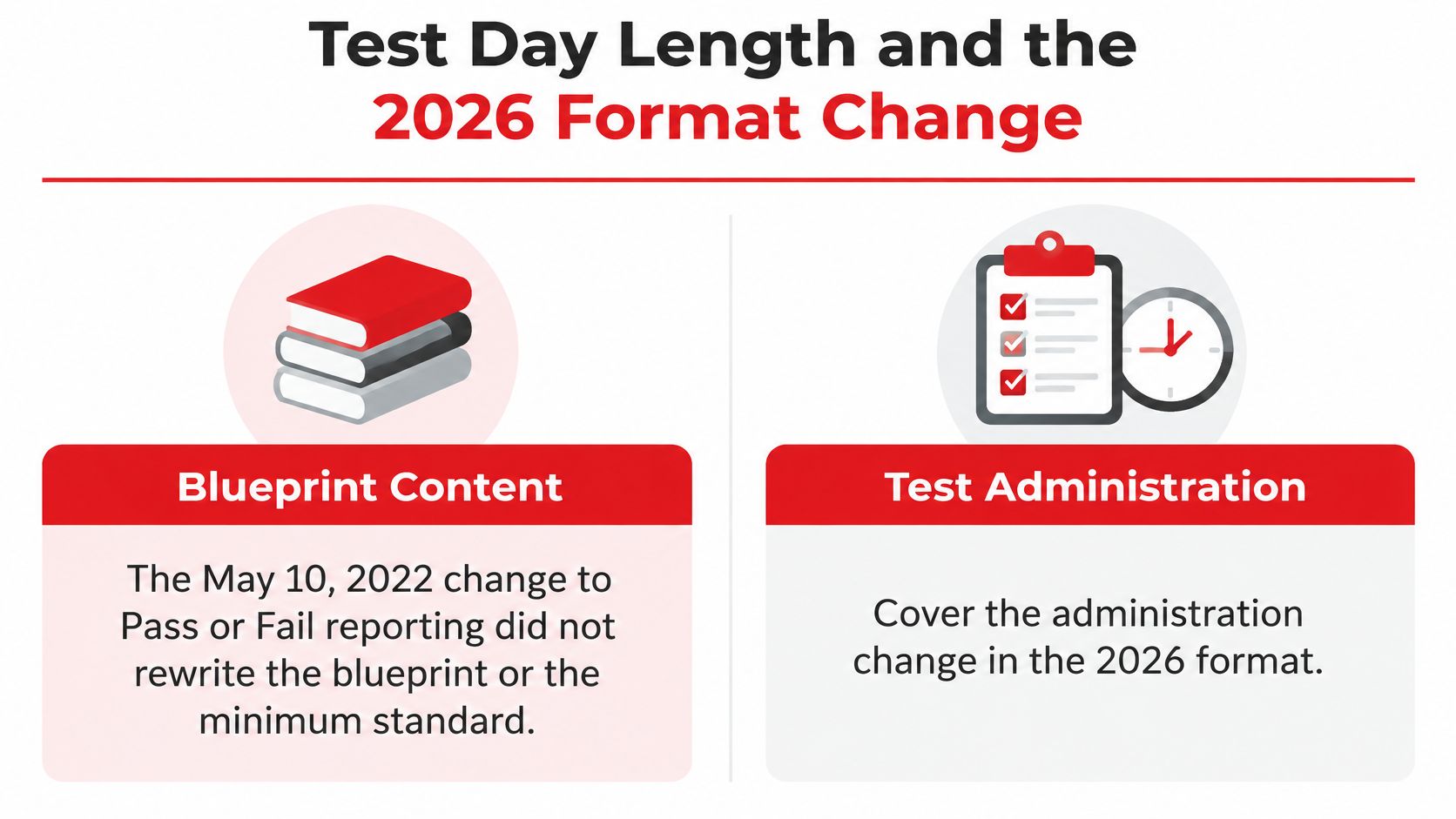
How should you adjust your pacing when the question count changes? Start by separating reporting policy from test-day structure. A change to Pass or Fail reporting does not, by itself, change the blueprint or the time available for testing.
The NBOME description of examinations dates the shift to Pass or Fail reporting to May 10, 2022, and says it did not change the blueprint, testing time, or minimum performance standard. That change is separate from the later administration updates.
Compare the formats before choosing a pacing target
The NBOME 2025–2026 COMLEX-USA Bulletin of Information states that the item count drops from 352 to 320 effective May 2026. It describes a one-day computer-based examination and revised breaks for candidates testing after May 7, 2026. The bulletin specifies eight hours of testing across two separately timed four-hour sessions. Earlier NBOME descriptions allowed a pooled 60 minutes for breaks; use the applicable bulletin to plan around the revised break schedule.
| Planning comparison | Earlier item count | Revised item count |
|---|---|---|
| Questions | 352 | 320 |
| Estimated average if eight hours are available for answering | About 82 seconds per item | 90 seconds per item |
| Best use in preparation | Legacy endurance and pacing practice | Format-aligned endurance practice |
The per-item figures are planning averages, not official limits for each question. They divide eight hours of answering time by the item count, without accounting for differences in question difficulty or time reserved for review.
Practice returning from breaks
Rehearse stopping and restarting, not only answering continuously. A break helps only if you return on time and can resume focused work.
With fewer questions, each response makes up a larger share of the total item count. That arithmetic does not show how a missed question affects a scaled result, and it does not mean the content framework is narrower.
A legacy-length self-assessment can help you notice fatigue or rushed decisions. It cannot predict performance on a revised form because its content resembles the blueprint.
Before setting a full-length rehearsal, confirm the current item count, answering time, session boundaries, and break lengths in the applicable NBOME bulletin.
Pass or Fail and the Performance Profile
Level 1 is reported as Pass or Fail, and the NBOME examination-scores information identifies a published passing standard of 400 standard-score points, using a criterion-based standard rather than a predetermined proportion of passing candidates. The decision rests on total examination performance, not on passing every individual content area.
That distinction matters when a performance profile contains a visibly weaker discipline. Relative weakness in a category isn't, by itself, proof that the candidate failed because of that category.
Interpret the profile as a remediation map
Candidates under pass/fail reporting don't receive the former reported three-digit Level 1 result. Instead, the formative profile describes relative strengths and weaknesses across blueprint areas, with comparison to the national mean for first-time Level 1 candidates.
The profile isn't a replacement numerical score. A category's position shouldn't be converted into an invented percentage correct or a private passing cutoff.
A useful remediation review separates several possibilities:
- Limited exposure: The student hasn't practiced enough material in the area to recognize recurring tasks.
- Conceptual confusion: The student repeatedly chooses the same incorrect mechanism or interpretation.
- Application difficulty: The concept is familiar during review but isn't retrieved reliably in a mixed timed set.
- Pacing effects: Errors cluster late in the session rather than consistently within a content category.
For a student who hasn't tested, tagged practice questions can create a provisional map. That map isn't an official performance profile, but it can make preparation more specific before an attempt.
Keep population results separate from personal readiness
The COMLEX Level 1 pass-rate discussion addresses a different question from an individual audit. A population outcome can't determine whether a particular student's preparation is adequate.
After an unsuccessful attempt, the practical task is to identify a changeable pattern and select a focused response. A result can have meaningful academic consequences, but it isn't a judgment of personal worth or the end of a medical career.
Interpretation safeguard: Relative performance describes where further investigation may help. It doesn't explain the cause of every error.
Audit Your Practice Against Both Dimensions
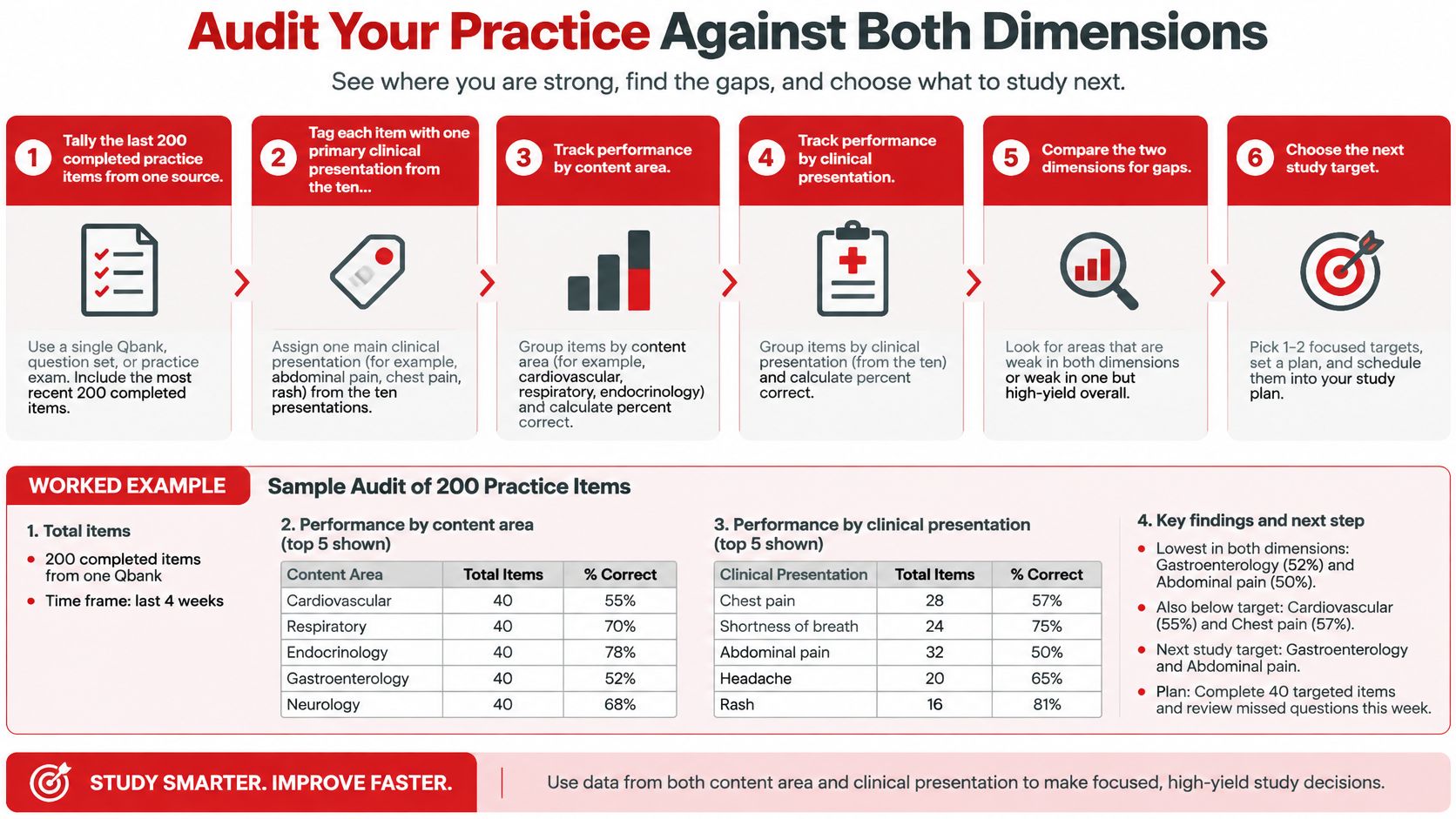
A useful audit preserves a stable denominator and distinguishes coverage, accuracy, and error cause. Combining selectively chosen questions from several resources can obscure whether a gap belongs to the learner or to the sampling method.
The following counts and thresholds are editorial worksheet choices, not NBOME readiness requirements. They provide a manageable way to inspect a practice sample.
A six-step item audit
- Tally the last 200 completed items from one source. Include correct answers and misses. A missed-question-only sample measures error distribution, not overall exposure.
- Assign each item one primary clinical presentation using the official names. If the resource label is ambiguous, record the answer-driving context rather than guessing from a single word.
- Identify the main competency. Add another competency tag only when the reasoning requires it. Record the error cause separately from content tags.
- Convert each count to a share using count ÷ 200 × 100. Secondary competency tags may overlap, so competency tallies shouldn't be forced into a mutually exclusive distribution.
- Compare exposure with the published figures. An editorial heuristic is to investigate a high-share area that falls about three percentage points below its listed allocation. This isn't an NBOME threshold or proof of inadequate readiness.
- Rewrite the next review block around the identified gap. Choose targeted questions, explanation review, or reasoning practice according to the error pattern rather than adding hours to every subject.
Fictional worked example
The following is a fictional practice sample, not a real student's result, an official item, or recalled examination content. It demonstrates arithmetic and tagging only.
Audit worksheet with worked example
| Blueprint dimension | Official figure | Your count | Your share | Gap |
|---|---|---|---|---|
| Musculoskeletal System (worked example) | 13% blueprint share | 18 of 200 | 9% | 4-point gap |
| Osteopathic Principles, Practice, and Manipulative Treatment (worked example) | At least 12% | 8 of 200 | 4% | 8-point gap |
| Community Health and Patient Presentations Related to Wellness | 12% blueprint share | _____ of 200 | _____% | _____ percentage points |
| Application of Knowledge for Osteopathic Medical Practice | At least 60% | _____ of 200 | _____% | _____ percentage points |
In this example, the learner first checks whether osteopathic reasoning was undercounted during tagging. If the gap remains, the next review block pairs structural-finding interpretation with the relevant biomedical mechanism, followed by fresh questions requiring that connection.
Wellness, community, and smaller presentations remain in the mixed-practice rotation. Correcting one gap shouldn't remove the rest of the blueprint from view.
Audit completion checklist
- Alignment checked: Resource tags have been compared with NBOME terminology.
- Both dimensions recorded: Presentation and competency labels exist for each reviewed item.
- Stable denominator retained: The worksheet uses at least the editorial sample size rather than a handful of memorable misses.
- Timing matched: Full-length rehearsals use the item count and session rules applicable to the testing date, not a single uninterrupted block.
- Patterns prioritized: Self-assessment results guide investigation rather than promise an outcome.
The COMSAE-to-COMLEX interpretation guide is relevant when a student is tempted to translate a practice result into a guaranteed examination result. This worksheet is examination education, not patient-care guidance; it doesn't provide diagnosis or treatment instructions.
Decide When the Audit Needs a Tutor
A small coverage gap with an obvious correction may not require tutoring. Independent review remains reasonable when the learner can explain each miss, finish format-matched timed practice, and demonstrate improvement on fresh questions.
A persistent pattern deserves a different response. Repeating the same reading or collecting more completed questions won't necessarily correct a misunderstanding that the learner hasn't identified.
Signs that independent review is working
- Explanations transfer: The learner can apply the corrected concept to a new stem rather than recite the previous answer.
- Pacing remains usable: Late-session answers still reflect deliberate reasoning rather than hurried selection.
- Corrections are specific: Each review note identifies a missing link, such as confusing the presentation with the competency being tested.
Targeted help becomes more useful when the same high-priority gap survives a second audit, when pacing deteriorates despite rehearsal, or when preparation resumes after an unsuccessful attempt. The purpose is to determine why the pattern persists, not merely to assign additional work.
What to bring to a focused discussion
The most useful materials are the completed worksheet, representative error explanations written in the student's own words, and a record of where time pressure began. Copyrighted question text and recalled live examination content aren't needed to explain the pattern.
A student considering targeted COMLEX preparation support can use that record to define a narrow objective. Available COMLEX tutoring information can then inform whether outside help fits the next review decision.
Ace Med Boards supports Level 1, Level 2-CE, and Level 3 preparation, including plateaus and returns after an unsuccessful attempt; its COMLEX tutoring covers content review, clinical reasoning, question approach, and pacing.
Tutoring supplements official practice materials, question banks, and independent study. It doesn't replace them or establish an examination outcome in advance.
Sources
For current exam details, use the NBOME's official pages:
- COMLEX-USA Level 1 blueprint
- COMLEX-USA examination descriptions
- COMLEX-USA examination scores
- 2025–2026 COMLEX-USA Bulletin of Information
For tutoring details, see Ace Med Boards COMLEX services.
Confirm current blueprint percentages, item counts, break rules, and score-reporting policies on the official NBOME pages before your exam.
Ace Med Boards offers COMLEX tutoring and a free consultation to discuss your examination level and timeline. Bring your completed audit worksheet to that discussion if a blueprint gap persists, and visit Ace Med Boards to consider whether targeted support fits your next review block.