
Recent national first-time COMLEX Level 1 pass rates cluster around 90% to 93%, including 90.25% for 2024-2025 and a reported 90.19% for 2025-2026. These are cohort benchmarks, not an individual student's odds of passing.
For a Doctor of Osteopathic Medicine (DO) student, the important question is not just whether most candidates pass. It's whether the published percentage reflects the relevant testing cycle and candidate population, and whether the student's own preparation supports the planned examination date.
By Ace Med Boards Editorial Team
National COMLEX Level 1 Pass Rates by Cycle
First-time pass rates have ranged from 90.6% to 93.05% across the cycles shown below. Each percentage describes a specific testing period and candidate group, so keep the cycle and publisher attached to the figure.
National first-time COMLEX Level 1 pass rates
| Testing cycle | First-time pass rate | Who is counted | Publisher |
|---|---|---|---|
| 2021-2022 | 92.2% | First-time candidates | NBOME annual report |
| 2022-2023 | 90.6% | First-time candidates | NBOME annual report |
| May 2023-April 2024 | 93.0%, or 93.05% in school tables | First-time candidates | NBOME annual report and Lake Erie College of Osteopathic Medicine |
| 2024-2025 | 90.25% | First-time candidates | Lake Erie College of Osteopathic Medicine |
| 2025-2026 | 90.19% | National first-time average | Michigan State University College of Osteopathic Medicine |
The National Board of Osteopathic Medical Examiners' 2024 annual report reports 92.2%, 90.6%, and 93.0% for the earlier cycles. Lake Erie College of Osteopathic Medicine's outcome table gives the more precise 93.05% figure for 2023-2024 and reports 90.25% for 2024-2025. Michigan State University College of Osteopathic Medicine's institutional outcomes publish a 90.19% national first-time average for 2025-2026.
Reading the movement accurately
Across the first three figures in the NBOME series, the rate fell 1.6 percentage points, then rose 2.4 percentage points. A percentage-point change is the subtraction between two rates: it is different from a relative percentage change.
A national rate is a cohort result, not a personal forecast. It describes how a group performed, while your readiness depends on your own preparation and performance.
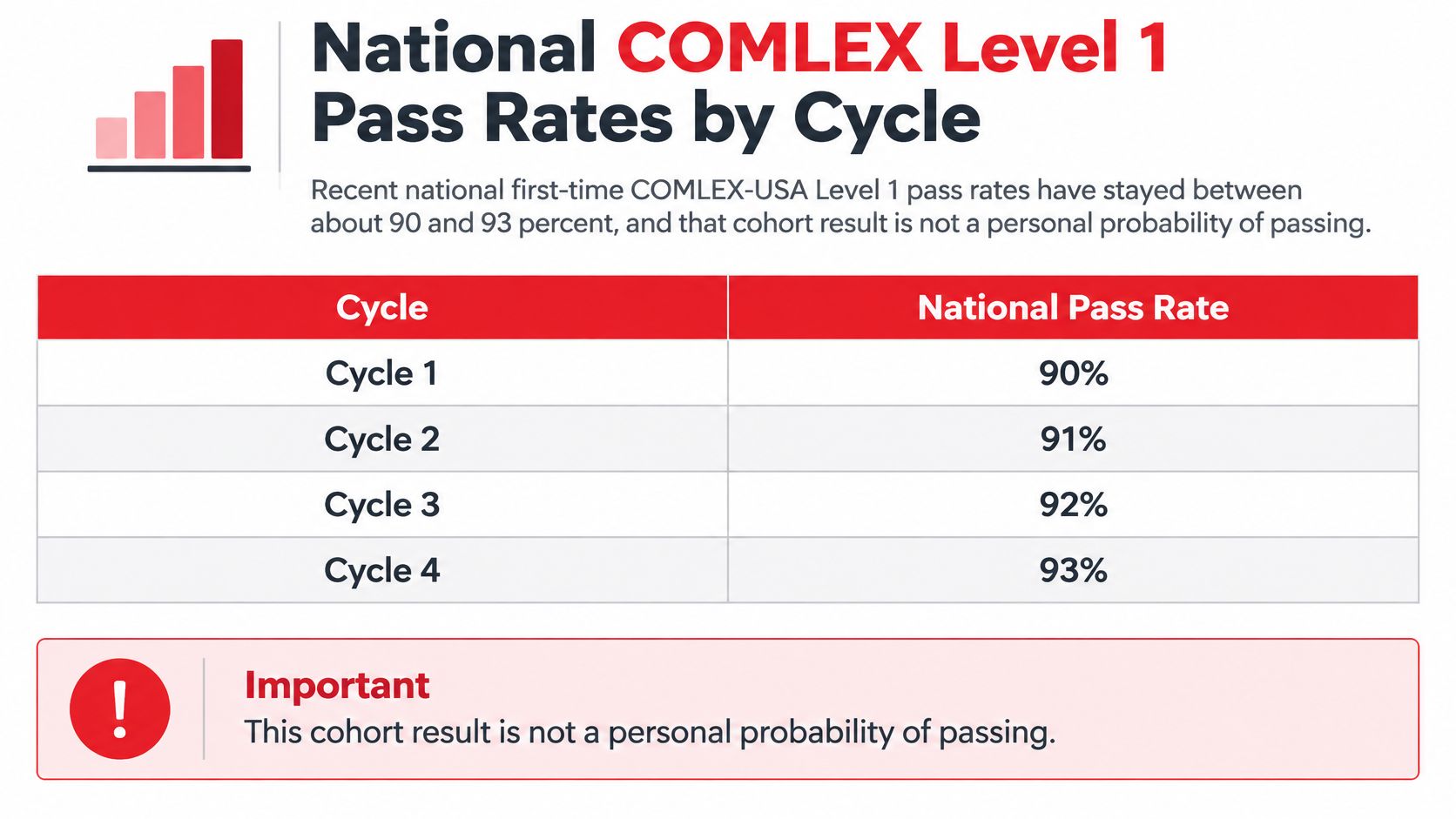
The infographic shows the general range. Use the dated table above when comparing specific cycles.
Key Takeaways
- Match the population and cycle. A first-time rate does not describe repeat attempts.
- Keep school and national outcomes separate. School rates describe a particular institution's candidates; national rates summarize a broader group.
- Read the trend in percentage points. This makes the change between rates clear without confusing it with relative growth.
- Treat an unsuccessful attempt as a planning problem. Review what needs work and adjust your preparation; one result does not determine your future.
How a Level 1 Pass Rate Is Counted
A pass rate is the share of a defined group that met the examination's passing standard. The denominator matters: a percentage describes the candidates included in that calculation, not every DO student or any one student's prospects.
Level 1 is reported as pass or fail, rather than as a three-digit score. The NBOME scoring and reporting page explains that the Formative Performance Profile compares overall and content-area performance with first-time examinees who passed. The pass/fail decision is based on total examination performance, not on meeting a separate minimum in every content area.
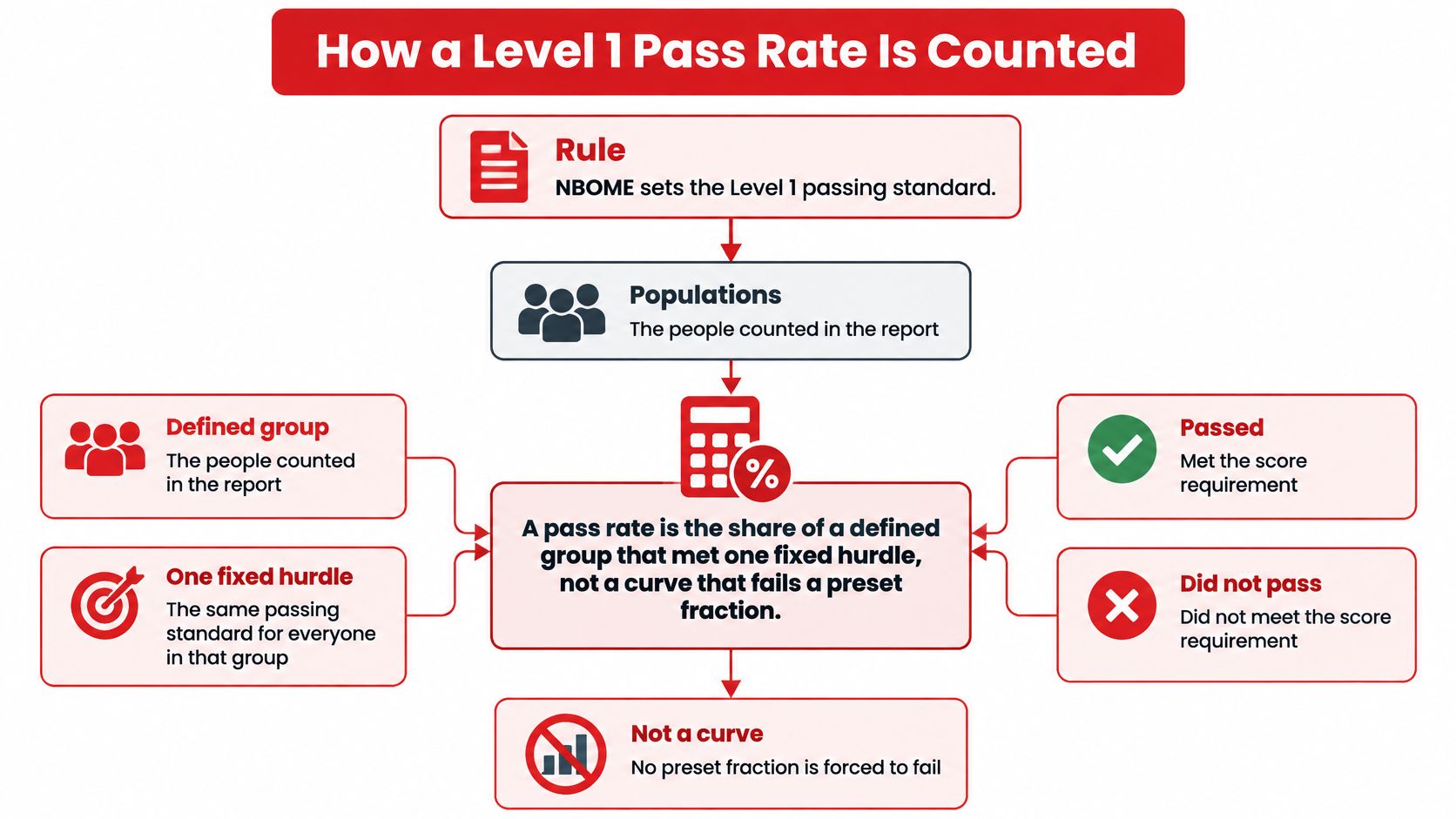
Separate the candidate populations
First-time candidates have not taken the examination before; repeat candidates have. An overall rate combines the groups included in a report, so it can differ from either group's rate.
2024-25 pass rates by candidate population
| Population (2024-25) | Pass rate | Candidates counted |
|---|---|---|
| First-time candidates | 90.3% | 9,381 |
| Repeat candidates | 76.5% | 956 |
These figures are reported in MedUniExam's summary of COMLEX Level 1 pass rates. The first-time and repeat rates describe different populations; neither is an individual prediction.
An overall rate depends on which candidates, dates, and attempt types a report includes. Even when counts are available, adding them does not by itself explain how a reported percentage was calculated.
Interpreting a repeat attempt calmly
A repeat-candidate average is not a personal forecast. Students returning after an unsuccessful attempt may have different content gaps, testing difficulties, or study circumstances.
Review what happened and decide what will change. A useful discussion can include the performance profile, recent timed practice, pacing, and circumstances surrounding the prior attempt. If you are preparing for a retake or another COMLEX level, COMLEX tutoring and preparation options include support for students facing a plateau or returning after an unsuccessful attempt.
Practical rule: A population label identifies a comparison group. It does not explain an individual result.
School Pass Rates Versus the National Benchmark
A school's first-time pass rate answers a narrower question: how did that institution's reported cohort perform? It doesn't establish the probability that a particular enrolled student will pass.
The following comparisons retain each institution's reporting period and national comparator. Where a denominator wasn't supplied, the table doesn't assume one.
Selected school first-time rates beside the national rate
| School | Cycle | School first-time rate | National rate cited | Cohort note |
|---|---|---|---|---|
| Sam Houston COM | May 2023-April 2024 | 99.01% | 93.05% | 101 first-time candidates |
| Liberty University | 2023-2024 | 96.7% | Not specified in the cited Liberty figure | 145 of 150 students passed |
| Touro University Nevada | 2023-2024 | 95.8% | 93.1% | Institutional figure published by the school |
| MSU COM | 2023-2024 | 91.78% | 93.05% | School below that cycle's national average |
| MSU COM | 2024-2025 | 93.82% | 90.25% | School above the national average |
| MSU COM | 2025-2026 | 92.23% | 90.19% | College-published pair, national figure requires primary confirmation |
| ARCOM | 2024-2025 | 89.93% | 90.25% | School slightly below the national rate |
| Touro University California | 2024-2025 | 85.19% | 90.25% | Same national benchmark, different institutional result |
The NBOME school report for Sam Houston State University College of Osteopathic Medicine records 99.01% among 101 first-time candidates, compared with 93.05% among 9,222 nationally. Liberty University reports 96.7%, with 145 of 150 students passing, while Touro University Nevada reports 95.8% against 93.1% nationally.
Michigan State University College of Osteopathic Medicine publishes the school and national pairs shown for 2023-2024 through 2025-2026. Arkansas College of Osteopathic Medicine reports 89.93% against 90.25%, and Touro University California reports 85.19% against 90.25% for 2024-2025.
Why the denominator changes the interpretation
In the Sam Houston report, the school-national gap is 5.96 percentage points, and a single candidate changes the school rate by approximately 0.99 percentage point. The same report uses an approximate 68% confidence interval around the national mean for competency-domain comparisons, another reason not to treat every small domain difference as definitive.
Touro University Nevada's national comparator uses different displayed precision from other school tables for the comparable cycle. Keeping each school's cited value visible avoids treating differently presented figures as identical records.
For applicants comparing colleges, the useful questions are concrete:
- Which cycle? Academic-year and testing-window labels shouldn't be casually interchanged.
- Which candidates? First-time, repeat, and eventual-pass outcomes aren't equivalent.
- What denominator? Small cohorts can show noticeable percentage changes from very few outcomes.
- What context? Cohort performance isn't an individual readiness cutoff or a complete measure of educational quality.
A Readiness Check Before You Choose a Date
A national first-time pass rate doesn't assign the same chance of passing to every student. A test-date decision needs evidence from the student's preparation, not reassurance borrowed from a large cohort.
The checklist below is an advising framework, not an NBOME eligibility rule or a validated prediction calculator. Each item can be marked yes or not yet, with unresolved items translated into specific actions.
A working readiness checklist
| Check | Evidence to review |
|---|---|
| Identify the attempt type | Confirm whether the planned sitting is a first attempt or a repeat, then select the relevant comparison population. |
| Understand the pass decision | Distinguish total examination performance from relative strengths and weaknesses in separate content areas. |
| Audit a prior unsuccessful attempt | Review the score report and Formative Performance Profile for recurring patterns rather than treating domain comparisons as additional passing rules. |
| Check the practice trend | Examine timed, mixed-question performance across several weeks, including pacing and unfinished questions. |
| Rehearse sustained testing | Complete a full-length practice session under the current applicable timing guidance before making the final date decision. |
| Map recurring misses | Organize errors by blueprint area, including osteopathic principles and practice. |
| Leave room for repair | Check whether the calendar allows focused review and reassessment of unstable areas. |
| Confirm school requirements | Obtain the current campus eligibility and self-assessment requirements directly from the school. |
A Osteopathic Medical Self-Assessment Examination (COMSAE) requirement imposed by a school is a local readiness or eligibility requirement. It shouldn't be confused with the examination's own passing standard.
No public national pass rate supplies a universally safe question-bank percentage or a school-specific COMSAE target. The COMSAE-to-COMLEX interpretation guide provides related context, but an assessment result shouldn't be treated as an exact conversion into a guaranteed examination outcome.
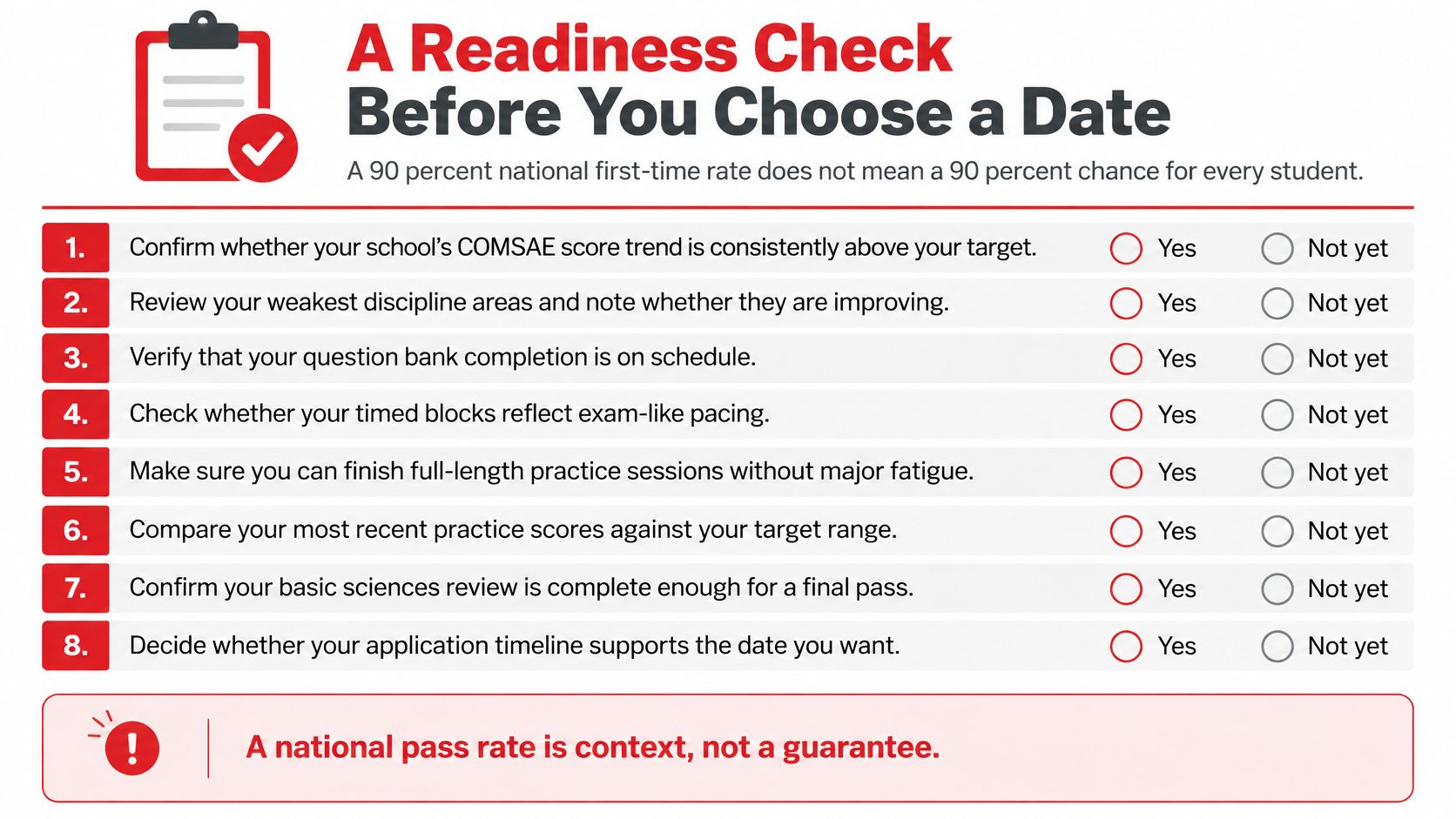
Any target referenced in the visual should come from the student's school or an appropriately interpreted assessment, not from the national pass rate.
Turn uncertainty into an observable task
Consider a student whose untimed work is improving but whose mixed timed sets remain unfinished. That pattern calls for a pacing review and another realistic practice session, not more reading.
Another student may finish comfortably while repeatedly missing the same foundational concepts. That student needs targeted content repair followed by fresh questions that test the concepts in a different context.
A useful readiness review names both the concern and the evidence that would show improvement.
Neither scenario requires judging the student's ability or effort. Both require a more precise plan than assuming that a favorable national average makes the scheduled date appropriate.
Why Rates Move and What Residencies See
Published pass rates show what happened within a cohort. They don't establish why it happened.
Differences in preparation, test timing, candidate composition, and eligibility practices could contribute to movement between cycles. Without an analysis that separates those factors, attributing a decline to a harder examination or a less prepared class would go beyond the evidence.
The passing standard isn't a quota
The NBOME Level 1 score-report document identifies an overall standard score of 400 or higher as passing and explains that the proportion of candidates passing isn't fixed in advance. This is criterion-based scoring: candidates must meet the established standard rather than outperform a predetermined share of peers.
A percentage-point change can still matter at the population level. As a clearly hypothetical illustration, a decline of 2.8 percentage points in an equally sized group of 10,000 candidates would mean 280 fewer passes; the arithmetic describes a cohort difference, not a prediction for any particular candidate.
Institutional leaders should therefore examine more than a headline school average. Useful subgroup reviews can include students with delayed progression, prior unsuccessful attempts, or persistent foundational difficulties, provided student information is handled appropriately.
- Cohort review asks whether preparation or timing differed across groups.
- Individual advising asks which barriers remain for a particular student.
- Program evaluation asks whether support changed the problems it was designed to address.
A strong aggregate result can coexist with substantial difficulties in a smaller subgroup. Neither fact cancels the other.
Keep residency implications narrow
Level 1's principal reported result is pass or fail, rather than a numeric score. A national pass percentage isn't a residency cutoff, and a school's rate isn't a substitute for an applicant's examination record.
The COMLEX scores and residency application guide addresses the broader application context. Individual program requirements still need direct checking; a cohort statistic doesn't establish a program's screening policy.
Comparing COMLEX with another examination also requires more than placing headline percentages side by side. Different candidate populations, blueprints, and standards prevent a simple conclusion that the examination with the higher pass rate is easier.
An unsuccessful attempt can require additional preparation and may affect progression. It deserves a revised plan and a conversation with the school, but the result alone doesn't determine an entire medical career.
Study Moves That Support a Passing Performance
Preparation becomes more useful when practice results lead to a specific change in the next study session. A question-bank completion total alone doesn't show whether a student has corrected recurring errors.
The following four-week pattern is an adaptable planning example, not an evidence-based minimum duration or a passing guarantee. It can sit within the broader COMLEX Level 1 study guide for DO students rather than replacing a complete preparation plan.
Use a repeatable weekly review loop
| Point in the week | Suggested task | What to record |
|---|---|---|
| Week start | Sort the prior week's misses by blueprint area; select two weak areas and one maintenance area. | The concepts that need repair and the reason each was missed. |
| Most study days | Complete a timed mixed block, then review misses and uncertain correct answers. | The decisive clue, error type, and concept to retrieve again. |
| Twice weekly | Include a short osteopathic principles block. | Persistent confusion requiring targeted review. |
| Week end | Complete a longer timed set and examine the trend. | Accuracy, completion, pacing, and recurrence of previously reviewed errors. |
These frequencies are proposed study choices, not examination requirements. A student with limited study time can shorten the blocks while preserving the sequence of practice, review, retrieval, and reassessment.
For each missed question, the review note should answer three questions: What information mattered? Why was the selected answer tempting? What knowledge or reasoning step needs to change?
A general explanation of retrieval practice is available in MasteryMind's a guide to active recall. It can help structure self-testing, but it isn't an authority on COMLEX scoring, eligibility, or readiness thresholds.
Change the task when the error changes
A knowledge gap calls for focused content review. A misread task calls for more deliberate identification of what the question asks, while unfinished blocks call for pacing practice under realistic conditions.
The study record can remain brief:
- Clue missed: Identify the information that should have changed the answer.
- Error type: Separate missing knowledge from misapplication, misreading, or timing.
- Retrieval task: Write a short prompt to answer without notes.
- Recheck: Return to the concept later using fresh material.
The COMLEX Level 1 preparation timeline can help fit this loop around the available calendar. Sleep and recovery should remain part of that calendar rather than becoming whatever time is left after studying.
Once a core question bank and class materials are in use, adding resources shouldn't be the automatic response to a plateau. One-on-one tutoring can complement independent work and official NBOME orientation materials by helping with content review, question approach, and pacing; it doesn't replace practice or guarantee an outcome.
Choose a Date or Get Targeted Help
Your test date should fit both your preparation evidence and your school's current requirements. A national pass rate can provide context, but it cannot tell you whether you are ready for a specific sitting.
Keep the planned date when timed practice is steady, pacing is manageable, and your school has confirmed the applicable requirements. Use the remaining study time to maintain strengths and address specific gaps.
If your performance remains uncertain, choose a response based on what is getting in the way:
- Move the date and revise the plan. If current school and examination policies allow it, set a clear purpose for the added time and decide how you will reassess progress.
- Get targeted help. A plateau, repeated difficulty applying reviewed material, or preparation after an unsuccessful attempt may call for a closer look at your study process.
Extra time helps when it changes what you do, not when it adds days to the calendar.
Ace Med Boards offers COMLEX tutoring for Level 1, Level 2-CE, and Level 3. Tutoring can address content review, clinical reasoning, question approach, and pacing. The COMLEX tutoring overview describes support for students who have plateaued or are returning after an unsuccessful attempt.
A free COMLEX consultation can help you discuss your exam level and timeline. Bring the recent practice pattern and the main obstacle you want to address. Those details can help make the conversation specific to your preparation needs.