A patient scheduled for a procedure asks whether the morning pill should still be taken. The chart says NPO. A student who answers immediately, either “yes” or “no,” may be treating a shorthand label as though it were a complete clinical order. That assumption is exactly where confusion begins.
The NPO medical abbreviation means nil per os, or “nothing by mouth.” It generally restricts oral food and beverages, but it doesn't automatically answer whether medications, sips of water, tube feeds, or other intake are permitted. Medical students should learn to clarify the order before giving or withholding anything.
Why NPO Needs Clarification Before You Give Anything
The safest response to the hypothetical morning-pill question isn't a guess. The student should identify the medication, inspect the written order, and ask the responsible team to clarify whether the medicine is permitted and by which route. The order may have been placed for anesthesia, a diagnostic test, bowel rest, feeding intolerance, aspiration precautions, or another reason, and each context can change what “NPO” means operationally.
The abbreviation alone may not specify:
- Food: Whether meals, snacks, or solid intake are prohibited.
- Fluids: Whether water or other clear liquids are allowed.
- Medication: Whether oral drugs may be given with a small amount of fluid.
- Route: Whether intravenous, subcutaneous, buccal, or enteral administration is permitted.
- Timing: When the restriction begins and when it ends.
Clinical literature distinguishes an NPO order from an automatic instruction to withhold every medication. Some institutions use “NPO except medications,” while others prohibit oral drugs entirely, so nurses and students should verify the exact order with the prescriber before administration. An unqualified label can lead to omitted essential therapy, but giving an oral medication without authorization can also conflict with aspiration precautions or procedural requirements. The distinction is summarized in this review of NPO orders and medication exceptions.

Practical rule: NPO is a starting point for clarification, not permission to make an unverified medication decision.
Clear written communication matters beyond this single abbreviation. Medical students can review AIDictation's abbreviation best practices to strengthen habits around ambiguous shorthand and documentation. The broader clinical principle is similar to the one taught in informed consent and patient autonomy. Patients deserve an understandable explanation of what is restricted, why it is restricted, and what the team still needs to decide.
The following sections separate the literal meaning of NPO from the clinical questions that must follow it.
What NPO Means From Latin to Clinical Practice
A patient is admitted with a possible bowel obstruction and an NPO order appears in the chart. The patient asks for water, a nurse prepares the morning tablets, and a feeding tube is already in place. One abbreviation now raises several different questions. NPO comes from the Latin nil per os, meaning nothing by mouth, as described in this peer-reviewed explanation of NPO terminology and use.
The translation identifies the route, not every clinical decision. Oral food and drinks are usually restricted, but the order may leave medications, small sips for swallowing pills, tube feeds, or medication through a feeding tube unclear. Those categories must be separated rather than treated as one form of intake. A patient can be NPO for oral food while receiving an approved medication by another route, or a patient may have a stricter order that stops all enteral intake.
The reason for NPO gives the order its clinical meaning. Before a procedure, the concern may be material in the stomach entering the airway. With suspected gastrointestinal obstruction, oral intake may worsen symptoms or complicate treatment. During an aspiration evaluation, the team may restrict swallowing until a safer plan is established. The same abbreviation can therefore lead to different follow-up decisions.
The exam-ready translation
Consider an inpatient who is NPO and scheduled for a procedure. The medication list includes insulin, an anticoagulant, an antihypertensive, an antiseizure drug, and an extended-release tablet. The correct response is not to administer or withhold every medication automatically. First identify why the patient is NPO, which route the order restricts, whether exceptions are written, and whether the procedure team has given separate instructions.
A tablet with water is not automatically permitted just because it is a medication. A feeding tube is not automatically available just because it bypasses the mouth. Tube feeds may still count as enteral intake and may require their own instructions. These distinctions prevent an abbreviation from becoming an unsafe shortcut.
NPO orders occur before procedural sedation, diagnostic studies, and other interventions, as well as during evaluation for surgery, gastrointestinal illness, or aspiration risk. For exams and clinical practice, translate nil per os once, then ask four questions: what intake is restricted, which routes remain available, which medications need a plan, and when the restriction begins or ends.
Understanding Fasting Guidelines and Timing Exceptions
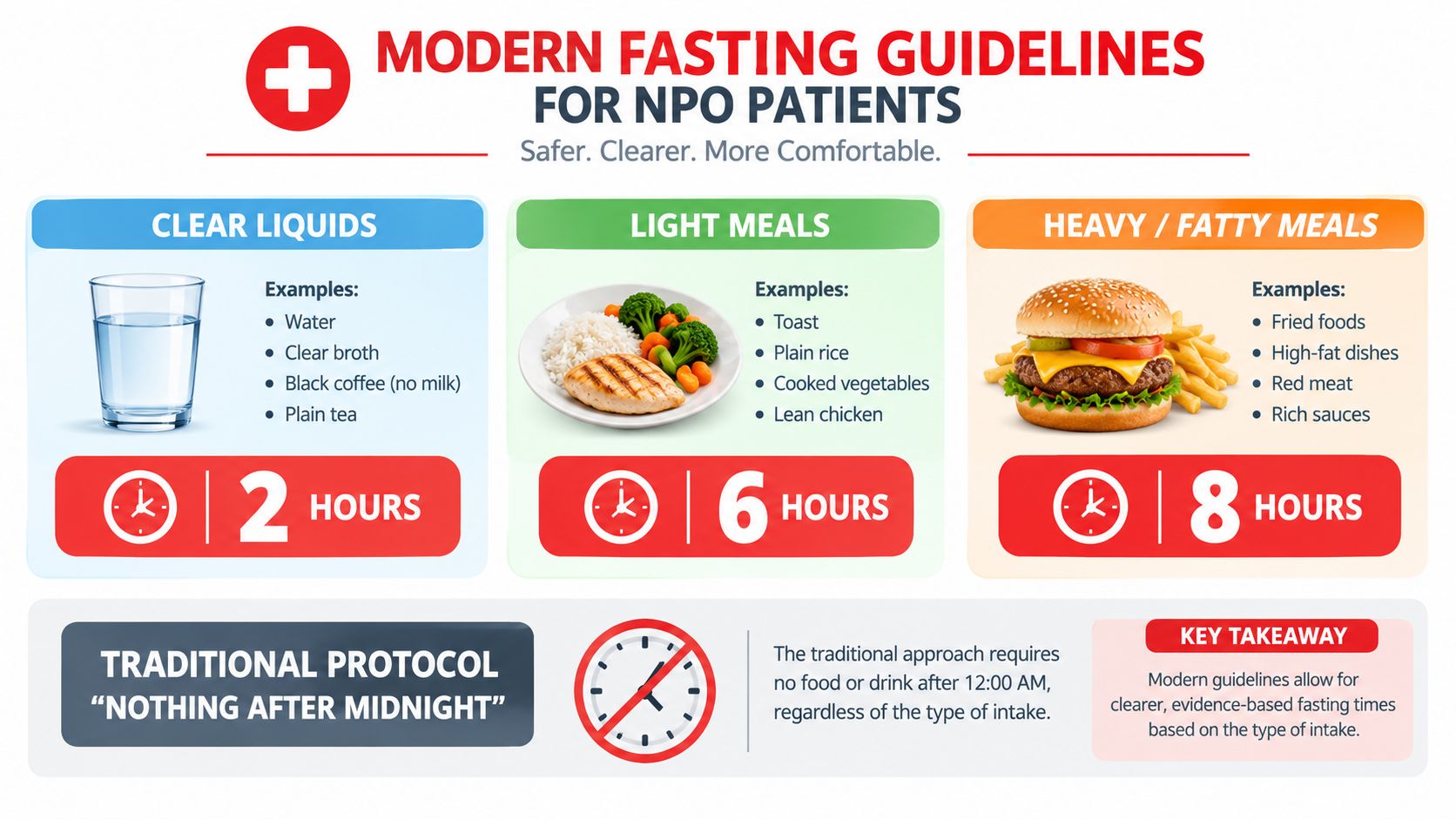
Modern fasting practice treats NPO as a procedure-specific risk-control order, not as an automatic “nothing after midnight” rule. For generally healthy patients undergoing elective general anesthesia, regional anesthesia, or procedural sedation, guidance supports clear liquids until 2 hours before the procedure and a light meal or nonhuman milk until 6 hours before. Heavier or fatty meals generally require at least 8 hours, because fat and meat delay gastric emptying. These intervals are summarized in the clinical guidance on non-anesthesia NPO orders.
| Intake type | Minimum fasting interval |
|---|---|
| Clear liquids | 2 hours |
| Light meal or nonhuman milk | 6 hours |
| Meat, fried food, or other fatty food | 8 hours |
The categories aren't interchangeable. Water, pulp-free juice, carbonated beverages, and black coffee generally fall within the clear-liquid category for appropriately selected elective patients. Coffee containing milk, a smoothie, or a dairy drink shouldn't automatically be treated like water. The American Society of Anesthesiologists fasting guidance provides the procedure-specific framework, but patient-specific written instructions take priority.
Why the timing is risk based
Sedation and general anesthesia can diminish protective cough and gag reflexes. If gastric contents enter the airway, the patient may develop chemical pneumonitis, airway obstruction, or aspiration pneumonia. Fasting allows different types of intake time to leave the stomach, which explains why clear liquids have a shorter interval than fatty meals.
Longer fasting isn't automatically safer. Evidence reviewed in perioperative literature describes clear-liquid fasting after midnight as unnecessary for many low-risk elective patients and associates prolonged restriction with dehydration and other adverse perioperative effects. That evidence supports policies based on what the patient consumed and when, rather than a blanket prohibition applied without regard to intake.
The general intervals still don't override clinical risk. Emergency procedures, bowel obstruction, active gastrointestinal bleeding, impaired consciousness, severe dysphagia, gastroparesis, and other delayed-emptying states may require individualized or stricter restrictions. Tube feedings are generally treated like solid intake in the cited perioperative guidance and should be handled according to the anesthesiology or procedural plan.
A student documenting an NPO status should capture more than two letters. The record should identify the planned procedure, anesthesia depth when known, last solid intake, last clear liquid, and comorbidities that may affect gastric emptying. Strong documentation practices for medical students reinforce the same habit: record the decision-relevant details, not only the shorthand.
Clarifying NPO Orders With the Essential Checklist
When the chart says NPO, the student should convert the abbreviation into a specific, closed-loop plan. The following checklist works for preprocedural orders and for inpatient restrictions that aren't related to anesthesia.
Start with the reason
Ask why the order exists. An upcoming surgery, endoscopy, imaging study, possible aspiration event, bowel rest, feeding intolerance, or diagnostic uncertainty may each produce an NPO order. The reason helps the team determine whether the restriction applies to all oral intake, only solids, or a particular route.
Confirm when it starts and ends
A student should establish whether NPO begins immediately, at midnight, after a specified meal, or at another documented time. The end point also matters. Some orders remain active until a procedure is complete or a clinician reassesses the patient, while others apply only during a defined interval.
Separate food from fluid
The words “nothing by mouth” can conceal important distinctions. The order should clarify whether it prohibits solid food, all liquids, clear liquids, ice chips, gum, oral rehydration fluids, contrast, or another specific intake. A patient who reports drinking something should have the contents and exact time documented rather than being described only as “not NPO.”
Identify permitted medicines and routes
The medication question deserves its own line. Some institutions permit selected oral medications with small sips of water, while other orders prohibit oral drugs entirely. Insulin, anticoagulants, antihypertensives, antiseizure medicines, steroids, and extended-release preparations may create different concerns involving hypoglycemia, bleeding, hypotension, seizure control, administration timing, or drug absorption.
The same caution applies to enteral access. A precise institutional order may distinguish no oral intake from no tube feeds, medications via feeding tube allowed, or tube feeds and medications allowed via feeding tube. A student shouldn't infer that a feeding tube is acceptable merely because the mouth isn't being used.
Identify who can clarify
If the order is incomplete, the student should ask the responsible prescriber, resident, attending physician, procedural clinician, or anesthesia team, depending on the setting. Nurses are also essential partners in verifying the active order and identifying institutional policy. The question should be repeated back after clarification so that the team has a shared understanding.
Closed-loop example: A patient scheduled for a procedure asks whether a morning medicine should be taken. The student notices that the NPO order doesn't explain medication exceptions and asks the responsible team to clarify the written plan before anything is taken. The lesson is not that the student prevented a verified adverse event. The lesson is that uncertainty was identified and closed before action.
A useful documentation best-practices resource can help learners build the habit of recording the exact restriction, exception, source of clarification, and timing.
The History Behind NPO From Lister to Modern Safety
A patient asks whether “NPO” means no water, no morning medication, or no tube feeding. The answer cannot come from the abbreviation alone. Its history explains why the order developed, but modern practice requires attention to the kind of intake involved, its timing, and the planned procedure.
The NPO medical abbreviation persists because it represents more than a Latin phrase. It reflects a long effort to reduce aspiration during anesthesia, followed by a gradual move from blanket fasting toward individualized instructions.
In 1883, surgeon Joseph Lister advised avoiding solid stomach contents before chloroform while allowing a small amount of liquid approximately 2 hours before administration. The early recommendation did not treat all intake as equivalent. Food and liquids already had different clinical implications, a distinction that remains important when an order addresses water, medications, or enteral feeds.
In 1946, obstetric anesthetist Curtis Mendelson published influential observations connecting aspiration with general anesthesia in obstetric patients. Concern about those observations helped popularize the rigid “NPO after midnight” instruction that shaped clinical teaching for decades. The historical account is reviewed in this medical discussion of fasting before anesthesia.
Why the old phrase remains
“NPO after midnight” was easy to communicate and remember. It supplied one default instruction when procedure times could change, schedules were uncertain, or teams wanted a broad safety margin. Its simplicity also created a hazard: a student may read it as one undifferentiated ban, even though the actual plan may treat solids, clear liquids, medications, and tube feeds differently.
Modern guidance preserves the aspiration-prevention rationale while refining the restriction. The practical question is what the patient consumed, when it was consumed, which procedure is planned, and what patient factors affect gastric emptying. A general NPO label should not replace a clear, patient-specific order.
That refinement has an ethical dimension. Clinicians should limit avoidable thirst, hunger, discomfort, dehydration, and metabolic stress when a shorter, evidence-based interval is appropriate. They must also follow stricter instructions when the surgeon, proceduralist, anesthesiologist, or responsible inpatient team identifies a particular risk.
The history helps with exams because it links mechanism to policy. Aspiration concerns explain fasting. Later refinement explains why the same NPO label does not always mean an overnight fast. Professional conduct, including the values described in the Hippocratic Oath for medical students, calls for protecting safety while respecting the individual patient's circumstances.
GLP-1 Medications and Modern Fasting Uncertainties
GLP-1 medicines expose the weakness of binary thinking. A learner may remember a simplified rule that every patient must stop the medication before surgery, or the opposite rule that every patient may continue it. Neither statement is appropriate.
ASA patient guidance reviewed October 22, 2025 states that most patients can continue GLP-1 medicines before surgery, while patients at higher risk may need a different plan coordinated with the care team. The relevant ASA guidance on diabetes and weight-loss medicines should be read as current patient guidance rather than converted into a universal instruction for every procedure.
What the student should identify
The clinical question involves the exact procedure, the medication plan, the patient's symptoms, and factors that could affect gastric emptying or aspiration risk. Nausea, vomiting, significant gastrointestinal symptoms, and other patient-specific concerns may change the plan, but the treating team must make that determination.
An NPO order doesn't independently settle whether a GLP-1 medicine should be continued, withheld, substituted, or administered by another route. Similarly, a medication policy doesn't independently determine whether the patient may consume liquids or food. The two plans must be coordinated.
For additional background, learners can review an educational discussion of how GLP-1 works with fasting, while keeping perioperative decisions anchored to the responsible clinical team and current institutional policy. The pharmacology principle is broader than this medication class: the drug, dose, route, indication, timing, procedure, and patient risk all matter. A focused pharmacology study resource can help students practice that style of reasoning without reducing medication safety to memorized slogans.
Key Takeaways and Exam-Focused High-Yield Points
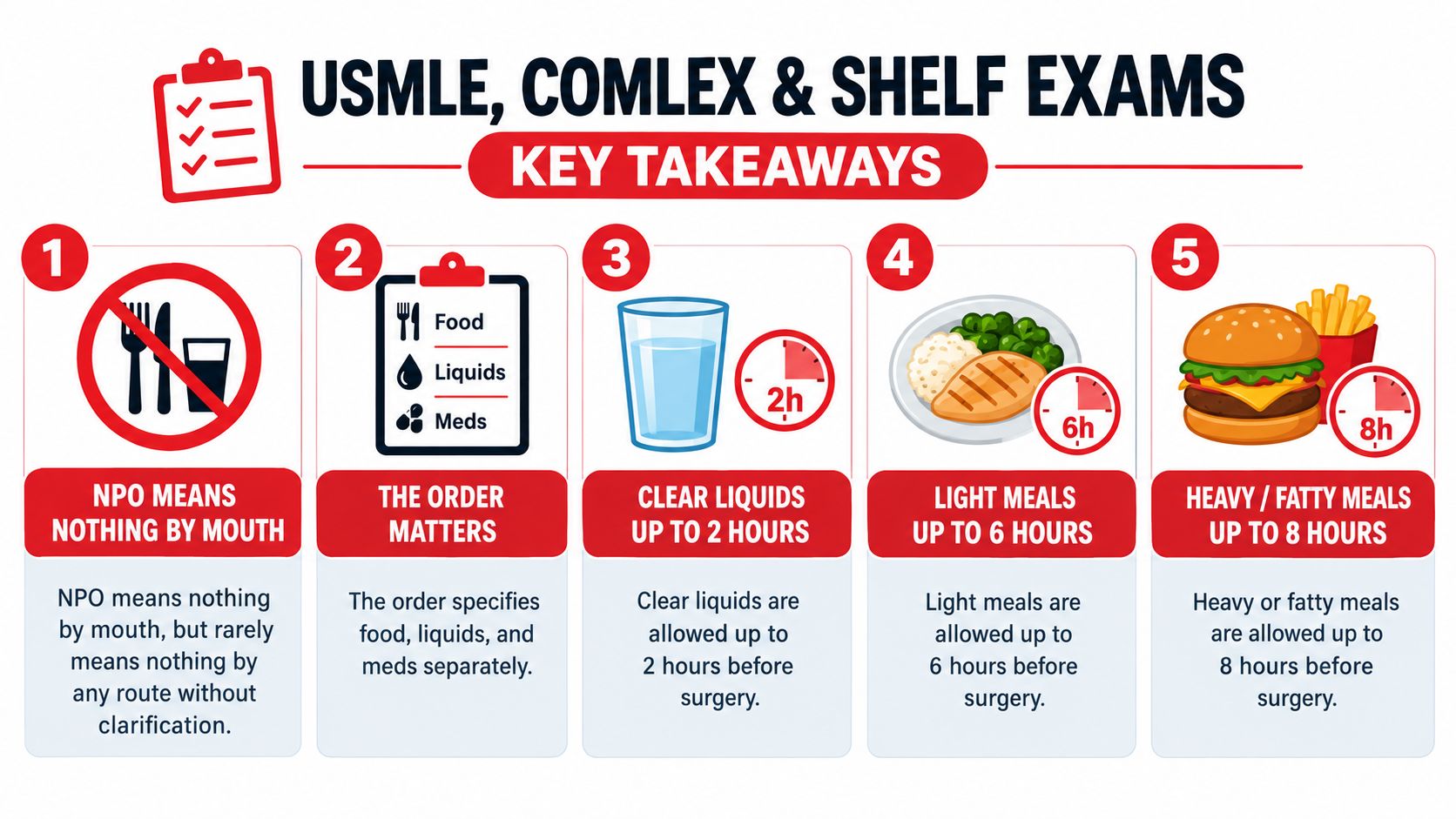
For USMLE, COMLEX, and Shelf exam preparation, NPO questions reward careful interpretation. The abbreviation supplies a starting definition, but the vignette often supplies the decisive details through the procedure, last intake, medication list, comorbidities, or order wording.
The compact mental checkpoint
An editorial aid for this article is:
No intake? Pause and confirm the Order.
This is an editorial aid, not a mnemonic developed or validated by Ace. Its purpose is to interrupt the reflex to treat NPO as a complete instruction. The student should pause, identify what is being restricted, and confirm the written plan before giving or withholding anything.
The highest-yield points are:
- Meaning: NPO expands to nil per os, or nothing by mouth.
- Scope: NPO generally concerns oral food and beverages, but it may or may not include oral medications.
- Mechanism: In peri-anesthetic settings, fasting reduces the chance that gastric contents will enter the airway when protective reflexes are diminished.
- Timing: Modern elective-procedure guidance distinguishes clear liquids, light meals or nonhuman milk, and heavier or fatty meals rather than relying automatically on “nothing after midnight.”
- Exceptions: Emergency procedures and conditions associated with delayed gastric emptying may require individualized restrictions.
- Medication safety: A student should never infer permission to take insulin, an anticoagulant, an antihypertensive, an antiseizure medicine, a steroid, or an extended-release drug from the acronym alone.
- Documentation: The last intake, its contents, and the exact time matter more than a bare statement that a patient is NPO.
A practical question-review workflow
When an NPO concept appears in a practice question, the learner can use this sequence:
- Name the context: Is the patient facing anesthesia, procedural sedation, a diagnostic test, bowel rest, or another inpatient concern?
- Classify the intake: Is the question testing food, clear liquids, a fatty meal, tube feeds, or medication?
- Locate the risk: Is aspiration, hypoglycemia, bleeding, hypotension, seizure recurrence, or delayed gastric emptying relevant?
- Read the order as written: Does it say NPO except medications, prohibit oral drugs, or specify a feeding-tube exception?
- Choose clarification over assumption: In a real clinical setting, unresolved ambiguity belongs with the responsible prescriber or procedural team.
A student who remembers only “NPO means nothing by mouth” has learned the vocabulary. A student who asks what is restricted, why it is restricted, when it starts, when it ends, and who authorized an exception has learned the clinical reasoning.
Medical education articles simplify real decisions for examination purposes. This explanation is for education and isn't medical advice or a substitute for patient-specific written instructions, institutional policy, or direction from the treating team.
Ace Med Boards offers individualized tutoring for USMLE, COMLEX-USA, and selected Shelf exams, including case-based review of medication safety, perioperative reasoning, and ambiguous order interpretation. Medical students who want structured help turning clinical concepts into a repeatable question-review method can visit Ace Med Boards to learn about tutoring and schedule a free consultation.
Sources
- American Society of Anesthesiologists, preoperative fasting guidance.
- American Society of Anesthesiologists, patient guidance on diabetes and weight-loss medicines.
- Peer-reviewed reviews of NPO terminology, aspiration prevention, medication exceptions, and fasting practice.
- Institutional clinical guidance on non-anesthesia NPO orders.