

A medical student finishes a long clinical day, opens a question bank, and then loses confidence after missing several “easy” management questions. An international medical graduate may face the same problem while also coordinating eligibility periods, score reporting, and residency application timing. USMLE Step 2 Clinical Knowledge, or Step 2 CK, tests whether examinees can apply clinical science to diagnosis, management, prevention, and patient-safety decisions. The most effective preparation connects the current blueprint to a disciplined weekly question-review plan.
What USMLE Step 2 CK Tests and How It Fits Your Residency Path
Step 2 Clinical Knowledge is a one-day, nine-hour examination designed to assess clinical knowledge and the reasoning required to make appropriate decisions in patient care. The exam uses a three-digit score, with reported scores ranging from 1 to 300. For first-time examinees from LCME-accredited U.S. medical schools, the mean score was 249 with a standard deviation of 15 in the 2023–2024 academic year and 250 with a standard deviation of 15 in 2024–2025, according to the USMLE score interpretation guidelines.
Those figures give examinees a reference point, not a universal residency cutoff. A score near 250 represents performance close to the average for that specific reference population. The same official guidance places a score of 240 at approximately the 23rd percentile in its cited three-year cohort, meaning that 23% of examinees scored lower. Specialty, applicant group, academic record, clinical evaluations, recommendation letters, and application timing all affect how a score is interpreted.

Why the score matters
Step 2 CK sits alongside Step 1, clinical evaluations, and the broader residency application. For students at LCME-accredited schools, it follows the foundational knowledge assessed earlier in medical education. For osteopathic medical students, it may be considered alongside COMLEX-USA, depending on the student's examination and application strategy. International medical graduates and foreign medical graduates also need to interpret Step 2 CK within their certification and application plans.
A numerical score can help programs compare applicants, but it doesn't summarize a physician's ability or determine a career outcome by itself. A low score, failed attempt, academic gap, or period of test anxiety calls for a more precise plan, not a judgment about the examinee's future.
How examinees should read results
USMLE scores are statistically equated across different examination forms. That means a raw percentage correct shouldn't be treated as a fixed three-digit score. The number of correct answers needed can vary because forms differ in item difficulty and composition.
A practical score review should ask three questions:
- Is the result passing? The relevant passing standard depends on the examination date.
- Where did errors cluster? Content areas, physician tasks, and disciplines can reveal different problems.
- What should change next? The answer may involve knowledge repair, clinical reasoning, pacing, or test-day planning.
Examinees comparing their results with residency-related benchmarks can also use the Step 2 scores by specialty resource, while remembering that score discussions shouldn't replace specialty-specific advising or a complete application review.
Key takeaways
- Step 2 CK measures applied clinical decision-making, not memorization alone.
- A score near 250 is close to the cited national mean for the reference population described above.
- Raw percentage correct doesn't convert into one permanent score.
- The weekly plan should follow both the official blueprint and the learner's error pattern.
2026 Exam Structure and High-Yield Content Weights
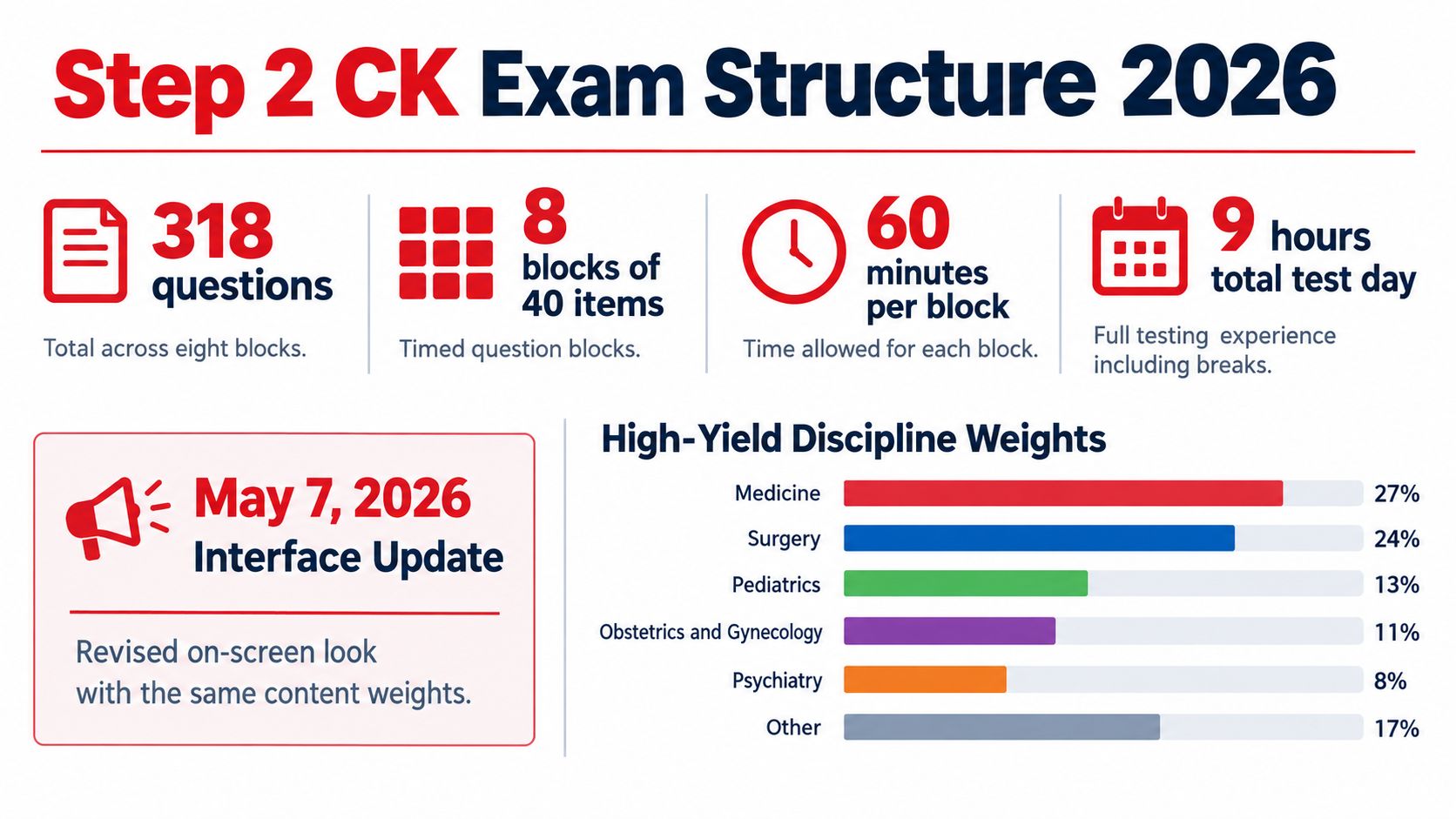
The interface changed for examinations taken on or after May 7, 2026. The exam retains a nine-hour testing session and the same total item count, but it uses 16 blocks of up to 20 questions, with 30 minutes per block and a minimum of 55 minutes of break time. The optional tutorial is five minutes. These details are documented in the USMLE update on the 2026 Step 2 CK testing software.
Older preparation materials may describe eight 60-minute blocks, up to 40 questions per block, no more than 318 questions overall, at least 45 minutes of break time, and a 15-minute optional tutorial. Those details apply to exams administered before the interface change, as described in the official Step 2 CK content and exam structure information. Examinees using older videos or schedules should therefore update their pacing practice rather than assume the older block rhythm still applies.
What the blueprint actually means
The current specifications describe content ranges, but those ranges aren't independent buckets. Nutrition is listed at approximately 15–20%, social sciences at 10–15%, renal, urinary, and reproductive systems at 7–13%, cardiovascular disease at 6–12%, musculoskeletal, skin, and subcutaneous disorders at 6–12%, and behavioral health at 5–10% in the official Step 2 CK content outline.
Nutrition is also cross-coded with system categories. An examinee may encounter nutrition through gastrointestinal disease, renal disease, pregnancy, pediatrics, or preventive care. Nutrition therefore deserves integrated review, not a separate block of study time that gets added mechanically to every other percentage.
The same caution applies to clinical disciplines. The score-report framework assigns approximately 55–65% to medicine, 20–30% to surgery, 17–27% to pediatrics, 10–20% to obstetrics and gynecology, and 10–15% to psychiatry. These ranges overlap because one item can involve more than one discipline or task. They shouldn't be summed to predict an individual form.
| Category | Percentage range |
|---|---|
| Medicine | 55–65% |
| Surgery | 20–30% |
| Pediatrics | 17–27% |
| Obstetrics and gynecology | 10–20% |
| Psychiatry | 10–15% |
| Nutrition | 15–20% |
| Social sciences | 10–15% |
| Diagnosis | 40–50% |
| Pharmacotherapy, interventions, and management | 30–40% |
| Health maintenance, prevention, and surveillance | 5–10% |
| Ethics and professionalism | 5–10% |
| Systems-based practice and patient safety | 5–10% |
Prioritizing without narrowing too far
The strongest weekly plans use the blueprint to protect broad coverage, then use the error log to determine emphasis. Medicine and diagnosis deserve substantial attention because of their broad ranges, but a learner who repeatedly misses pediatric prevention or psychiatric management shouldn't postpone those topics just because they appear less frequently in a personal study calendar.
The USMLE content outline resource can help examinees compare their schedule with the official categories. The practical rule is simple: use percentages to prevent neglect, not to make unsupported promises about the next set of questions.
Scoring Standards, Practice Exams, and Diagnostic Use
For examinations administered on or after July 1, 2025, the Step 2 CK passing standard is 218, increased from 214. The USMLE examination results and scoring policy explains that the change followed a formal performance-standard review and wasn't designed to make a predetermined percentage of examinees fail.
Passing decisions are criterion-referenced. The examination evaluates whether an examinee reaches a defined proficiency level rather than reserving a fixed proportion of passing outcomes. USMLE materials also state that examinees typically need to answer approximately 60% of questions correctly to reach a passing score, but that figure isn't a universal cutoff because item difficulty, form composition, and score conversion vary.
Turning practice performance into action
A practice score becomes useful when it changes the study plan. A single number may indicate that more work is needed, but it can't identify whether the problem involves cardiology knowledge, choosing the next diagnostic test, recognizing a safety issue, or running out of time.
A peer-reviewed predictive study found positive associations between Step 2 CK performance and prior measures including Step 1, clinical block grades, the Comprehensive Clinical Science Self-Assessment, the Comprehensive Clinical Science Examination, and USMLE practice exams. A newer model explained 45% of the variability in Step 2 score using MCAT percentile, Clinical Basic Science Examination results, neurology, psychiatry, and surgery NBME subject exams, and in-house block examinations. Surgery NBME performance had the largest coefficient among the included predictors, as reported in the peer-reviewed study indexed by PubMed.
Diagnostic rule: A weak subject assessment should trigger targeted remediation before a full-length Step 2 CK push.
An examinee who misses surgery questions because of anatomy knowledge needs a different intervention from one who knows the diagnosis but selects the wrong next step. Practice exams should therefore be reviewed by domain, error type, uncertainty, and pacing. Increasing question volume without analyzing those patterns can create the appearance of work without correcting the underlying problem.
Digital tracking can also reduce administrative friction. A structured system to track student progress and scores efficiently can help a learner or educator compare practice dates, error categories, and follow-up tasks without relying on memory.
One-on-one tutoring can complement official practice materials, NBME assessments, and a question bank, but it doesn't replace them. Examinees comparing study support should evaluate whether a service offers relevant clinical reasoning practice, a clear error-review process, flexible scheduling, and a plan grounded in the official blueprint. The NBME practice exam guidance for Step 2 can support that assessment.
Weekly Question Review Plan and Error-Log Workflow
A productive week doesn't treat every question as an isolated event. Each timed set should produce a small number of corrective actions that return later through spaced review.
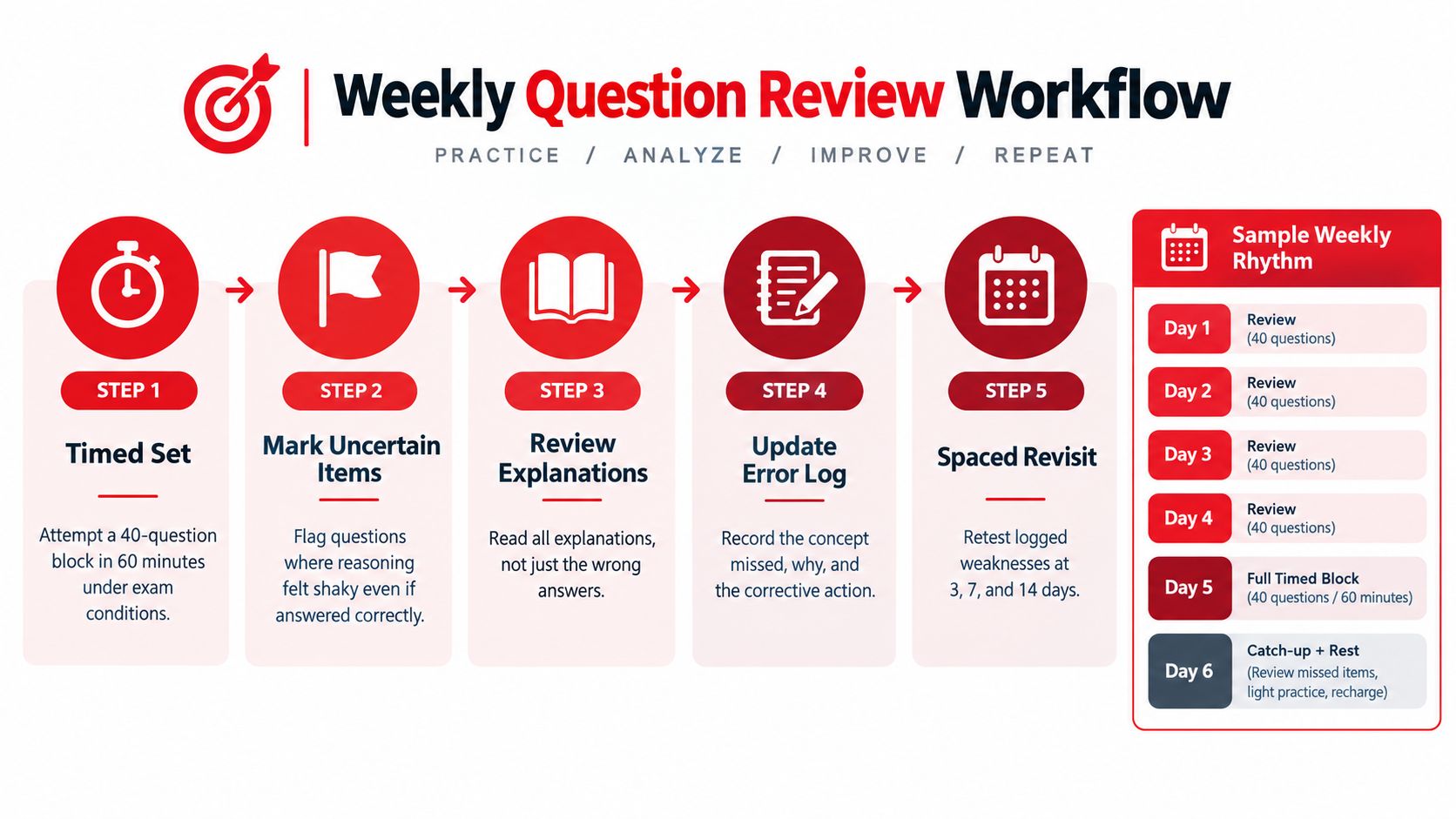
The 2026 interface makes 30-minute blocks the natural unit for software familiarity. The plan below uses those blocks for current-format practice, while allowing longer mixed sessions when the learner needs to build endurance.
The five-step review cycle
Attempt a timed set. Use a suitable timed block and commit to an answer before reviewing explanations. The purpose isn't only speed. It also reveals whether uncertainty comes from missing knowledge or an inability to organize the case.
Mark uncertain items. Flag questions that felt shaky, even when the selected answer was correct. A correct guess can represent the same learning gap as an incorrect answer.
Review the reasoning. For each selected item, identify the decisive clue, explain why the correct answer fits, and explain why the nearest distractor doesn't. Review all relevant explanations, not only the questions marked wrong.
Write one corrective rule. A useful rule is short and actionable, such as “In a stable patient with this pattern, choose the least invasive confirmatory test before treatment.” The rule should reflect the examinee's error, not copy an explanation paragraph.
Revisit the concept. Find a new, related item later and answer it without looking at the original explanation. The distractor analysis guide can help learners separate recognition of a diagnosis from selection of the best next action.
An original weekly planning worksheet
The following worksheet preserves broad coverage while giving repeated misses priority. The exact number of questions should depend on clinical duties, sleep, and the examinee's baseline. The categories are study targets, not predictions of what an individual form will contain.
| Study day | Primary work | Blueprint emphasis | Review output |
|---|---|---|---|
| Day 1 | Timed mixed block | Medicine and diagnosis | Log uncertain and incorrect items |
| Day 2 | Review and new questions | Surgery plus management | One corrective rule per recurring error |
| Day 3 | Targeted block | Pediatrics and prevention | Identify knowledge versus reasoning gaps |
| Day 4 | Review and new questions | Obstetrics and gynecology | Revisit missed decision pathways |
| Day 5 | Timed current-format practice | Psychiatry, ethics, and social sciences | Record pacing and uncertainty |
| Day 6 | Integrated nutrition review | Nutrition within organ systems | Complete new related items |
| Day 7 | Catch-up and recovery | Weakest repeated category | Close open log items and rest |
Nutrition should appear inside the system review rather than as an isolated additive category. For example, renal nutrition can be reviewed with renal management, pregnancy nutrition with obstetrics, and pediatric nutrition with growth and preventive care.
The error-log fields that matter
A compact log is easier to maintain than a collection of lengthy notes. Each entry can include:
- Topic: The system, disease process, or physician task.
- Error type: Knowledge gap, misread clue, wrong next step, distractor confusion, calculation, or pacing.
- Decisive clue: The finding that should have controlled the reasoning.
- Nearest distractor: The tempting alternative and the reason it fails.
- Corrective rule: One sentence that changes future decisions.
- Next action: A new item, flashcard review, targeted reading, or tutor discussion.
- Revisit status: Whether the learner solved a related item later.
A hypothetical example would involve a learner who identifies the diagnosis correctly but chooses a treatment before confirming a necessary test. The review should classify that as a management-reasoning error, write the missing decision rule, and later test the rule in a different clinical context. No outcome should be assumed until the learner demonstrates the reasoning on new material.
Practical rule: The question isn't fully reviewed until the learner can explain both the correct choice and the strongest wrong choice.
Readiness Checklist and When to Seek Tutoring Support
Readiness is shown by repeatable decisions under timed conditions, not by reaching a particular question-bank percentage. A prepared learner can explain why an answer is correct, why the nearest distractor fails, and which error pattern needs attention.
A practical readiness check
- Pacing stability: Complete 2026-format timed blocks without repeated last-minute guessing or losing time during interface transitions.
- Error recognition: Identify recurring errors, such as missed clues, wrong next steps, or distractor confusion, instead of treating every block as a new problem.
- Blueprint coverage: Review medicine, surgery, pediatrics, obstetrics and gynecology, psychiatry, nutrition, ethics, prevention, and patient safety.
- Cross-coded nutrition: Revisit nutrition within renal management, pregnancy, pediatrics, prevention, and other relevant system reviews rather than as a separate extra subject.
- Reasoning clarity: State the decisive clue, the next best action, and the finding that would change the plan.
- Practice trend interpretation: Read scores alongside uncertainty, domain errors, and pacing. A score is a signal for study decisions, not a verdict.
- Recovery plan: Return missed concepts through new questions and spaced review during the weekly cycle.
A useful weekly check resembles a clinical handoff. After each timed block, choose a small set of missed or uncertain questions, classify the error, and write one corrective rule. Re-test those rules in mixed questions later in the week. This shows whether performance is improving through reasoning rather than answer recognition.
Low practice performance may reflect a knowledge gap. Stronger knowledge with repeated misses can point to distractor analysis, prioritization, or test anxiety. A failed attempt or academic gap calls for a personalized diagnostic conversation rather than a generic schedule.
Virtual one-to-one support is described in detail in the Step 2 CK tutoring guide, which covers question analysis, clinical reasoning, and blueprint-aligned review. Tutoring can help when explanations have been reviewed but the same error returns, or when clinical responsibilities make a weekly plan difficult to maintain. It should supplement official USMLE materials and independent practice.

A free Board Score Audit or consultation can organize the starting score, test date, practice patterns, repeated errors, and next study decisions. Its purpose is to adjust the plan and choose suitable support, not promise a score or residency result.
Common Misconceptions About the 2026 Format and Scoring
Does the 2026 update change the tested content?
The interface and block structure change, but the total item count and nine-hour duration remain the same. Examinees should practice shorter current-format blocks while preserving enough mixed-session work to evaluate fatigue and transition costs.
Is nutrition a separate extra percentage?
No. The 15–20% nutrition range is cross-coded with system categories, so nutrition should be integrated into organ-system, prevention, pediatrics, pregnancy, and renal review rather than added to every category.
Does one target score guarantee residency success?
No. A publicly available summary reports average Step 2 CK scores of 236 for matched U.S. IMGs and 248 for matched non-U.S. IMGs, demonstrating why applicant group and specialty context matter. Those figures shouldn't become universal targets or guarantees.
What should international examinees verify?
International students and graduates register through ECFMG, while NBME scores examinations and issues score reports. USMLE-related services for international examinees moved from ECFMG to FSMB in January 2026, so eligibility periods, score delivery, testing-region changes, and support channels should be checked directly in the 2026 USMLE bulletin addendum. ECFMG states that Step 2 CK results are typically available two to four weeks after testing and remain accessible through online services for approximately 365 days after the notification email, according to its registration and test-delivery information.
Ace Med Boards offers virtual one-to-one USMLE Step 2 CK tutoring centered on question analysis, clinical reasoning, and blueprint-aligned review. Examinees who want help turning a score report and error log into a practical weekly plan can visit Ace Med Boards to schedule a free Board Score Audit or consultation.