You're on call at 3 a.m., the list is long, the senior already left, and the note you're about to sign has to do too much. It has to help the attending see your thinking, help the nurse know what to do next, help billing understand what was done, and still make sense if someone opens the chart months later after a complication. That's why documentation best practices aren't clerical polish, they're part of clinical care. They turn scattered bedside work into a record that survives review, handoff, and scrutiny.
Most trainees learn this the hard way. They copy yesterday's note, tweak a few lines, and hope it passes. It might pass a cursory glance on rounds, but it can still fail the next reader, the chart audit, or the legal review. Official guidance now treats documentation as part of the statistical product itself, with emphasis on full-method documentation, reproducibility, versioning, and permanent availability, because the record has to remain interpretable long after the original work is done. That same logic applies in medicine. If the note can't be trusted later, it wasn't complete enough today. ACGME core competencies
Why Documentation Matters Before You Write a Single Word
At 3 a.m., the patient is admitted with chest pain, the ECG is reassuring but not definitive, and the plan is still evolving. The intern wants a note fast, the attending wants the reasoning visible, and the day team wants a clean handoff. That's the moment when documentation stops being a form and becomes the thing that connects your exam, your thinking, and your follow-through.
A good note also has four audiences at once. The clerkship grader wants to see you can organize facts. The next clinician needs enough detail to act safely. The billing team needs the right elements to support the level of service. If something goes wrong, the chart becomes evidence of what you saw, what you considered, and what you did.
Practical rule: if a sentence would make sense only to you, it's not finished yet.
The problem with thin notes is that the failure doesn't always show up immediately. A missing differential can slow overnight care. A vague assessment can make the attending doubt your reasoning. A sloppy timestamp or copied-forward exam can raise questions about whether you saw the patient. In the worst case, the note becomes part of the problem rather than the solution.
Medical trainees often think of documentation as separate from real clinical skill. It isn't. It's the written version of your clinical judgment. If you can't explain the patient clearly on paper, you usually haven't organized the case well enough in your head either. Strong notes don't just score points on a clerkship, they protect continuity, reduce confusion, and create a paper trail that others can rely on when the chart gets crowded.
The Four Note Templates You Will Use on the Wards
The fastest way to write better notes is to stop treating every note like a fresh invention. Most ward documentation comes back to four structures, and once you know those skeletons, the rest is clinical content placed in the right spots. Ghent University recommends starting documentation early and keeping it consistent across levels, from study to file to object and item, which is the same discipline that makes clinical notes easier to grade and easier to use over time. Ghent University documentation guidance
SOAP notes and the daily progress note
SOAP is still the workhorse. Subjective, Objective, Assessment, and Plan give you a clean way to show what changed since yesterday and what you're doing about it. The trap is turning SOAP into a dump of everything in the chart. Keep it task-focused, and make the assessment answer the question, “What do I think is happening today?”
A usable template looks like this, not a novel:
- S: Overnight events, symptoms, pain, bowel movements, breathing, appetite.
- O: Vitals, exam, labs, imaging, pertinent I/O.
- A: Working diagnosis, brief reasoning, alternatives if relevant.
- P: Tests, treatment, consults, disposition, follow-up.
One tight line can carry a lot of weight: “Slept poorly due to dyspnea, now improved, exam shows bibasilar crackles, most consistent with volume overload, continue diuresis and reassess after morning labs.”
H and P for admission or consults
The history and physical is the first complete clinical story. It needs the reason for presentation, the timeline, relevant background, a focused review, and a physical exam that supports your thinking. Don't bury the chief complaint under a wall of normal data. The reader should know within a few lines why the patient is here and why you think the current problem is serious or not.
A clean H and P should include the problem representation, pertinent positives and negatives, past history, medications, allergies, and your initial assessment. The concise version still works: “68-year-old with new exertional chest pressure, risk factors include diabetes and smoking, ECG without acute ischemic change, troponin pending, admit for serial evaluation.”
Progress notes and discharge summaries
Progress notes are for movement. They show what changed, what's stable, and what needs attention next. Discharge summaries are for continuity, so they need the admission reason, hospital course, procedures, key results, discharge condition, medication changes, follow-up, and pending items in a way the next clinician can use.
The University of Wisconsin recommends a few practical components that map well to medicine, cite the source, define the data, describe the package, track lineage, and capture the workflow environment. In charting terms, that means state where the information came from, what it means, what happened to it, and what the next team needs to know. For a wider look at how medical students can keep notes organized and defensible, see a guide for clerkship medical students.
| Note Type | Primary Purpose | Must-Have Sections | Typical Length |
|---|---|---|---|
| SOAP | Daily clinical updates | Subjective, Objective, Assessment, Plan | Short to moderate |
| H and P | New admission or consult | HPI, ROS, exam, assessment, initial plan | Moderate to long |
| Progress note | Ongoing inpatient reasoning | Interval events, exam, key data, assessment, next steps | Short to moderate |
| Discharge summary | Continuity after discharge | Hospital course, procedures, meds, follow-up, pending issues | Moderate |
The White House archives' proposed standards for statistical surveys require documentation sufficient to understand and replicate results, and the same standard is useful on the wards. A note should let the next person understand how you reached your plan and whether they can trust it without starting from zero.
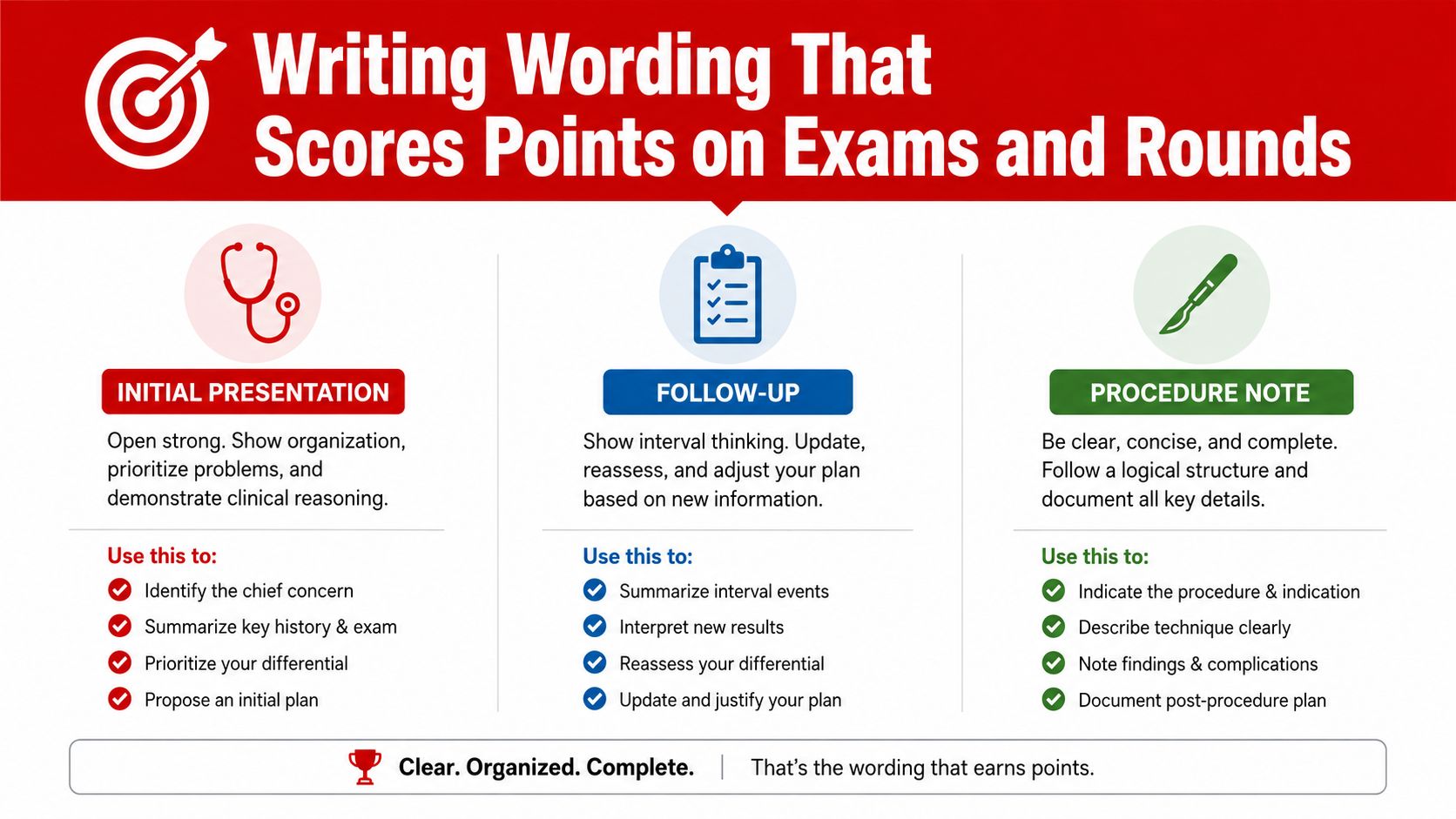
Writing Wording That Scores Points on Exams and Rounds
The words inside the template matter as much as the template itself. A clean structure with vague language still reads like weak thinking. A messy structure with sharp wording can sometimes still pass, but the goal is to make your reasoning obvious, not to rely on goodwill from the attending.
Phrase the assessment like clinical reasoning
The assessment should tell the reader what you think, why you think it, and what would change your mind. Vague lines like “stable, continue current management” don't show clinical judgment. They hide it.
Use wording that names the working diagnosis and the supporting data. A better pattern is, “Persistent hypoxia most consistent with atelectasis versus volume overload, improved after incentive spirometry and diuresis, continue both while trending oxygen requirement.” That sentence shows you can synthesize the chart instead of just reciting it.
For exams and rounds, the same principle applies. A differential should be focused and ranked. Don't list every possibility you can remember. List the ones that matter, and show why the top one is on top.
Use procedure and discharge language that stays defensible
Procedure notes should read like a record, not a brag sheet. State indication, consent, location, key steps, immediate outcome, complications, and who was present. If the note needs an attestation, write it cleanly and consistently.
Discharge language should be specific enough that the next team doesn't guess. “Follow up with PCP” is weak if the patient has heart failure, diabetes, and a new medication change. “Follow up with primary care within one week to review weight, renal function, and diuretic dose” is much more useful.
The most useful sentence stems are the ones you can reuse without sounding canned:
- “Most likely diagnosis is…”
- “This is supported by…”
- “Less likely because…”
- “Will reassess after…”
- “Discharge pending…”
On clerkships, that phrasing signals that you're not just reporting facts, you're making decisions visible. That's what earns trust on rounds and on exams. Communication skills for doctors
Keep the wording tight enough to survive review
A note filled with qualifiers can sound careful while being evasive. Say what you saw, what you think, and what you plan. If you're unsure, say what remains unresolved instead of hiding behind bland phrasing.
If the attending has to decode your sentence, you've already lost points.
The standard isn't elegance. It's clarity under pressure. Good phrasing shows that you can carry uncertainty without making the chart vague.
The High-Impact Documentation Mistakes That Cost You
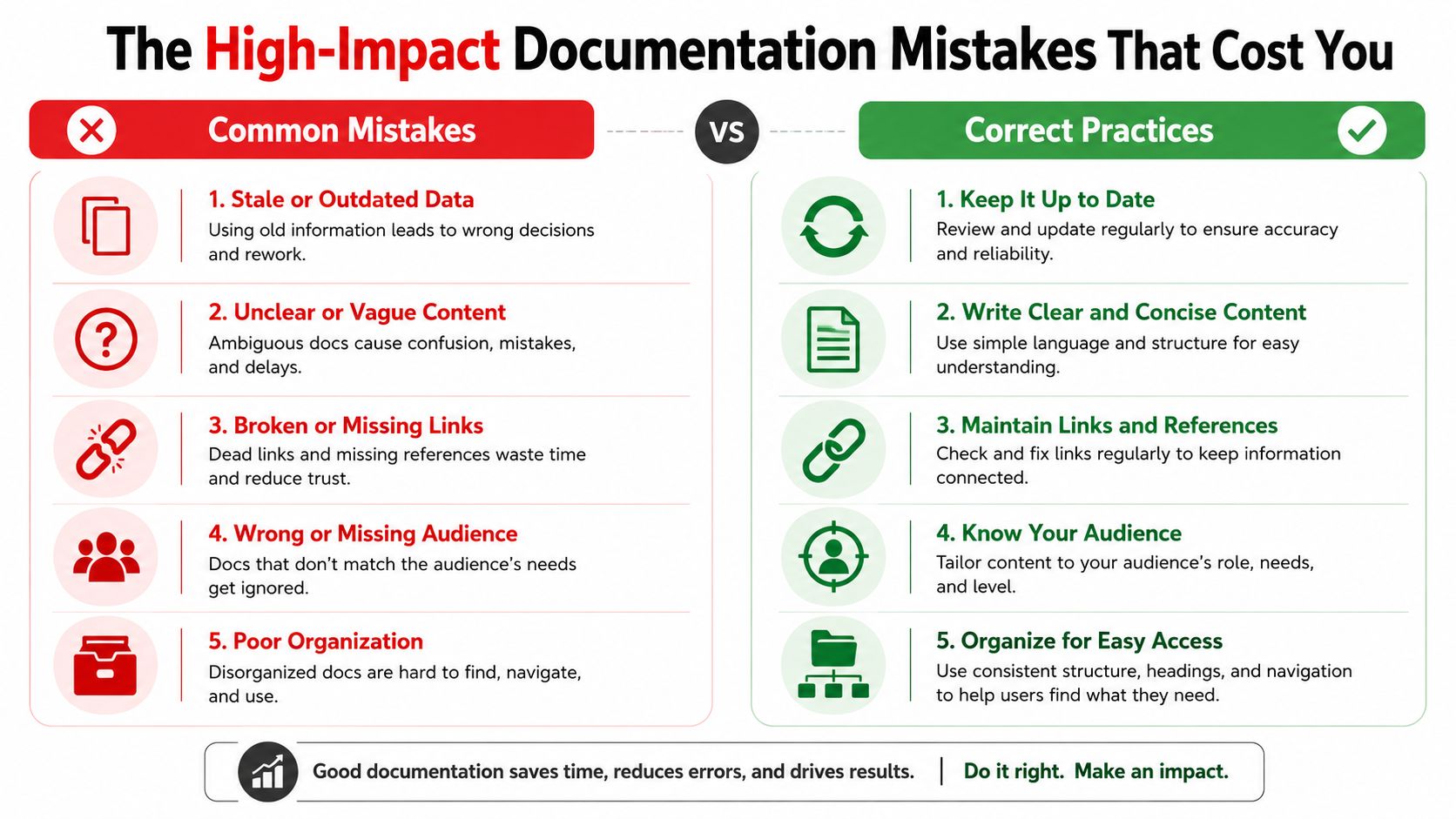
The worst documentation errors are usually small, repetitive, and easy to miss when you're rushed. They also stack up fast. A copied-forward exam, a late addendum, or a vague assessment might look harmless in isolation, but together they make the chart harder to trust.
Copy-forward without verification
Copying forward isn't always wrong. Blind copy-forward is. If yesterday's ROS said no chest pain and today the patient is still here for chest pain, the chart stops matching reality. That's a credibility problem on rounds and a risk if anyone later reads the note as if it were fresh data.
Use copy-forward only for stable facts you have rechecked. If you didn't confirm it, remove it. If you confirmed it, update it. That simple habit protects both accuracy and your reputation.
Missing timestamps, unsigned work, and late entries
Timing matters because the chart is a timeline. Missing or inconsistent timestamps make it harder to reconstruct what happened first, especially when notes conflict. The same applies when someone signs work they didn't write or writes an addendum that contradicts the original note.
If you're adding information late, say so. Late entries are sometimes necessary, but they should be clearly labeled and explained. Hidden edits look much worse than honest corrections.
Vague medical decision-making
“Continue current management” is the kind of sentence that sounds acceptable until someone asks why. The note should show the logic behind continued treatment, changed treatment, or observation. If the plan is unchanged, the reasoning still has to be explicit.
That's where tools such as AI document review from LegesGPT can be useful as a second pass for clarity and consistency, especially when a note feels polished but still leaves gaps in attribution or sequence. The tool doesn't replace judgment, but it can help catch wording problems that students and interns miss when they're tired.
Incomplete procedure notes and unattributed handoffs
Procedure notes fail when they leave out who was present, what was done, or what happened immediately afterward. Handoffs fail when critical information lives only in conversation. If the next clinician can't tell what changed, the handoff wasn't complete.
A quick audit list helps:
- Verify each copied line.
- Check timestamps and signatures.
- State who did what.
- Explain any late correction.
- Make the plan reproducible.
The more polished a note looks, the easier it is to miss these errors. That's why the best trainees review substance first and formatting second.
EHR Workflow and Time Management That Holds Up
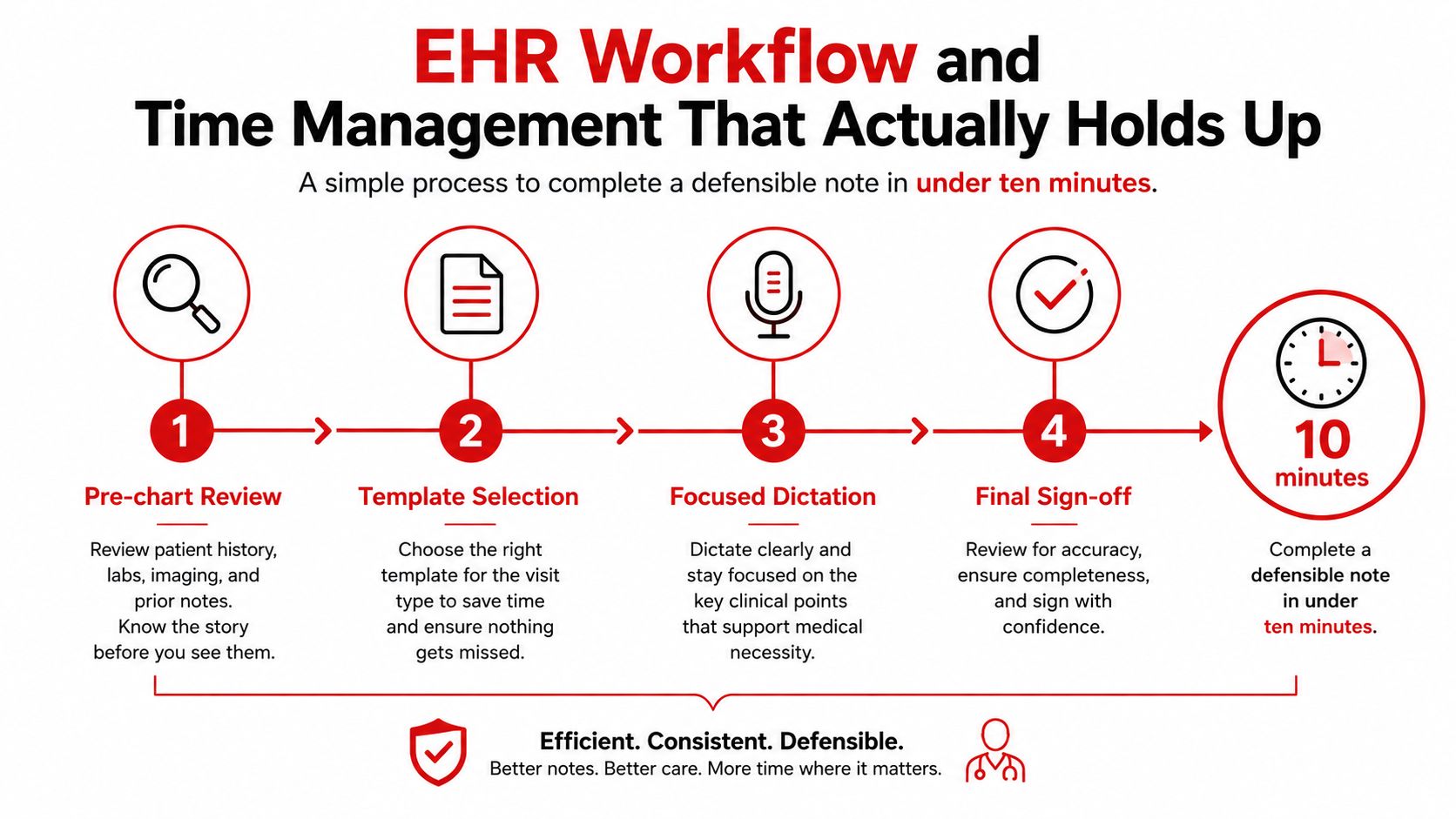
A note that takes forty-five minutes will not survive a busy service. The process has to be fast enough that you can do it while the facts are still fresh. The practical answer is to move through the chart in a repeatable order instead of improvising every time.
Build the note before you sit down to write it
Pre-rounding should give you the raw material. Pick up the overnight events, vitals, labs, and any changes in the plan before you open the note template. Then choose the right structure once and reuse it. That reduces the time spent staring at a blank screen and keeps you from forgetting a section later.
Dot phrases and smart phrases help, but only if they fit your workflow. A smart phrase that inserts five irrelevant sentences is slower than typing from scratch. Keep the template narrow, and keep only the pieces you use.
Batch the work so you aren't rewriting the chart all day
The biggest time saver is batching. Fill in the note soon after rounds, while the discussion is still active and the attending's changes are fresh. Then make one pass after feedback to adjust wording, update the plan, and clean up anything that changed.
A realistic rhythm looks like this:
- Pre-round review for overnight events and key data.
- Template selection before you start typing.
- Focused dictation or typing for the assessment and plan.
- Final sign-off after attending feedback and cross-checking.
That framework is simple enough to repeat and strict enough to prevent drift. EHR systems and workflow
Workflow rule: write the note while the case is still in your short-term memory, before the day has already blurred together.
Use sign-out language that matches the note
Sign-out and progress notes should tell the same story. If your handoff says the patient is stable but your note implies active uncertainty, someone on call has to reconcile the mismatch. That slows care and invites errors.
The goal is to document once in a way that supports both the chart and the handoff. If you stay consistent, the on-call team will not need to reread the whole note just to find the next step.
I've seen students get faster by doing a short, disciplined routine every day. Five minutes before rounds, ten minutes after rounds, five minutes after feedback. That is enough time to build speed without turning the chart into a late-night scramble. The same routine also helps the note hold up when an attending reviews it, when billing staff checks the details, and when a question comes up later about who said what and when. MEDIAL on Article 32 compliance
Legal, Billing, and Medico-Legal Flags You Must Recognize
Billing and medico-legal risk live in the same sentences as your clinical reasoning. That's the part trainees often miss. A note can sound medically sound and still be weak from a documentation standpoint if it doesn't support the level of service, procedure requirements, or the timeline of care.
When billing gets involved, the exact elements matter. The medical decision-making has to show complexity, data reviewed, and risk. If a procedure is documented, the record has to show who was present, what was done, and that the right attestation language was used. A note written loosely can fail both coding and scrutiny, even if the care itself was fine.
The same principle applies to compliance. MEDIAL's guide on Article 32 compliance is a good reminder that documentation is not just content, it's also traceability, accountability, and control of sensitive information. In medicine, the chart has the same obligation to be clear about who did what and when.
Recognize the phrases that create risk
A few patterns are worth avoiding:
- Subjective opinions written as facts. If you didn't verify it, don't state it as certain.
- Late entries without explanation. The chart should make timing obvious.
- Contradictory addenda. Corrections should clarify, not erase.
- Unclear attribution. If someone else said it, make that clear.
- Unsupported billing language. If the assessment is shallow, the code support usually is too.
That's where internal consent and responsibility matter as well, which is why a review of informed consent and autonomy is worth keeping in mind when you're documenting procedures or significant decisions. The chart should show that the patient understood, that the team explained, and that the decision was recorded accurately.
Write once, satisfy three readers
The attending wants a clinically coherent note. Billing wants support for complexity. Risk management wants a chart that can be defended later. Those aren't competing goals if you write clearly.
A strong note will explain why the patient was admitted, what data changed your thinking, and what the plan is now. That same note supports coding and reduces ambiguity if the chart is ever reviewed. If you build the note around the logic of care instead of the language of convenience, you'll satisfy more readers with less rewriting.
Your 30-Day Documentation Improvement Plan and Quick Checklist
Documentation gets better when the system gets better. A single good note doesn't change much if the next one is rushed, copied, and vague. A month of deliberate repetition does.
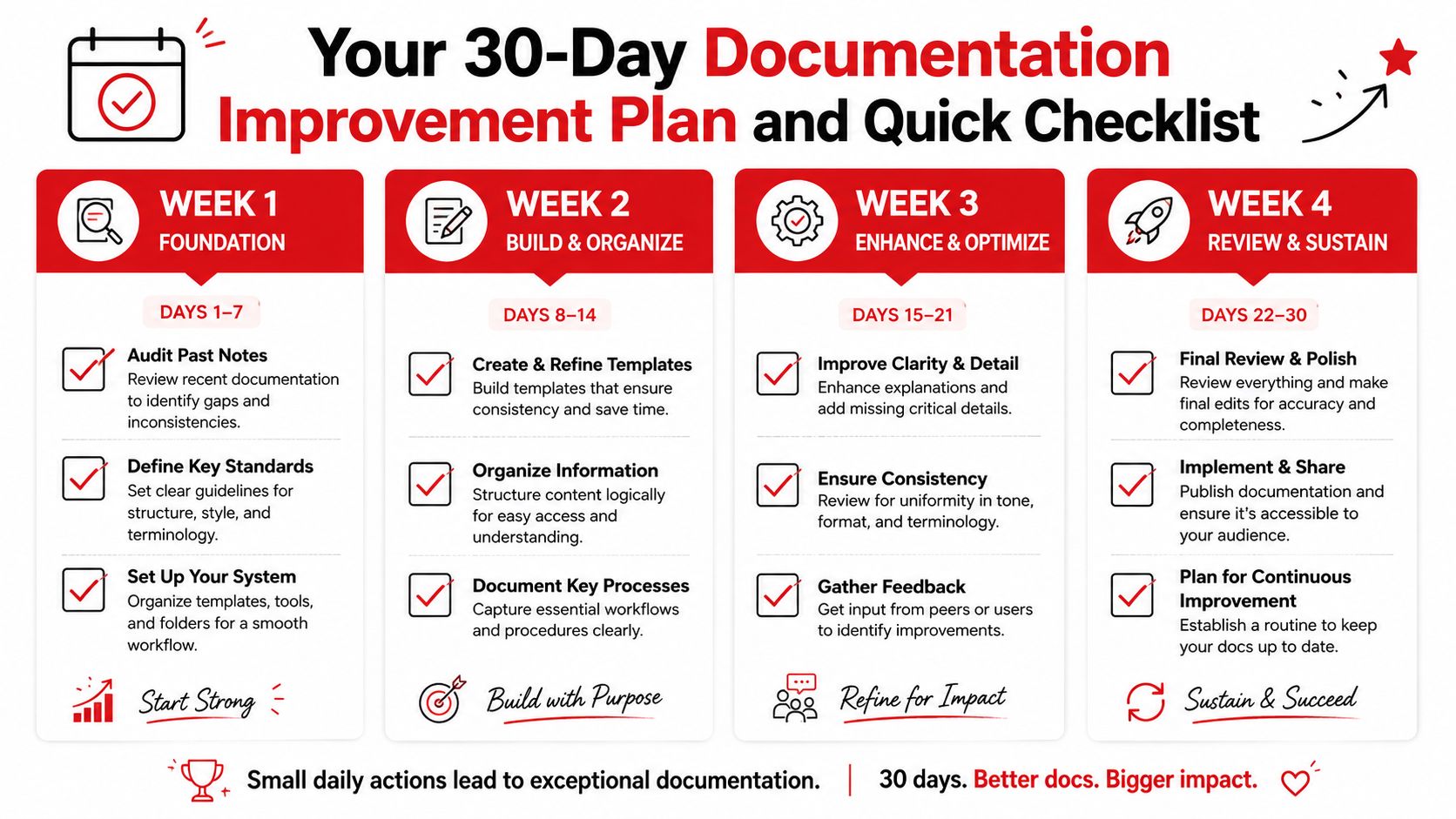
A simple four-week plan
Week one is foundation. Pick your four templates, build your dot phrases, and read three of your own recent notes like a stranger would. Look for copied-forward text, vague assessments, and places where you forgot to say what changed.
Week two is reps. Finish every note using the same workflow, and aim to get it done while the patient is still fresh in your mind. Ask for feedback on wording, not just content, because a note can be clinically correct and still be hard to read.
Week three is polish. Tighten your medical decision-making, align your wording with what billing and attending review need, and make your sign-out match your note. The goal is not to sound formal, it's to sound precise.
Week four is teaching. Explain your note structure to a junior student or intern. If you can't teach it clearly, you probably don't own it yet.
For teams that like a structured planning approach, the new employee success blueprint is a useful parallel. The principle is the same, a short, repeatable ramp beats vague intentions every time.
One-page checklist for the next note
- Use the right template for the note type.
- Confirm every copied-forward fact.
- Write the assessment as reasoning, not filler.
- Include timestamps and clear attribution.
- Make the plan specific enough to follow.
- Keep handoff language consistent with the chart.
- Check procedure and discharge details for completeness.
- Read the note once as if you were the next clinician.
If you want more structured coaching on exam performance, note wording, and how to translate clinical thinking into points on the page, Ace Med Boards offers one-on-one tutoring and test prep built around practical study structure and error review. Visit Ace Med Boards if you want help turning your documentation habits into a stronger rotation performance and a cleaner chart.