The headline is reassuring: in the 2025 Main Residency Match, U.S. MD seniors matched at 93.5% and U.S. DO seniors at 92.6%, a difference of less than one percentage point, according to the NRMP-linked comparison reported by Gradpilot. But that near-parity can obscure the decision applicants need to make. In fields such as plastic surgery, neurosurgery, vascular surgery, and thoracic surgery, specialty-level differences remain large, while exam strategy, clinical networks, school mission, and cost can shape an individual path.
MD and DO graduates are both physicians. The practical question isn't whether one degree is universally better. It's whether a particular school and training model fit your specialty goals, learning preferences, finances, geography, and tolerance for a more complex licensing-exam strategy.
What MD vs DO Actually Means in 2026
MD means Doctor of Medicine and identifies graduates of allopathic medical schools. DO means Doctor of Osteopathic Medicine and identifies graduates of osteopathic medical schools. Both degrees qualify graduates to practice medicine as physicians in the United States, as the American Medical Association explains in its MD versus DO overview.
The most consequential structural change is postgraduate training. By 2020, osteopathic medicine had fully integrated into a single graduate medical education accreditation system, allowing MD and DO graduates to train in the same residency programs under the Accreditation Council for Graduate Medical Education, or ACGME. The old assumption that DO graduates must use a separate residency pathway is therefore outdated. The AACOM history of osteopathic medical education documents that transition and its significance.
Working definition: The degree determines the school's educational tradition and the early exam pathway. It doesn't create a separate physician scope of practice after graduation.
The distinction still matters in two places. First, DO programs include osteopathic manipulative medicine, or OMM, while MD programs don't have that standard curricular requirement. Second, residency access isn't equally distributed across every specialty, even though both degrees enter the same accreditation framework.
| Dimension | MD, allopathic | DO, osteopathic |
|---|---|---|
| Degree | Doctor of Medicine | Doctor of Osteopathic Medicine |
| Medical school type | Allopathic medical school | Osteopathic medical school |
| Accreditation identity | Typically accredited through LCME | Accredited through COCA |
| Distinctive curriculum | Biomedical and clinical medicine | Biomedical and clinical medicine, plus osteopathic principles and OMM |
| Licensing exam pathway | USMLE is the standard pathway | COMLEX-USA is the osteopathic pathway; some students also take USMLE |
| Residency framework | ACGME single accreditation system | ACGME single accreditation system |
| Practice scope | Physician practice after licensure | Physician practice after licensure |
| Main strategic difference | Usually one primary licensing sequence | May require planning for COMLEX alone or COMLEX plus USMLE |
Applicants comparing the pathways can review the osteopathic medicine pathway from Ace Med Boards for additional context. The useful baseline is simple: MD and DO are different educational identities inside one physician profession, with meaningful variation appearing later in curriculum, exams, school resources, and specialty competition.
How the Two Degrees Got Here
Osteopathic medicine began in 1874, when Andrew Taylor Still developed the osteopathic philosophy. The first osteopathic medical school opened in 1892 with 21 students, including 6 women, according to AACOM's history of osteopathic medical education. That origin created a parallel training system rather than a different level of physician practice.
Allopathic medical education developed along a separate institutional path, with standardization and scientific training gaining influence through reforms associated with Abraham Flexner. Over time, MD and DO schools developed different accrediting organizations, examinations, hospitals, and professional structures. Those differences help explain why older advice sometimes describes DO graduates as having limited access to training environments that MD graduates used.
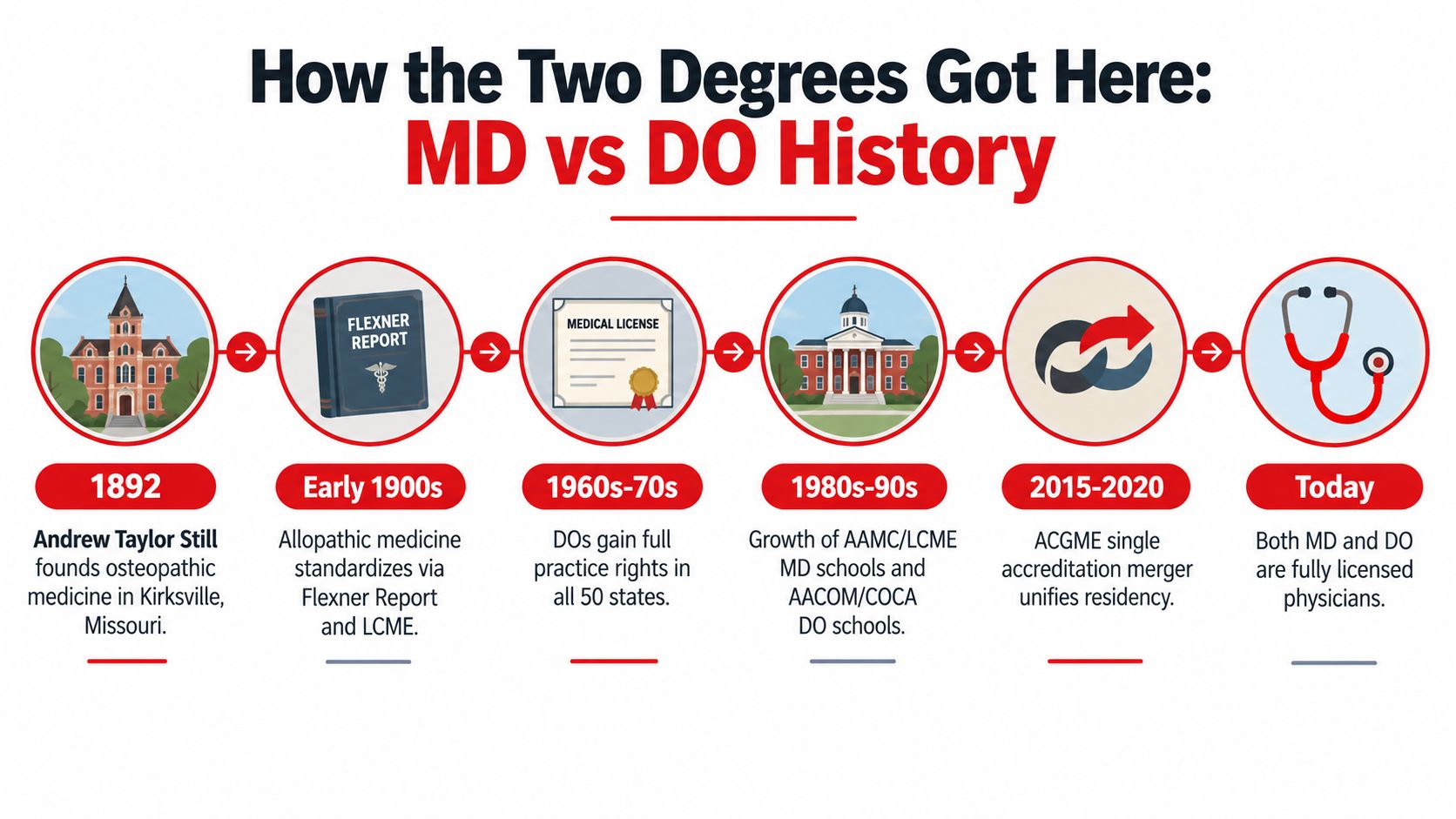
The most important modern milestone was the move to a single ACGME graduate medical education accreditation system, completed by 2020. That change structurally removed separate residency accreditation pathways. It didn't instantly erase differences in institutional reputation, research access, program familiarity, or specialty-specific selection patterns.
This distinction matters for applicants. The merger equalized the formal residency framework, but formal eligibility and practical competitiveness aren't identical. A student can enter an ACGME program as a DO graduate, yet still need to evaluate whether a target specialty is familiar with COMLEX-USA results, whether the school offers meaningful research mentorship, and whether clinical rotations create access to the programs the student hopes to join.
History should therefore correct two opposite misconceptions. A DO graduate isn't confined to a separate residency system, but the existence of one accreditation framework doesn't guarantee equal outcomes in every specialty. The path has converged institutionally while retaining curricular identity and uneven specialty-level results.
Curriculum, Accreditation, and OMM Side by Side
The first two years of medical school typically emphasize foundational science and clinical preparation. The later years place students in supervised clinical rotations, although the quality, scheduling, hospital affiliations, and degree of student responsibility depend heavily on the school. The degree label alone can't tell an applicant whether a clinical curriculum is well organized.
The clearest curricular difference is OMM, which includes hands-on instruction in osteopathic principles and manipulative techniques. One osteopathic medical education source describes approximately 200 hours of additional musculoskeletal-focused education during osteopathic clinical training in its DO versus MD comparison. That added material may be a deliberate fit for students who want formal training in osteopathic structural assessment and manipulation, not merely a branding feature.
| Element | MD, allopathic | DO, osteopathic |
|---|---|---|
| Accrediting medical education body | LCME for qualifying allopathic programs | COCA for osteopathic programs |
| Core preparation | Basic science, clinical science, patient care | Basic science, clinical science, patient care, osteopathic principles |
| OMM requirement | Not part of the standard MD curriculum | Required osteopathic manipulative medicine instruction |
| Clinical rotations | School-specific hospitals and affiliated sites | School-specific hospitals and affiliated sites |
| Licensing eligibility | USMLE pathway | COMLEX-USA pathway; students may add USMLE |
| Residency accreditation | ACGME | ACGME |
| Best comparison method | Review curriculum, hospitals, outcomes, and support | Review curriculum, hospitals, outcomes, and support, including OMM integration |
A prospective DO student should ask how OMM is integrated into anatomy, physical examination, and clinical reasoning rather than treating it as a separate block to endure. A prospective MD student should ask equally specific questions about longitudinal clinical exposure, academic medical center access, and the school's board-preparation support. The LCME accreditation information and COCA accreditation resources can help applicants verify institutional status rather than relying on marketing language.
Clinical training can feel very different from one school to another. Some schools place students in large academic hospitals, while others use distributed community networks. Before choosing, compare rotation guarantees, required travel, teaching-hospital access, faculty availability, and the school's published residency outcomes.
Students considering OMM as part of their professional identity can also review OMM and osteopathic manipulative medicine tutoring context. The practical conclusion isn't that one curriculum is more complete. Patient-centered care exists in both professions. The more useful question is whether you want the DO curriculum's additional osteopathic framework to be part of your formal training.
Licensing Exams for Each Track
The exam decision is where the two pathways become operationally different. MD students generally plan around the United States Medical Licensing Examination, or USMLE, while DO students must plan around COMLEX-USA, administered by the National Board of Osteopathic Medical Examiners, or NBOME. A DO student may also take USMLE examinations when a specialty or program strategy makes that useful.
The core comparison looks like this:
| Dimension | USMLE, common MD path | COMLEX-USA, DO path |
|---|---|---|
| Sponsoring structure | USMLE program, involving FSMB and NBME | NBOME |
| Primary sequence | Step 1 and Step 2 Clinical Knowledge, or Step 2 CK | Level 1 and Level 2-CE |
| Step 1 or Level 1 scoring | Step 1 is reported pass/fail | Level 1 is reported within the COMLEX framework |
| Osteopathic content | No standard OMM component | Includes osteopathic principles and manipulative medicine |
| Applicant strategy | Usually the principal exam sequence | COMLEX alone or COMLEX plus USMLE, depending on goals |
| Residency communication issue | Familiar to most ACGME programs | Some program directors have reported less familiarity interpreting COMLEX scores |
The USMLE versus COMLEX comparison from Ace Med Boards can help organize the content distinction, but applicants should verify current registration and reporting rules directly with USMLE and NBOME. Exam policies, eligibility windows, and score-reporting practices can change, so this article shouldn't substitute for the current official candidate bulletins.
Step 1 has been pass/fail since 2022. That shift increases the importance of Step 2 CK for applicants who use USMLE results to communicate readiness to residency programs, particularly in competitive specialties. It doesn't mean every DO student must automatically take both pathways. The decision should follow the target specialty, school advising, clinical performance, preparation capacity, and downside risk of adding another high-stakes examination.
Exam-planning rule: Choose the specialty strategy first, then determine whether COMLEX alone communicates your readiness to the programs you're targeting.
The 2024 AMA discussion of COMLEX, USMLE, and graduate medical education identifies program-director familiarity with COMLEX interpretation as a relevant consideration. That isn't a judgment about DO education. It's an application-communication issue, and students should address it early with specialty-specific advising.
Residency Match Outcomes by Specialty
A near-parity overall match rate can conceal a substantial specialty-specific gap. In the 2025 Main Residency Match, MD and DO senior rates were close, yet convergence was uneven across highly selective fields. The available PubMed-linked analysis covering 2020 through 2023 shows markedly different match rates in several specialties.
For a broader review of current specialty figures, see our 2025 residency match statistics by specialty analysis.
| Specialty | MD match rate | DO match rate | Gap |
|---|---|---|---|
| Neurosurgery | 74.82% | 30.88% | 43.94 percentage points |
| Thoracic surgery | 46.45% | 16.67% | 29.78 percentage points |
| Plastic surgery | 68.84% | 4.17% | 64.67 percentage points |
| Vascular surgery | 74.18% | 23.21% | 50.97 percentage points |
| Otolaryngology, ENT | 72.57% | 53.10% | 19.47 percentage points |
| Orthopedic surgery | 72.51% | 56.92% | 15.59 percentage points |
These figures come from the specialty-level MD versus DO match analysis. They are not individual probability estimates. Applicant pools, program types, application volume, research experience, geographic preferences, and comparison-group definitions all affect how the rates should be interpreted.
The narrower conclusion is more useful: the degree gap is smaller overall than it is in selected competitive specialties. Applicants targeting neurosurgery, plastic surgery, vascular surgery, thoracic surgery, ENT, or orthopedics should account for specialty-level differences when building a school list, selecting examinations, and planning research or away rotations.
A 2021 NRMP-linked analysis found that matched U.S. DO seniors had lower average USMLE Step 1 and Step 2 CK scores than matched MD seniors across low-, medium-, and high-competitiveness groups. The study also reported lower research output and fewer contiguous programs ranked among DO applicants. Its findings appear in this peer-reviewed analysis available through PubMed Central.
Several mechanisms may contribute to these patterns without reducing them to student ability:
- Exam interpretation: Programs differ in how readily they interpret COMLEX results, so USMLE planning may matter for some DO applicants.
- Research access: School-linked academic medical centers and faculty infrastructure can affect specialty-specific scholarship opportunities.
- Clinical exposure: Away rotations and affiliated hospitals may shape visibility, mentorship, and letters.
- Application density: Ranking fewer contiguous programs can limit geographic flexibility and narrow a student's match strategy.
Primary care and some hospital-based fields may provide a more degree-neutral setting, but applicants should still examine current specialty data rather than assume parity. The practical decision matrix is specialty-specific: the more selective the target field, the more closely applicants should evaluate degree, school resources, examination strategy, research access, and clinical-network reach together.
Choosing a School, Not Just a Degree
The school decision deserves more precision than “MD is research-focused” or “DO is primary-care focused.” Those are broad tendencies, not reliable substitutes for school-level evidence. Compare the actual curriculum, teaching hospitals, clinical rotation design, board support, faculty mentorship, published outcomes, cost, and geographic reach.
A useful school review asks:
- Mission and patient population: Does the school's mission align with your interest in urban academic medicine, rural care, underserved communities, or another setting?
- Clinical network: Where do students rotate, and how much control do they have over elective and away experiences?
- Academic infrastructure: Can you identify mentors and research projects in your intended specialty?
- Board preparation: Does the curriculum provide structured support for USMLE, COMLEX-USA, or both?
- Financial exposure: Compare tuition and living costs using each school's current official disclosures, not general assumptions about degree type.
- Geographic fit: Can you realistically train and build professional relationships in the region where you hope to practice?
Consider a labeled composite applicant, not a real student: the applicant values whole-person care, is unsure whether OMM will be a meaningful part of daily practice, and is interested in a competitive academic specialty. The sound decision process isn't to declare MD superior or DO easier. It's to compare specific schools for research mentorship, specialty match history, rotation access, OMM expectations, cost, and exam advising.
School-level test: If two schools produce different opportunities, the degree letters won't explain the difference by themselves. The hospital network, faculty access, and specialty infrastructure may matter more.
Applicants should examine each school's published outcome reports and ask current students targeted questions. How early can students join specialty research? Are clinical sites assigned or self-arranged? Does the school provide a clear policy for students considering both COMLEX-USA and USMLE? What happens when a student struggles academically or experiences test anxiety?
The osteopathic medical school comparison resource may help frame questions, but it shouldn't replace direct review of each institution's accreditation, disclosures, curriculum, and rotation agreements. A lower-cost school with strong regional support may be a better fit than a more recognizable institution that leaves you with weak clinical access or an unsustainable financial burden.
Study Planning and Tutoring for Both Tracks
A responsible study plan starts with the examination sequence, not the degree stereotype. MD students commonly organize preparation around USMLE content and question formats. DO students must protect time for COMLEX-specific osteopathic content while deciding whether their specialty goals justify additional USMLE preparation.
Because the provided evidence doesn't establish a universal dedicated-period length, question-bank volume, or readiness threshold, use the framework below as a planning scaffold rather than a guaranteed formula.
USMLE-focused planning
Build a systems-based content map, then pair each topic with timed questions and deliberate review. Resources such as First Aid for the USMLE Step 1, UWorld, and NBME practice forms are commonly used by students, but they are independent third-party resources and should be checked for current editions and policies.
A weekly review cycle can include:
- Baseline audit: Identify weak systems, calculation errors, and recurring reasoning failures.
- Timed practice: Complete question blocks under realistic conditions.
- Error classification: Label each missed question as knowledge gap, misread stem, faulty reasoning, or timing problem.
- Retention pass: Convert only important recurring errors into spaced-repetition prompts.
- Readiness review: Use official self-assessment information and faculty guidance before selecting an exam date.
COMLEX-focused planning
COMLEX preparation needs the same clinical reasoning discipline plus deliberate review of OMM, osteopathic principles, ethics, and biomedical science. Students often consider resources such as Savarese OMT Review, COMLEX-style question banks, TrueLearn, COMQUEST, and NBOME self-assessments. None should be treated as a substitute for the current official examination guidance.
Students considering USMLE should create a separate content and practice plan rather than assuming COMLEX preparation transfers perfectly. The workload, question style, and reporting goals need to be evaluated against the student's specialty target and preparation capacity.
Digital planning can reduce administrative friction, especially when students use calendars, error logs, and spaced-repetition systems. Readers who want to evaluate productivity tools can review these student AI workflow tools, while keeping clinical content and exam decisions grounded in official materials.
Readiness checklist
Before scheduling an exam, ask:
- Coverage: Have you reviewed every tested domain at least once?
- Application: Can you explain why each answer choice is right or wrong?
- Consistency: Are practice results stable across more than one assessment?
- Stamina: Can you sustain concentration through a full testing day?
- OMM integration: If taking COMLEX, can you connect osteopathic concepts to clinical presentations?
- Risk control: Do your advisors agree that your preparation supports scheduling now?
One-on-one tutoring can complement, not replace, question banks, official practice materials, faculty advising, and independent review. For students who need structured help with USMLE or COMLEX preparation, Ace Med Boards offers online one-on-one tutoring and test-preparation support. The relevant value is targeted review of reasoning patterns and difficult content, not a promised score or pass outcome.
A Practical Decision Framework for Applicants
Use a sequence rather than a slogan. Specialty target determines exam planning. Exam planning influences school selection. School selection shapes application strategy.
| Specialty target | Recommended degree mix | Exam plan | Key trade-off | Weighted score drivers |
|---|---|---|---|---|
| Dermatology, neurosurgery, orthopedic surgery, integrated plastic surgery | Compare MD schools broadly and DO schools with documented specialty outcomes | DO applicants should evaluate whether adding USMLE is appropriate | Greater emphasis on research, rotations, specialty access, and exam communication | Specialty infrastructure, research mentorship, clinical network, exam tolerance |
| Primary care, pediatrics, psychiatry | Evaluate both MD and DO schools | Choose the pathway that matches school advising and personal capacity | Mission, cost, location, and clinical fit may outweigh degree label | Mission alignment, affordability, rotation quality, support |
| International or foreign medical graduate pathway, or career changer | Compare individual schools and eligibility requirements carefully | Build an exam plan around the intended residency pathway | School choice doesn't erase licensing, documentation, or residency competitiveness requirements | Eligibility, exam preparation, clinical experience, geography, support |
The first branch is specialty-driven. If you're targeting a highly selective field, examine school-level outcomes, faculty access, research opportunities, and the practical expectations around USMLE results before accepting an offer. Don't choose a school solely because its admissions process feels more accessible if it leaves you without the infrastructure your specialty requires.
The second branch is fit-driven. For applicants pursuing primary care, pediatrics, psychiatry, or another field where the degree may be less decisive than in the most selective specialties, compare mission, cost, location, rotation quality, and student support. OMM should be treated as a genuine educational preference. If you don't want hands-on osteopathic training, investigate the curriculum before committing to a DO program.
The third branch requires careful separation of admissions from residency strategy. A DO degree isn't a shortcut around licensing or matching requirements, and an MD degree isn't a guarantee of admission or residency placement. International medical graduates and foreign medical graduates should verify current eligibility and documentation rules with the responsible organizations before relying on any general comparison.
Score each school from your own priorities:
- Specialty fit: Does the school support the field you want?
- Clinical access: Are rotations strong and geographically practical?
- Exam tolerance: Can you manage the required licensing pathway?
- Cost and location: Is the financial and regional commitment sustainable?
- Personal fit: Do the curriculum, mission, and learning environment suit you?
The strongest choice is the one that performs well across your actual constraints, not the one that wins an abstract MD versus DO debate.
If you're comparing USMLE and COMLEX preparation or want to audit how your specialty goals should shape your exam plan, visit Ace Med Boards to learn about its online one-on-one tutoring and exam-preparation support. A free consultation can help you identify the most relevant preparation questions without promising a particular score, admission result, or residency match.