

You circled a Saturday that fits work, a lab, or a caregiving handoff, and the Medical College Admission Test (MCAT) search shows that date as full. The center is the one you can reach the night before. Refreshing the same screen does not create a new appointment.
MCAT seats full almost always means that one date at that center has no remaining appointment, not that every seat in the country is gone. Label the screen you are looking at, then weigh any move against your application timeline and the final change deadline, instead of treating another refresh as a plan.
What Full Means in the MCAT Search
The Association of American Medical Colleges (AAMC) offers the exam many times from January through September at hundreds of testing sites in the United States, Canada, and other countries. Each center has limited capacity, and appointments are reserved first-come, first-served. There is no public national seat count. The live registration system is the only source for what is open right now.

A listed center is not proof of an open seat. The AAMC registration guidance warns that a center's appearance does not guarantee appointment availability. Capacity is appointment-specific. Late-year seats can fill, and a replacement after an AAMC-caused disruption may be impossible if nothing is left. For a student with a tight travel budget, a disability-related need, a job, a visa, or caregiving, “try another center” is not always an equal option.
Three screens, three different problems
| What you see | What it means | First move |
|---|---|---|
| Center listed but no appointment times | That date at that center is fully booked | Join the official waitlist or change date or radius |
| Preferred date missing from the calendar | Registration for that location group may not be open, or the site does not offer that date | Check the AAMC opening schedule before assuming it is sold out |
| A time appears after an earlier search showed none | Someone canceled and one appointment was released | Book it only if the date, travel, and prep window still work |
Key takeaways
- Search by the center, not your home address. Seats are tied to where the testing site is.
- A visible center is not an open seat. Listing and capacity are different facts.
- The final 10 days are a lockout, not a backup plan. After that cutoff, the appointment you hold is the one you keep.
Account setup, identification matching, and the registration tabs belong in the existing AAMC registration guide. Name which row matches your screen before you change travel plans or an application year.
As of October 30, 2026, the January through September 2027 registration window that ran October 20 to 22 has already passed. A full result now can reflect bookings from that opening and the live queue. Confirm current availability in the AAMC registration system before you act.
How to Find and Monitor an Open Seat
A full downtown Saturday is usually a local capacity problem. Another center, or a nearby date, can still be open because each site holds a fixed number of seats.
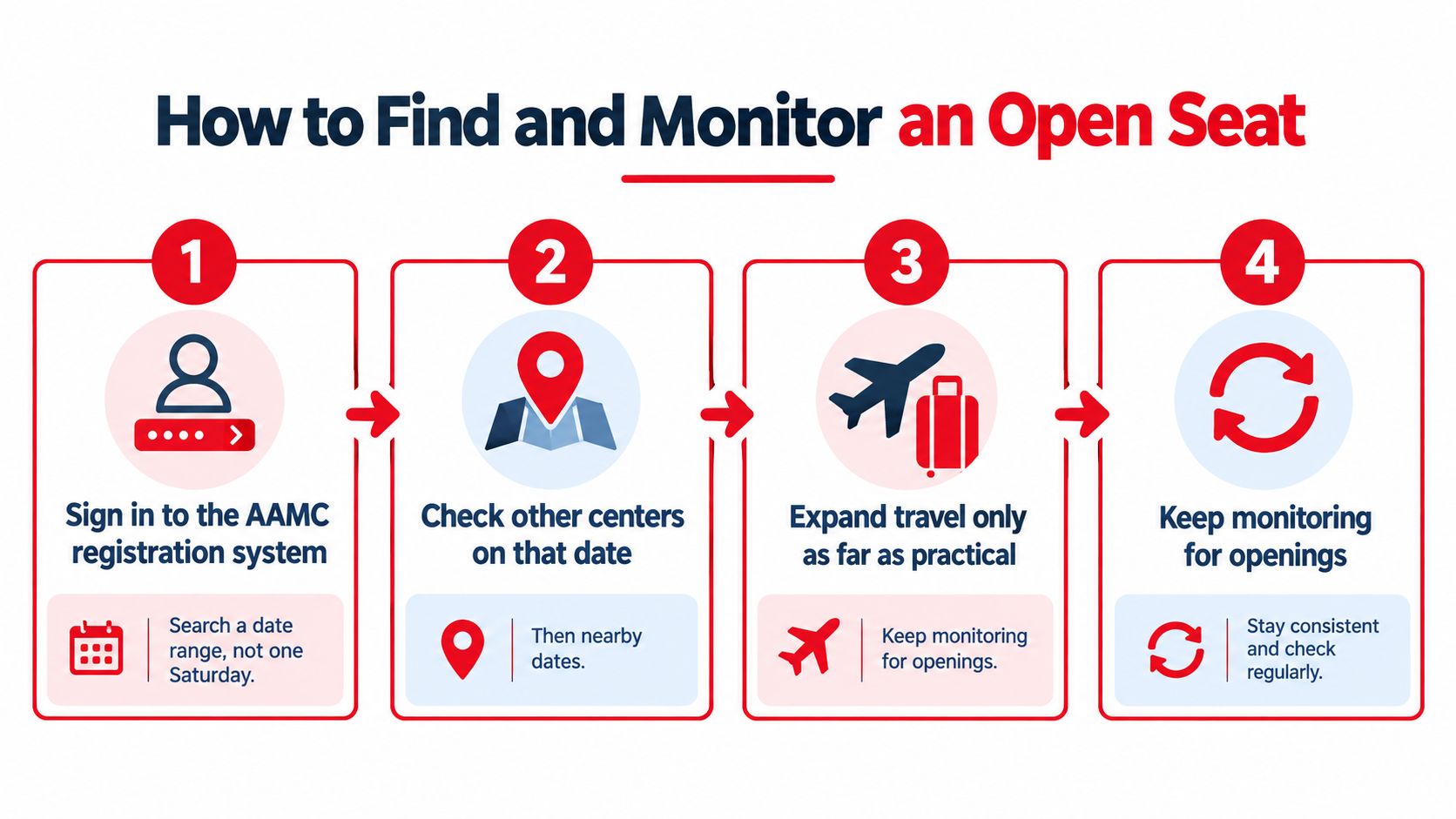
The AAMC scheduling chapter states that individual centers have limited capacity and that appointments are first-come, first-served. A preferred date can fill while seats remain elsewhere. Availability lives in the registration system, not in a published national tally. Register based on where the center is available, not where you live.
Search in this order
- Sign in and search a date range. One Saturday hides every other open day in that month. Use your own AAMC login.
- If that center is full, check other centers on the same date, then nearby dates. A released cancellation is one appointment. It can disappear while you compare hotels.
- Expand travel only as far as you can arrive the night before, with a backup for delays. Measure distance to the testing center, not to your apartment. A student whose downtown site is full may accept a center two hours away. A student with caregiving, disability, visa, or work limits may need a later date instead.
- Join the official AAMC waitlist for a full date you still want. A notification is not a held seat and not a guarantee.
- Reserve a workable time once you see one. A listed center is not a reservation. Availability is real-time.
- Write down 11:59 p.m. in the test center's local time as the clock that governs later changes. Your phone's home time zone is the wrong clock if the center is elsewhere.
- Keep searching, but do not cancel a seat you already hold until you have applied the fee rules. Dropping a workable date to chase a preferred one can leave you with neither.
What the 2027 opening showed
For the 2027 testing year, the AAMC registration opening was a three-day window from October 20 through October 22. Different groups of testing locations became available at noon Eastern Time on successive days. Examinees were told to enter a waiting room. Everyone present at 11:50 a.m. Eastern Time received a random place in line, and people who arrived later went to the end. The 2027 calendar includes multiple U.S. testing dates and four dates available only at select locations, so usable appointments depend on geography as well as how many dates exist. If a desired date or location is full, the AAMC says you can join a waitlist for notification.
Practical rule: Prepare the account and two or three alternate centers before you sit in any queue. Decide the alternates while you are calm, not while a timer is running.
After an opening, check at a few planned times. A cancellation releases one seat, not a block. Use only the official waitlist and your own login. Reject bots, shared logins, and any service that reserves or promises seats. This search does not guarantee a seat. Accept a released time only if prep and travel still work. Steps for getting into the system sit on the AAMC MCAT registration walkthrough.
Fees and Deadlines Before You Move a Date
Moving a date gets more expensive as the exam gets closer, and the last window closes entirely. Every dollar figure below is time-sensitive AAMC policy. Recheck it in the registration system before you pay.
| Time before the exam | Standard reschedule fee | Cancellation | Changes allowed |
|---|---|---|---|
| At least 60 days | $55 | Confirm the published refund on the AAMC fee schedule before you cancel | Yes, if a seat exists |
| 30 to 59 days | $110 | Confirm the published refund on the AAMC fee schedule before you cancel | Yes, if a seat exists |
| 10 to 29 days | $210 | No refund | Yes, until the 10-day deadline, if a seat exists |
| Fewer than 10 days | Not permitted | Not permitted | No |
The AAMC scheduling fees page sets standard rescheduling at $55 at least 60 days out, $110 at 30 to 59 days, and $210 at 10 to 29 days. A cancellation 10 to 29 days before testing receives no refund. Changes are allowed only at least 10 days before the appointment. Scheduling, rescheduling, and canceling close at 11:59 p.m. local time at the test center. That same cutoff is the last chance to edit your name, address, and consent selections.
Holding a seat can cost less than dropping it
Fee Assistance Program examinees pay lower change fees. They still cannot change inside the 10-day cutoff. Reduced amounts are not listed here because they must be read on the current AAMC schedule for that testing year.
Say you hold a seat two hours away and a closer Saturday might open. Keeping the distant seat preserves an exam date while you watch the waitlist. Canceling inside the no-refund window, then finding nothing new, means you paid to give the date up and you still need another registration. For a student using fee assistance, or an international examinee facing a flight, that is often the more damaging path.
If the AAMC disrupts an exam, a replacement appointment still depends on open seats. Travel and lost wages are not reimbursed. The same habit applies to the hotel and the train: read the cancellation terms before you pay a nonrefundable night, the way Theory Bookings cancellation terms spell out what a reservation lets you change. Pair any new date with the MCAT test date list only as a starting map, then confirm it in the live system.
A fee buys a calendar change when a seat exists. It does not buy readiness, and it does not buy a seat that is already gone.
Check Your Application Timeline First
A seat is useful only if the score can arrive in time for the schools you are applying to. Write four dates on one page before you choose: the date your target schools need your score, the date you plan to submit the American Medical College Application Service (AMCAS) application, the 60-day readiness mark, and the 10-day change deadline.
- Confirm score-release timing for each candidate date on the AAMC site. Confirm the application cycle on the official AMCAS site and on each school's site. Do not copy those dates from memory or from a forum thread.
- Note whether a later spring or summer date still lets the score arrive before schools begin review. Rolling review means a later score can push a file back even when the application is otherwise complete.
- Count the prep weeks before each candidate date at a weekly hour total you can keep. A number copied from someone else's plan is not your number.
- List travel cost, time off, and caregiving or disability needs for each option. If you cannot arrive the night before without breaking one of those, that center is not workable.
- Mark the date by which you must choose, which is before the 10-day deadline. After that, the choice is already made.
- Ask whether a seat taken now still leaves a readiness recheck at 60 days. If the only open date is already inside that window, you are choosing to test on the preparation you have.
Say a student can reach an open center this month, or wait for a spring date closer to home. They mark which of those dates can still be moved, and which one still releases a score before their schools read files. The spring date wins if the score still lands in time and the travel for the nearer date would wipe out a week of study. The distant center wins if spring would push the score past review.
A full seat is not a scored attempt. It does not count as an exam you sat. Each school's process still has to be confirmed with that school. The AMCAS application timeline is the place to line those dates up with a primary submission, not a substitute for the school's own page.
Choosing a Later Date or Another Cycle
When every open seat conflicts with preparation or with the application, the question is which imperfect option does the least damage. It is not which option looks most impressive.
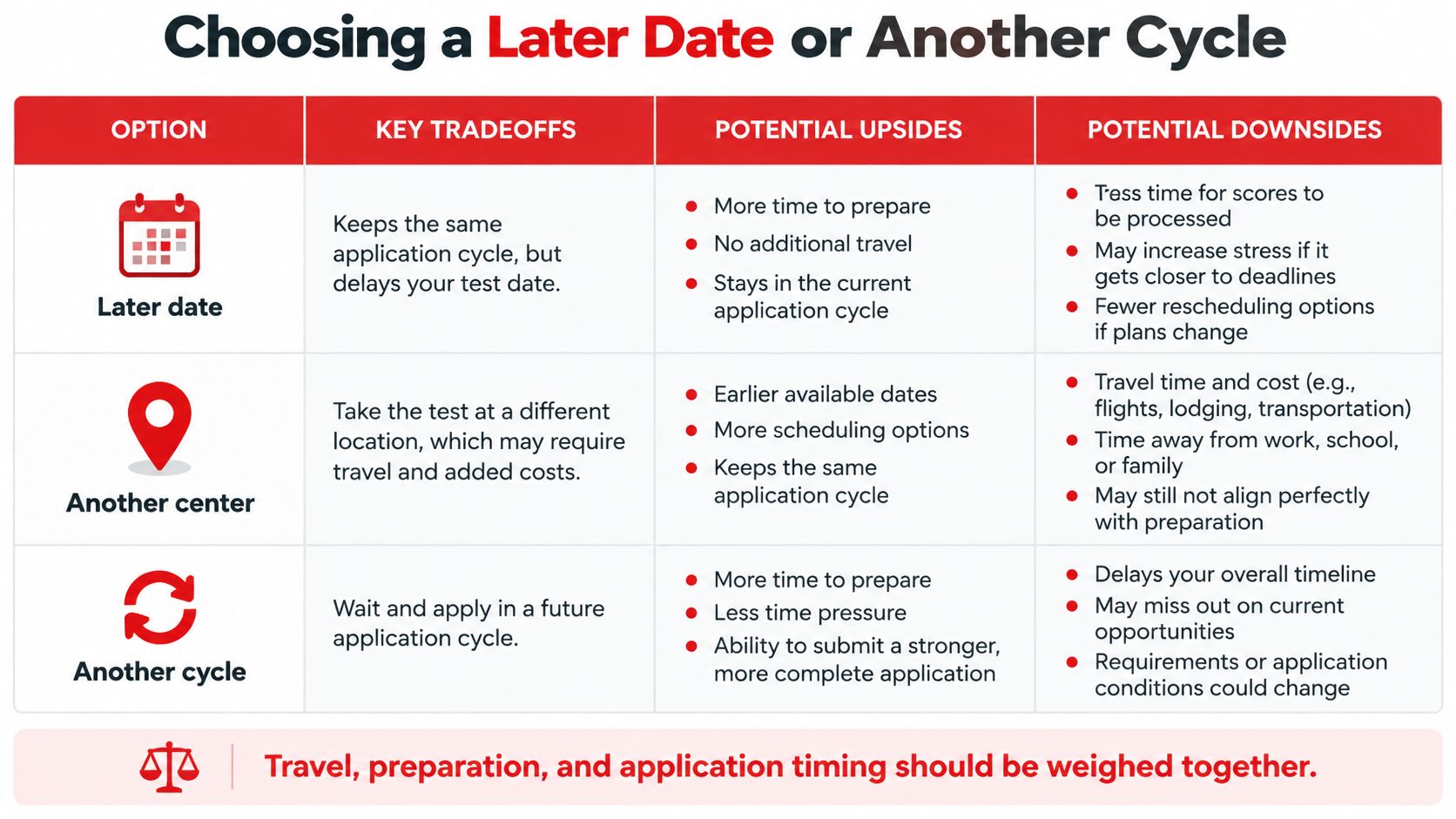
| Choice | When it fits | Main risk |
|---|---|---|
| Travel to an open center | You can arrive the night before and still study | Fatigue, cost, or a conflict with work, caregiving, visa, or disability limits |
| Later date in the same cycle | The score-release timing still meets your schools' process | Less time before secondary essays or interviews |
| Next cycle or a planned gap year | No open seat leaves a realistic prep window | The application year moves; it is not a verdict on your career |
| Keep a poor-fit seat | A change would pass the 10-day lockout and you are ready to test | An underprepared test day, which a fee cannot fix |
Travel fits when you can be at the center the night before without missing work, caregiving, or disability-related limits. A later date in the same cycle fits when score release still meets the schools' process. A spring or summer date often still serves that cycle. A much later date can miss early review. Confirm those deadlines rather than assuming them. Check MCAT score release dates against each school, and send calendar lookups to the registration guide instead of copying a date table into your plan.
A deliberate next cycle, or a planned gap year, fits when no seat leaves a realistic prep window. That is a scheduling strategy. It is not a failed career, and it is not a judgment on whether you belong in medicine. Keeping a poor-fit seat fits only when a change would pass the lockout and you are ready enough to test. International examinees and Fee Assistance applicants should weigh nonrefundable travel more heavily than convenience. A full seat is not a scored attempt, and it does not end an application.
The AAMC U.S. calendar of scheduling deadlines permits schedule, reschedule, or cancel only through the 10-day deadline, at 11:59 p.m. local time at the test center, not necessarily in your home time zone. That deadline is also the last time to edit your name, address, and consent selections. No appointment changes are allowed fewer than 10 days before the exam.
A go or no-go you can run on paper
Reserve a workable seat once the application timeline needs a score. Reassess readiness at the 60-day mark. Move before the 30-day tier only if another seat exists. Treat the last 10 days as an operational lockout. If you are unsure about readiness, decide before that cutoff, not the night before the exam.
Plan Your Prep Around the Seat You Can Get
Study toward the earliest realistic date you can hold. A Saturday that is already full is not a study plan.
If a candidate date falls inside the current prep window, keep one paced full-length rhythm and review every missed question by content area. One exam plus a real review beats a stack of untouched practice tests.
If the date is still unknown, prioritize content gaps and passage timing. Do not stack full-length exams with no test day on the calendar. Hours spent refreshing the scheduler are hours you did not spend on the section that is weak.
Use the readiness checkpoint to decide whether the plan still fits the seat you hold. If the checkpoint says the date is too soon and a later seat exists, that is a scheduling decision, not a personal failure.
For MCAT tutoring, the student tells Ace Med Boards their test date, current practice results, available study time, and the hardest parts of preparation. More hours alone do not determine the final MCAT score. Medical school admissions consulting is separate from MCAT tutoring and covers applications, personal statements, secondary essays, and interviews. A moved date can change when those pieces need to be ready, even when the science review stays the same. Build the weeks on a MCAT study schedule that matches the seat you hold, not the one you wanted.
Confirm current AAMC rules in the registration system before you pay any fee. Policies, score-release timing, and seat counts change by testing year. A full screen today is a scheduling problem with a few real options, and none of those options is a verdict on your career.
Current tutoring options are listed on the MCAT pricing page, and registration steps stay on the AAMC registration guide. If help mapping a delayed date to your prep and your application would be useful, a free consultation is available. Nothing on this page promises a seat, a score, or admission.
Sources
- AAMC, Register for the MCAT Exam
- AAMC, Scheduling the MCAT Exam
- AAMC, 2027 MCAT Registration Opening
- AAMC, MCAT Scheduling Fees
- AAMC, U.S. MCAT Calendar, Scheduling Deadlines, and Score Release Dates
Ace Med Boards offers MCAT preparation support and separate medical school admissions consulting for applicants who need to line a real test date up with study time, score release, and an application. That planning is about the seat you can hold and the work that fits it, not a promise of a score or a seat. If you want help sorting a delayed date, visit Ace Med Boards.