The 3 AAMC CARS skills are Foundations of Comprehension, Reasoning Within the Text, and Reasoning Beyond the Text. If a student knows those names but still can't tell what a question is asking, what's missing?
Usually, it's an evidence boundary: a clear sense of whether the answer requires understanding meaning, connecting an argument, or applying that argument somewhere new. Recognizing that boundary is more useful than memorizing lists of question stems.
The Three CARS Skills at a Glance
Byline: Ace Med Boards Editorial Team
The Association of American Medical Colleges (AAMC) organizes Critical Analysis and Reasoning Skills (CARS) questions around comprehension, argument analysis, and application. CARS is part of the Medical College Admission Test (MCAT), but its task differs from recalling scientific content: the passage supplies the ideas needed to reason toward an answer.
A student searching for MCAT CARS 3 types of questions needs to distinguish skills from question formats. Main idea, tone, inference, and analogy describe what a question looks like. The skill describes the mental work required to answer it.
How the Three CARS Skills Differ
| Skill | Evidence boundary | Typical stem signal |
|---|---|---|
| Foundations of Comprehension | One nearby sentence or short span can prove a local answer; main idea and tone may require the whole passage | Meaning, detail, tone, or main idea |
| Reasoning Within the Text | Two or more parts of the same argument must connect | Function, relationship, or evaluation of support |
| Reasoning Beyond the Text | The author's logic must transfer to a new case, analogy, or newly introduced information | Apply, illustrate, analogous, or author would respond |
These are working distinctions, not automatic classification rules. A stem containing infer doesn't identify a skill by itself, and a main-idea question doesn't become argument analysis merely because the student reads several paragraphs.
In its 2026 overview, UWorld's CARS section guide reports 53 passage-based multiple-choice questions and approximate skill proportions of 30% Foundations of Comprehension, 30% Reasoning Within the Text, and 40% Reasoning Beyond the Text. Format information is presented as of 2026; students should confirm current details in official AAMC MCAT materials before testing.
Key Takeaways
- Name the task before defending a choice. Determine whether the question asks for meaning, an argumentative relationship, or transfer.
- Keep passage evidence in control. Familiarity with the topic doesn't establish what the author believes.
- Sort look-alike stems by the required reasoning. Identical introductory wording can lead to different skills.
- Keep classification brief. The label should guide an answer, not become another question to solve.
Ace Med Boards's broader MCAT CARS strategy guide provides related preparation context; the focus here is diagnosing the task in an individual question.
For premeds helping younger applicants compare entrance exams, Mrs. College Counselor's explanation of SAT versus ACT differences offers a separate admissions resource. Those exams shouldn't supply a classification system for MCAT CARS.
The Evidence Boundary for Overlapping Stems
A stem's wording is a clue, not a verdict. The AAMC's guidance on preparing for CARS distinguishes understanding meaning and intent, analyzing claims and evidence, and applying passage ideas beyond their original context.
A useful map comparison is this: Foundations reads a marked road, Within the Text checks whether roads belong to the same route, and Beyond the Text uses the route in a city the map didn't draw. The comparison describes how far the reasoning travels, not how difficult the question feels.
A Practical Evidence-Boundary Test
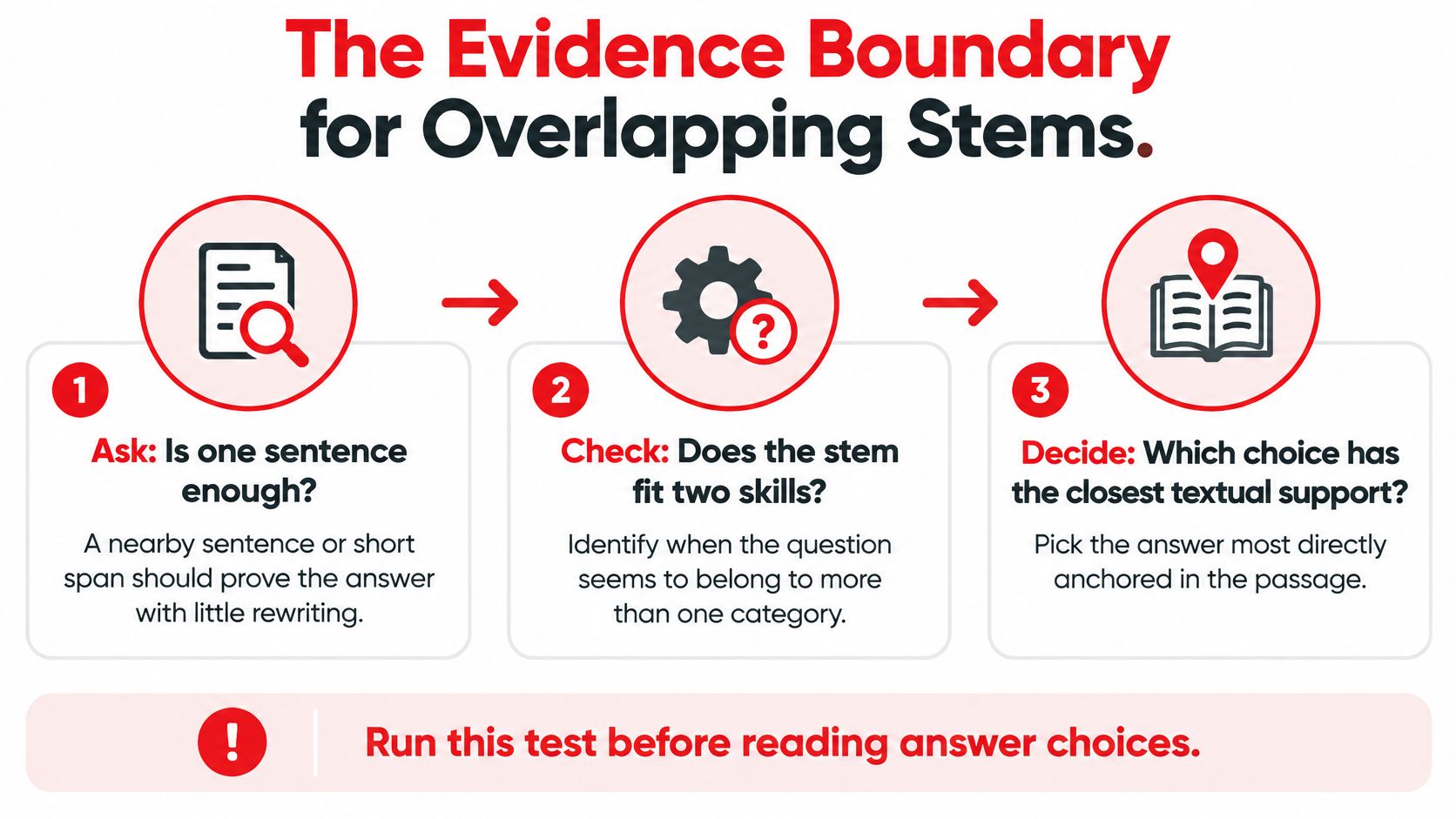
- Check for comprehension. Can a sentence or nearby span establish the intended meaning with little rewriting? If so, Foundations is a strong candidate. For main idea or overall tone, the relevant evidence may extend across the passage without requiring evaluation of its logic.
- Check for argument integration. Does the answer require connecting a claim with evidence, a qualification, a contrast, or an assumption? That points toward Reasoning Within the Text.
- Check for transfer or new information. Does the question introduce an unfamiliar situation, analogy, condition, or finding and require applying or reassessing the passage's ideas? That points toward Reasoning Beyond the Text.
The infographic provides a compact reminder to establish the evidence boundary before comparing choices.
Why Agreement Stems Are Ambiguous
Consider an original educational stem:
The author would most likely agree that…
If the answer restates a meaning established in the passage, the task may be Foundations. If the student must reconcile the author's central claim with a later qualification, the task is argument integration.
If the answers instead describe unfamiliar policies or institutions, the task asks how the author's reasoning transfers. That's Beyond the Text, even though the opening wording hasn't changed.
Strengthen and weaken questions need similar care. Evaluating support already in the passage differs from incorporating a new hypothetical finding; newly introduced information can make the latter a Beyond the Text task.
Practical rule: Classify the reasoning required, not the verb printed in the stem.
Main idea, tone, strengthen, weaken, and analogy aren't additional official skills. Before reading choices, a student can write a brief boundary note such as meaning in context, example supports claim, or principle applied to new policy.
Foundations of Comprehension Questions
Foundations of Comprehension asks whether a student understands what the passage communicates. The task may involve a phrase's meaning, an explicit detail, the author's purpose, or a modest inference about attitude.
Comprehension doesn't mean copying. A correct answer may paraphrase the passage closely without repeating its vocabulary. The important question is whether the meaning stays intact.
Original Stems and Their Proof
The following examples are original educational material, not official examination questions.
| Original stem | Passage evidence | Defensible interpretation | Tempting error |
|---|---|---|---|
| As used in the passage, economy most nearly means… | A critic praises a poem's economy because it conveys grief without unnecessary description. | Concise use of language | Selecting financial management because that dictionary definition is familiar |
| The author's primary purpose is… | An essay states that museum labels should reveal uncertainty, then explains why definitive labels can mislead. | Advocate acknowledging uncertainty in interpretation | Choosing a supporting detail about label design |
| Which statement is directly supported by the second paragraph? | The paragraph says residents disagreed about a statue's meaning. | Residents didn't share a single interpretation. | Inferring an unmentioned dispute in another town |
The purpose example requires attention to the whole essay. That doesn't automatically make it Within the Text: identifying what an author is trying to communicate differs from assessing how well the argument works.
A Solving Path That Preserves Meaning
- Locate the cited line, paragraph, or passage-level claim.
- Paraphrase it in plain language.
- Predict the answer before inspecting choices.
- Select the option that preserves the meaning, scope, and degree of certainty.
A student's paraphrase of some residents questioned the proposal shouldn't become the community rejected the proposal. That change introduces both a broader group and a stronger conclusion.
The main traps are contextual vocabulary errors, true-but-irrelevant details, and inferences that travel farther than the text permits. A mild expression of doubt doesn't establish hostility, and an author's description of a controversy doesn't establish endorsement of either side.
A true statement can still be the wrong answer when it answers a different question.
For local questions, inability to identify a supporting sentence or short span is a reason to reconsider the label. For global questions, the student should instead check whether the selected answer represents the passage rather than an isolated example.
Ace Med Boards's guidance on enhancing comprehension skills offers related work on accurately extracting meaning.
Reasoning Within the Text Questions
An author can describe an archive, quote a critic, and acknowledge an objection in the same passage. Reasoning Within the Text asks how those pieces contribute to the argument, rather than merely what each piece says.
The central unit is a claim-and-support relationship. The student might need to identify an example's function, compare claims, uncover an assumption, or assess whether the author's conclusion follows from the evidence already presented.
From Content to Function
Consider this original miniature scenario:
A historian argues that official records preserve selective accounts of civic disputes. The passage then describes an archive containing council minutes but no statements from residents who opposed the council.
The author mentions the archive primarily in order to…
The archive's contents are the subject matter. Its function is to illustrate how surviving records can exclude a viewpoint.
An answer saying to describe council procedures might accurately identify something mentioned in the example while missing its argumentative role. Function questions require a connection between the example and the larger claim.
Another original stem is:
The relationship between the opening and final paragraphs is best described as…
If the opening proposes that records are neutral and the final paragraph qualifies that proposal, the answer should describe qualification or revision. Merely summarizing both paragraphs doesn't establish their relationship.
Testing the Argument
A compact reasoning chain helps:
- Claim: State what the author wants the reader to accept.
- Support or limit: Identify the example, assumption, contrast, or qualification that matters.
- Relationship: Predict whether that material supports, challenges, narrows, or explains the claim.
- Choice check: Reject any answer that reverses the relationship or adds an unsupported premise.
A stem such as Which finding would most undermine the argument? requires extra attention. If the question supplies hypothetical information absent from the passage, it can test Beyond the Text rather than Within the Text. The word undermine alone doesn't settle the classification.
The student still needs to identify the existing argument's vulnerable connection. For example, evidence that an archive includes extensive opposition testimony would challenge a claim built specifically on that testimony's absence.
Coursework can create a tempting distraction here. An answer may sound historically informed yet fail to address the author's actual support. Likewise, a student may reverse the logic by treating an example as the conclusion it was introduced to support.
Ace Med Boards's critical-thinking guidance provides related reasoning practice. The diagnostic check for Within the Text is whether the proof connects parts of the existing argument without requiring transfer to a newly supplied situation.
Reasoning Beyond the Text Questions
A student may understand an author's position accurately and still choose an application that doesn't follow from it. Reasoning Beyond the Text tests whether the student can preserve the author's logic when the setting or information changes.
The task can involve a new example, an analogy, a critic's position, a changed condition, or additional evidence. Beyond the Text doesn't mean beyond the need for evidence.
Preserve the Relationship, Not the Topic
Consider an original passage principle:
Public monuments record negotiation among groups rather than a single, neutral collective memory.
An application involving another statue isn't automatically correct. A privately commissioned statue with no competing interpretations might share the topic while failing to illustrate the principle.
A school-renaming dispute could fit better. If alumni, current students, and local residents negotiate which history the school's name should recognize, the setting changes but the relationship remains: groups shape public memory through disagreement and compromise.
Original stems that invite this work include:
- Application: Which situation best illustrates the author's principle?
- Analogy: The passage's view is most similar to which approach?
- Advice: The author would be most likely to advise a city planner to…
In the advice example, the defensible response might be to examine whose interpretations a proposed memorial includes and excludes. A claim that the author would endorse every public-art project goes beyond the principle.
A Controlled Transfer Method
- Compress the relevant principle into a sentence.
- Change the setting while keeping the logical relationship.
- Reject choices that repeat topic words but alter the relationship.
A student should also preserve the author's limits. A passage describing negotiation doesn't necessarily argue that every compromise is fair, that every monument should remain, or that every disputed name should change.
Transfer check: A defensible application keeps both the author's principle and the author's qualifications.
Personal agreement is a separate issue. A student may favor a proposed policy while recognizing that the passage doesn't support attributing it to the author.
For a lengthy transfer item, targeted rereading is usually more useful than restarting the entire passage. The student can return to the sentence establishing the relevant principle, make a provisional selection, flag the item, and continue if the comparison remains unresolved.
The closing diagnostic is specific: the situation or information is new, but the reasoning connecting it to the passage must remain explainable.
A Miniature Passage and Classification Checklist
The passage and questions below are wholly original educational examples. They aren't AAMC questions, recalled examination content, or question-bank material.
Original Miniature Passage
Public monuments are often treated as containers of shared memory. Yet a monument's meaning emerges through negotiation among groups whose histories do not fit neatly together. In one town, a statue celebrated a general's victory for some residents while reminding others of violence their families had endured. The council eventually moved the statue and added explanatory plaques after public debate. These changes did not replace politics with neutral history; they made the competing claims more visible. Preservation can conceal conflict when officials present an inherited monument as universally admired. Removal can conceal it too, if the community erases the record of why the object became controversial. A historian should therefore examine the dispute, not merely whether the statue remains.
The accompanying visual provides a reading checklist. Its passage-topic classification is separate from identifying the CARS skill required by a question.
Worked Question Diagnoses
| Original micro-question | Correct skill | Prediction | Proof |
|---|---|---|---|
| What does negotiation mean in the passage? | Foundations of Comprehension | Groups contest and reshape shared meaning. | The surrounding sentences describe residents advancing competing interpretations. |
| Why does the author include the town's statue dispute? | Reasoning Within the Text | The dispute demonstrates competing historical interpretations. | The example supports the opening claim that public memory emerges through group negotiation. |
| Which school-renaming dispute best illustrates the author's principle? | Reasoning Beyond the Text | Competing groups negotiate whose history counts. | A new dispute fits when groups contest which past the school's name should represent. |
The final question's best match would describe a school community negotiating among conflicting historical interpretations. A choice describing a name change solely to simplify spelling wouldn't preserve the principle.
Classification Checklist
- Underline the task cue. Identify whether the stem points to a word, a relationship between claims, or a new case.
- Name the evidence boundary. Write meaning, argument connection, or transfer.
- Make a six-word prediction. The predictions in the table model concise answers before choices appear.
- Exclude outside history. Knowledge about actual generals or naming disputes isn't needed.
- Resolve overlap by examining the task. A new application points toward Beyond the Text; an unfamiliar noun alone doesn't.
For pacing context, the AAMC's official MCAT overview describes CARS as 53 passage-linked questions across nine passages in 90 minutes, with no independent items, averaging about ten minutes per passage. Classification should therefore take seconds rather than become an extended annotation exercise.
Additional MCAT CARS practice passages can support drills in which the student records the task and proof before reviewing an explanation.
Review the Missed Label Before More Passages
A missed answer doesn't automatically mean the student misunderstood the passage. The error may have occurred while identifying the task, selecting evidence, or comparing the final choices.
A useful review entry records the stem, the predicted skill, the supporting passage language, and the reason the chosen answer failed. That record is more actionable than a note saying the question was confusing.
A Short Error-Review Workflow
- Wrong skill: Reclassify the item by describing the required reasoning without relying on its opening verb.
- Right skill, wrong proof: Identify the exact meaning, argumentative connection, or transferred principle the answer requires.
- Right proof, rushed choice: Find the overlooked qualifier, reversal, or mismatch in scope.
For a Foundations miss, the student should locate the language establishing the answer's meaning. For a Within the Text miss, the student should rewrite the claim and its support. For a Beyond the Text miss, the student should restate the principle before reconsidering the new information.
The AAMC's explanation of MCAT scoring states that there's no additional penalty for an incorrect answer, so leaving a question blank provides no advantage over an educated guess. The practical response is to answer uncertain items, mark them, continue, and return if time permits.
Broader guidance on improving an MCAT CARS score addresses preparation beyond question diagnosis. Students considering individualized support can review current MCAT program information; a discussion includes the test date, current practice results, available study time, and hardest parts of preparation.
Sources
The examination references used are the AAMC's official MCAT overview, CARS preparation guidance, and scoring explanation. UWorld's section guide supplies the attributed skill-distribution overview.
Ace Med Boards offers private online MCAT tutoring for content gaps, passage reasoning, timing, and retakes, including help distinguishing a question's task from its answer choices. A student seeking individualized support can visit Ace Med Boards to request a free consultation and discuss current preparation needs; no particular score, admission, or examination outcome is promised.