
The highest-yield approach combines retrieval practice, spacing, interleaving, immediate feedback, and transfer to unseen questions. For medical exams, question triage, pacing, and systematic error analysis make those learning methods usable under timed conditions.
Many medical students and osteopathic medical students know substantial content yet struggle to retrieve it, interpret long vignettes, or finish a block. A strong test-taking system treats those problems as trainable skills, not as proof that one low score or failed attempt defines a medical career. The 2024 PubMed-indexed study on test-taking skills found that problem-solution videos and collaborative group assessments improved test-taking skills significantly more than other strategies, with p < 0.01 in the reported analysis (PubMed). That result supports active explanation and peer interaction over passive rereading alone.
This guide keeps United States Medical Licensing Examination (USMLE), Comprehensive Osteopathic Medical Licensing Examination of the United States (COMLEX-USA), Shelf or Comprehensive Osteopathic Medical Achievement Test (COMAT) exams, and the Medical College Admission Test (MCAT) distinct where their demands differ. The examples are original educational composites, not recalled or copyrighted examination content.
Key Takeaways
- Retrieve before rereading: Use questions, free recall, and flashcards to make memory do the work.
- Space reviews: Schedule follow-up retrieval on Day 1, Day 3, Day 7, Day 14, and Day 30 when appropriate.
- Study mixed material: Interleaving helps you decide which concept applies when the diagnosis or mechanism isn't announced.
- Track the reason for every miss: Separate knowledge gaps, reasoning errors, careless mistakes, and pacing problems.
- Practice transfer: Use unseen questions to check whether you can apply a principle beyond the item you just reviewed.
1. Retrieval Practice Testing Yourself to Strengthen Memory
Retrieval practice turns studying into a testable process. Close the notes, generate an answer, commit to it, and compare your reasoning with reliable feedback. Familiar pages can create fluency without proving recall. Producing an answer exposes what you can retrieve independently and what still needs work.
For diabetic ketoacidosis, write standalone prompts instead of highlighting another summary: “What explains the anion gap?” and “Which findings distinguish diabetic ketoacidosis from another cause of metabolic acidosis?” Answer without notes, then check the explanation promptly. Record the missed concept in an error log and assign it a later review date, so each question becomes part of a repeatable weekly system rather than a one-time exercise.
A peer-reviewed biology education study reported that 79% of students used active self-testing, while 68% still relied on rereading notes (CBE Life Sciences Education). Rereading can orient you to unfamiliar material, but retrieval shows whether you can produce and apply the idea. For a method-focused explanation, see active recall for medical exam preparation.
Practical rule: Count an answer as learned only after you can explain it before viewing the explanation.
Turn questions into a daily drill
Choose a high-quality, exam-aligned source such as UWorld, NBME materials, or COMSAE materials based on your exam. USMLE and Shelf or COMAT preparation generally use medical question formats, while COMLEX-USA and COMSAE may require attention to osteopathic principles as well. The resources are mentioned neutrally and are not affiliated with Ace Med Boards unless an official relationship is separately verified.
- Predict first: Commit to an answer before opening the explanation.
- Check the reasoning: Read why the correct option fits and why the alternatives fail.
- Log the miss: Note the task, error type, correction, and next review date.
- Test transfer: Find an unseen question that applies the same principle in a different presentation.
The error log connects retrieval with spacing and feedback. During your weekly calendar review, begin with missed or uncertain prompts, then mix in a few stable topics to check whether recall transfers beyond the original wording.

2. Spacing Strategic Timing of Review Sessions
Spacing turns review into a planned cycle. You study a topic, allow some forgetting to occur, then retrieve it and use feedback to repair weak memory. That delay makes recall work more like a path you repeatedly walk, rather than a page you recognize after rereading.
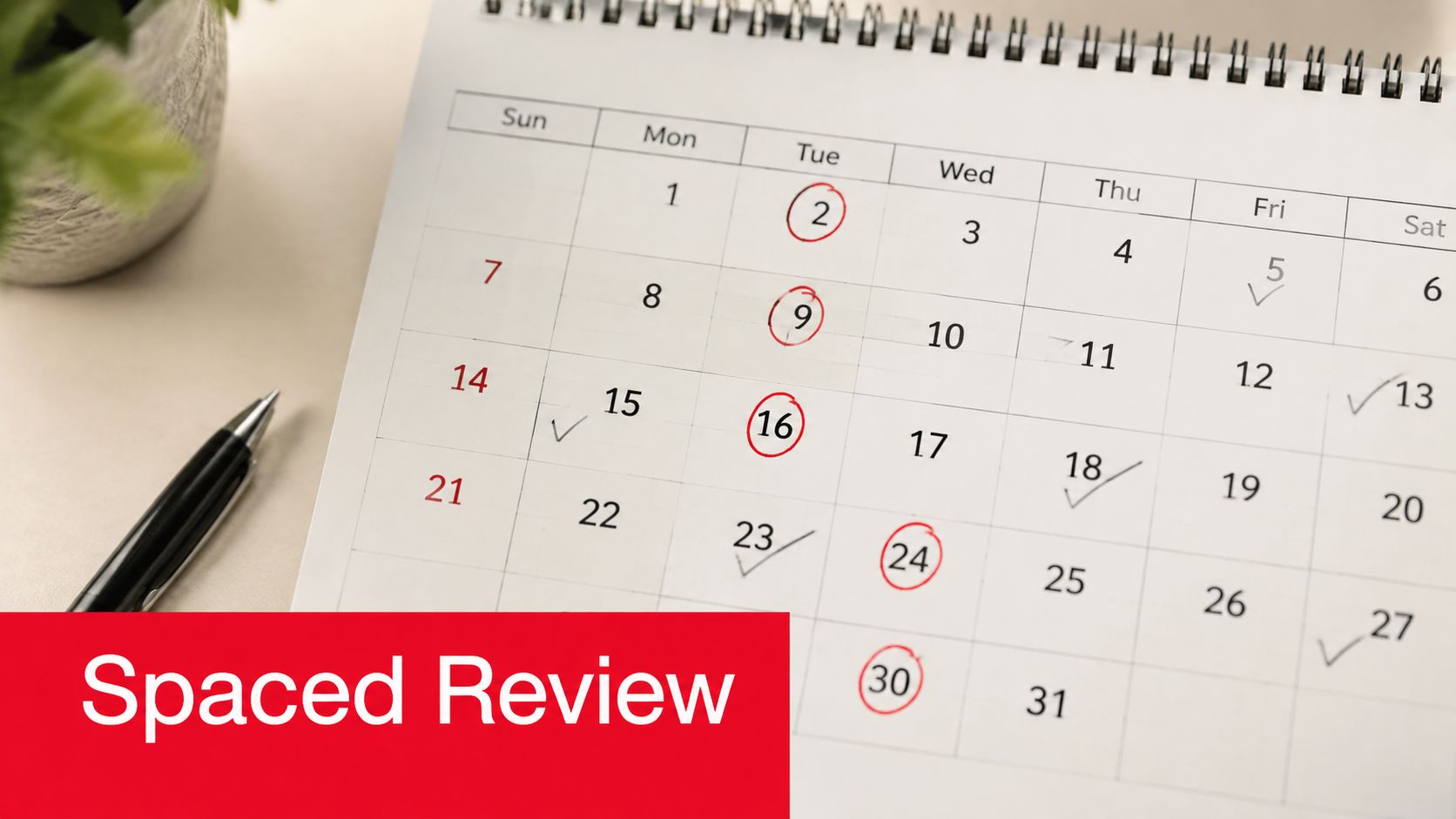
Use an anemia topic to build the cycle. Study it on Monday, retrieve it on Thursday, revisit it the following Monday, then schedule another review after a longer interval. For high-yield material, a calendar might use Day 1, Day 3, Day 7, Day 14, and Day 30. Each appointment should require questions or free recall before you reopen notes.
A 2026 PubMed-indexed meta-analysis of medical education included 21,415 learners and reported that spaced repetition outperformed standard studying, with a standardized mean difference of 0.78, a 95% confidence interval of 0.56 to 0.99, and p < 0.0001 (PubMed). The finding supports spacing as a planning choice for medical trainees. It does not predict an individual score. Your exam date, baseline knowledge, and error pattern should shape the schedule.
Make the calendar part of the study system
Set review dates when you first add a topic to your weekly calendar. Begin with a short gap, then extend it when retrieval stays accurate. Repeated misses call for an earlier return, while stable recall permits a longer interval.
- Record each appointment: Use a planner, spreadsheet, or study app to track the topic and next date.
- Retrieve before reviewing: Answer questions or write what you remember before checking the source.
- Start early: Spacing needs several opportunities to work, so do not reserve it for the final days.
- Adjust from evidence: Shorten the next interval after repeated misses and lengthen it after reliable recall.
- Link the error log: Mark uncertain answers and recurring errors for the next session, then test the same principle in a new question format.
The spaced repetition guide for medical learners offers a practical way to configure this routine. A weekly calendar keeps older material active while new topics enter the schedule, which reduces the pressure to relearn everything at the end.
3. Interleaving Mixing Related Topics During Study
Interleaving turns studying into a repeated decision exercise. Blocked practice helps you learn a topic, such as hypertension, while interleaving asks you to recognize whether hypertension, hyperkalemia, or pulmonary edema best explains the presentation. The topic is no longer announced by a string of similar questions. You must identify the discriminating clues, select the relevant framework, and explain why nearby concepts do not fit.
For a Surgery Shelf or COMAT block, mix hernia, bowel obstruction, and appendicitis after you have learned their basic patterns. The value lies in choosing the correct pathway, not recalling a sequence in which every item concerns one diagnosis. USMLE-style clinical vignettes similarly reward transferring mechanisms across presentations. COMLEX-USA preparation can apply the same process while keeping osteopathic concepts in the question set. For the MCAT, interleave related science topics and question types, while separating passage interpretation from clinical diagnosis.
“The exam usually tells you the problem indirectly. Practice choosing the framework before you practice reciting it.”
Let the mix reveal your decision process
Start with related subjects, such as cardiovascular topics, then combine cardiovascular and renal material as you become more accurate. Interleaving should feel like a gradual increase in discrimination, not random confusion. For each question, write one sentence answering, “Why does this concept apply here?” Add the closest competing concept and state why it does not fit. This creates a small diagnostic record of your choices.
A weekly calendar can place mixed sets between spaced reviews, while an evidence-based guide to medical study skills and test-taking strategies can help connect the method to broader preparation.
- Mix deliberately: Reorder questions when a platform does not provide the needed combination.
- Name the clue: Identify the feature that directed your choice.
- Test transfer: Revisit the same principle in an unfamiliar question format.
- Adjust the difficulty: Simplify the mix after repeated confusion, then add a neighboring topic again.
- Record the decision: Note whether the problem was missing knowledge or poor discrimination.
The weekly system should make interleaving repeatable. Each session becomes a small rehearsal for selecting a framework under uncertainty, rather than a test of how familiar a question sequence feels.
4. Metacognition and Error Analysis Tracking and Learning from Mistakes
A missed question becomes useful when you identify the failure behind it. Metacognition is the habit of examining your thinking: what you noticed, what you overlooked, and why you chose an answer. Reading an explanation can restore confidence without correcting the process, so the same error may return in a different topic.
Treat the error log as a diagnostic map, not a collection of confessions. Classify each miss as a knowledge gap when you lacked a fact or mechanism, a reasoning error when you knew the information but used the wrong framework, a careless mistake when you misread or closed too early, or a strategy error involving pacing, triage, or an unjustified answer change.
Turn every miss into a repair cycle
For an aldosterone physiology question, record “knowledge gap,” explain the corrected mechanism in your own words, and schedule retrieval on Day 1, Day 3, and Day 7. Then answer an unseen question. The new item checks whether you can transfer the correction rather than recognize a familiar explanation.
Repeated time-management misses require a different repair. Mark them as a strategy error, practice flagging difficult items for later, and check whether the pattern clusters at a particular point in the block. That information can guide the next timed session.
Use one log across question banks, coursework, and practice exams. Give every entry five fields:
- Question task: Identify whether the item required a diagnosis, calculation, mechanism, or next step.
- Error type: Apply the same categories each time.
- Correction: Write the governing principle or revised pacing action.
- Next review dates: Schedule retrieval instead of trusting memory.
- Transfer test: Specify the unseen task that will verify the repair.
Review the log weekly and place recurring errors on the next week's calendar. Repeated misses across topics deserve priority because they reveal a process problem, not just an isolated fact gap. For guidance on examining your own preparation, see metacognitive awareness for medical test preparation.
5. Active Question Deconstruction Breaking Down Multi-Step Clinical Cases
A long clinical vignette is a sequence of decisions, not a wall of text. Start by identifying the task, then reduce the stem to findings that change the diagnosis, mechanism, or management. Read the final question first when appropriate. Before studying the options, state a predicted answer or focused differential.
For an educational composite involving an inferior ST-elevation myocardial infarction, the prediction might be immediate reperfusion with percutaneous coronary intervention when the clinical setting supports it. Compare each option with that prediction and name the governing principle. The goal is to connect findings to the requested decision rather than memorize one item or threshold.
A positive straight-leg raise creates a different reasoning path. Consider disc-related radicular pain, then check for red flags before judging management. If the prediction fails, classify the problem: missing knowledge, an overlooked clue, or a misunderstanding of the question task. That diagnosis determines the next repair.
Use a decision script for difficult items
Apply the complete script to a small set of complex questions, such as three to five per day. For each item, write:
- Task: Is the question asking for a diagnosis, mechanism, next step, or management?
- Representation: Can you summarize the patient and the highest-value findings in one sentence?
- Prediction: What answer or differential follows before you inspect the choices?
- Option audit: Why does each tempting alternative fail?
- Principle: Which clinical rule or mechanism supports the conclusion?
This sequence works like a funnel. It filters distracting details before the answer choices pull your reasoning toward recognition. It also makes review more precise: a wrong prediction based on a knowledge gap needs different study from a correct concept applied to the wrong task.
Record the task, representation, prediction, and correction in the same error log used for weekly review. The guide to mastering USMLE-style question analysis can complement this method.
Clinical examples here support examination education, not patient treatment or individualized medical advice. Real-world decisions require complete clinical information, supervision, and current guidance.
6. Timed Practice Blocks and Pacing Strategy Simulating Exam Conditions
Timed practice trains a different skill from untimed problem solving. It shows whether you can retrieve information, interpret the stem, choose an answer, and continue while time and attention are limited. Treat each block like a rehearsal for a performance, not merely a score-producing exercise.
Start with shorter timed sets after foundational review. Later, use longer simulations that match your exam's format. A fixed-limit block can reveal whether you linger on early questions, lose focus near the end, or rush because you lack a triage rule. Record those observations in your error log beside content and reasoning errors.
The Wichita State University test-taking guidance recommends surveying the exam, planning time, reading directions carefully, answering easier questions first, and using practice tests with active recall. Caltech and Harvard Summer School resources also emphasize practice tests, anticipating questions, rest, and regular review.
Build a pacing rehearsal
Use permitted, high-quality materials suited to your exam. NBME practice exams and USMLE Self-Assessments apply to USMLE preparation, while COMSAE materials apply to COMLEX-USA. Shelf or COMAT and MCAT practice should match their own timing and question formats. Do not check answers during the block. Flag uncertain items, continue, and return only when your plan leaves time.
Set up a quiet space, permitted materials, a timer, and planned breaks. Afterward, review missed and guessed questions promptly. Label each issue as content, reasoning, careless execution, or pacing. A practice score without this diagnosis is incomplete information.
Use the formative and summative assessment guide to frame assessment as feedback rather than judgment. Treat score trends as signals to investigate, not guarantees of an official result. Rehearse the same pacing rules weekly, then adjust them using evidence from your log.
7. Elaboration and Self-Explanation Articulating Your Reasoning Aloud
A correct answer is more useful when you can explain why it is correct. Elaboration and self-explanation turn retrieval into a check of understanding: state the mechanism in plain language, connect it to the governing principle, and identify the clue that makes the alternatives less suitable.
Use a repeatable script after each selected question:
“This answer fits because the key finding changes the pretest probability and points toward this mechanism. The other choices describe nearby conditions, but they do not explain the decisive clue.”
Keep the explanation brief enough to repeat during spaced review. If you cannot state the missing link, record that gap in your error log rather than copying a full explanation.
A classmate can test whether your reasoning is clear. Explain acid-base disorders without notes and invite questions. Studying alone? Record a short explanation or write it from memory. Organizing the logic often exposes knowledge that sounds familiar but cannot yet guide a decision.
Choose the representation that fits the material
Learning-style labels do not require teaching through a preferred sensory mode. Select the format that matches the task. Use words for mechanisms, tables for comparisons, and a concept map when relationships matter more than isolated facts.
- Use plain language: Name the missing link when the mechanism remains unclear.
- Explain alternatives: Wrong choices define the boundaries between similar concepts.
- Revisit explanations: Re-explain the principle during later spaced sessions.
- Use a concept map selectively: Diagram pathways, feedback loops, or branching decisions when structure carries the meaning.
Apply the same routine across USMLE, COMLEX-USA, Shelf or COMAT, and MCAT preparation, while keeping examples aligned with each exam's content and question format. The 2024 PubMed-indexed study on test-taking skills noted earlier supports structured explanation and peer interaction as useful parts of preparation. It does not promise a particular score.
8. Integrated Strategy Combining Learning and Exam-Day Skills
A system works when each activity has a job. Blocked study can establish a foundation. Retrieval and elaboration encode usable knowledge. Spacing protects it over time. Interleaving teaches discrimination. Error analysis directs the next session. Deconstruction develops question-level reasoning, and timed blocks test whether the whole process survives pressure.
A practical 12-week roadmap can organize those jobs without treating the schedule as universal. Use an initial foundation phase, then progressively increase mixed retrieval and spaced review. Later, add more timed work and complex-vignette analysis. In the final period, reduce novelty and focus on high-value errors, stable routines, and sleep.
Use a weekly retrieval calendar
This calendar can be adapted for USMLE, COMLEX-USA, Shelf or COMAT, and MCAT preparation. The content source and question style must remain aligned with the exam rather than blended casually across formats.
8-Strategy Test-Taking Comparison
| Method | 🔄 Implementation Complexity | ⚡ Resource & Time Cost | ⭐ Expected Outcomes | 📊 Ideal Use Cases | 💡 Key Advantages / Tips |
|---|---|---|---|---|---|
| Retrieval Practice: Testing Yourself to Strengthen Memory | 🔄🔄 (moderate, create/use questions) | ⚡ Moderate per session; high cognitive effort; needs Q-banks/flashcards | ⭐⭐⭐⭐, Durable retention and improved transfer | 📊 Board-style exams, daily mixed-question drills, identifying gaps | 💡 Convert notes to questions, use high-quality Qbanks, check explanations immediately, log misses |
| Spacing: Strategic Timing of Review Sessions | 🔄🔄 (low–moderate, scheduling required) | ⚡ Low per-session time but requires long-term schedule/app | ⭐⭐⭐⭐, Much longer retention vs massed study | 📊 Long-term exam prep, cumulative review across topics | 💡 Start early, use expanding intervals (1d→3d→1w→2w→1m), combine with retrieval |
| Interleaving: Mixing Related Topics During Study | 🔄🔄🔄 (moderate, curate mixed sets) | ⚡ Moderate; feels slower initially; needs question reordering | ⭐⭐⭐⭐, Better discrimination and transfer to novel cases | 📊 Diagnostic discrimination, clinical reasoning, shelf/Step prep | 💡 Shift to interleaving after foundations, mix related topics, pair with spacing |
| Metacognition & Error Analysis: Tracking and Learning from Mistakes | 🔄🔄🔄 (moderate–high, consistent reflection/tracking) | ⚡ Time-consuming to log/analyze; needs template/spreadsheet | ⭐⭐⭐⭐⭐, Efficient remediation; prevents repeat errors; improves scores | 📊 Post-practice review, targeted remediation, tracking trend-based weaknesses | 💡 Limit error categories (4–6), log immediately, review weekly, prioritize repeated errors |
| Active Question Deconstruction: Breaking Down Multi-Step Clinical Cases | 🔄🔄🔄🔄 (high, deep stepwise analysis) | ⚡ High time per item (15–20 min); worksheet recommended | ⭐⭐⭐⭐, Strong clinical reasoning and transfer for complex vignettes | 📊 Step 2 CK, Shelf exams, complex case practice | 💡 Predict answer before options, eliminate choices explicitly, use selectively (3–5/day) |
| Timed Practice Blocks & Pacing Strategy: Simulating Exam Conditions | 🔄🔄 (low–moderate, scheduling/logistics) | ⚡ Very high time cost for full-lengths (7–8 hrs); needs official exams | ⭐⭐⭐⭐, Realistic score estimates; stamina and pacing gains | 📊 Final exam simulation, pacing practice, score benchmarking | 💡 Simulate real conditions, space full-lengths 10–14 days, review errors after each block |
| Elaboration & Self-Explanation: Articulating Your Reasoning Aloud | 🔄🔄 (moderate, requires active articulation) | ⚡ Moderate time; may need peer or recording tools | ⭐⭐⭐⭐, Deeper understanding; improved transfer | 📊 Concept mastery, post-question consolidation, peer teaching | 💡 Explain immediately after retrieval, use simple terms, write brief self-explanations in error log |
| Integrated Strategy: Combining All Methods | 🔄🔄🔄🔄 (high, planning & coordination) | ⚡ High setup/time; needs schedule, logs, Qbanks, timed exams | ⭐⭐⭐⭐⭐, Maximizes retention, reasoning, pacing when implemented | 📊 Full 8–12 week board-prep plans and high-stakes exam preparation | 💡 Phase over 12 weeks (foundation→strengthen→simulate), use error log to prioritize, balance depth and breadth |
Build a System You Can Reuse
The most useful answer to a search for test taking strategies test isn't a collection of isolated tricks. It's a repeatable loop: retrieve, receive feedback, record the error, schedule the repair, and verify the correction on an unseen question. That loop turns preparation into performance practice.
Start each topic by deciding what you should be able to do without notes. Create questions that require recall, interpretation, or application. Review them on Day 1, Day 3, Day 7, Day 14, and Day 30 when that schedule fits the topic and your exam timeline. At every review, include mixed questions so you can't rely on the order of your study session.
Your error log should remain compact enough to use consistently. Record the question task, error type, correction, next review dates, and transfer test. If the same knowledge gap returns, use spaced retrieval. If you keep confusing similar diagnoses or mechanisms, use interleaving and explicit comparisons. If you misread “except,” “not,” or another qualifier, slow the task-reading step and practice identifying the exact question demand. Stanford's medical-school guide specifically recommends underlining words such as always, not, never, and except, considering each answer choice separately, and avoiding an answer change unless the question was misread or you have clear evidence the original choice was wrong (Stanford test-taking guide).
Choose the adjustment by exam
- USMLE: Emphasize clinical task recognition, concise problem representation, mechanism-based reasoning, and mixed timed blocks aligned with current official materials. Consult current information from the USMLE program.
- COMLEX-USA: Add deliberate attention to the exam's osteopathic content and current blueprint, while preserving retrieval, spacing, interleaving, and question deconstruction. Verify current details through NBOME's official resources.
- Shelf or COMAT: Anchor study to the relevant rotation and the current subject outline. Combine rotation learning with mixed questions, error review, and timed practice rather than assuming a board strategy transfers unchanged.
- MCAT: Keep content review, passage interpretation, timing, and application practice distinct from clinical board preparation. Use the AAMC MCAT preparation resources for current exam-aligned information.
Timed blocks help you determine whether a weak result comes from missing content, inefficient reasoning, or pacing. A test-taking and study-strategies course may reduce anxiety for some learners, but evidence reviewed in U.S. medical students found that such an intervention modestly reduced anxiety without improving USMLE scores in one study (PubMed review). Strategy training can support distress management, but score gains aren't guaranteed.
A hypothetical composite learner, not a verified Ace Med Boards student result, spends four hours rereading and still can't retrieve facts the next day. The plan converts notes into questions, schedules expanding reviews, mixes related topics, and checks retention one week later with unseen items. That example illustrates a process, not a promised outcome.
Clinical examples in this article are for examination education only and aren't medical advice. They shouldn't guide diagnosis or treatment for an actual patient.
Sources
- 2024 PubMed-indexed study on test-taking skills
- Meta-analysis of spaced repetition in medical education
- Study of self-testing in undergraduate biology
- Wichita State University test-taking guidance
- Stanford medical-school test-taking guide
If your current practice results show a recurring pattern, an individualized review can help you decide whether to prioritize content repair, question deconstruction, pacing, or accountability. You can also compare this framework with LSAT study plan and mindset shifts and Optimal Native's exam guide, while keeping medical exam decisions anchored to the appropriate official materials.
Ace Med Boards offers online tutoring and test preparation for USMLE, COMLEX-USA, selected Shelf exams, and MCAT preparation, with a focus on question analysis, retrieval-based study planning, and individualized strategy review. Visit Ace Med Boards to learn about a free consultation or Board Score Audit and decide whether targeted support fits your current preparation needs.