
COMLEX-USA is the three-level national licensing exam path for osteopathic physicians, administered by the National Board of Osteopathic Medical Examiners. It matters because osteopathic graduates generally need COMLEX results for licensure, residency screening, and verification of osteopathic clinical competency.
If you're trying to understand whether COMLEX-USA is “just like USMLE,” the cleaner answer is no. It's a distinct osteopathic assessment with its own blueprint, pacing, scoring logic, and career implications, especially when residency programs review applicants in a post-Step 1 pass/fail environment.
What COMLEX-USA Is and Why It Matters
COMLEX-USA exists because osteopathic training is built around a specific clinical framework, and the licensing exam has to measure that framework directly. The National Board of Osteopathic Medical Examiners (NBOME) administers the sequence, and the program is divided into Level 1, Level 2, and Level 3. Those three levels are designed to assess competencies that align with osteopathic medical education and practice in the United States. NBOME COMLEX-USA overview
Why this is a separate pathway
A lot of confusion starts when students compare COMLEX to USMLE as if one is the “real” exam and the other is an alternate route. That framing misses the point. COMLEX-USA is the required licensing path for osteopathic physicians, and it functions as a gateway credential for progression through medical school, residency, and eventually full practice.
Practical rule: If you're a DO student, COMLEX isn't an optional side project. It's part of the licensing path your training is built around.
That distinction matters in real decisions. A student deciding when to sit for an exam, how to interpret a score, or whether to add another exam has to think about residency expectations, licensure timing, and the fact that COMLEX is built to test osteopathic reasoning, not generic multiple-choice performance alone.
The broader scale of the U.S. training market also explains why COMLEX matters structurally. The United States had 341,784,857 residents in 2025, and the median household income was $80,734 in 2020–2024 dollars, reflecting the size and capacity of the national professional education environment. U.S. Census Bureau QuickFacts
For students looking for a focused osteopathic resource, a good place to start is Ace Med Boards' guide to osteopathic manipulative medicine fundamentals, since OMM is part of what makes COMLEX its own exam family. The key idea is simple. COMLEX-USA is not a mirror image of another board exam, it's the licensing system that checks whether a DO trainee can apply osteopathic medical judgment in U.S. clinical practice.
How the COMLEX Blueprint Is Built
COMLEX-USA is organized around two dimensions, and that structure matters more than students often realize. The first dimension evaluates physician-task competencies, while the second organizes the content by how patients present clinically. That means the exam is testing reasoning in context, not just whether you can remember isolated facts.
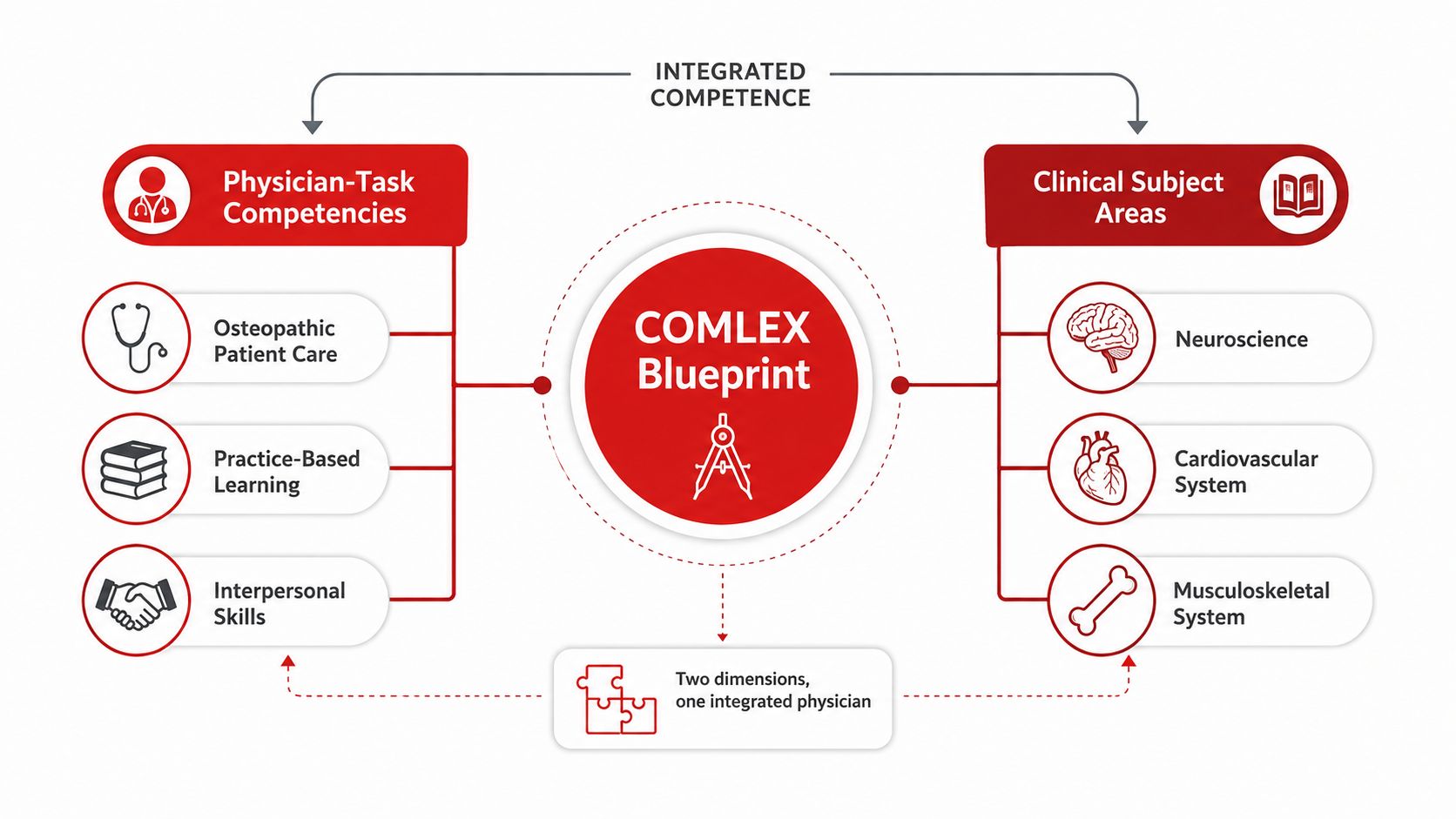
The two dimensions work together
Dimension 1 includes osteopathic patient care and procedural skills, practice-based learning and improvement, interpersonal and communication skills, professionalism, and systems-based practice. Dimension 2 includes presentations such as community health and wellness, human development/reproduction/sexuality, endocrine/metabolism, genitourinary/renal, and integrative multisystem presentations. AMBOSS COMLEX-USA master blueprint
That matters because a COMLEX question rarely asks for a detached fact in isolation. It asks you to identify the patient presentation, connect it to a clinical context, and then apply osteopathic reasoning. Students who study only as if they were cramming a fact list often miss the exam's real logic.
The best COMLEX preparation starts with blueprint literacy, not with memorizing random details.
The blueprint also helps explain why osteopathic principles, OMT, and community health appear in ways that may feel unfamiliar to students who rely too heavily on USMLE-style study habits. COMLEX wants integrated clinical judgment. It rewards the student who can see the patient, the system, and the osteopathic approach at the same time.
A useful way to read the blueprint is to ask, “What kind of physician action is this item testing?” If you can answer that quickly, you're already thinking in the logic the exam uses.
Level 1, Level 2-CE, and Level 3 Compared
A student can know the COMLEX-USA blueprint and still feel surprised by how the three levels differ in practice. They share the same licensing purpose, but they test different stages of judgment. Level 1 and Level 2-CE are both one-day, computer-based exams with 352 single-best-answer multiple-choice questions split across two 4-hour sessions, with up to 60 minutes of break time between sessions. That pace works out to roughly 4.1 minutes per item on average, so timing discipline is part of the test itself. NBOME exam format
A quick comparison
| Level | Format | Items | Sessions | Focus |
|---|---|---|---|---|
| Level 1 | One-day computer-based exam | 352 | Two 4-hour sessions | Foundational osteopathic reasoning and application |
| Level 2-CE | One-day computer-based exam | 352 | Two 4-hour sessions | Clinical application and patient-centered reasoning |
| Level 3 | Residency-stage licensing exam | Format differs from Levels 1 and 2-CE | Multi-part clinical assessment | Unsupervised clinical decision-making |
The exam logic changes most clearly in Level 1. Application of Knowledge for Osteopathic Medical Practice makes up 60% of the exam, Osteopathic Principles/OMT makes up 12%, and patient care/procedural skills makes up 6%. The clinical presentation mix also concentrates in musculoskeletal (13%), community health/wellness (12%), and several systems at 10% each. NBOME Level 1 blueprint
That weighting should change how you prepare. If your plan treats Level 1 like a pure memorization exam, you will miss the areas COMLEX emphasizes most, especially the part where content knowledge has to be applied to a patient scenario and interpreted through osteopathic reasoning. A student who studies only for recall can know the fact and still miss the task.
Level 2-CE keeps the same one-day, computer-based structure, but the mental work shifts toward clinical application. The question is less about whether you remember a topic and more about whether you can use that knowledge in a patient-centered setting. In practice, that means the exam asks you to combine diagnosis, next-step thinking, and osteopathic judgment without losing speed.
Level 3 belongs in a different category. It is taken during residency and evaluates clinical decision-making in the setting of more independent practice. Students often underestimate how different that feels from school-year exams, because the question is no longer only, “What is the diagnosis?” It becomes, “What should an unsupervised physician do next?” That is why programs read Level 3 as evidence of readiness for more autonomous care, while Level 1 and Level 2-CE are still tied to the earlier stages of training.
Eligibility, Registration, and Timeline Steps
The NBOME sets eligibility by stage, and each step has to line up before you sit for the exam. Level 1 requires completion of the first year at an accredited College of Osteopathic Medicine, plus a good academic and professional standing attestation from the COM dean. Level 2-CE requires that you've passed Level 1, completed the second year, and received another dean attestation. Level 3 requires that you've passed Levels 1 and 2-CE, graduated from an accredited COM, and received a good academic and professional standing attestation from the residency program director. NBOME also lists a recommended six months of graduate medical education before Level 3. NBOME eligibility rules
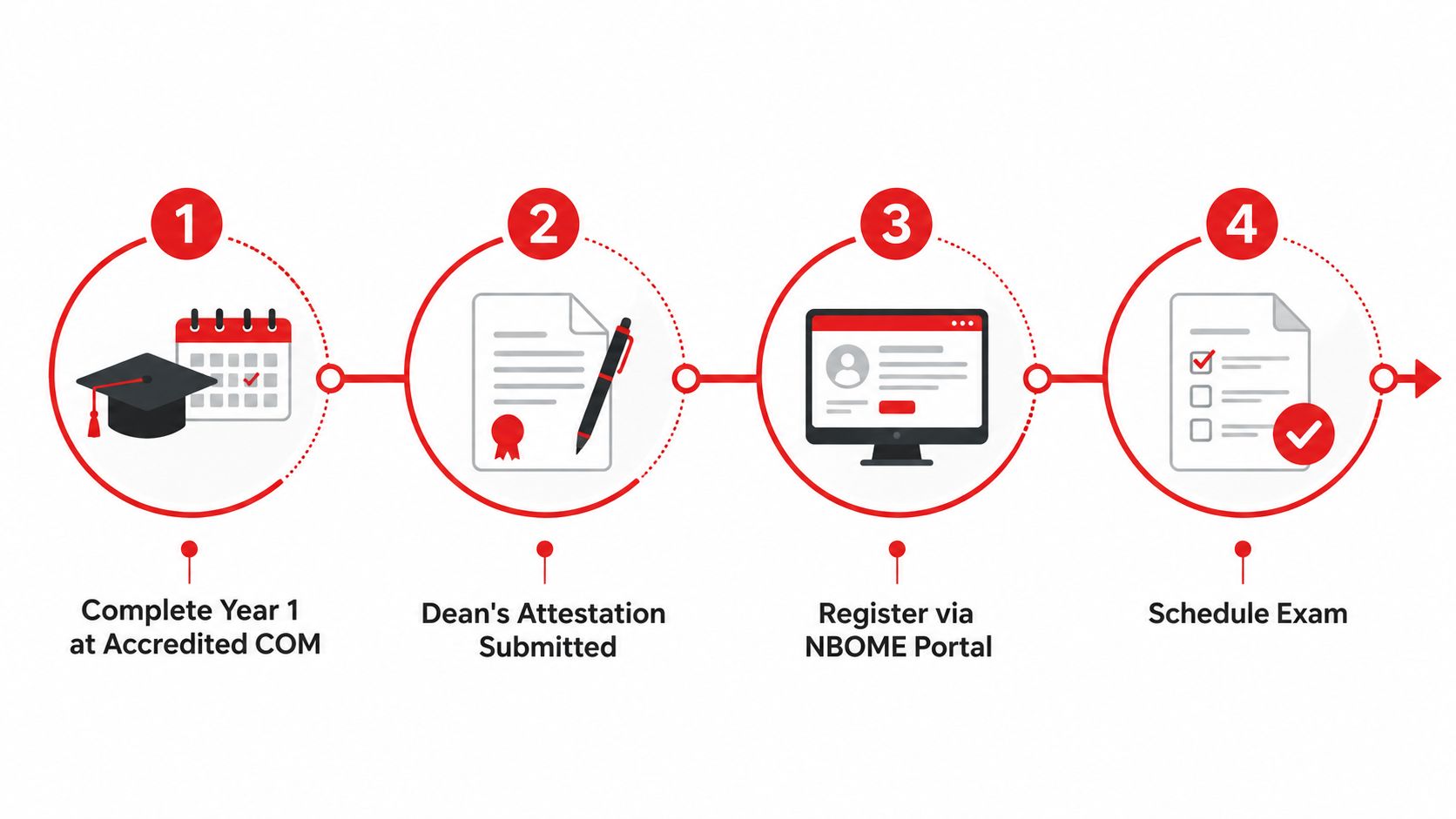
A practical registration workflow
Start with the paperwork, because timing on COMLEX is not just a study question. First, confirm your eligibility with your COM or residency program. Then make sure the attestation process has started before you try to reserve a seat. After that, register through the NBOME portal and choose an exam window that fits your training calendar.
Practical rule: Don't assume your school or program will automatically file every document on time. Confirm the attestation step yourself.
That verification step matters because students sometimes build study schedules around an ideal test date before checking whether the administrative prerequisites are complete. A short delay can turn into a much larger setback if the paperwork stalls and the seat you wanted is no longer available.
For students who want a planning reference, Ace Med Boards' COMLEX Level 1 score release guide can help you think through timing around test day and the period after the exam. The main principle is simple. Put eligibility first, then schedule, then study calendar, not the other way around.
When you map your own timeline, check three things before paying for a seat. Eligibility status, attestation status, and rotation or academic obligations. If those do not line up, wait until they do.
Scoring, Passing Standards, and Score Reports
COMLEX-USA Level 1 and Level 2-CE use a minimum passing score of 400, and the reported mean sits between 500 and 550. That matters because it gives you a rough frame for reading your result without treating every point as a verdict on your future. A published COMLEX overview from UNT Health Science Center lays out those benchmarks, and the same reference is useful when you want to anchor your expectations before score release. UNT Health Science Center COMLEX overview PDF
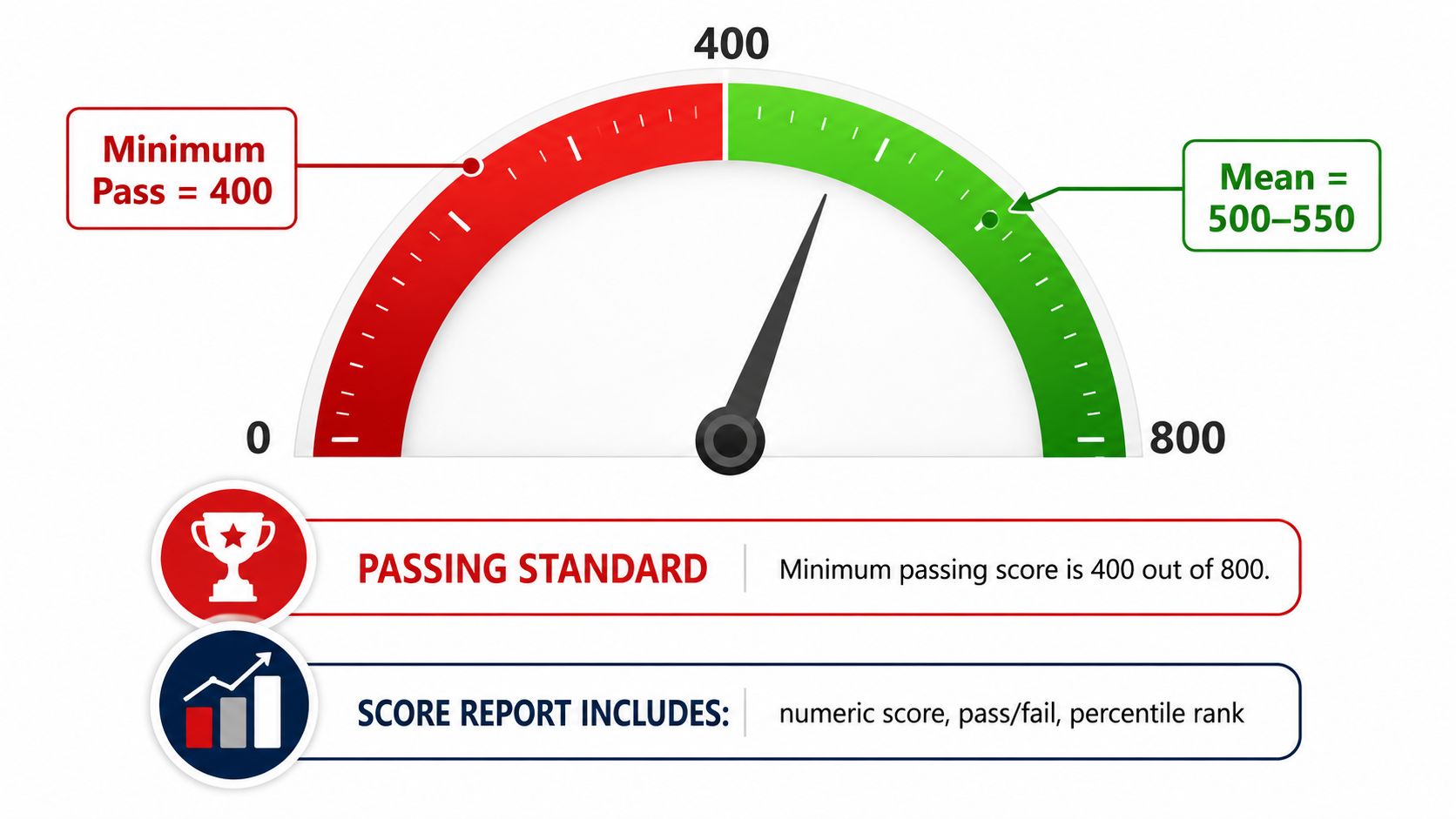
A COMLEX score report is not just a pass-fail notice. It gives you a standardized score and a breakdown that can show where your performance was stronger or weaker, which matters because COMLEX is built around its own osteopathic assessment logic rather than a simple copy of another exam. A useful report should help you decide what to do next, whether that means tightening content knowledge, improving pacing, or correcting answer-choice habits.
How to read the report without spiraling
The first task is to separate content gaps from test-taking gaps. If a domain looks weak, that may mean your review plan missed a blueprint area. If the material felt familiar but the score still came in lower than expected, pacing, question interpretation, or answer selection may be the issue.
Practical rule: Read the report for patterns, not for self-judgment.
That distinction matters because the same score can point to very different next steps. A student who missed questions in osteopathic principles needs a different plan from a student who knew the facts but ran out of time. The score report is most useful when it tells you which problem you have.
For retake questions, use the current NBOME materials, since policies can change and they matter more than advice passed around informally. The report becomes more valuable when you use it to build the next study cycle with intention, especially if you need to decide how much time to spend on OMT review, broad content review, or timed question practice.
If you want a broader frame for interpreting score meaning, the COMLEX score percentile guide can help you place a result in context. That number still represents only one part of the picture, but it is a useful part when you are deciding how programs may read your application later.
How COMLEX Compares to USMLE for Residency
A student may finish COMLEX and then wonder how a program director will read the score file. That question matters more now that Step 1 is pass/fail, because COMLEX has to do more of the explanatory work on its own. Research has found measurable but imperfect concordance between COMLEX-USA Level 1 and USMLE Step 1, and between COMLEX-USA Level 2-CE and USMLE Step 2 CK, so the two exams share some signals without lining up cleanly one-to-one. COMLEX and USMLE concordance research
What program screens often do with that reality
Residency programs do not screen applications in the same way. Some still rely on older USMLE benchmarks, while others have shifted to reading COMLEX more directly, especially after Step 1 became pass/fail. In practice, that means more weight can fall on COMLEX Level 2-CE, COMLEX Level 3, letters, rotations, and the rest of the application.
The trade-off is real for applicants. Sitting for both exams can give programs a second point of reference if they are accustomed to USMLE-based screening. Relying on COMLEX alone can also be a sound choice, depending on specialty, the strength of the rest of the file, and how target programs review candidates. The better decision comes from knowing how your intended programs evaluate applicants.
Timing matters as well. Analyses have found that taking COMLEX and USMLE close together can affect performance and the way results are compared across exams, so scheduling is more than a convenience question. It can shape how the two score reports line up. COMLEX and USMLE concordance research
For a side-by-side review of the two tests, the COMLEX versus USMLE comparison guide can help if you are deciding whether to take one exam or both. Programs increasingly have to interpret COMLEX on its own terms, rather than mapping it onto USMLE benchmarks.
If you are also sorting out how to present your application more clearly, affordable social media education may be useful for keeping your public professional presence aligned with residency expectations.
Study Strategies and Common Pitfalls
A student who treats COMLEX like a memory test usually leaves points on the table. The exam rewards blueprint-based study, so your prep should match its own logic, especially integrative diagnosis, osteopathic principles, OMT, and community health. A strong plan starts with the blueprint, then trains you to apply knowledge under time pressure, the way the exam asks you to do it.
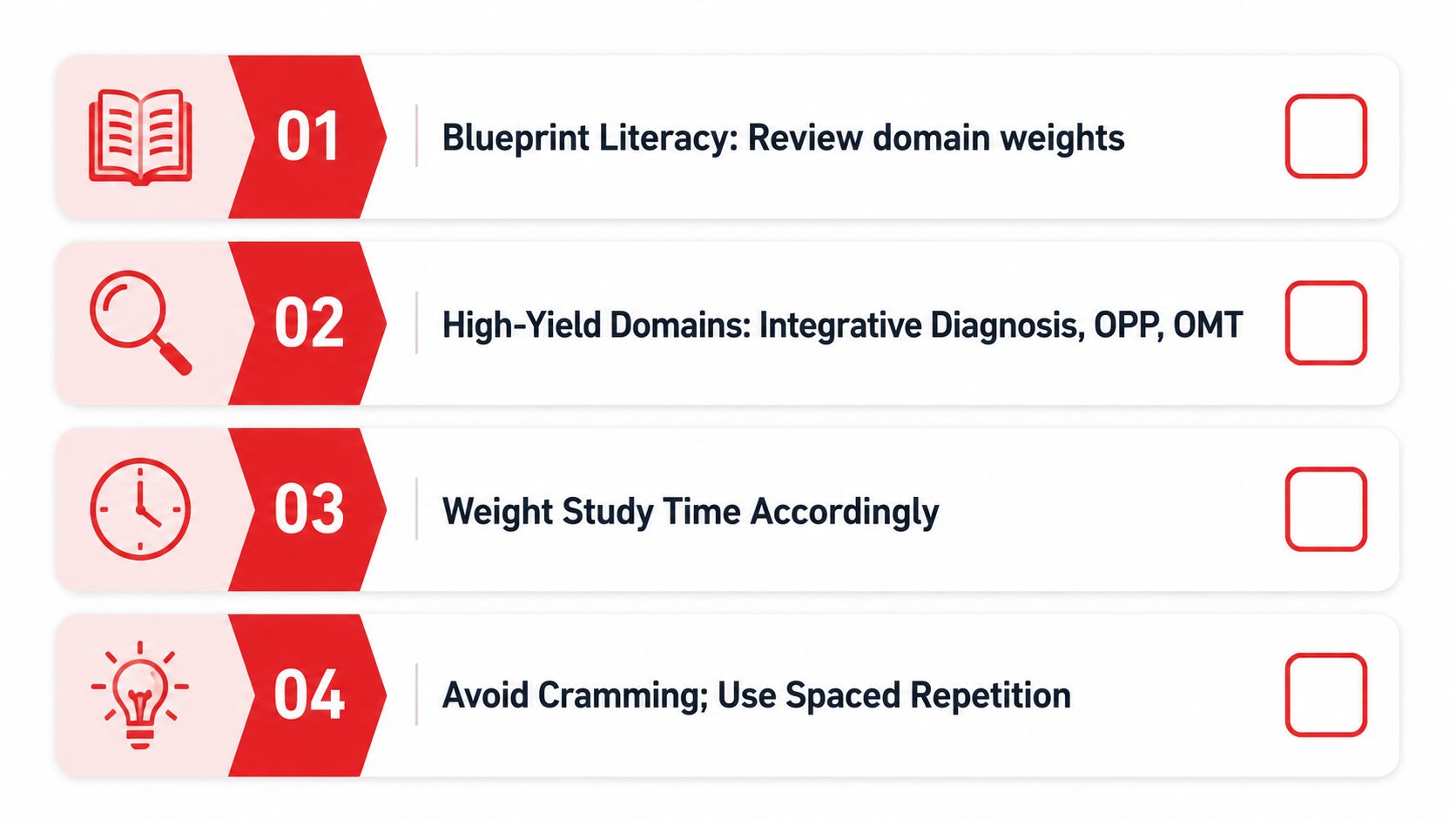
A question-review workflow that fits COMLEX
Start with the clinical presentation, not the answer choices. Then identify which Dimension 2 category the item fits, which Dimension 1 competency it is testing, and where the osteopathic reasoning sits inside the stem. That sequence keeps you from grabbing a familiar fact before you have understood what the question is asking.
A practical review routine helps with that discipline. Use the same four-part check on every block:
- Name the presentation: Identify the symptom pattern or patient context before looking at the answer choices.
- Map the blueprint: Decide which patient category and physician-task domain are being tested.
- Check the trap: Look for distractors that ignore OMM, community context, or systems-based reasoning.
- Review the miss: Decide whether the error came from content, timing, or interpretation.
The goal is not to read faster at random. It is to read with a map, then answer with purpose.
Common mistakes show up in predictable ways. Some students underweight OMT, some underestimate the pace demanded by a one-day exam, and some use USMLE-style resources without filling the COMLEX-specific gaps. Those errors rarely cause a single dramatic drop. More often, they create a steady loss of points across many items.
Practical rule: If your prep resource never asks you to think osteopathically, it is incomplete for COMLEX.
Targeted tutoring can help when you need an outside set of eyes on question reading and pacing. One option students sometimes use for supplemental educational planning is affordable social media education from Smarcomms, but for COMLEX specifically, tutoring works best when it supports official practice materials and question banks rather than replacing them. Ace Med Boards also offers one-on-one COMLEX tutoring, which can help when a student needs structured review of timing, blueprint gaps, or question analysis.
If you want a study plan that is already organized around the exam structure, the COMLEX Level 1 study schedule is a practical starting point.
Key Takeaways and Next Steps
A student can study hard for COMLEX-USA and still miss the point if they treat it like a USMLE clone. The exam follows its own logic. It is the three-level NBOME licensing sequence for osteopathic physicians, and it matters because it supports licensure, residency screening, and osteopathic competency verification. Its blueprint is built around two dimensions, so the test rewards integrated clinical reasoning instead of isolated memorization. Eligibility is also structured, since each level depends on the correct training stage and the correct attestation. Level 1 and Level 2-CE use a passing standard of 400, with a mean score range of 500 to 550, as noted earlier in the discussion of format, eligibility, and score reporting.
The most useful mindset is to study to COMLEX's own structure, not to borrow a USMLE template and hope it fits. That means keeping pacing in view, giving OMT its proper weight, and remembering that residency programs may read COMLEX in a post-Step 1 pass/fail setting where the score has to carry more of the interpretation burden. Programs are not comparing you to a USMLE copy. They are asking whether your COMLEX result shows readiness for osteopathic clinical work.
If you are early in preparation, start with the blueprint and the eligibility timeline. If you have already tested and the result was not what you wanted, use the score report to identify which part of the process needs repair, not your value as a future physician. A retake is a planning problem, not a career verdict.
If you want a calm, structured review of your exam plan, Ace Med Boards can help you organize your COMLEX preparation into a practical study path. Visit Ace Med Boards when you want to map your next step with more clarity and less guesswork.
If you need to turn results into action, Ace Med Boards also offers one-on-one tutoring and score-focused planning for osteopathic students. Visit Ace Med Boards to review options and decide whether a consultation fits where you are right now.