

A COMLEX score percentile isn't just a number—it tells you exactly how you measure up against every other osteopathic medical student in the country. It's less about your raw score and more about your competitive ranking.
For example, a 75th percentile score means you performed better than 75% of your peers. That simple percentage gives residency programs an immediate, clear snapshot of where you stand in the applicant pool.
COMLEX Level 2 Score Percentiles
If you're taking Level 2-CE, you're probably wondering how your score translates into a percentile. I've seen many students focus solely on the scaled score, missing the percentile context that matters to programs. The table below maps common Level 2-CE scores to their corresponding percentiles for the 2025–2026 testing cycle.
| Scaled Score | Approximate Percentile |
|---|---|
| 750+ | 99th |
| 700–749 | 95th–98th |
| 650–699 | 85th–94th |
| 600–649 | 70th–84th |
| 550–599 | 50th–69th |
| 500–549 | 30th–49th |
| Below 500 | Below 30th |
These percentiles are relative rankings, not fixed labels permanently attached to particular three-digit scores. The National Board of Osteopathic Medical Examiners (NBOME) explains that percentile information compares a candidate's performance with that of other examinees who have received scores during the relevant testing cycle. For the 2025–2026 cycle, the interim converter covers examinations taken from June 4, 2025, through April 24, 2026. NBOME also cautions that these figures are preliminary because final percentiles are not established until the testing cycle ends You can check the official interim converter.
Historical Level 2-CE performance data show that passing rates are high overall but have varied across testing cycles and candidate groups. In the 2020–2021 cycle, 7,575 first-time candidates were reported, with a 96.5% first-time pass rate; among 285 repeat takers, the pass rate was 77.89%, and the overall pass rate for 7,911 candidates was 95.25%. By 2022–2023, the number of first-time candidates had increased to 7,816, while the first-time pass rate declined to 94.5%; the overall pass rate was 92.8% among 8,382 candidates. The 2023–2024 cycle, identified as the first cycle under a new standard, saw further shifts Review the detailed pass-rate breakdown.
COMLEX Level 3 Percentiles
Level 3 percentiles are less commonly discussed, but they matter for certain specialties—especially those that require a completed residency or fellowship application. Level 3 is taken during residency, and while programs rarely use it for initial screening, a strong percentile can still bolster your credentials for fellowship applications or academic positions. The percentile scale works the same way: your score is compared against everyone else who took the exam in the same testing cycle. Because fewer students take Level 3, the percentile distribution can shift more noticeably from year to year.
What Does Your COMLEX Percentile Actually Mean?
While your three-digit COMLEX score is the official result, the percentile is what provides the essential context. It's the number that answers the big question on every program director's mind: "How well did this applicant perform relative to everyone else?" This comparison is what makes or breaks your competitiveness.
Think of it like a race. If one runner finishes in 55 minutes and another in 58 minutes, you don't know if those are impressive times without more information. But if you learn the 55-minute runner placed in the 90th percentile and the 58-minute runner was in the 50th, you instantly get the full picture. Your COMLEX percentile functions in the exact same way.
How We Interpret These Scores
Percentiles are derived from NBOME's national norming data and can shift slightly year-over-year based on cohort performance. When we reference a score like 650 at the 75th percentile, we're using the most recent available data from the current testing cycle. This means a 650 might land at the 75th percentile one year and the 73rd the next—the number is always relative to who took the exam alongside you. For practical purposes, residency programs understand this variability and use percentiles as a general benchmark rather than a precise cutoff.
Score vs. Percentile: What's the Difference?
To really make sense of your score report, you have to get comfortable with the distinction between your score and your percentile rank. They each tell a different piece of your performance story. Getting this right is the first step to using your score strategically when you apply for residency.
Here's a quick breakdown to clear things up:
| Metric | What It Represents | Why It Matters |
|---|---|---|
| Raw Score | The total number of questions you answered correctly. | This is just the initial calculation. It's not reported to you or to residency programs. |
| Scaled Score | Your raw score converted to the standardized, three-digit number you see on your report. | This is your official score, but it doesn't show how you compare to others on its own. |
| Percentile Rank | The percentage of test-takers whose scores were lower than yours. | This is the key metric for competitiveness. It's what shows residency programs where you stand nationally. |
The relationship between scores and percentiles is also a major focus for researchers, especially for students who take both the COMLEX and USMLE. There are ongoing studies that use statistical methods to map equivalent percentile ranks between the two exams. This work helps program directors better interpret an applicant's performance, no matter which test they took.
This research ensures your COMLEX percentile is understood in the broader context of all medical school graduates. For a deeper dive, you can explore the findings of one such study on percentile concordance.
How to Read Your COMLEX Score Report
Opening your official score report from the NBOME can be an intense moment. The screen is filled with numbers, charts, and data, but knowing where to focus makes all the difference. The first thing you'll probably notice is your name, your ID, and that big, bold, three-digit number—your scaled score.

While that score is important, the next thing you should find is your COMLEX score percentile. This is usually right next to your scaled score, often in a table or alongside a graph. This single number is what gives your score its real-world context by showing you exactly how you stacked up against every other student who took the exam nationally.
Seeing a score of 650 is one thing. But seeing that a 650 also puts you in the 75th percentile? That signals to you (and residency programs) that you performed better than three-quarters of your peers.
Now, let's make this concrete. Imagine two students both score 650 on Level 2-CE. One is at the 75th percentile, the other at the 50th. The first student is comfortably in the competitive range for most specialties. The second student, while still passing, needs to think more carefully about where to apply. The same three-digit number carries completely different weight depending on the percentile. That's why I always tell students to look at the percentile first, then the scaled score.
Breaking Down Your Performance Profile
Beyond the headline numbers, your report contains a graphic breakdown of your performance. This is your personal roadmap for identifying exactly where you shined and where you have room to grow.
The chart usually breaks down your performance into two main categories:
- Competency Domains: You can see how you did on foundational skills, like Osteopathic Principles, Practice, and Manipulative Medicine; Osteopathic Patient Care; and Application of Knowledge for Osteopathic Medical Practice.
- Clinical Disciplines: This section gives you the rundown on your performance in core subjects like Emergency Medicine, Family Medicine, Internal Medicine, and Surgery.
Think of each bar on the graph as a measure of your strength in that area compared to a candidate who just barely passed. The longer the bar, the stronger your performance.
Your score report is more than just a grade; it's a diagnostic tool. Use the performance profile to see exactly where you excelled and which topics might need more attention for future exams or clinical rotations.
By looking past that single three-digit number and digging into these details, you can turn your score report from a source of anxiety into a practical guide for the rest of your medical education. This deeper understanding is absolutely vital for building a strong, strategic residency application.
Why Your Percentile Matters More Than Ever
The game has changed. With the USMLE Step 1 exam now pass/fail, residency applications have been thrown for a loop. Program directors, who once relied on that three-digit score to quickly sort through thousands of files, are now looking for other objective data points. And for osteopathic students, that puts a massive spotlight right on your COMLEX score percentile.
Let's be blunt: your COMLEX Level 2-CE performance is no longer just another box to check. It's now one of the most powerful tools you have to differentiate yourself. Program directors need a way to gauge your clinical knowledge against a national standard, and a strong percentile tells them exactly where you stand. It's become a critical first impression.
COMLEX Level 2-CE results can matter in residency applications, but percentile standing is only one component of a broader selection process. The National Resident Matching Program identifies COMLEX-USA Level 2-E score among the measures used in match-data analyses, alongside factors such as contiguous ranks in the preferred specialty, the number of specialties ranked, research experiences, work experiences, and volunteer experiences. NRMP also notes that older reports used self-reported examination data, whereas newer reporting may use primary-source exam data, so historical comparisons should be made carefully See the NRMP's charting outcomes.
The New Landscape of Applicant Evaluation
In this post-Step 1 scoring era, your percentile rank has become a sorting hat. Where a numeric Step 1 score used to be the first hurdle, program directors are now leaning heavily on other quantitative metrics to build their initial interview lists. A high COMLEX percentile is what gets your foot in the door and ensures your application gets a serious look, especially for competitive specialties.
This isn't just a COMLEX-specific phenomenon. We're seeing the exact same trend in the allopathic world, where Step 2 CK scores have become king. In fact, recent data shows that roughly 40% of residency applicants saw their rank drop after the Step 1 change, showing just how much weight has shifted to second-level board exams. Understanding this is key—a stellar COMLEX Level 2-CE percentile can put you on equal footing with an applicant who has a top-tier Step 2 CK score. You can read more about how Step 2 scores now shape residency selection to see the parallels.
A strong COMLEX percentile is your chance to shout from the rooftops that you're ready. It proves you have the knowledge base to hit the ground running and gives program directors a very compelling reason to offer you an interview.
Ultimately, your percentile isn't just a number. It's the story of how you measure up against every other osteopathic medical student in the country. A percentile in the 80th range or higher, for instance, immediately signals that you're in the top echelon of applicants. That kind of distinction can open doors to highly competitive programs and specialties. It's your ticket to being seen.
Using Your Percentile to Target Residencies
So, you have your COMLEX percentile. What now? That number isn't just a grade to feel good or bad about—it's one of the most powerful strategic tools you have. Think of it as a GPS for your residency applications. It helps you build a smart, targeted list of programs, making sure you apply where you're a strong candidate while still reaching for those ambitious goals.
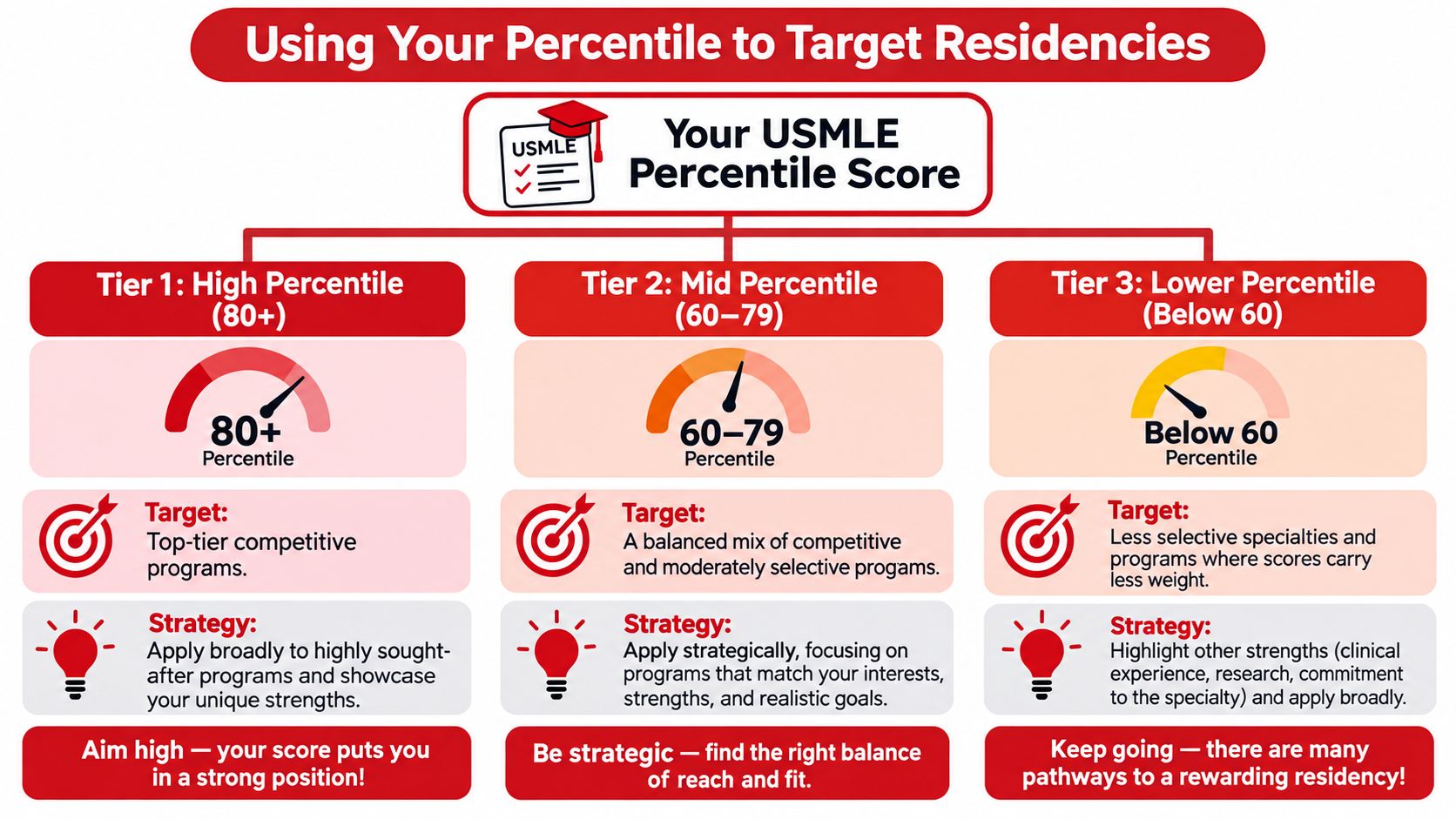
A high percentile gives you a green light for the most competitive specialties. On the other hand, a solid, average percentile makes you a fantastic applicant for many excellent primary care programs and other valuable fields. Getting this right is the key to building a balanced application list that maximizes your chances of matching. You can avoid the stress of applying too broadly or, even worse, too narrowly.
This image breaks down the general tiers of competitiveness you can expect based on different percentile ranges.
As you can see, performance generally falls into a few key tiers. Each one lines up with different levels of specialty competitiveness. It's a simple way to map your national standing to a practical, real-world application strategy.
When reviewing applications for internal medicine, I've noticed that a 60th–70th percentile is often the sweet spot for competitive programs, whereas surgical fields demand much higher thresholds. This isn't a hard rule, but it reflects what I've seen across multiple application cycles. Use this as a starting point, not a definitive verdict.
Mapping Percentiles to Specialty Competitiveness
How do you translate your percentile into an actual application list? The trick is to align your COMLEX score percentile with the data on applicants who have successfully matched in different specialties.
Here's a general breakdown:
- Top Tier (80th-99th percentile): Scoring in this range is an exceptional performance. You are likely a very competitive candidate for the most sought-after specialties, like orthopedic surgery, dermatology, or integrated interventional radiology.
- Strong Tier (50th-79th percentile): This is a great place to be. Your score makes you a strong candidate for many competitive programs, including anesthesiology, emergency medicine, and general surgery. It also positions you extremely well for top-tier primary care residencies.
- Competitive Tier (Below 50th percentile): While you'll need to be more strategic with your list, you are still a competitive applicant for many fantastic programs. This is especially true in essential fields like family medicine, pediatrics, and psychiatry.
The table below provides a general guide for how different COMLEX percentile ranges tend to align with the competitiveness of various medical specialties. It's a great starting point for building your initial list.
COMLEX Percentile Ranges and Specialty Competitiveness
| Percentile Range | General Competitiveness Level | Example Specialties |
|---|---|---|
| 80th – 99th | Highly Competitive | Orthopedic Surgery, Dermatology, Otolaryngology (ENT) |
| 60th – 79th | Very Competitive | Anesthesiology, Emergency Medicine, General Surgery |
| 40th – 59th | Competitive | Internal Medicine, OB/GYN, Pathology |
| Below 40th | Less Competitive | Family Medicine, Pediatrics, Psychiatry, Physical Medicine |
Remember, this table is a general framework. Your overall application—including letters of recommendation, research, and clinical grades—plays a huge role. Use your percentile as one key piece of the puzzle, not the whole picture.
Key Takeaway: Your percentile helps ground your application strategy in reality. Use it to anchor your list with programs where you are a strong fit, then add a few "reach" and a few "safer" programs to create a well-rounded and balanced approach.
Once you've used your percentile to identify target residencies, the next phase begins. Crafting a standout application requires careful attention. This means having a polished CV, and using a professional CV builder can help you organize your experiences and achievements effectively. Of course, a strong score starts with a strong plan; creating a detailed COMLEX Level 1 study schedule is what builds the foundation for achieving the score you need in the first place.
Common Myths About Your COMLEX Percentile

The residency application process is filled with stress, and a lot of that anxiety comes from bad information. Regarding your COMLEX score percentile, a few persistent myths can cause unnecessary panic. Knowing the facts can prevent that alarm.
One of the biggest fears for medical students is that a single number will define their entire future. Residency programs review candidates by considering many factors beyond a single number.
Myth 1: A Low Percentile Means I Won't Match
This is easily the most destructive myth out there. A lower-than-expected percentile is not a death sentence for your residency dreams—not even close. While a high percentile certainly helps, especially for the most competitive specialties, program directors are looking for well-rounded future physicians, not just good test-takers.
In my experience coaching students, a 40th percentile isn't a death sentence. I've seen students at that level match into excellent family medicine and psychiatry programs because they pivoted to stronger Letter of Recommendation strategies and highlighted their clinical rotations. The key is to be realistic about your target list and to make the rest of your application shine.
Residency programs conduct comprehensive reviews. They understand that a single exam, taken on one specific day, is not the full measure of a candidate's potential.
Reality Check: Your application is a portfolio, not a single data point. Strengths in other areas—like stellar clinical grades, compelling letters of recommendation, meaningful research, or a powerful personal statement—can absolutely compensate for a less-than-ideal percentile.
Focus on building a strong overall profile. A lower score might mean you need to be more strategic with your application list, but it rarely closes the door entirely.
Myth 2: Only My COMLEX Score Matters
This myth is the flip side of the first one. Some students who score in a high percentile believe their number is a golden ticket, allowing them to coast on other parts of their application. This is a critical mistake.
Program directors read every part of your file. They are building a cohesive team and want to see solid evidence of professionalism, teamwork, and clinical acumen, qualities a test score cannot demonstrate.
Here's what else they're looking at:
- Letters of Recommendation: What do attending physicians really say about your clinical skills and work ethic?
- Clinical Grades: How did you perform during your core rotations?
- Personal Statement: Who are you as a person, and what drives you to pursue this specialty?
- Research and Activities: What have you done to show your commitment and passion beyond the classroom?
If you're struggling to balance test prep with these other critical areas, personalized guidance can make all the difference. Exploring options like professional COMLEX tutoring can help you develop an efficient study plan, freeing up precious time to strengthen your complete application.
Answering Your Top COMLEX Score Questions
Once you get that COMLEX score report, your mind probably starts racing with questions. It's totally normal. Beyond the numbers and charts, you need to know what it all really means for your future.
Let's cut through the noise and get straight to the practical answers you're looking for. From figuring out what a "good" percentile is to deciding on a retake, this is the information you need to move forward with confidence.
What Is a Good COMLEX Score Percentile?
This is the million-dollar question, and the answer is: it depends entirely on your residency goals. A "good" score is completely subjective.
For the most competitive specialties like dermatology or orthopedic surgery, programs are often looking for applicants scoring in the 80th percentile or higher.
But for many fantastic programs in fields like internal medicine, pediatrics, or family medicine, a score right around the 50th percentile is often considered strong and competitive. The trick is to research the average scores for your target specialty. A "good" score is one that makes you a competitive candidate for the programs you care about most.
What Is a Good COMLEX Level 2 Percentile?
For Level 2-CE, the same logic applies, but the stakes are slightly higher because this exam is often the last board score programs see before ranking. A percentile in the 60th–70th range is solid for most primary care specialties. If you're aiming for something more competitive like emergency medicine or anesthesiology, you'll want to be in the 75th percentile or above. Below the 50th percentile, you should focus on building a well-rounded application with strong letters and clinical grades.
Do Residency Programs See My Percentile?
Yes, they absolutely do. When your COMLEX-USA transcript zips over to programs through ERAS, they get the full picture. This includes your three-digit score and your COMLEX score percentile rank.
Program directors love percentiles because they provide instant context. A score of 600 might not mean much by itself, but seeing it's in the 65th percentile immediately tells them how you stack up against your peers nationwide. It's often one of the first data points they use to sort through a mountain of applications.
Should I Retake the COMLEX for a Higher Score?
Hitting the "retake" button on the COMLEX is a huge decision and shouldn't be taken lightly. If you passed, the only time to seriously consider it is if your score is a major roadblock for your target specialty and you are confident you can make a significant jump.
Keep in mind that all of your attempts are visible to program directors. A small bump in your score might not be worth the risk, time, and financial cost. It's often a better strategy to pour that energy into strengthening other parts of your application, like getting stellar letters of recommendation or crushing your clinical rotations.
The pressure of prepping for a retake can be absolutely draining, too. You have to actively manage the mental and emotional toll, because that kind of prolonged stress is a fast track to burnout. Recognizing the signs of academic fatigue is key, and our guide on preventing USMLE and COMLEX exam burnout offers real strategies to help you stay resilient.
Ultimately, this is a conversation to have with your academic advisor or a mentor you trust. They can help you realistically weigh the potential pros against the very real cons.
Frequently Asked Questions
Do Residency Programs Care About Level 3 Percentiles?
Generally, no, at least not for initial residency applications. Level 3 is taken during residency, so programs can't use it to screen applicants. However, if you're applying for a fellowship or an academic position, a strong Level 3 percentile can be a useful differentiator. Some competitive fellowships do review these scores as part of an overall evaluation.
How Often Do Percentiles Change?
Percentiles are recalculated for each testing cycle. NBOME updates its interim converter throughout the year, and final percentiles are locked in once the cycle ends. This means your percentile could shift slightly if you compare it to data from a previous year. Always check the most recent converter for the most accurate picture.
Can My Percentile Improve With a Retake?
Yes, but only if your scaled score improves significantly. Because percentiles are relative, a modest score increase might not move the needle much—especially if many other test-takers also improve. Focus on making a substantial jump (e.g., 50+ points) before deciding a retake is worth it.
What If My Percentile Is Lower Than Expected?
First, don't panic. Look at your performance profile to see if there's a specific competency domain dragging you down. Then, talk to your advisor about your residency list. A lower percentile means you'll need to be more strategic, but it doesn't eliminate your chances. Many students successfully match with percentiles below the 50th by building strong applications elsewhere.
For a helpful resource on creating a standout application, you can also check out StoryCV's site for example CV formats for physicians.
At Ace Med Boards, we get it. Navigating COMLEX scores and the whole residency application maze is tough. Our expert tutors provide personalized guidance to help you not only hit your target score but also build a competitive application that showcases your strengths. Visit us at https://acemedboards.com to book a free consultation and take the next step toward your medical career.