You're staring at a CCS case that gives you a few lines, a few vital signs, and a clock that starts moving the moment you do. That pressure is real, but usmle step 3 ccs cases aren't about guessing every diagnosis instantly. They reward a calm sequence, safe ordering, and steady reassessment, which is why a repeatable workflow matters more than memorizing a giant checklist.
Your Guide to Mastering the CCS Cases
The first few seconds of a CCS case can feel like walking into a room mid-crisis. One patient looks unstable, another seems vague, and the interface doesn't wait for you to feel ready. That's where a system helps, because the exam rewards how you think, not just what you know.
A useful mental model is to treat each case like a short clinical conversation. You gather what's in front of you, stabilize what's urgent, then narrow the diagnosis and keep checking whether your actions worked. If you need a quick refresher on distinguishing findings during clinical reasoning practice, the discussion in symptoms vs signs in OMOP is a clean reminder of how exam data gets sorted before decisions are made.
Practical rule: If you feel rushed, return to the same three questions, what is unstable, what is most likely, and what needs to be reassessed next.
That calm sequence matters because CCS is a high-weighted part of Step 3. The CCS section is reported to contribute about 25–30% of the total Step 3 score, despite appearing in only 13–14 cases on Day 2, and community prep analyses estimate its impact as roughly equivalent to 60–90 multiple-choice questions (StudyCCS). For a closer look at how Ace Med Boards organizes preparation around that section, the relevant overview is on the Step 3 CCS preparation page.
Decoding the CCS Exam Structure and Scoring
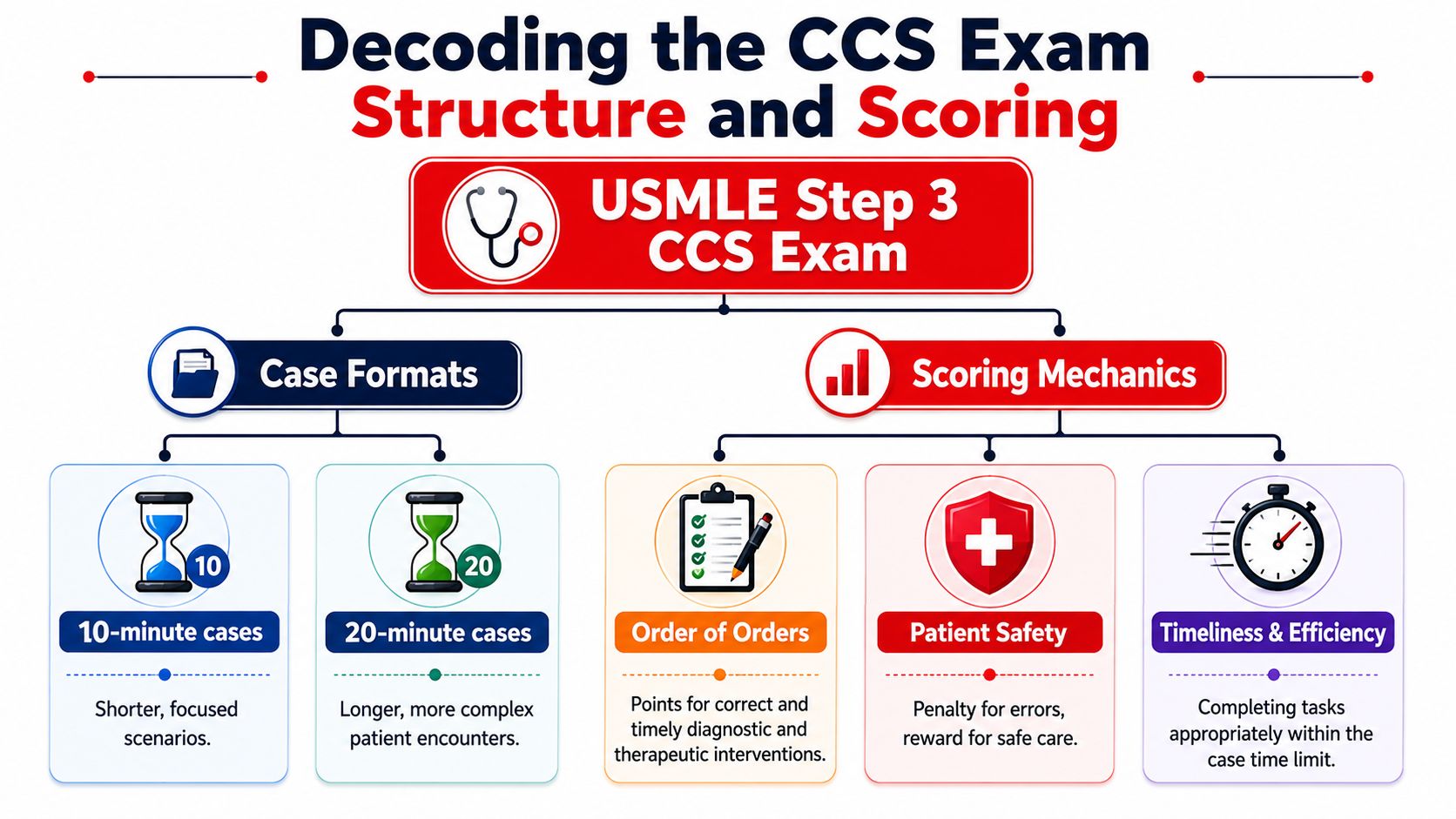
A student can know the medicine and still lose points if the case is handled in the wrong order. That is the part many people miss at first. USMLE Step 3 is a two-day exam, Day 1 is MCQ-heavy, and Day 2 includes multiple-choice blocks followed by CCS cases, so a strong multiple-choice performance can still be undercut if CCS management is weak.
The structure matters because CCS is not graded as a simple diagnosis question. It tests whether you can manage a patient step by step under time pressure, with the case changing as your orders take effect. That makes the section feel closer to supervised clinical work than to a static test item.
What the cases actually reward
Independent CCS guidance breaks scoring into six evaluative domains, diagnosis, therapy, monitoring, timing, sequencing, and location of care (MasterCCS). Those domains explain why two students can reach the same diagnosis and still earn very different scores. The exam looks at whether you picked the right plan, whether you ordered it in the right order, whether you acted soon enough, and whether you used the correct care setting.
A useful way to read those domains is to separate them into two loops. The first loop is stabilization and safety, which speaks to timing, sequencing, and location of care. The second loop is refinement, which covers diagnosis, therapy, and monitoring once the patient is stable enough for the next decision. That is why a correct treatment entered too late, or a plan that is never reassessed, can still lose points.
The official exam description also frames CCS as a dynamic patient-management task, not a memory test. USMLE says these cases evaluate diagnosis, treatment, and monitoring, so the workflow has to include reassessment after orders return and clinical status changes. Ace Med Boards' Step 3 average score page is a useful place to place CCS in the broader Step 3 score picture, but the key point here is simpler, you are managing the patient as the case evolves, not choosing a single best answer.
Why the timing matters so much
A commonly reported operational benchmark is that CCS includes about 12–13 interactive cases, with cases split into 10-minute and 20-minute formats (StudyCCS guide). The last 2 minutes are reserved for end-of-case actions, so the usable management window is about 8 minutes for 10-minute cases and 18 minutes for 20-minute cases. Those limits explain why a student who pauses too long at the start can feel behind even when the clinical reasoning is sound.
The safest response is to treat the clock as part of the case structure, not as background noise. Early minutes go to stabilization and basic setup, then the next decisions should confirm the diagnosis, guide treatment, and schedule reassessment. That sequence mirrors the hidden scoring domains and keeps the case moving before the timer starts to control your choices.
A Step-by-Step Workflow for Any CCS Case
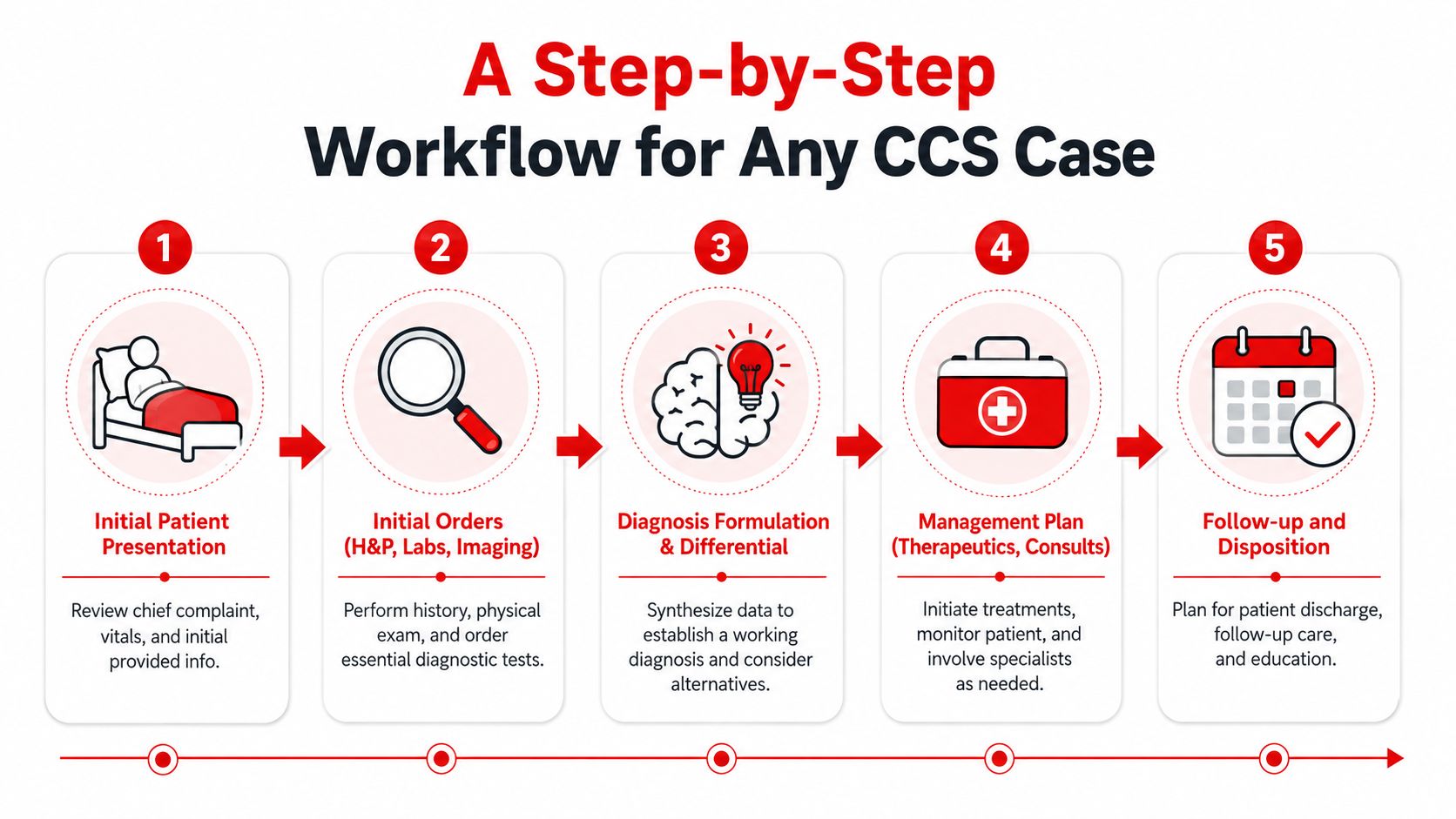
The safest way to start is to treat the opening screen like a short triage note. Read the chief complaint, check the vitals, identify the setting, and decide whether this is an unstable patient or a slower diagnostic case. Then use the same sequence every time, because consistency lowers the chance of missing a critical order under pressure.
First loop, stabilize
The first loop is about ABCs, glucose, pain, oxygenation, and basic monitoring. Expert strategy sources describe this as the stabilization loop, and it lines up with the scoring domains of timing and sequencing (MDSteps playbook). In practical terms, you're asking, “What could hurt this patient right now if I wait?”
A good opening often includes oxygen if needed, cardiac monitoring when appropriate, pulse oximetry, IV access when the case is urgent, fingerstick glucose when mental status is altered, and repeat vitals after treatment. The goal isn't to order everything. It's to make sure the patient is safe enough to move forward.
Second loop, diagnose and treat
Once the patient is stabilized, shift to the diagnostic-therapeutic loop. In this phase, you confirm the leading diagnosis, order targeted tests, begin treatment, and then reassess when new results come back. The scoring model supports that sequence, because CCS rewards monitoring and not just the first intervention.
Practical rule: Don't advance the clock just because you feel done. Advance it after you've placed the orders that should produce the next useful piece of information.
The interface also encourages planning around time rather than panic. A common approach is to think, “stabilize first, then confirm, then treat, then check again.” That keeps you from jumping to a definitive therapy before the case has supplied enough data. If you want a concise review text to pair with this style of practice, the relevant overview is First Aid for Step 3.
A simple way to remember the flow is this:
- Identify immediate instability.
- Place safety and monitoring orders.
- Work up the likely diagnosis.
- Start targeted therapy.
- Recheck and disposition.
In the final two minutes, focus on end-of-case actions such as follow-up, counseling, and disposition. That last screen still matters because CCS doesn't stop caring about patient management when the clock does.
High-Yield Order Sets and Clinical Templates
The most efficient CCS writers do less improvising at the start. They use small, adaptable templates for common presentations, then adjust based on the case. That approach helps because the early minutes are where candidates tend to lose time deciding what's “worth ordering.”
Starter templates for common presentations
For chest pain, the first-pass order set usually needs to confirm stability, identify ischemia, and avoid missing dangerous alternatives. For altered mental status, the priority is safety, glucose, oxygenation, and a search for reversible causes. For shortness of breath, the first steps are usually oxygenation, cardiopulmonary monitoring, and a targeted workup based on whether the patient looks infectious, obstructive, cardiac, or embolic.
Here's a practical starting table you can adapt during practice:
| Order Category | Specific Orders |
|---|---|
| Immediate safety | Vital signs, pulse oximetry, cardiac monitoring, oxygen if indicated |
| Basic assessment | Focused history, targeted physical exam, repeat assessment after interventions |
| Core labs | CBC, CMP, glucose, urinalysis, pregnancy test when appropriate |
| Common studies | ECG, chest imaging, other case-specific imaging |
| Disposition support | Admit, observe, transfer, or arrange follow-up based on stability |
That's not a rigid script. It's a memory scaffold. If the patient is unstable, the safety items come first. If the case is outpatient and stable, the workup can be narrower and the disposition might be simpler.
A CCS case management checklist
Use this checklist during practice until the sequence feels automatic:
- Before advancing the clock: confirm you've addressed safety, monitoring, and the most likely diagnosis.
- After starting treatment: check whether the plan needs repeat vitals, repeat exam, or a higher level of care.
- Before the case ends: think about counseling, prescriptions, follow-up, and the correct disposition.
A few examples matter more than broad theory. Chest pain cases usually benefit from early ECG logic and careful disposition. Altered mental status cases often punish delayed bedside checks. Shortness of breath cases frequently expose whether you remembered that initial monitoring is not the same as complete treatment.
The point is to build muscle memory. Once the opening orders become routine, you have more attention left for the parts of the case that change the score.
Common Case Archetypes and Critical Pitfalls
A CCS case often looks simple at first glance, then hides the part that costs points. The exam keeps recycling familiar patterns, so the task is to recognize the case quickly and choose the right management sequence before the clock eats your attention. The trap is usually incompleteness, not confusion.
Common archetypes you should expect
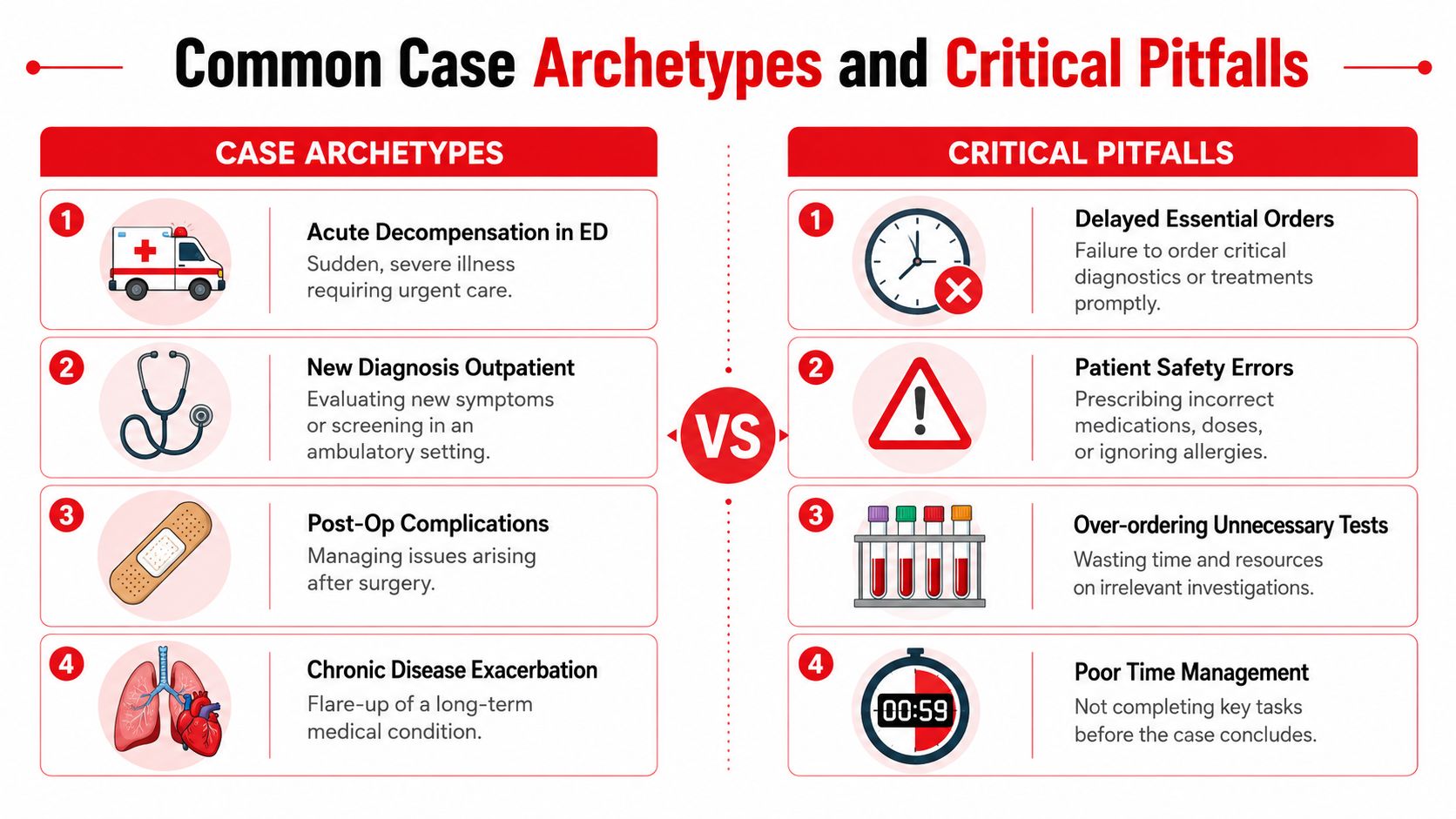
An acute decompensation in the ED usually needs stabilization first, then a focused workup, then disposition to the right level of care. A new diagnosis in outpatient clinic usually calls for a narrower plan, with counseling and follow-up built in. Post-op complications push you to think about timing, monitoring, and surgical escalation. Chronic disease exacerbation tests whether you can treat the flare without losing sight of the long-term plan.
These archetypes matter because they shape the order of your actions. A patient who is unstable should not get the same sequence as a stable preventive visit. In Step 3 CCS cases, the right pattern recognition helps you choose whether the first loop is rescue, workup, or counseling.
Why omissions hurt more than bad guesses
A major analysis in Academic Medicine found that first-time examinees frequently entered inappropriate, risky, or harmful actions, which shows how often CCS penalties come from management errors rather than from one wrong diagnosis, and the same study reported that more than one in five examinees ordered at least one action with the potential to cause significant patient harm (Academic Medicine analysis). The takeaway is simple. CCS scoring is sensitive to what you omit, what you do too late, and what you order without checking whether the patient is safe first.
The biggest misses are often not dramatic mistakes. They are missed monitoring steps, missed disposition moves, and orders that arrive too late to earn credit.
Common omissions include forgetting pulse oximetry separately, missing pregnancy testing in women of childbearing age, not repeating vitals after treatment, or leaving the patient in the wrong care setting. A resident who can name the diagnosis but keeps the patient on the wrong unit still loses points because CCS scores the whole management sequence, not just one step of clinical reasoning. what is clinical reasoning helps explain why the same case can be handled well or poorly depending on whether the candidate sees the case as a sequence of actions, not a list of disconnected orders.
Practice Resources and Key Takeaways for Exam Day
A student walking into USMLE Step 3 CCS cases with no plan usually wastes time on scattered orders and slow reassessment. A better approach is to choose a small set of resources, then use them to rehearse the same case pattern until the sequence feels automatic. The official USMLE materials stay closest to the actual interface, while a focused question source gives you repeated practice with the kinds of decisions CCS rewards.
For many students, the cleanest setup is simple:
- Official USMLE practice materials: best for learning the actual interface and for seeing examples that match the exam format.
- UWorld CCS: useful when you want integrated practice alongside broader Step 3 study. Ace Med Boards' UWorld Step 3 page outlines one way students fit that resource into a larger plan.
- One-on-one tutoring: helpful when the same CCS mistake keeps coming back, especially with timing, sequence, or the final reassessment steps.
The exam format itself is built around case management over time, not a single burst of guessing. The USMLE CCS format page shows that the scoring process expects you to respond, wait for results, and adjust the plan as the case unfolds. That is why practice should include both order entry and clock management. A resident mentor would call this the difference between writing a plan and carrying it out.
Key Takeaways
- CCS is score-dense. It makes up a large share of Step 3 even though the case count is limited, so weak performance can move the overall result more than students expect (StudyCCS).
- Use a two-loop workflow. First stabilize the patient and prevent harm. Then return to the case, refine the diagnosis, treat, and reassess.
- Score the whole plan. Diagnosis, treatment, monitoring, timing, sequencing, and care setting all feed into the final result (MasterCCS).
- Watch for quiet omissions. Missing pulse oximetry, pregnancy testing, repeat vitals, or the right level of care can cost easy points because CCS tracks the full management sequence, not just the first decision (MedBoardTutors).
- Reassess after treatment. The exam rewards follow-through, so the next action after an intervention should be another check on whether the patient is improving or needs a new step.
A few questions come up again and again during practice. Students often ask whether they should order everything at once, and the answer is to start with what protects the patient and clarifies the problem, then narrow the plan once the first data returns. They also ask when to advance the clock. Do it after the initial orders that should produce the next meaningful result, not before the case has had a chance to respond. If the first pass feels messy, the case is often still recoverable, because steady monitoring and better sequencing can restore points as long as the same mistake is not repeated.
For students who keep missing the same workflow problems, Ace Med Boards also offers one-on-one USMLE tutoring that can be used to review CCS case flow and practice management with feedback. The value is practical, not magical. It helps turn the two-loop process into a habit you can repeat under pressure.
If you want personalized CCS strategy help, visit Ace Med Boards and request a free consultation. A focused review of your workflow can make practice feel more organized, especially when the clock or the order sequence keeps throwing you off.