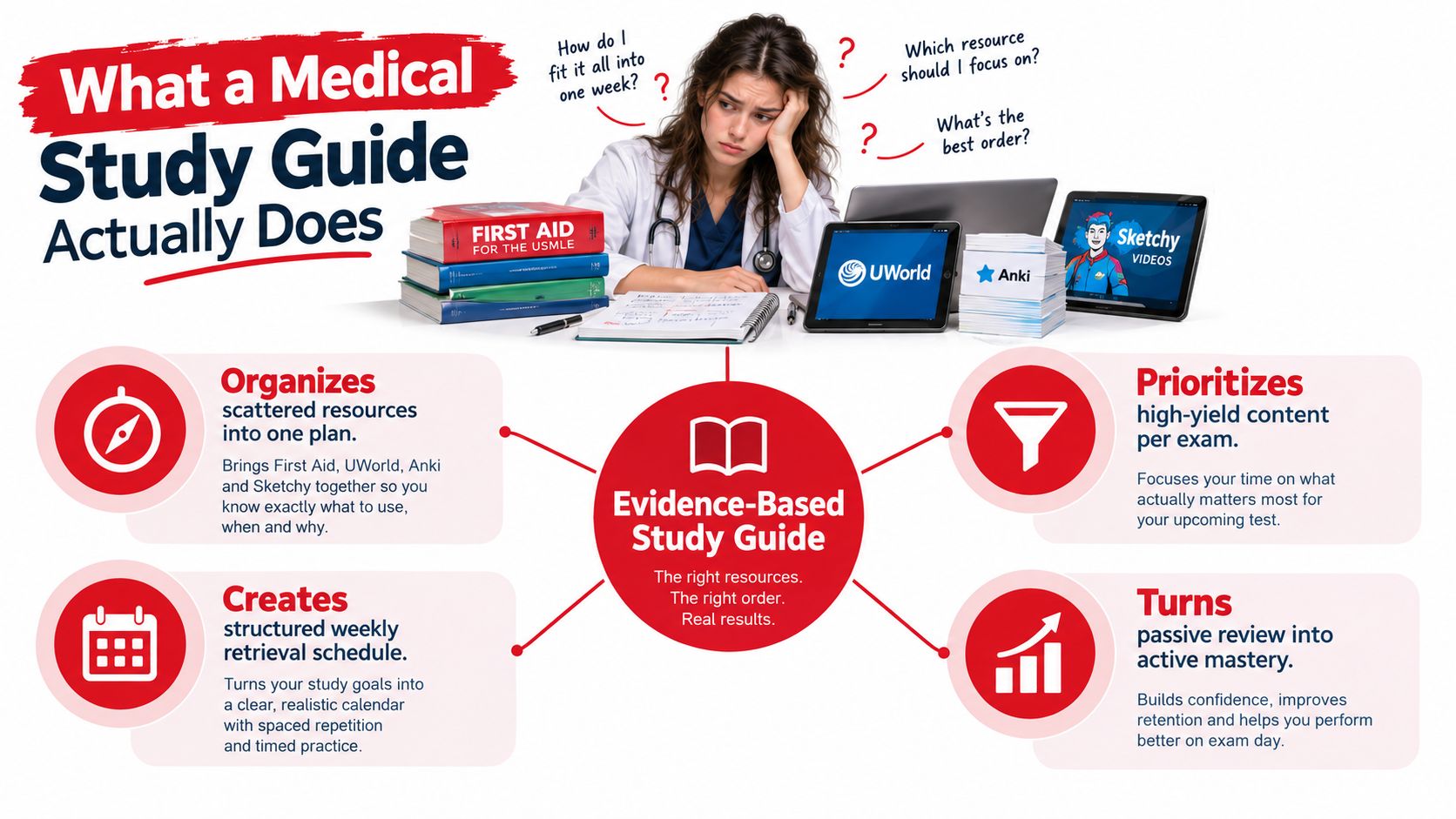
You're staring at First Aid, UWorld, Anki cards, Sketchy videos, and a calendar that has no realistic place for any of them. The problem usually isn't a lack of resources. It's the absence of a medical study guide that tells you what to retrieve, when to retrieve it, how to review mistakes, and how to test whether the learning transfers to an unfamiliar question.
A useful guide is a working plan for USMLE or COMLEX preparation, not a longer reading list. It turns diagnostic information into scheduled practice, separates knowledge gaps from reasoning errors, and gives you evidence for what to change during the next study week.
What a Medical Study Guide Actually Does
You finish a long study block, close First Aid, and still cannot explain what you learned without looking back. A medical study guide prevents that uncertainty by turning resources into scheduled actions, review decisions, and evidence of improvement.
Guides have long organized information for education and research. Princeton describes its historical statistics guide as an “essential starting point” and a reference that directs readers toward broader sources, showing how a guide can arrange knowledge without replacing the underlying material (Princeton's historical statistics research guide).
For medical education, a useful guide functions as a living document with four connected parts:
- Diagnostic baseline: What can you answer now under realistic conditions?
- Retrieval calendar: Which topics will you recall today, later in the week, and after a delay?
- Error log: Why did each missed question go wrong?
- Decision checkpoints: What evidence will tell you to continue, intensify, or change your method?
“Review cardiology, renal, and immunology” is a topic list, not a study plan. A performance-first guide assigns a concrete task to each block. During a two-hour session, you might retrieve a topic from memory, complete exam-style questions, classify the errors, and schedule the items that still need work. Every block should generate recall, evaluate recall, or address a gap found through evaluation.
Content-first versus performance-first preparation
Rereading and highlighting can produce familiarity. A familiar page may feel mastered, yet recognition does not show that you can produce an answer independently or apply it to an unfamiliar vignette.
A peer-reviewed review of test-enhanced learning found benefits for testing over studying across immediate learning, retention, and transfer outcomes (peer-reviewed review of test-enhanced learning). The practical lesson is simple: retrieval belongs on the calendar, and transfer checks belong after retrieval. If a topic is weak, write or answer questions from it. If you miss a question, classify the cause. If you recall a fact but cannot use it in a new clinical setting, schedule a different vignette rather than another reread.
For practical help converting scattered materials into active work, see these study skills and strategies for medical students. The same framework can support Step 1, COMLEX Level 1, Shelf exams, or MCAT preparation, provided the retrieval tasks, error categories, and transfer checks match the exam blueprint and question style.
Running a Diagnostic Assessment Before You Plan
On Monday morning, a learner opens a question bank and chooses topics by intuition. By Friday, the week is full of notes, yet it remains unclear which weaknesses matter most. A timed, exam-style diagnostic prevents that drift. Complete one before assigning topics to calendar dates, using conditions that resemble the assessment you are preparing for. Depending on the exam, this might be a Basic Science Self-Assessment, a COMSAE, an NBME practice form for a Shelf exam, or an AAMC full-length practice exam.
Treat the result as a sampling tool, not a verdict about your ability. Review performance by system, task, and error type, rather than relying only on the overall result. A missed physiology question may show a knowledge gap. A missed clinical vignette may instead reflect premature closure, weak prioritization, or failure to identify the decisive clue. Those causes require different study actions, so one total score cannot provide a useful plan by itself.
Build a baseline map
Create a row for each meaningful exam domain. Record a baseline percentage only when the assessment reports it reliably, then compare your performance with the official exam outline or content framework. For USMLE, consult current information on the official USMLE examination results and scoring page. Step 1 has been reported as pass/fail for exams administered on or after January 26, 2022, and its official three-digit passing standard is 196, according to that source. A passing standard is a reference point, not a personal preparation target or a guarantee of readiness.
| Exam Domain | Baseline Score (%) | Blueprint Weight (%) | Priority Rank | Weeks Until Exam |
|---|---|---|---|---|
| Cardiovascular | ||||
| Renal and electrolytes | ||||
| Pharmacology | ||||
| Question interpretation | ||||
| Timing and endurance |
Audit the timeline before building a study week. List usable study weeks, rotation or class conflicts, scheduled examinations, and days that support focused preparation. Count hours you can protect, not hours you wish existed. Inventory the resources you will use, including a primary reference, question bank, flashcard system, lecture material, and official practice material.
End the diagnostic with three to five baseline goals. Each goal should name a domain, behavior, measurement, and time window. “Understand renal” is vague. “Explain the mechanism of acid-base compensation from memory, then apply it to mixed question blocks” gives you observable evidence. A practical assessment option is USMLE practice exams and assessment support, while official exam materials should remain central to blueprint alignment.
Setting Goals and Building a Weekly Retrieval Calendar
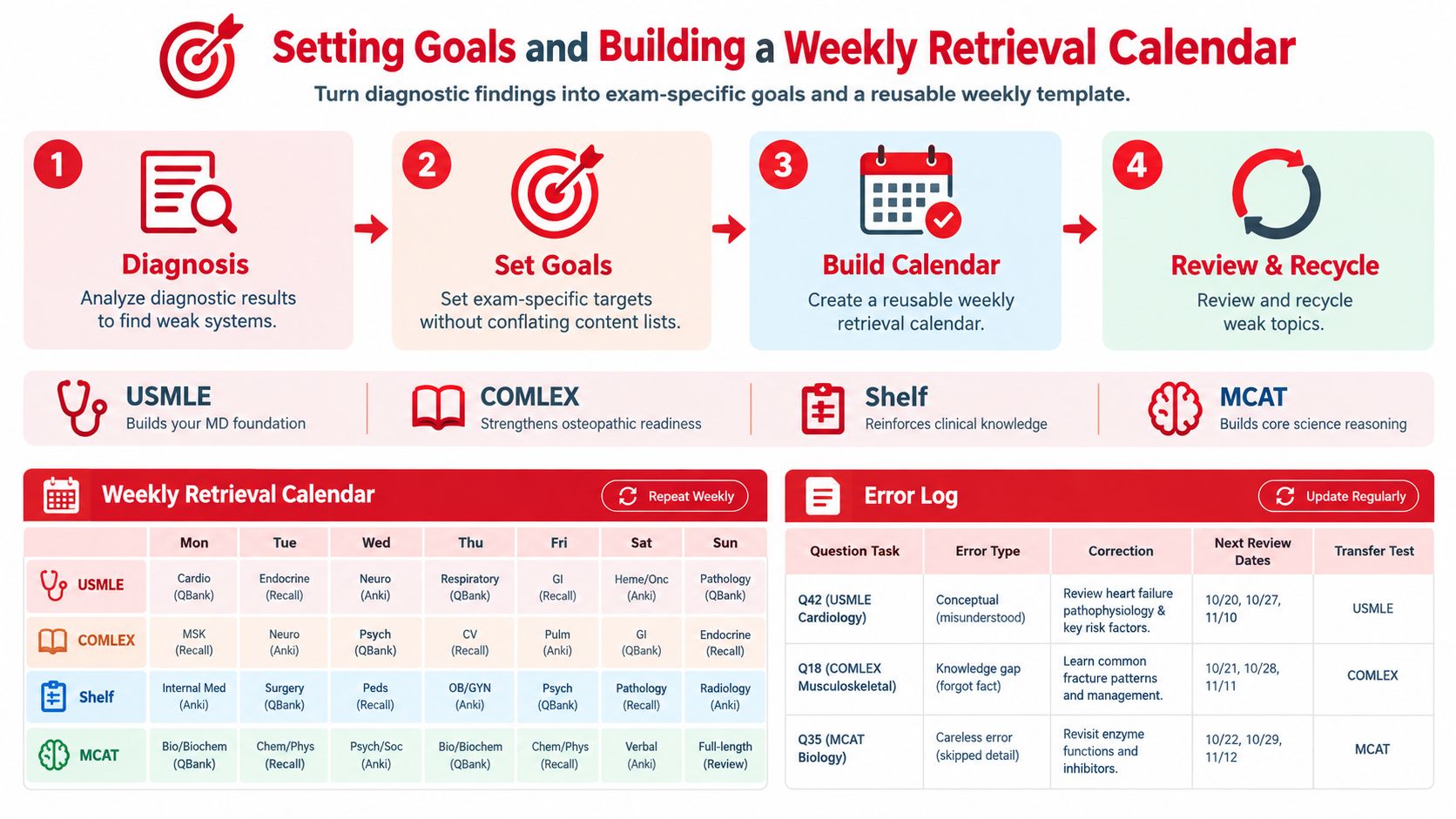
Your diagnostic should produce goals that describe observable performance, not feelings. For example, a goal might be to improve timed cardiovascular question reasoning over a defined study period, or to explain a difficult mechanism without notes and then apply it to an unfamiliar vignette. The exact target depends on your baseline and exam, so don't borrow a target from another learner's schedule.
A reusable week contains four kinds of work:
- Acquisition: Learn a limited amount of new material from a trusted resource.
- Retrieval: Close the source and produce the answer from memory.
- Feedback: Review questions and identify the reason for each error.
- Transfer: Test the concept in a different format, topic mix, or question set.
A weekly retrieval calendar
| Day | Core study task | Retrieval requirement | Evidence to record |
|---|---|---|---|
| Monday | New content tied to the highest-priority domain | Closed-book explanation after each short section | Concepts recalled and gaps found |
| Tuesday | Spaced review of Monday's material | Short-answer prompts or flashcards before rereading | Items still unavailable from memory |
| Wednesday | Timed, exam-aligned questions | Explain why each option is right or wrong | Error type and correction |
| Thursday | New content plus interleaved review | Mix current and older topics | Transferable rules, not isolated facts |
| Friday | Timed questions and cumulative review | Retest selected errors without notes | Updated error log and next week's priorities |
| Saturday | Lower-intensity consolidation | Teach a concept or draw a mechanism from memory | Remaining uncertainty |
| Sunday | Rest or brief maintenance only | Optional light retrieval if it supports consistency | Energy, sleep, and readiness |
A dedicated Step 1 week might emphasize foundational science, integrated systems, timed question blocks, and repeated retrieval of previously missed concepts. A COMLEX Level 1 week should preserve the exam's osteopathic content and question demands rather than treating it as a USMLE plan with a few added flashcards. A Surgery Shelf week may connect rotation cases, surgical principles, and timed clinical questions. An MCAT CARS-heavy week should prioritize passage reasoning, argument analysis, and review of why an answer choice did or didn't follow from the text. These are distinct exams, so the calendar structure can transfer, but the content blueprint cannot.
Protect at least one half-day for recovery. Exhaustion can turn active study into automatic clicking and passive rereading. Reserve Friday evening for self-scoring and error-log review, then let those findings determine the next week's first priorities.
The measurable performance goals framework can help you turn broad intentions into behaviors you can inspect. The essential question is simple: What will you produce from memory, and what record will prove that you did it?
Choosing Active Study Techniques That Fit the Exam
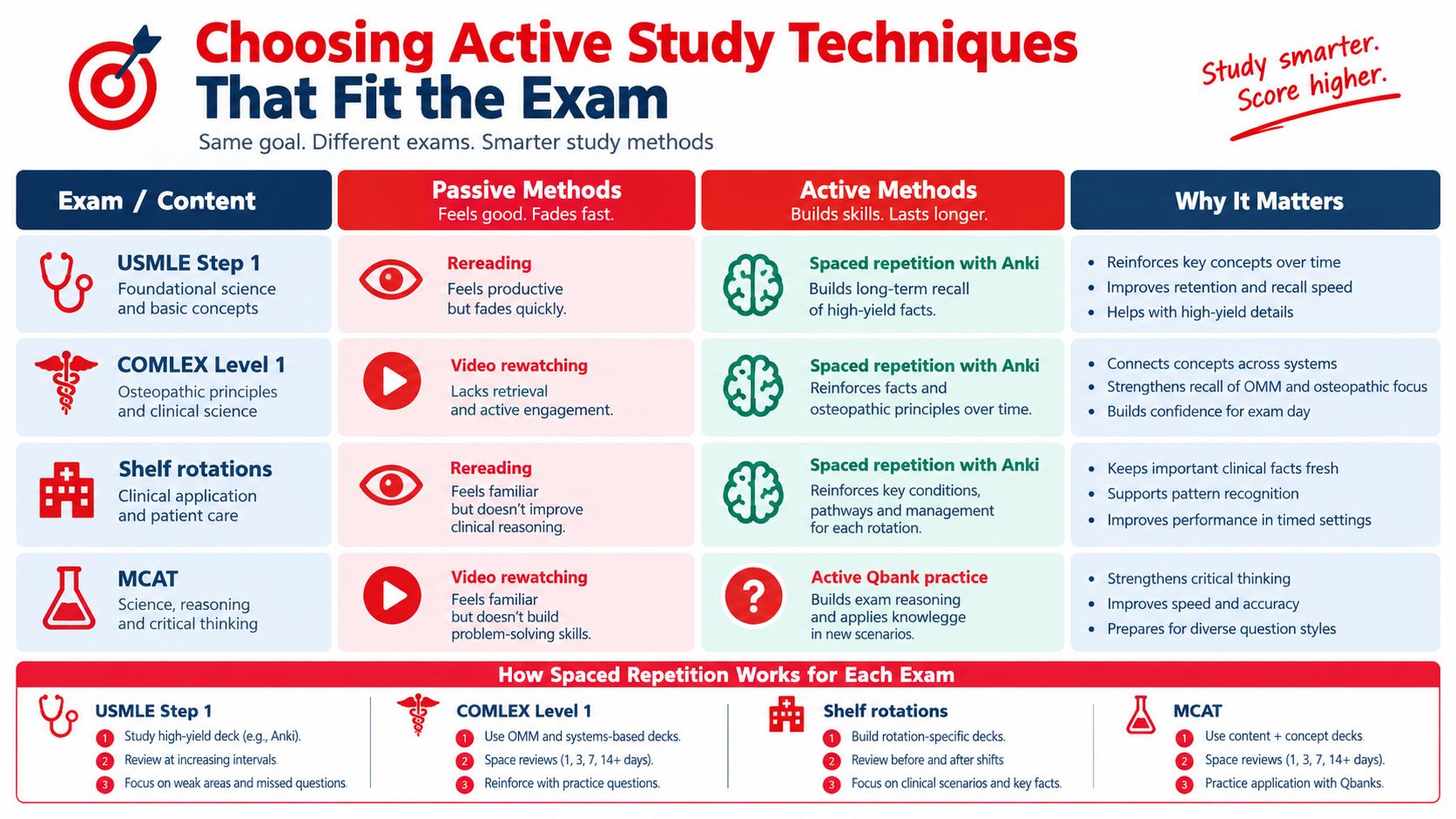
The right technique depends on what the exam asks you to do. Flashcards can support first-pass fact acquisition, free recall can reveal whether a mechanism is available without prompts, concept maps can organize relationships, and question blocks can expose application and reasoning failures. None should become a ritual detached from the assessment blueprint.
Retrieval practice means attempting to produce information before looking at the answer. For a preclinical learner, an Anki card might ask for the mechanism, associated findings, or a key distinction. During a clinical rotation, a teaching script may work better: explain how you'd recognize a pattern, what alternatives compete with it, and which finding would change your reasoning. The method should fit the material, not a label about your preferred learning style.
Match the method to the exam task
| If the exam mainly requires | Use more of | Watch for |
|---|---|---|
| Rapid factual recall | Spaced flashcards and short-answer prompts | Recognizing a card without producing the answer |
| Mechanistic explanation | Free recall, diagrams, and teaching scripts | Copying a pathway without explaining causality |
| Clinical application | Timed questions followed by option-by-option review | Reading explanations without predicting the answer |
| Passage-based reasoning | Mixed passages and written reasoning audits | Focusing on outside facts instead of the presented evidence |
| Flexible transfer | Interleaved blocks and delayed retesting | Practicing only one topic in a predictable order |
Spacing matters because a concept should return after some forgetting, not only while it feels fresh. Interleaving matters because exam questions rarely announce the topic before you reason through the stem. During an early phase, blocked review can help establish a framework. As the exam approaches, mix related and contrasting topics so you must identify the relevant principle.
Passive rereading and video rewatching can still have a limited role when you're orienting yourself to unfamiliar material. They become a problem when they replace retrieval. After a short explanation, close the resource and write what you remember, draw the process, or answer an original prompt. If you're looking at the answer key before committing to a choice, switch from recognition to closed-book prediction.
A consistent environment can reduce friction, but music isn't a substitute for a method. If background sound helps you begin a block without distracting you, you can build a focus playlist and keep it separate from your question-review routine.
For more examples of retrieval, elaboration, and feedback in practice, review active learning strategies for students.
Practicing Questions and Tracking Errors With a Log
Question banks such as UWorld, AMBOSS, TrueLearn, Rx, and AAMC bundles can provide practice, but the educational value comes from what happens after you choose an answer. Use only resources appropriate for your exam, respect their terms, and never reproduce recalled or copyrighted examination content.
Start with a timed block when you're training pacing and decision-making. Review it untimed afterward. For every miss, and for every correct answer reached through uncertain reasoning, record the selected option, correct answer, concise stem summary, and the reason your thought process failed.
A practical review workflow
- Commit before checking. Write or say why you chose the answer.
- Classify the error. Was it a knowledge gap, misread clue, reasoning error, timing problem, or careless execution?
- Correct the process. Write the smallest rule or distinction that would prevent the error.
- Retrieve later. Revisit the concept after a delay without looking at the explanation first.
- Test transfer. Use a different question set or an original prompt that requires the same principle in a new context.
A transfer check should not ask whether you remember the old answer. It should ask whether you can use the concept elsewhere. For example, after missing an original educational question about acid-base reasoning, you might later draw the compensation pattern from memory and explain how the conclusion would change if a second disorder were present. That example is intentionally generic and isn't an official or recalled exam item.
| Date | System / Topic | Question ID | Your Answer | Correct Answer | Reason for Error | Concept to Revisit | Transfer Check Date |
|---|---|---|---|---|---|---|---|
A useful log separates what happened from what you'll do next. “Got pharmacology wrong” doesn't guide behavior. “Confused receptor effect with downstream adverse effect, create a comparison prompt, retrieve it later, then apply it in an unfamiliar vignette” does.
If you're trying to track study sessions easily, use that type of tool for consistency and time awareness, but keep the error log focused on reasoning quality. A timer can tell you that a block occurred. It can't tell you whether the correction transferred.
Auditing Progress and Avoiding Common Pitfalls
Progress is a pattern, not a single difficult block. Review performance across comparable assessments, question types, and content domains. For USMLE preparation, distinguish official Step 1 pass/fail reporting from practice-assessment feedback. For COMLEX preparation, inspect whether osteopathic principles and manipulative medicine are receiving deliberate attention. For Shelf preparation, compare clinical reasoning across rotation-relevant topics. For MCAT preparation, separate content recall from passage analysis and timing.
The Friday audit
Ask yourself:
- Energy: Did sleep and recovery support focused work, or did fatigue make the plan unrealistic?
- Questions: Did you complete the planned timed practice and review it carefully?
- Errors: Did every meaningful miss receive a classification and correction?
- Coverage: Did the week address the highest-priority domains from the diagnostic?
- Transfer: Could you solve a new problem without recognizing the original explanation?
Common pitfalls are predictable. Students can spend too much time on low-yield details because those details feel concrete. Osteopathic students may use USMLE-oriented resources while underplanning COMLEX-specific content. Others reduce question review when time feels tight, even though review is where the reasoning correction occurs. A plan that produces more completed questions but fewer analyzed errors may be moving backward.
A tutor becomes more useful when the learner has a defined problem that self-study hasn't resolved. Examples include a persistent plateau despite several weeks of consistent work, difficulty switching between exam systems, uncertainty about U.S. question style for an international medical graduate, or a gap the learner can identify but cannot remediate. Self-study may remain sufficient when the schedule is being executed, errors are diminishing, and the learner can independently choose the next corrective action.
Audit rule: Don't ask only, “How much did I study?” Ask, “What can I now retrieve, explain, and transfer that I couldn't do before?”
A Readiness Checklist and When Tutoring Helps
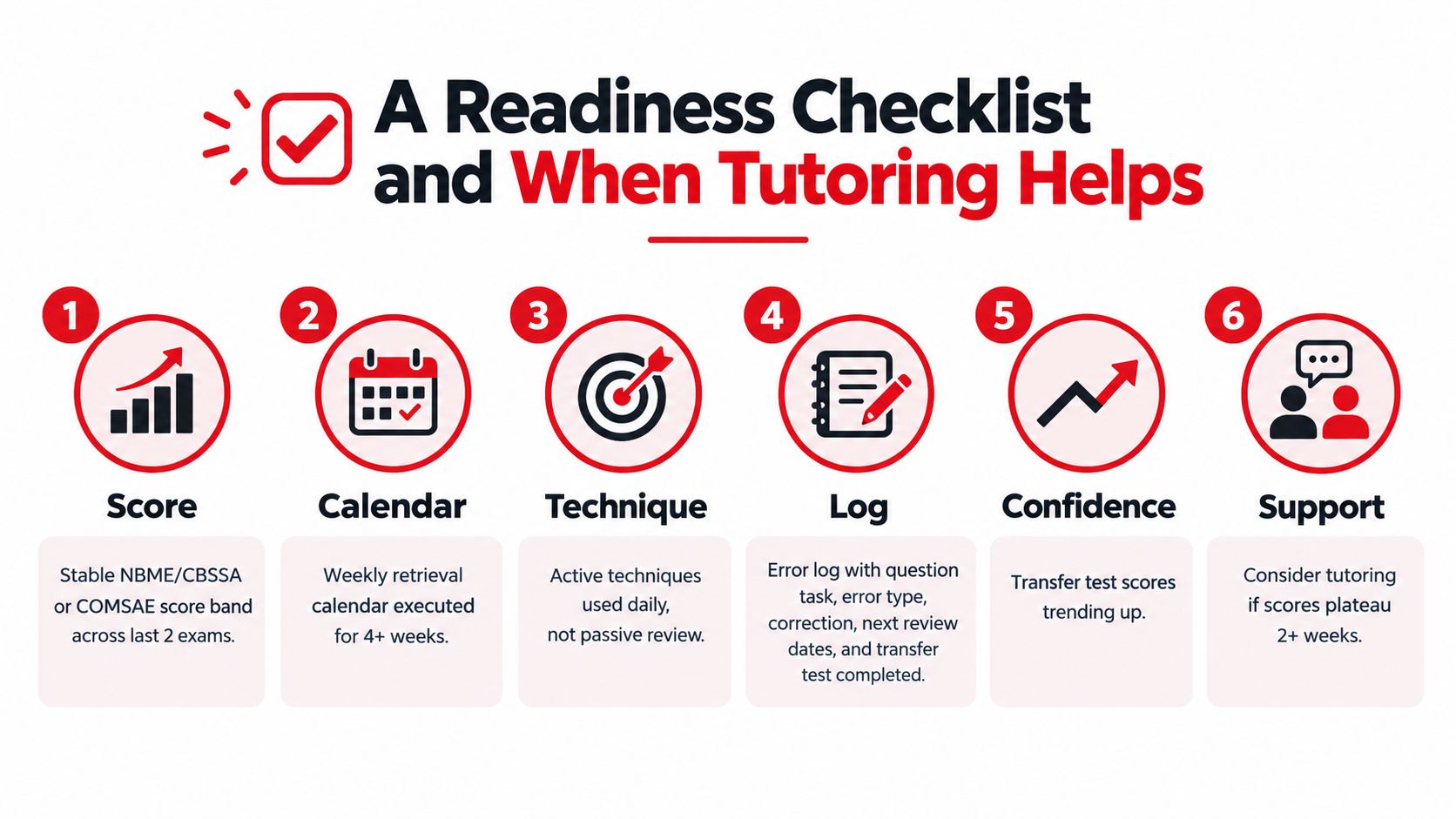
You have studied consistently for weeks, your question blocks look familiar, and then an unfamiliar form exposes a gap you did not see. That situation is why readiness should rest on repeated performance and a workable process, not one reassuring day. Before scheduling the exam, review the checklist below and record evidence for each item.
- Assessment consistency: Recent practice results show a stable pattern across comparable forms or exams. An isolated result cannot establish readiness.
- Calendar execution: You followed a retrieval-based weekly plan long enough to learn whether it fits your actual schedule.
- Active technique: You can produce answers, explanations, mechanisms, or passage reasoning without continuous rereading.
- Error-log completion: Each meaningful miss has an error type, correction, next review date, and transfer test.
- Transfer evidence: You can apply a corrected concept to an unfamiliar question, rather than merely recognize the original explanation.
- Logistics: You rehearsed timing and breaks, checked identification requirements and permitted materials, planned travel, and reviewed the applicable official testing policies.
Keep the checklist specific to the exam. For Step 1, the passing standard is 196. Exams administered on or after January 26, 2022 are reported as pass/fail under the current policy. See the USMLE examination results and scoring page for current pass/fail policy and passing standard 196. A pass/fail report does not remove the need for disciplined preparation, and it should not become a basis for comparing your path with another learner's.
When targeted tutoring adds value
One-on-one tutoring should support your study guide, question bank, and official practice materials. It can help when several weeks of consistent work produce a plateau, when you are switching between USMLE and COMLEX, when an international medical graduate is adapting to U.S.-style question interpretation, or when your error log repeatedly identifies a gap that self-study has not repaired.
A focused first session should examine the error log, audit the calendar, and create a written adjustment plan for the next two weeks. The plan should state which tasks will change, how progress will be measured, and when the result will be reviewed. Tutoring can supply structure and feedback, but no educator can promise a pass, score, admission, or residency match.
If you are comparing support options, learn how one-on-one tutoring can help and decide whether your main obstacle is content, reasoning, planning, or accountability.
This article provides examination education, not medical advice or patient treatment. Exam policies and reporting rules can change, so verify current details with the responsible organization before registering or testing.
Key takeaways
- A medical study guide should combine a diagnostic baseline, retrieval calendar, error log, and transfer checkpoints.
- Retrieval practice, spacing, interleaving, feedback, and transfer provide more useful preparation than passive rereading alone.
- Keep USMLE, COMLEX, Shelf, and MCAT blueprints distinct, even when the planning framework is shared.
- Review every meaningful question error by cause, correction, delayed retrieval, and transfer.
- Use tutoring for a defined plateau or planning problem, not as a replacement for independent practice.