You're six weeks out from Step 1, and your study day looks painfully familiar. You keep rereading biochemistry pathways you already half-know, while the part of your brain that can spot the right answer in a clinical vignette sits there unused. That's the trap with a pure deficit mindset, it makes every weak spot feel urgent, but it can drain motivation, blur retention, and leave you studying harder without studying smarter.
A better plan starts with a different question, not “What am I bad at?” but “What already works for me, and how do I use that on purpose?” That's the heart of strength based learning, a framework that can turn a tired, discouraging prep routine into a more measurable way to build recall, confidence, and exam performance. It matters in medical education because high-stakes exams reward both knowledge and follow-through, and students usually need a method that supports both.
Why Medical Learners Burn Out Studying the Wrong Way
The most exhausting study plans usually look responsible on paper. A student sees a low score in renal physiology, so they spend the next week only patching renal physiology. Then another weak area appears, and the cycle repeats. The problem isn't that weaknesses should be ignored, it's that a plan built almost entirely around deficits often feels like a never-ending triage list.
That approach can also make a student forget what they already do well. A learner who reasons clearly through mechanisms, reads clinical stems carefully, or organizes information visually may spend almost no time using those skills strategically. Instead, they sit in damage-control mode, which can make every session feel heavier than it needs to be.
Practical rule: if your plan only asks where you're missing points, it's incomplete.
For a lot of med students, that's where the burnout starts. The brain starts to associate studying with correction instead of progress, and once that happens, even good resources like UWorld, First Aid, or Anki can start to feel like punishment instead of tools. If the emotional cost keeps climbing, the studying itself gets less durable, which is why mental health and study structure have to work together, not against each other, especially for learners already under pressure, as discussed in this medical student mental health resource.
Strength based learning changes the order of operations. It doesn't deny gaps, it starts by using what's already strong to make the hard material easier to hold, connect, and retrieve. That shift is what makes the model feel less like motivational talk and more like an actual study strategy.
What Strength Based Learning Actually Means
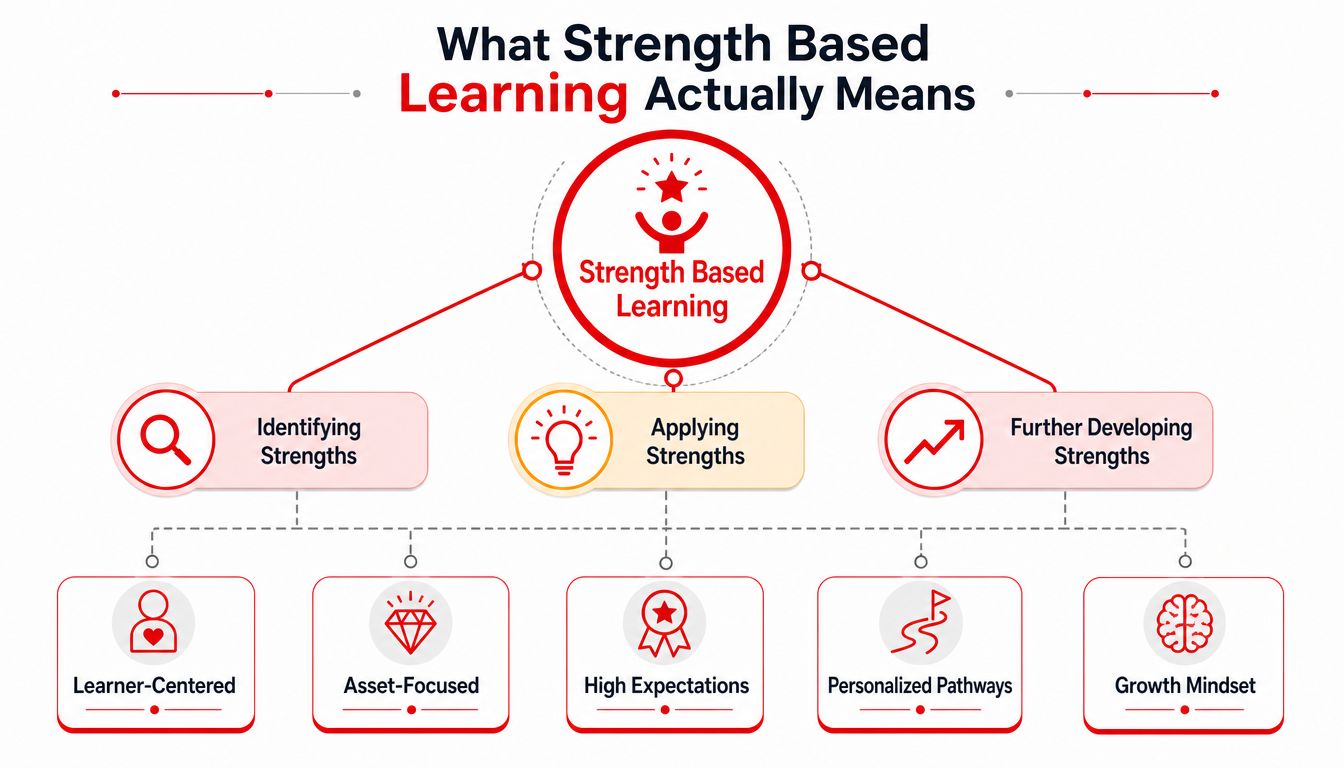
Strength based learning is a learner-centered approach built around three linked processes, identifying strengths, applying strengths, and further developing strengths. The National Education Association describes it as a way to help students identify, articulate, and apply their individual skills, and it also notes three core processes identified by researchers in New Zealand. In practice, that means the student isn't treated like a pile of gaps, they're treated like a working system with assets that can be used strategically as described by the NEA.
The framework is more structured than generic positivity. It has five organizing principles, measurement, individualization, networking, deliberate application, and intentional development. That structure matters because a med student needs a method that can survive a dedicated period, not just a mindset that sounds encouraging on a hard Monday.
How to translate the principles into study behavior
Think of measurement as your scoreboard, not your mood. If you're not checking retention, question accuracy, or recall quality, you're guessing.
Individualization means the same plan won't fit every student. One person may learn best through visual systems maps, another through mechanism chains, another through verbal explanation.
Deliberate application is where strengths become exam tools. If you're strong at pattern recognition, you use that strength while reviewing pathology stems instead of waiting for it to “just happen.”
Intentional development keeps strengths from becoming comfort zones. You still build weak areas, but you do it in a way that extends the strengths you already have.
A residency director wouldn't screen candidates only for red flags. They'd look at what each person can actually do well, then decide how that talent fits the team.
That's the right mental model for this approach. It isn't soft. It's selective, structured, and useful, especially when paired with personalized instruction like the kind discussed in this personalized learning strategies guide.
The Research Case for Studying From Strength
A student opens a practice block, sees another missed renal question, and immediately assumes the whole study plan is broken. That reaction is exactly why the research case for strength based learning matters. The point is not to replace honest performance tracking with optimism, it is to change the study conditions that shape what students can sustain.
The strongest evidence does not show a vague confidence boost. In two randomized experiments on self-regulated learning, students assigned to strength-based strategies reported higher perceived competence, stronger intrinsic motivation, and greater effort intentions than students using deficit-based strategies PMC4565885. Those are not just nice feelings. They are the mental conditions that make it more likely a student will open the next deck, review the next block, and keep going after a hard day.
For a med student, perceived competence is the difference between starting a block with dread and starting with a plan that feels possible. Intrinsic motivation is what keeps Anki from becoming a task you keep postponing until the end of the day. Effort intention shows up in whether you finish the next practice set, not just whether you meant to.
Why that matters for exam prep
Medical learning is adult learning, and adults usually do not improve just because someone tells them to work harder. They improve when the setup respects prior knowledge, self-direction, and usefulness. That is why it helps to read adult learning theory principles together with the strengths literature, because the logic lines up, learners stay engaged when the method feels relevant and workable. The same idea is also discussed in this guide to metacognitive awareness, since students need to notice how they learn, not how they hope they learn.
The limit matters too. Strength based learning is not a cure-all. If a student only talks about strengths and never measures performance or deliberately applies the strategy to weak material, the approach turns into empty reassurance. A student can feel better and still miss questions if the study process never changes.
The stronger version of this approach works like a loop. Identify the asset, use it on a real exam task, then check whether the task improved. That keeps the method tied to outcomes instead of slogans. For med students trying to improve retention in a difficult system, the question is not whether the plan feels encouraging, it is whether the next retrieval attempt is better than the last one.
A Tutoring Session Plan Built Around Your Strengths
A good tutoring session should surface what the student already does well before it attacks what's missing. That matters because a student who feels seen can usually work longer without shutting down. It also makes the plan easier to repeat across USMLE Step 1, COMLEX Level 1, shelf exams, and MCAT prep.
Start with a short diagnostic that looks for assets, not just errors. Ask what types of questions the student gets right most often, which stems feel easiest to organize, and whether they think best in visuals, mechanisms, or narratives. If you're a tutor, this is the point where you stop assuming the weak subject is the whole story.
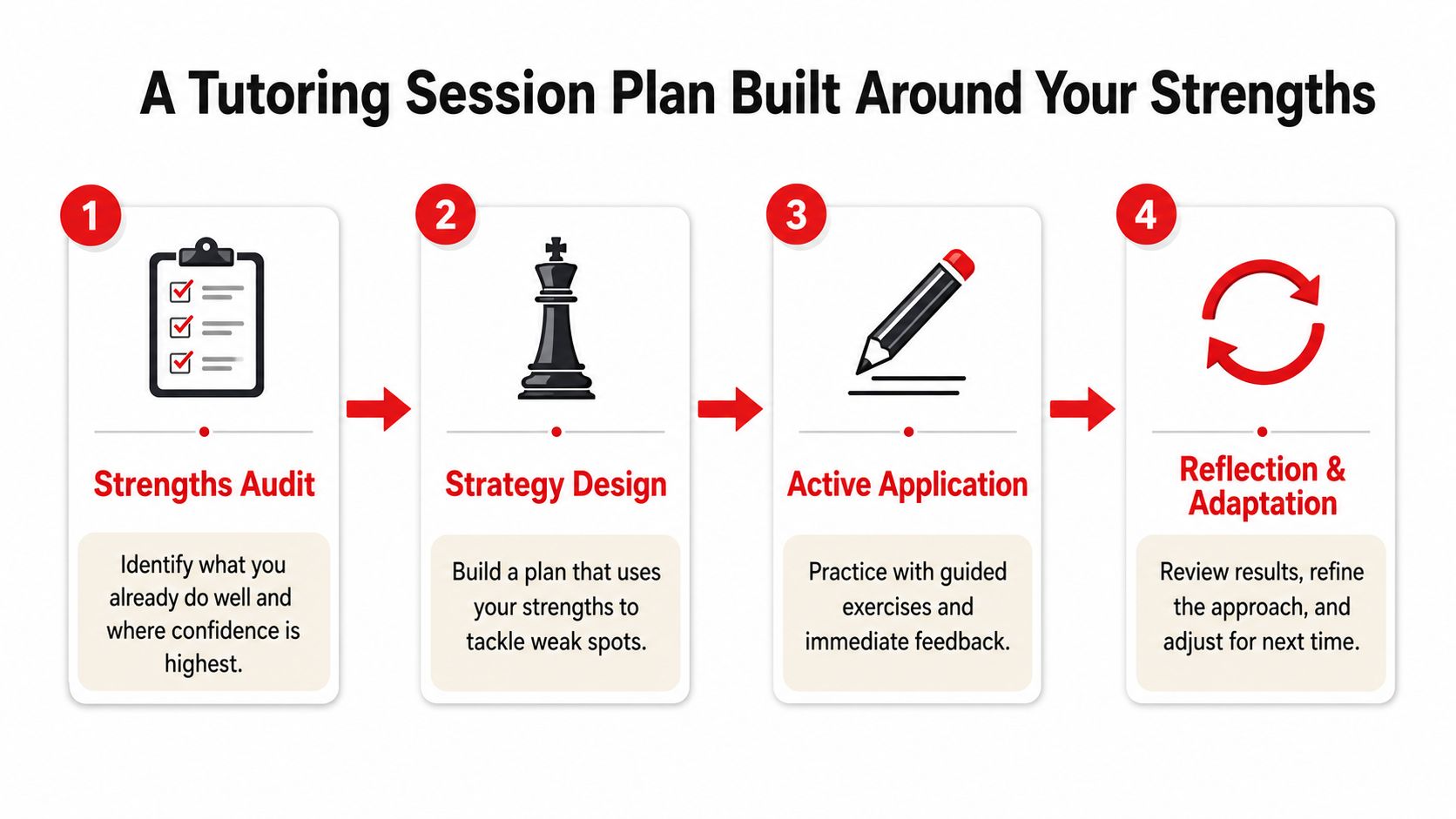
A simple 90 minute Step 1 structure
1. Strengths audit, 10 minutes.
Name three to five things the student already does well. That could be mechanism reasoning, recognizing distractors, or building clean concept maps.
2. Strategy design, 15 minutes.
Pick one weak topic and pair it with a strength. A student strong in patterns might use repeated question stems to anchor biochemistry, while a student strong in verbal logic might explain each pathway out loud.
3. Active application, 45 minutes.
Work through a focused question block, but start with a topic where the student has some traction. That early success reduces friction and gives the harder material a stronger anchor.
4. Reflection and adaptation, 20 minutes.
End with free recall, Anki, or a one-page summary from memory. Then ask what part of the session felt smooth and what part still felt slippery.
If you want a faster way to turn a live tutoring session into a teachable clip or review asset, tools that help you browse text-based video generators can make the follow-up more reusable for students who need a second pass.
For MCAT CARS, the same scaffold works with different content. A student with a strong humanities background might lead with passage structure, tone shifts, or argument mapping. That student isn't being “helped around” a weakness, they're using an existing cognitive tool to make the passage less opaque. If you're comparing how a good session feels versus a random cram session, the difference is similar to the kind of focused one-on-one support described in this one-on-one tutoring benefits page.
Strength Based vs Deficit Based Study Approaches
The easiest way to see the difference is to use one topic, then watch how the study plan changes. Take cardiac physiology for Step 1, or genetics for the MCAT. A deficit-based plan usually starts by asking, “What do I not know?” A strength-based plan starts by asking, “What part of this topic do I already understand well enough to build from?”
| Dimension | Deficit Based Plan | Strength Based Plan |
|---|---|---|
| Time focus | Spends most time patching the weakest areas first | Starts with a familiar area to create traction, then expands outward |
| Motivation | Feels corrective, often heavy and discouraging | Feels more workable because the student begins with something recognizable |
| Retention strategy | Often relies on rereading and repeating missed facts | Uses the student's strongest thinking style to encode and retrieve new material |
| Assessment focus | Watches for errors and gaps only | Tracks both errors and whether the strength is helping the weak topic stick |
A strong student in systems thinking might approach cardiac physiology by using flow diagrams, pressure-volume relationships, and cause-effect chains. A deficit-only plan might instead force that same student to memorize isolated formulas first, which is like asking a carpenter to build without using the tools they already trust. The result can be more effort with less coherence.
What this looks like in real studying
For Step 1, a student who understands pathophysiology well can use that framework to revisit cardio drugs, murmurs, or preload and afterload. For COMLEX, a student who likes clinical reasoning can anchor osteopathic concepts in patient presentation instead of memorizing them in isolation.
The point isn't to skip weak material. The point is to stop making weak material the first thing you touch every day.
That order matters because the first topic of the session often sets the emotional tone for the rest of it. If the opening topic is always the hardest one, the student may start each block already behind. If the opening topic is a strength, the student gets momentum first, then uses that momentum to pull the weak area into place.
Measuring Whether Strength Based Learning Is Working
This is the question that most study advice avoids, and it's the one medical learners care about most. If the plan sounds smart but nothing changes on practice tests, it's not helping enough. Strength based learning only earns its place in a dedicated period if you can see movement in the numbers and the patterns.
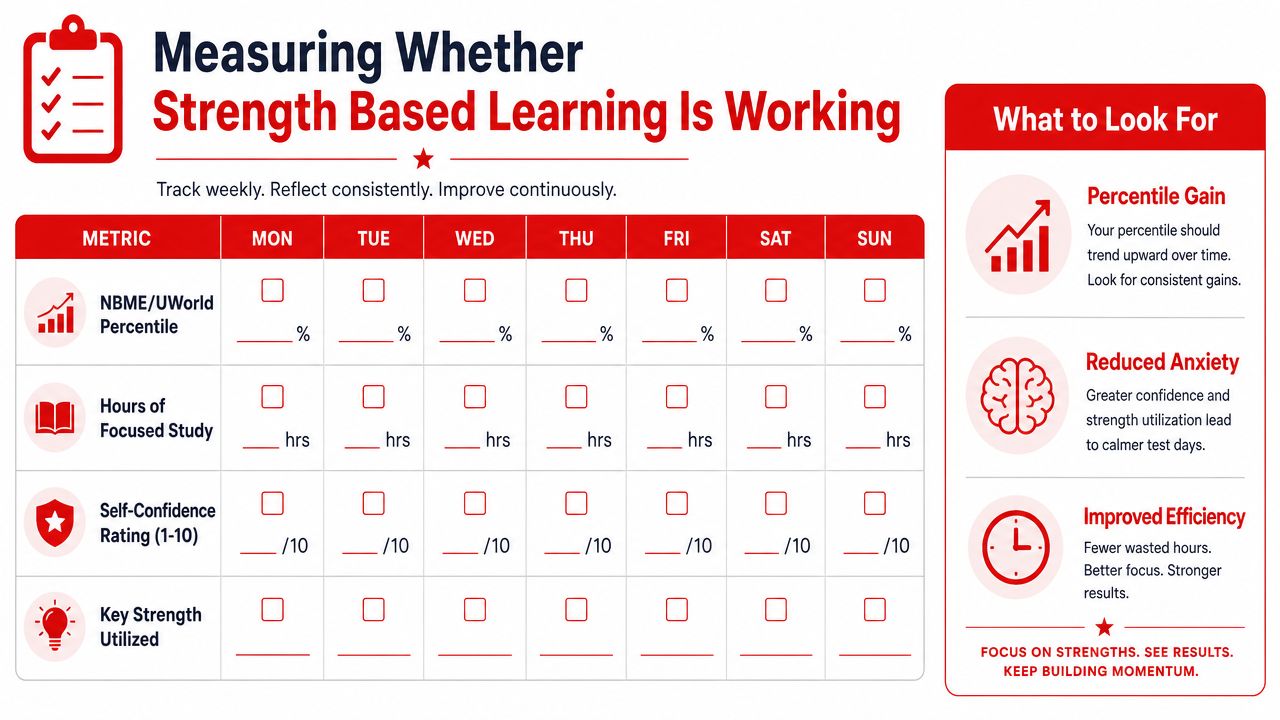
The easiest metrics are the ones you can track every week without turning your life into a spreadsheet factory. Record NBME or UWorld percent correct by system, Anki retention, practice block timing, free-recall accuracy, and a simple motivation rating from 1 to 10. If you need a place to organize that information, a progress tracking dashboard can keep the data visible instead of scattered across notes and screenshots.
What to look for in the data
The first sign is usually not a dramatic score jump. It's cleaner recall. A student may miss fewer questions in the same system, finish blocks with less mental drag, or explain a concept more fluently when asked the same week they reviewed it.
Track these five things weekly.
- System accuracy: Compare question performance by subject or organ system, not just overall.
- Recall quality: Use a quick free-recall check after study, then score how complete the explanation felt.
- Efficiency: Note whether a block takes less cognitive effort to complete.
- Confidence: Rate how much resistance you felt before starting the session.
- Strength usage: Write down which strength helped, like visual mapping or mechanism chaining.
How to review it without overthinking
Once a week, look for patterns across the last several sessions. If your confidence is up but accuracy is flat, the plan may be soothing you without challenging you enough. If accuracy is up and recall is better, the strength is probably doing real work.
In a monthly review, ask three questions with a tutor or advisor. Which strength helped most? Which weak area is still resisting the plan? What should be changed next week so the strength gets used more deliberately? That kind of review turns the framework into a process, not a preference, which is exactly the difference between a useful method and a nice idea.
Two Realistic Case Studies From USMLE and MCAT Prep
Maya was a Step 1 retaker who kept getting stuck around the same baseline on practice exams. Her first instinct was to hammer biochemistry harder, but that just made her feel more fragmented. In review, it became obvious that she was already strong at microbiology pattern recognition, so her tutor used that strength to rebuild metabolic pathways as linked stories instead of isolated lists.
That changed the shape of her studying. She still did biochemistry, but she did it through comparative patterns, repeated retrieval, and targeted question blocks that connected pathways to infectious disease and organ system clues. Twelve weeks later, her score moved to a level that made her more confident walking into the exam room, and she had a process she could explain to herself when the material got hard.
Devin was an MCAT repeater whose weakest section was CARS, but the deeper issue was confidence. He had a strong humanities background and read well when he trusted the text, yet he kept second-guessing himself because he treated every wrong answer like proof that he was bad at reading. His tutor reframed that background as an asset, then changed his strategy to focus on argument structure, tone, and author purpose.
The difference was immediate in the way he approached passages. He stopped hunting for the “right fact” and started tracking how the passage was built. That didn't make CARS easy, but it made it learnable, which is a much more useful goal. In both cases, the strength wasn't a distraction from the weakness, it was the bridge that made the next step possible.
FAQs and Your First Week With Strength Based Learning
The questions students ask first are usually practical. They want to know whether this still works after failing Step 1 or COMLEX, whether it applies to IMGs and FMGs, and how it fits with Anki and First Aid. The short answer is yes, it can still help after a setback, because the framework is about changing how you use your current abilities, not pretending a past result never happened.
For international and foreign medical graduates, the approach can be especially useful because it helps you identify the parts of your background that transfer well, like disciplined reading, multilingual explanation, or strong memorization habits. Those are real strengths, and they should be part of the plan instead of hidden behind worry.
Anki and First Aid still fit. Strength based learning doesn't replace them, it changes how you use them. First Aid becomes the reference point for deliberate application, and Anki becomes the retrieval engine that keeps the strengthened material available when you need it.
Your first week can be simple.
- Complete a strengths audit. Write down three things you already do well as a learner.
- Identify your top two strengths. Pick the ones that help with exam tasks, not just the ones that sound nice.
- Schedule one strategy session. Use a tutor or study partner to test the framework on one weak topic.
- Set one measurable goal. Choose a metric you can check next week, like recall quality or question accuracy.
If your school doesn't support this approach, start small anyway. One good diagnostic, one structured tutoring session, and one tracking sheet are enough to see whether the method gives you better retention and a steadier study day.
If you want a study plan that treats your strengths as exam tools, not just personality traits, Ace Med Boards can help you build that structure into USMLE, COMLEX, Shelf, and MCAT prep. Visit Ace Med Boards to explore one-on-one tutoring and turn your current strengths into a more measurable study system.