You've already earned a bachelor's degree, you know medicine is still the goal, and now you're trying to figure out whether a premed postbac is a smart repair strategy or an expensive detour. The short answer is that a postbac can be the right move when you need missing prerequisites, stronger recent grades, or a more structured path into the medical-school pipeline, but it isn't automatically the best next step for every applicant.
The decision makes more sense once you separate the label from the job. Some programs help you finish the science sequence, some help you prove academic readiness, and some are closer to graduate-level reinvention. The right choice depends on where your transcript is thin, where your timeline is tight, and how much advising structure you need.
What a Premed Postbac Is
A student often reaches this point after trying for years to piece together medical school preparation. Maybe the bachelor's degree is in psychology, music, engineering, or public health, and the science sequence is incomplete. Maybe the prerequisites are there, but the GPA in science courses does not reflect the student's current ability.
A premed postbac is a postbaccalaureate program built to help applicants complete medical-school prerequisites, strengthen an academic record, or do both. It is part of the undergraduate-to-medical-school bridge, and it serves a different purpose from medical school itself or a generic graduate program, even though the label gets used loosely across many schools.
Practical rule: If the missing piece is a prerequisite chain, a postbac is usually about efficiency and sequence, not just taking more classes.
The U.S. pipeline matters here because attrition is common. In a national study of students who initially intended to major in pre-med, only a fraction completed the full set of medical-school prerequisites, and a small share never completed any chemistry, biology, or physics courses at all PMC study. The same study also reported that progress through the usual premed milestones dropped at each stage, which helps explain why structured bridge programs became so important.
What the term really includes
The phrase covers more than one pathway. Some students are career changers, some are academic enhancers, and some need something closer to a specialized, graduate-level repair plan. Northwestern's overview notes that programs often require the full premedical science sequence, plus supporting coursework, and many can be finished in about 1 to 2 years depending on full-time or part-time pacing Northwestern premedicine post-bacc overview.
For students trying to understand where a postbac fits in the broader application process, the key question is whether the program is filling a gap, proving readiness, or reorganizing an entire path into medicine. A resource like Ace Med Boards' guide for non-traditional medical school applicants can also help frame that decision in the context of the full med school pipeline.
That is why a postbac is more than extra coursework. It is a targeted bridge between undergraduate study and medical-school application readiness.
Career Changer, Academic Enhancer, and Other Program Types
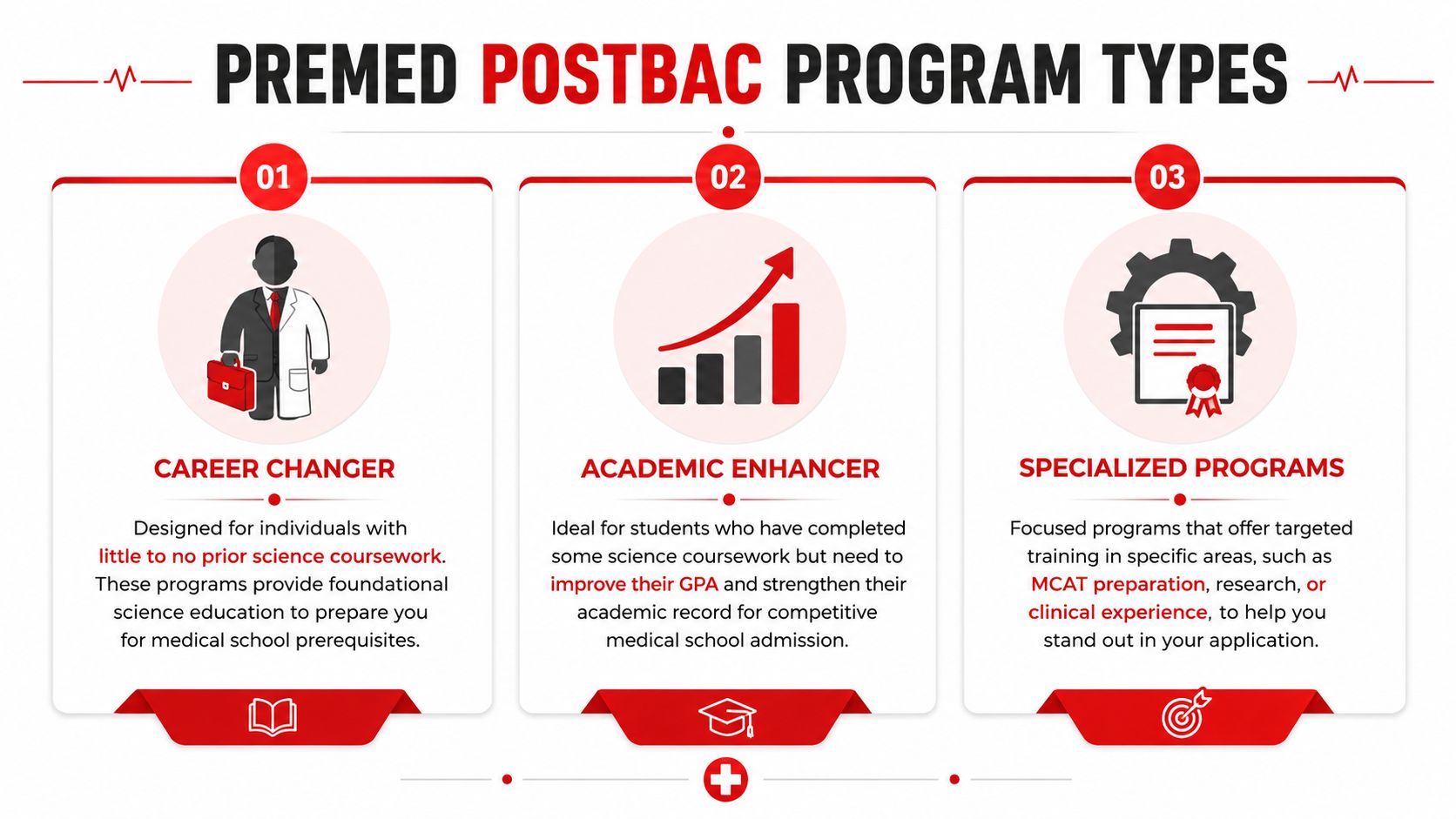
A postbac is easier to understand once you stop treating every program as the same fix. The right category depends on what part of the med school application pipeline needs repair, whether that is missing science, a weak recent record, or a broader reroute into medicine.
Career changer programs
These programs are built for students who still need the core premed sciences. The usual sequence includes biology, general chemistry, organic chemistry, physics, and often biochemistry, with labs and supporting courses such as calculus or English added along the way. That structure fits a student whose original degree was in a field far from the sciences and who now needs a disciplined path through the prerequisites.
A career changer program works like a structured reset. The goal is to finish the missing coursework in the right order, earn strong grades, and enter the medical-school application process with a transcript that shows you can handle the science load.
A student in this category should also check how the program handles advising, pacing, and the med school timeline. A non-traditional applicant often needs more than a class schedule, so a guide to non-traditional medical school applicants can help you compare how a postbac fits your broader plan.
Academic enhancer programs
These programs fit applicants who already completed the prerequisites but need a stronger recent academic record. The purpose is not to repeat the whole sequence. It is to show current performance in science courses when earlier grades no longer reflect how ready you are now.
That distinction matters. If the course sequence is complete, the question becomes whether your transcript still gives admissions committees a reason to doubt your current academic strength. An academic enhancer is built to answer that question with recent grades, steadier performance, and a clearer signal that the earlier record is no longer the full picture.
Special master's programs and similar tracks
Special Master's Programs, or SMPs, go beyond undergraduate repair and move into graduate-level biomedical work. They can resemble the academic pace and expectations of medical school more closely than a standard postbac does, which is why they often appeal to students who already have the basics in place and need a stronger proof point.
The trade-off is intensity. If you are still missing several prerequisites, an SMP can ask you to carry advanced material before you have built the foundation it assumes. If you already have the core science sequence and want to show you can succeed in a more demanding setting, it may fit your situation better.
A simple readiness check can help sort the options. If you still need the prerequisite sequence, a career changer program belongs at the top of the list. If your courses are complete but your recent grades need repair, an academic enhancer makes more sense. If the basics are finished and you need graduate-level academic evidence, an SMP may be the stronger match.
Is a Postbac the Right Move Compared With DIY or SMPs
The tempting mistake is to choose the most visible option instead of the highest-return option. A formal postbac can be excellent, but it isn't always the smartest repair strategy.
Compare the three main paths
A DIY approach means enrolling in prerequisite classes at a local university without joining a formal cohort. That can work well if you already know exactly what you need and don't require built-in advising. The upside is flexibility, and the downside is that you may lose the structure, committee support, and linkage opportunities that more organized programs provide.
An SMP is different again. It usually suits applicants who've already completed the prerequisites and need to demonstrate readiness through advanced biomedical work. Because it can be more intense than standard postbac coursework, it's not a substitute for missing basics.
Think in terms of fit, not prestige
A formal postbac is strongest when the program's structure solves a problem you have. If your issue is prerequisite completion, a career-changer postbac may be efficient. If your issue is GPA repair, an academic-enhancer program may be enough. If your issue is broader academic readiness, an SMP may be more appropriate.
A useful way to think about it is this. If you need course sequence repair, choose the option that gets you through the sequence cleanly. If you need academic reinvention, choose the path that gives admissions committees the clearest new evidence.
Where structure matters
The long-term outcomes literature on U.S. premedical postbaccalaureate programs emphasizes that these programs were designed to promote healthcare access and workforce diversity, but results vary by program type and structure PMC long-term outcomes evaluation. That's the key point many applicants miss. The label alone doesn't guarantee value.
If you want a broader comparison of graduate-level repair options, see this overview of SMP-style pathways. It pairs well with the question applicants should ask first, which is whether they need prerequisite repair, GPA repair, or a deeper academic reset.
Eligibility, GPA, and Coursework Requirements
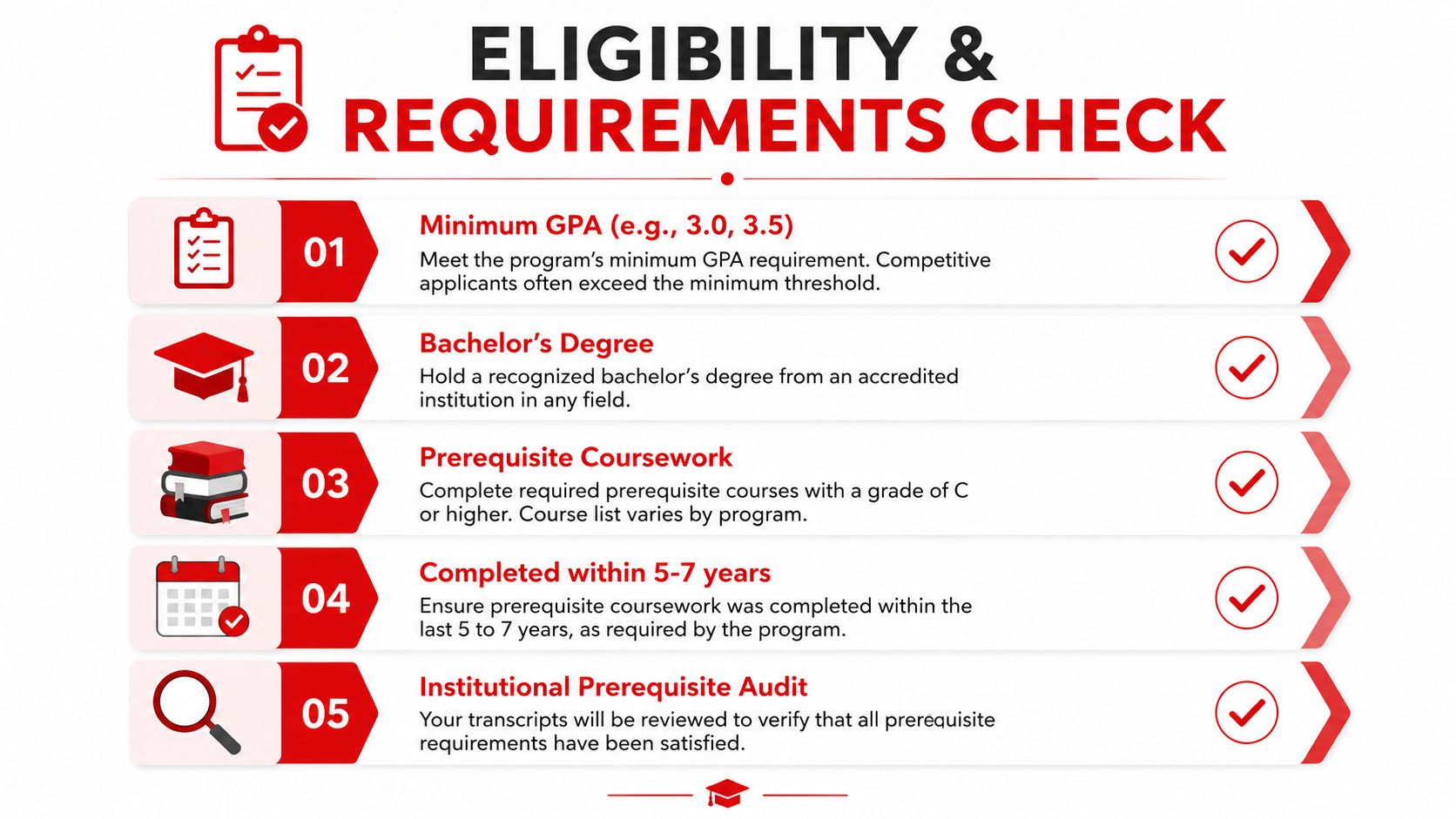
Once you know which category fits, the next question is simple. Do you qualify?
What representative programs ask for
At George Washington University's post-baccalaureate pre-med program, applicants must already hold a bachelor's degree from an accredited U.S. or Canadian college or university. The program requires a minimum GPA of 3.0 as calculated by PostBacCAS. GW also says applicants generally should not have completed more than 50% of the core science coursework during the past five years, and two letters of recommendation are required through PostBacCAS GW admission requirements.
Georgetown's post-bac FAQ says admitted students must complete at least 30 credit hours to receive the certificate and be reviewed by the Georgetown Pre-Health Recommendation committee. Students are also expected to maintain a minimum GPA of 3.2 while completing the required coursework Georgetown post-bac FAQ.
Columbia's postbaccalaureate premedical program lays out a more detailed content structure, including at least 120 hours of health-care experience, one year of college English, one year of math beyond pre-calculus split into calculus and statistics, one year of biology plus a biology lab, one year of general chemistry plus a chemistry lab, and one year of general physics plus a physics lab Columbia bulletin.
Why some programs screen more tightly
Johns Hopkins states that applicants must complete a bachelor's degree before enrolling, and they are not eligible if they have taken the MCAT, already applied to medical school, been admitted to medical school, or are an international student needing an I-20 form. The program also typically does not consider applicants who have taken more than half of the core science courses, with exceptions sometimes made only if the relevant coursework or MCAT is more than seven years old Johns Hopkins eligibility.
That screening is about fit. Selective programs want students who still need the same academic repair and who will benefit from the same advising model.
Screen yourself early: If you already finished most prerequisite science courses, have a recent MCAT, or have applied to medical school before, some career-changer programs may be the wrong match even if the brochure sounds appealing.
If you are still mapping required courses, start with this prerequisite guide. It is much easier to compare programs once you know exactly which courses are missing.
How a Postbac Fits Into the Med School Application Timeline
A postbac is not just a course list. It sits inside the larger medical school application pipeline, and timing can decide whether the work you do shows up in the cycle you want.
Build backward from the application cycle
Start with the date you plan to apply, then count backward from there. The science courses need to be finished before you submit the primary application, because an unfinished transcript can leave your file looking incomplete just when schools are deciding whom to review. If your postbac schedule is demanding, MCAT study, lab work, and application writing all have to share the same calendar, so the test usually cannot be treated as a separate project.
That is why many students plan in a 12 to 24 month window rather than by semester alone. As noted earlier, some programs are built to be finished in about 1 to 2 years, depending on pace and format.
Decide whether you'll apply during or after the program
Some students apply after the postbac ends, when the transcript already shows the full repair they were aiming for. Others apply while they are still finishing the last required classes. The better choice depends on how strong the record already looks and whether the remaining coursework is likely to reassure reviewers or leave them waiting for one more grade.
Committee letters and linkage options, where available, also shape the calendar. These programs often require internal checkpoints, so you need enough time to finish required credits, complete advising steps, and gather recommendation letters before the committee process closes. A postbac can help create a stronger application, but only if the timing leaves room for the school's own deadlines.
A simple planning rule
Practical rule: Build the timeline around the last class you still need, then add room for MCAT study, recommendation letters, and application writing.
A readiness check helps here. Before you set dates, ask whether your missing coursework is clearly identified, whether you can finish it before your target application cycle, and whether you still have time for letters and MCAT preparation without rushing. If the answer to any of those is unclear, the timeline needs more padding.
For a fuller view of the primary application calendar, the AMCAS timeline guide is a useful companion while you map your own dates.
Costs, Tuition, and Financing Options
A postbac can feel affordable on paper and expensive once the hidden pieces show up. The total bill depends on how the program is built, what support it includes, and whether you can keep working while you study.
What you're really paying for
Tuition is only the starting point. Lab fees, application fees, books, commuting, and housing can all change the total cost, especially if the program expects full-time attendance. If you apply through a centralized service like PostBacCAS, that fee belongs in your budget too. Private programs may fold more advising and linkage support into the price, while public programs may keep the sticker price lower but leave more of the planning to you.
The question is not just what a program costs. It is whether the spending moves you toward a cleaner application path. A lower-cost option can become the pricier one if the sequencing is unclear, you repeat coursework, or the timeline slips far enough that your med school application loses momentum.
How to think about financing
Federal financial aid may be available for qualifying programs, but the structure of the postbac matters. Some programs fit aid rules more cleanly than others, so it helps to check the school's policy before you commit. Scholarships can reduce the burden in some cases, and employer sponsorship can matter for students shifting careers while still working. Review available scholarship guidance before you enroll, because outside support can change the total cost more than a brochure estimate suggests.
A practical budget looks at three things. First, the program price. Second, the living expenses tied to the year. Third, the cost of a slower or less direct route if the program does not lead to medical school right away. That broader view matters because a postbac is part of the wider application pipeline, not just a standalone class schedule.
For applicants weighing education spending against long-term debt, private practice financial strategy can help frame how today's training costs fit into later career planning. The point is not to treat a postbac like a business deal, but to make sure the investment matches the kind of medical-school repair you need.
Evaluating and Comparing Programs
A strong comparison starts with a clear question: what problem is the postbac supposed to fix in your application? If you answer that first, it becomes easier to separate useful structure from attractive marketing.
A program can look impressive on paper and still be the wrong fit. The name on the brochure matters less than whether the school gives you the kind of repair your record needs.
What to compare side by side
Start with advising. Some programs give close academic planning, committee letter access, and direct help with the medical-school application. Others are mostly coursework, with only light guidance after you enroll.
Then compare linkage arrangements, schedule flexibility, and location. Evening or part-time options matter if you are working, while a more fixed cohort can help if you need outside structure to stay on track. Cost matters too, especially when two programs reach similar outcomes but one leaves you with more debt and less room to adapt later. For applicants thinking about how education spending fits into later career plans, private practice financial strategy offers a useful way to frame the long view.
A comparison sheet should also ask how each program fits the rest of the med school pipeline. Does it help you finish missing prerequisites, strengthen your science GPA, or support the application itself? Does it create more certainty, or does it add another layer of classes without changing your trajectory much? Those questions matter because a postbac is not just a class schedule, it is part of a larger repair plan.
How to weigh trade-offs
The cleanest way to compare programs is to sort them by what they solve. One program may be better at academic advising, another at structured accountability, and another at helping students stay in one place while they keep working. The best choice is often not the one with the most features, but the one that removes the biggest obstacle in your path.
A higher-cost program can still make sense if it gives you stronger advising, a clearer committee-letter process, or a linkage that matches your profile. A lower-cost local program can also be the smarter choice if you already know the courses you need and only want grades, credits, and a disciplined way to finish them.
The same discipline applies to private practice financial strategy, where the point is not to spend less at all costs, but to match the investment to the outcome you want. Once you understand what each program offers, you can evaluate whether it fits your specific situation.
Readiness Checklist, Sample Schedule, and Next Steps
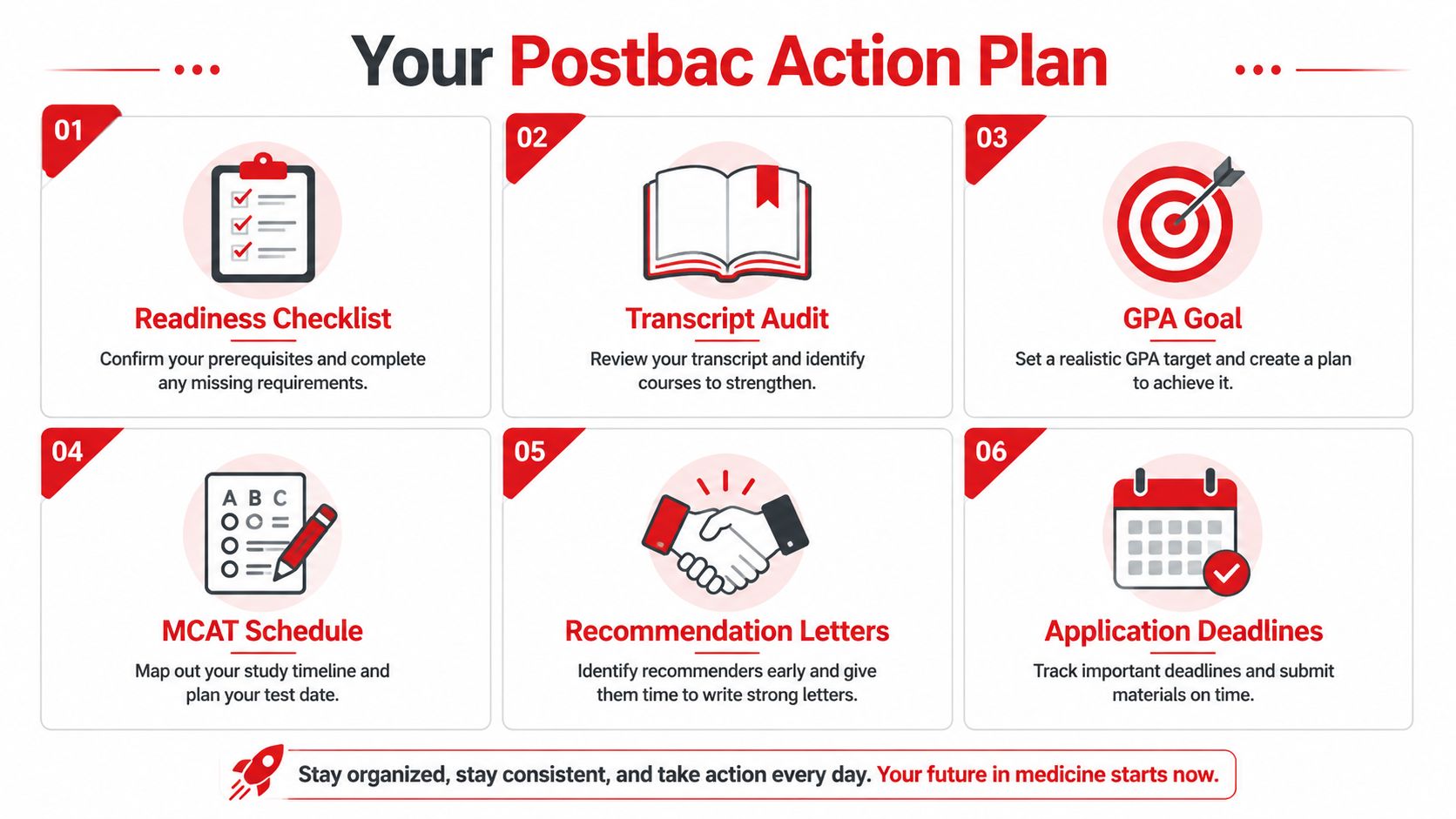
A serious postbac decision starts before the application form. If you can answer the basics cleanly, you'll waste less time and choose more confidently.
Readiness checklist
- Transcript audit: Gather every undergraduate and postbac transcript so you can see which prerequisites are missing and which grades need repair.
- GPA reality check: Separate your overall GPA from your science GPA, then identify whether you need prerequisite completion, academic enhancement, or a broader reset.
- MCAT timing: Decide whether the test fits before, during, or after coursework, and make sure the calendar leaves room for preparation.
- Recommendation letters: Confirm who can write for you, and whether the program wants letters through a centralized system like PostBacCAS.
- Personal statement draft: Write early enough to explain the academic story clearly, without sounding defensive.
- Application deadline map: List the schools you're considering, then compare their credit-hour, committee, and timing rules side by side.
Sample weekly schedule for a full-time career changer
A full-time postbac week needs to be realistic, not aspirational. A student taking lecture and lab-heavy science courses might use a rhythm like this:
- Monday: Morning lecture, afternoon lab, evening review of class notes and problem sets.
- Tuesday: Lecture, office hours, one block of practice questions, short clinical volunteering shift if scheduled.
- Wednesday: Lab, group study, review of mistakes from earlier quizzes.
- Thursday: Lecture, content review, application or shadowing logistics after dinner.
- Friday: Quiz prep, lab write-up, catch-up block, then an early stop to preserve energy.
- Saturday: Longer study block, transcript or application work, MCAT practice if test timing is close.
- Sunday: Light review, schedule planning, and rest.
That schedule works only if the student protects sleep and keeps the week repeatable. A postbac doesn't reward heroics. It rewards consistency.
What to do next
Shortlist programs that match your transcript first, not the programs with the most recognizable names. Then request information sessions, compare committee-letter rules, and ask how the program handles students with your exact coursework gap. If you need support with admissions strategy, MCAT planning, or deciding whether a formal postbac is even the right repair path, it makes sense to get help before you submit applications.
Ace Med Boards works with pre-med applicants on medical school admissions preparation and MCAT-focused support, so it can be part of the planning conversation when you're trying to decide how much structure you need. If you want a calm, practical next step, visit Ace Med Boards and use a free consultation to map your coursework, your test timeline, and your application strategy before you commit.